A plot diagram is a visual tool that helps readers and writers understand how a story develops from beginning to end. It organizes the main events of a narrative into clear stages, making it easier to identify the introduction, central conflict, rising action, climax, falling action, and resolution. Whether you are studying a novel, analyzing a short story, or planning your own creative writing, a plot diagram provides a useful roadmap for understanding story structure.
Students often use a plot diagram worksheet to analyze characters, identify important events, and explain how a conflict is resolved. Writers can also use a story plot diagram to plan a logical sequence of events before drafting a story. By arranging the main moments visually, you can see how each event contributes to the narrative and keeps readers interested.
This guide explains what a plot diagram is, describes its main elements, and shows you how to complete a printable plot diagram template for reading assignments, classroom activities, and creative writing projects.
What Is a Plot Diagram?
A plot diagram is a visual representation of a story’s structure. It shows how the narrative begins, develops through a series of events, reaches its most intense moment, and moves toward an ending. Many plot diagrams use a mountain-shaped line to illustrate how tension builds toward the climax before gradually decreasing.
The traditional plot structure is often associated with the five-part narrative model, which includes exposition, rising action, climax, falling action, and resolution. Some educational plot diagram worksheets also identify the central conflict as a separate component. This helps readers distinguish the main problem from the events that develop it.
A plot diagram is useful for many kinds of fiction, including short stories, novels, fairy tales, myths, and narrative films. Although not every story follows the same pattern, the diagram provides a starting point for examining how events relate to one another.
Why Is a Plot Diagram Important?
A plot diagram makes a story easier to understand by separating a complex narrative into manageable parts. It can help students analyze literature and give writers a practical way to organize their ideas.
- Improves reading comprehension: Helps readers recognize the sequence of events and understand how the story develops.
- Identifies the main conflict: Clarifies the central problem or struggle that drives the narrative.
- Explains character development: Shows how important events influence characters’ decisions and behavior.
- Highlights the climax: Makes it easier to identify the turning point or most intense moment of the story.
- Supports literary analysis: Provides an organized structure for discussing cause and effect, tension, and resolution.
- Helps writers plan stories: Allows authors to arrange events before writing a complete draft.
- Encourages clear communication: Gives students a visual framework for explaining a story in discussions, assignments, and presentations.
Using a plot diagram does not mean every story must follow a rigid formula. Instead, it helps readers and writers recognize patterns and make deliberate choices about narrative structure.
Printable Plot Diagram Template
A printable plot diagram template provides a ready-made worksheet for recording the important elements of a story. It allows students to organize their observations and gives writers space to plan a narrative before drafting it.
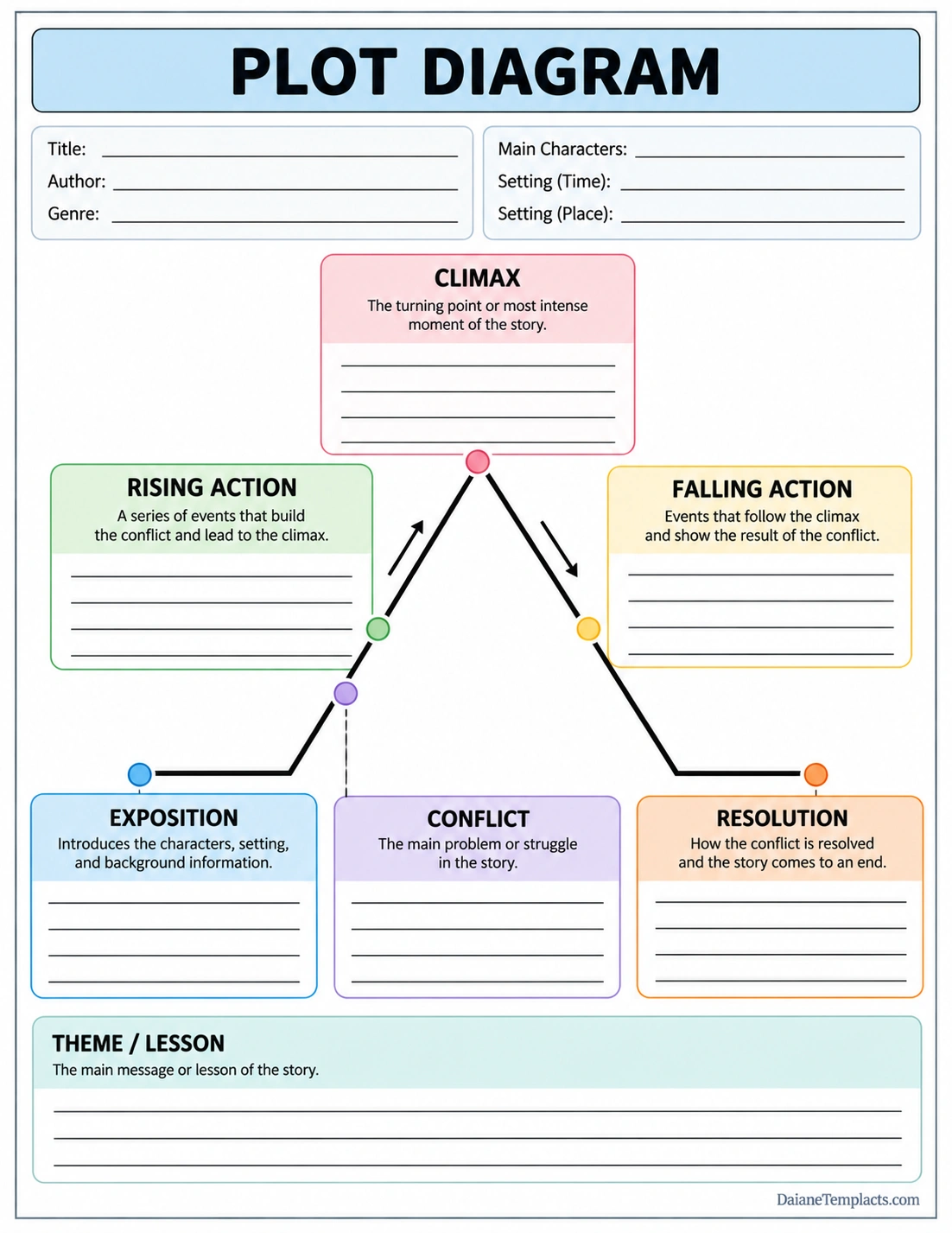
The worksheet includes fields for the story title, author, genre, main characters, and setting. Its central story mountain illustrates the progression from exposition through rising action and climax to falling action and resolution. Separate writing spaces help users summarize the conflict and identify the story’s theme or lesson.
You can use the template for a reading assignment, a book report, a group discussion, or a creative writing project. For younger students, write one or two simple sentences in each section. Older students can include evidence from the text and explain how each event affects the next stage of the story.
The Six Main Elements of a Plot Diagram
Plot diagrams commonly use five traditional stages, with the central conflict identified as an additional element. Understanding each component helps you complete a story structure worksheet accurately.
Exposition
The exposition introduces the story’s characters, setting, and background information. It establishes where and when the story takes place and gives readers the context they need to understand the events that follow.
When completing the exposition section, identify the main character, the setting, and any important circumstances that shape the beginning of the story. Avoid summarizing the entire opening chapter if only a few details are necessary.
Conflict
Conflict is the main problem, challenge, or struggle that drives the narrative. It creates tension and gives the protagonist something to overcome or understand.
Common types of literary conflict include character versus character, character versus self, character versus society, and character versus nature. A story may contain several conflicts, but a basic plot diagram usually focuses on the central one.
Rising Action
Rising action consists of the events that develop the conflict and increase tension. The protagonist may face obstacles, make difficult choices, discover important information, or experience setbacks that move the story forward.
When filling in this section, select the events that contribute most directly to the main problem. Arrange them in chronological order and explain how they make the situation more complicated or move the story toward its turning point.
Climax
The climax is the major turning point of the story. It is often the moment of greatest tension, when the main conflict reaches a decisive stage and the protagonist must face an important challenge or make a significant choice.
The climax does not always involve a dramatic battle or surprise. In some stories, it may be a realization, a confession, a difficult decision, or a moment when the main character finally understands the problem.
Falling Action
Falling action includes the events that follow the climax. These events show the consequences of the turning point and begin to resolve the main conflict.
Use this section to describe what happens after the decisive moment. Explain how characters respond to the outcome and how the story moves toward its ending.
Resolution
The resolution, sometimes called the denouement, is the ending of the story. It shows how the central conflict concludes or what the characters’ lives look like after the main events.
Some stories provide a clear solution, while others leave questions unanswered or end with an open interpretation. When completing the resolution section, describe what the reader knows at the end without assuming that every problem must be completely solved.
How to Complete a Plot Diagram Step by Step
Completing a plot diagram is easier when you read the story carefully and identify the most important events before writing your summary. Follow these steps to create a clear and useful analysis.
- Step 1: Read the story. Read the complete narrative when possible so that you understand how the events connect and how the conflict ends.
- Step 2: Record the basic details. Write the title, author, genre, main characters, and setting in the worksheet’s identification fields.
- Step 3: Identify the exposition. Note the background information readers need to understand the story.
- Step 4: Define the central conflict. Describe the main problem in one clear sentence.
- Step 5: Select the rising action events. List the important events that build tension or complicate the conflict.
- Step 6: Find the climax. Identify the turning point that most directly changes the direction of the story.
- Step 7: Summarize the falling action. Explain what happens immediately after the climax and how the consequences unfold.
- Step 8: Describe the resolution. State how the story ends and what happens to the main conflict.
- Step 9: Identify the theme. If the worksheet includes a theme section, explain the broader message or insight the story communicates.
- Step 10: Review the sequence. Check that the events are accurate, concise, and placed in the correct stages.
Plot Diagram Example
Consider a fictional story about a student who discovers that the community garden at school may be closed. The student organizes classmates to repair the garden and persuade the school to keep it open.
- Exposition: The story introduces the student, the school, and the community garden.
- Conflict: The school plans to close the garden because it has become neglected.
- Rising action: The student gathers volunteers, repairs planting beds, and prepares a proposal for the school administration.
- Climax: The student presents the proposal at a school meeting, where administrators decide whether the garden can remain open.
- Falling action: The school agrees to review the plan, and students begin demonstrating that they can maintain the garden.
- Resolution: The garden stays open under a student-led maintenance schedule.
This example shows how a plot diagram summarizes the main events without retelling every detail. Each section contributes to the central conflict and explains how the story reaches its ending.
Tips for Using a Plot Diagram Effectively
A plot diagram is most useful when it captures the events that matter to the story rather than every scene. These tips can improve your analysis and make the worksheet easier to complete.
- Focus on major events: Choose events that change the situation or move the conflict forward.
- Use your own words: Summarize the story instead of copying long passages from the text.
- Keep each section concise: One to three clear sentences may be enough for a short story.
- Distinguish conflict from climax: The conflict is the central problem, while the climax is the turning point in its development.
- Support interpretations with evidence: Refer to relevant scenes or details when explaining why an event belongs in a particular stage.
- Track cause and effect: Consider how each major event leads to the next.
- Adapt the diagram to the story: Some narratives use flashbacks, multiple plotlines, or open endings, so the traditional sequence may need adjustment.
- Review the theme separately: The theme is the story’s broader message, not simply a list of events or the topic of the narrative.
Common Plot Diagram Mistakes to Avoid
Students sometimes confuse the stages of a plot or include too much information. Avoid these common errors when analyzing a story.
- Confusing the conflict with the climax: The conflict is the main struggle; the climax is a decisive turning point.
- Listing every event: A diagram should summarize the most significant events, not provide a chapter-by-chapter retelling.
- Choosing the wrong climax: The most dramatic scene is not always the true turning point. Consider which event changes the direction of the conflict.
- Skipping the falling action: Include the important consequences that connect the climax to the ending.
- Assuming every ending is complete: Open endings may leave some questions unresolved.
- Mixing up theme and plot: Plot describes what happens, while theme communicates a broader idea or insight.
Frequently Asked Questions About Plot Diagrams
What is the main purpose of a plot diagram?
The main purpose of a plot diagram is to show how a story develops from its introduction to its ending. It helps readers identify the central conflict, follow major events, and understand how the climax leads to the resolution.
What are the five parts of a plot diagram?
The five traditional parts are exposition, rising action, climax, falling action, and resolution. The central conflict is often identified separately to clarify the problem that drives the story.
What is the difference between rising action and falling action?
Rising action develops the conflict and increases tension before the climax. Falling action follows the climax and shows the consequences of the turning point as the narrative moves toward its ending.
Can I use a plot diagram for a novel?
Yes. A plot diagram can summarize the main structure of a novel, although a long or complex book may contain several subplots. You can create a separate diagram for each major storyline if needed.
Is a plot diagram useful for creative writing?
Yes. Writers can use a plot diagram to plan major events, develop conflict, build tension, and create a more coherent ending. It can also help identify gaps in the story before drafting begins.
Does every story follow the same plot structure?
No. The traditional plot diagram is a useful model, but stories may use nonchronological timelines, multiple perspectives, circular structures, or open endings. Adapt the diagram to the narrative rather than forcing every story into the same pattern.
What is the difference between plot and theme?
Plot refers to the events that happen in a story and how they are connected. Theme is the broader idea or message that the narrative explores, such as friendship, courage, responsibility, or the consequences of choices.
Conclusion
A plot diagram is a practical tool for understanding story structure and organizing narrative events. By identifying the exposition, conflict, rising action, climax, falling action, and resolution, readers can see how a story develops and how its major events connect.
Use a printable plot diagram template to summarize a novel, analyze a short story, support a classroom assignment, or plan an original narrative. Keep each section focused, use evidence when necessary, and remember that the diagram is a guide rather than a strict rule. With practice, plot diagrams can strengthen reading comprehension, literary analysis, and creative writing skills.
Download: Plot Diagram Template
