A strong pharmacist resume is more than a list of jobs, education, and qualifications. It is a professional introduction that helps potential employers quickly understand your skills, experience, and ability to contribute to safe and effective patient care. The power of a pharmacist resume comes from how clearly it connects your qualifications with the needs of the pharmacy, hospital, clinic, or healthcare organization.
A well-written resume can highlight your experience in prescription dispensing, medication management, patient counseling, pharmacy operations, and healthcare collaboration. It can also demonstrate important soft skills such as communication, teamwork, attention to detail, problem-solving, and professionalism.
Whether you are an experienced pharmacist, recent PharmD graduate, clinical pharmacist, retail pharmacist, or pharmacy professional seeking a new opportunity, your resume should make your most relevant qualifications easy to identify. The following guide explains how to create a pharmacist resume that presents your professional value clearly and effectively.
What Is the Power of a Pharmacist Resume?
The power of a pharmacist resume lies in its ability to communicate your professional value quickly. Hiring managers may review many applications for a single position, so a resume needs to present relevant information in a clear and organized format.
A strong pharmacist resume can demonstrate that you understand medication safety, patient care, pharmacy operations, and the responsibilities associated with your target position. Instead of simply stating that you performed certain duties, an effective resume explains what you accomplished and how your work contributed to better outcomes.
For example, instead of writing that you were responsible for prescription dispensing, you could describe the volume of prescriptions handled, your attention to accuracy, or your contribution to medication safety initiatives.
This approach gives employers a better understanding of your experience and professional impact.
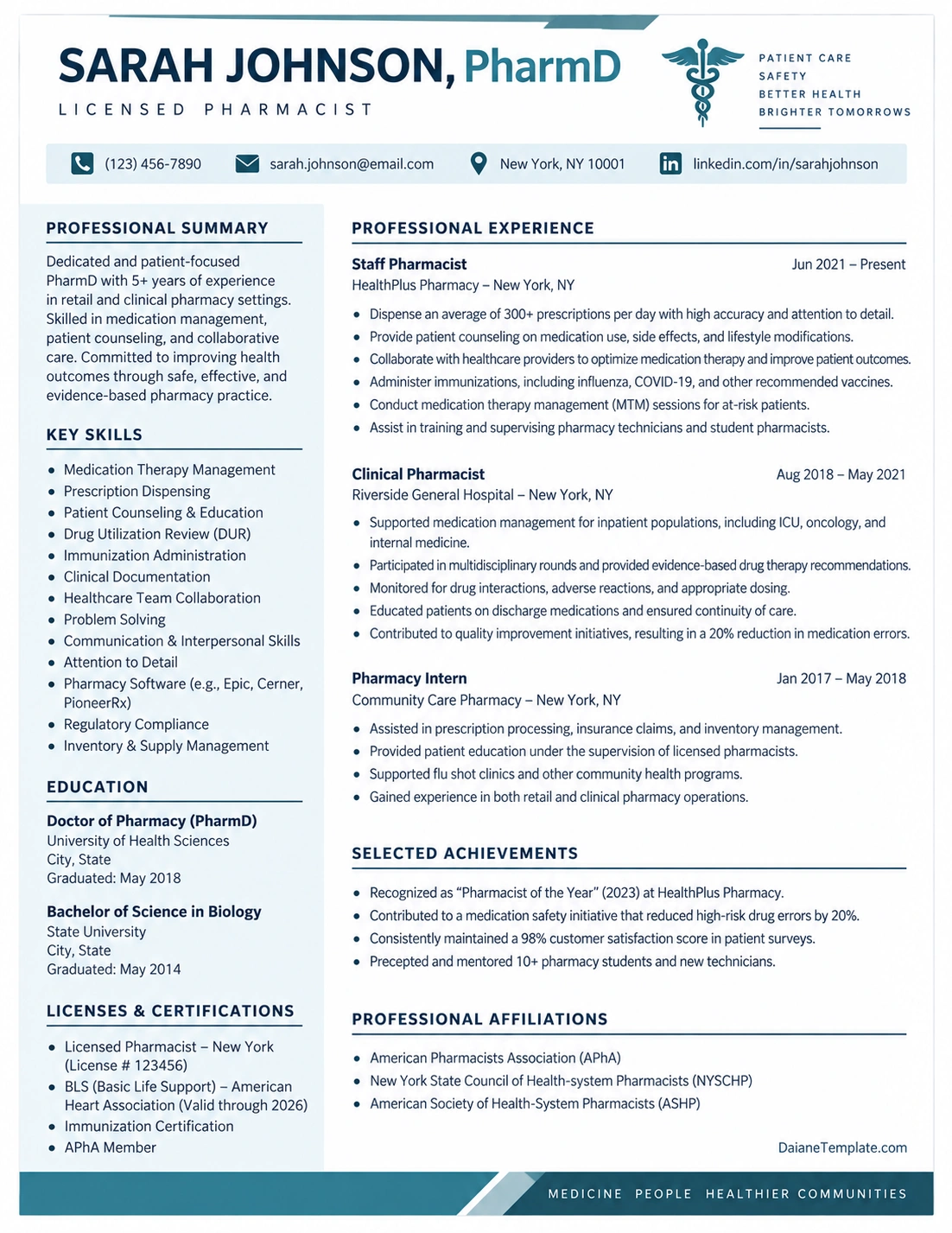
What Should a Pharmacist Resume Include?
A pharmacist resume should contain the information an employer needs to evaluate your qualifications. While the exact sections can vary depending on your career stage and target position, most effective resumes include several core components.
Contact Information
Start with clear and professional contact information. Include your name, phone number, professional email address, location, and an appropriate professional profile or LinkedIn URL when relevant.
Make sure your email address looks professional and that all contact information is current. Avoid unnecessary personal details that do not help an employer evaluate your qualifications.
Professional Summary
A professional summary provides a short introduction to your background. It should explain who you are professionally, your primary areas of expertise, and the type of value you can bring to an employer.
For example, a pharmacist with several years of experience might emphasize medication therapy management, patient counseling, prescription accuracy, healthcare collaboration, and medication safety.
Keep the summary focused. Rather than describing your entire career history, use this section to highlight the qualifications that are most relevant to the position.
Pharmacist Skills
The skills section gives employers a quick overview of your technical and interpersonal abilities. Include skills that genuinely reflect your experience and match the requirements of the position.
- Prescription dispensing and verification
- Medication therapy management
- Patient counseling and education
- Medication safety
- Drug utilization review
- Immunization administration
- Clinical documentation
- Drug interaction assessment
- Pharmacy inventory management
- Healthcare team collaboration
- Pharmacy software systems
- Regulatory compliance
- Communication and interpersonal skills
- Problem-solving
- Attention to detail
How to Write a Powerful Pharmacist Resume Experience Section
The professional experience section is often one of the most important parts of a pharmacist resume. It gives employers evidence of how you have applied your education and skills in real-world pharmacy settings.
List your positions in reverse chronological order, starting with your most recent or current role. Include your job title, employer, location, employment dates, and several concise bullet points describing your responsibilities and accomplishments.
Focus on Achievements, Not Just Duties
A common resume mistake is listing responsibilities without showing the results of your work. Whenever possible, transform routine duties into accomplishment-focused statements.
For example, instead of writing:
Dispensed prescriptions and counseled patients.
You could write:
Dispensed high-volume prescription orders while providing individualized counseling on medication use, potential side effects, and adherence.
The second version provides more context and demonstrates both technical and patient-facing skills.
Use Quantifiable Results When Appropriate
Numbers can make professional accomplishments easier to understand. Consider including measurable information when it is accurate and appropriate to disclose.
- Average prescriptions processed per day
- Number of patients counseled
- Medication safety improvements
- Inventory accuracy or efficiency improvements
- Patient satisfaction results
- Training or mentoring responsibilities
- Quality improvement results
Quantifiable achievements can help transform a generic pharmacist resume into a more compelling representation of your professional experience.
Highlight Both Technical and Soft Skills
Pharmacy work requires a combination of technical knowledge and interpersonal abilities. A pharmacist may have strong medication knowledge but also needs to communicate effectively with patients, physicians, nurses, technicians, and other healthcare professionals.
Hard Skills
Hard skills demonstrate your technical pharmacy capabilities. Depending on your background, these may include prescription processing, medication reconciliation, drug utilization review, medication therapy management, immunization services, clinical documentation, inventory control, and pharmacy information systems.
Soft Skills
Soft skills demonstrate how effectively you work with people and respond to professional situations. Communication, teamwork, leadership, organization, empathy, adaptability, problem-solving, and attention to detail can all be valuable additions when supported by your experience.
The strongest resumes do not simply create a long list of soft skills. They demonstrate these qualities through professional achievements and examples in the experience section.
Education, Licenses, and Certifications
Pharmacists typically need to present their professional education and credentials clearly. Place your Doctor of Pharmacy degree or other relevant educational qualifications in a dedicated education section.
Depending on your career and target position, you may also include relevant licenses and certifications.
- Doctor of Pharmacy (PharmD)
- State pharmacist license
- Immunization certification
- Basic Life Support certification
- Board certification when applicable
- Relevant continuing education
- Professional pharmacy memberships
Only include credentials that you actually hold. If a license or certification has an expiration date, make sure the information is current before submitting your resume.
Tailor Your Pharmacist Resume to the Job
One of the most effective ways to improve a pharmacist resume is to customize it for each position. A resume for a clinical pharmacist position may emphasize different qualifications than a resume for a community pharmacy or hospital pharmacy role.
For Clinical Pharmacist Positions
Emphasize clinical decision-making, medication therapy management, interdisciplinary collaboration, medication reconciliation, patient education, clinical documentation, and experience with specific patient populations when relevant.
For Retail or Community Pharmacist Positions
Focus on prescription dispensing, patient counseling, immunizations, customer service, medication adherence, pharmacy workflow, inventory management, insurance processing, and team leadership.
For Hospital Pharmacist Positions
Highlight inpatient medication management, medication safety, collaboration with healthcare teams, formulary knowledge, clinical interventions, medication reconciliation, and experience in hospital pharmacy operations when applicable.
Make Your Pharmacist Resume Easy to Read
A resume can contain excellent qualifications but still be difficult to evaluate if the layout is cluttered. Use clear section headings, consistent formatting, readable fonts, and sufficient white space.
Keep bullet points concise and begin them with strong action verbs such as managed, dispensed, counseled, administered, reviewed, collaborated, implemented, improved, and trained.
Review the document carefully for spelling, grammar, inconsistent dates, formatting errors, and outdated contact information. A polished presentation reinforces the impression of professionalism and attention to detail.
Common Pharmacist Resume Mistakes to Avoid
Even qualified pharmacists can weaken their applications through avoidable resume mistakes. Before submitting your resume, check for the following issues.
- Using the same resume for every position: Adjust relevant skills and experience to the job description.
- Writing a vague summary: Clearly communicate your professional background and areas of expertise.
- Listing duties without achievements: Explain how your work contributed to patient care, safety, efficiency, or pharmacy operations.
- Including irrelevant information: Prioritize information that supports your professional goals.
- Creating a cluttered design: Use a clean structure that allows important qualifications to stand out.
- Ignoring keywords from the job description: Naturally incorporate relevant skills and terminology when they accurately describe your experience.
- Failing to proofread: Grammar, spelling, and formatting mistakes can make a professional document appear careless.
How to Make Your Pharmacist Resume More Competitive
A competitive pharmacist resume should provide evidence rather than simply making broad claims. Think about the specific ways your work has benefited patients, pharmacy teams, or healthcare organizations.
Ask yourself questions such as: Did you improve a workflow? Did you train new pharmacy technicians? Did you participate in a medication safety initiative? Did you provide counseling to a large patient population? Did you contribute to quality improvement? Did you help improve adherence or patient education?
These examples can become strong achievement statements when they are described accurately and supported with measurable information where appropriate.
You should also review the job description before submitting your application. Identify the employer’s most important qualifications and make sure your resume clearly demonstrates the relevant experience you already possess.
Using a Pharmacist Resume Template
A pharmacist resume template can make the writing and formatting process easier by providing an organized structure for your professional information. A good template can help separate your summary, skills, experience, education, certifications, and achievements while maintaining a professional appearance.
However, a template should be treated as a starting point rather than a finished resume. Replace sample information with your own accurate credentials, employment history, accomplishments, and contact information.
Choose a layout that keeps the focus on your qualifications. Avoid excessive graphics, decorative elements, or design choices that make the resume harder to read or interfere with applicant tracking systems when those systems are used by an employer.
Final Tips for a Strong Pharmacist Resume
Before sending your resume to a potential employer, use this final checklist:
- Make sure your contact information is accurate.
- Write a concise and targeted professional summary.
- Highlight relevant pharmacist skills.
- Use accomplishment-focused descriptions for professional experience.
- Include measurable results when appropriate.
- List your pharmacy education clearly.
- Verify licenses and certifications.
- Tailor the resume to the position.
- Use relevant keywords naturally.
- Proofread the entire document carefully.
- Keep the design clean, professional, and easy to scan.
Conclusion
The power of a pharmacist resume comes from its ability to turn your education, technical expertise, professional experience, and patient-care abilities into a clear professional story. A strong resume does more than list pharmacy responsibilities. It demonstrates how you apply your knowledge, protect medication safety, communicate with patients, collaborate with healthcare teams, and contribute to effective pharmacy operations.
Whether you are applying for a clinical pharmacist, hospital pharmacist, community pharmacist, or another pharmacy position, focus on relevance, measurable accomplishments, and clear presentation. A carefully tailored pharmacist resume can give employers a concise view of what you bring to the role and help create opportunities for the next stage of your career.
Download: Pharmacist Resume Template
