A rental application form is a document landlords and property managers use to collect information from prospective tenants before deciding whether to approve a rental application. It provides a structured way to gather personal information, employment details, rental history, references, and other relevant information needed to evaluate a prospective renter.
Finding a suitable tenant involves more than simply confirming that someone is interested in a property. Landlords may need to review an applicant’s ability to pay rent, previous rental experience, employment information, and references. A well-organized rental application form makes this process easier by keeping important information together in a consistent format.
For applicants, completing a rental application provides an opportunity to present accurate information and demonstrate that they are prepared to meet the requirements of the rental arrangement. For landlords, the form can provide a useful starting point for screening and verification procedures.
What Is a Rental Application Form?
A rental application form is a written form completed by a person who wants to rent a house, apartment, condominium, or other residential property. It typically collects information that a landlord may need when evaluating the applicant.
Depending on the property and applicable requirements, a rental application may include information about the applicant’s current address, employment, income, rental history, references, additional occupants, vehicles, pets, and other relevant details.
The form itself does not necessarily mean that an applicant has been approved for the property. Instead, it provides information that may be used as part of the landlord’s tenant screening and application process.
Why Is a Rental Application Form Important?
A structured rental application can make the tenant screening process more organized. Instead of collecting information through separate conversations, emails, or handwritten notes, the landlord can use one document to gather the relevant details.
A rental application form can help landlords:
- Collect consistent information from prospective tenants.
- Review an applicant’s rental history.
- Verify employment and income information where appropriate.
- Collect contact information for references.
- Identify additional occupants who may live at the property.
- Record relevant vehicle or pet information.
- Obtain authorization for permitted screening or verification.
- Maintain an organized record of the application process.
For applicants, a clear application form also makes it easier to understand what information is being requested before submitting an application.
What Information Should Be Included in a Rental Application?
The exact contents of a rental application depend on the landlord, property, and applicable laws. However, several sections are commonly useful when creating a comprehensive tenant application.
Property Information
The form should identify the property being applied for. This may include the property address, apartment or unit number, desired move-in date, and proposed lease term.
Clearly identifying the property is especially important when a landlord or property manager is handling applications for multiple units.
Applicant Information
The applicant section typically collects basic information needed to identify and contact the prospective tenant. This may include the applicant’s full name, current address, phone number, email address, and other information permitted and appropriate for the screening process.
Landlords should only request information that is relevant and legally appropriate for evaluating a rental application.
Additional Occupants
If other people will live in the rental property, the application can provide space for the applicant to list additional occupants. Depending on the circumstances, this may include their names and other relevant information.
This section helps the landlord understand who is expected to occupy the property and ensures that the application accurately reflects the proposed household.
Employment Information
Employment information can help a landlord evaluate an applicant’s stated ability to meet rental obligations. A rental application may ask for the employer’s name, position, employment start date, contact information, and income information where appropriate.
Applicants should provide accurate information and be prepared to provide supporting documentation if the landlord’s lawful screening process requires it.
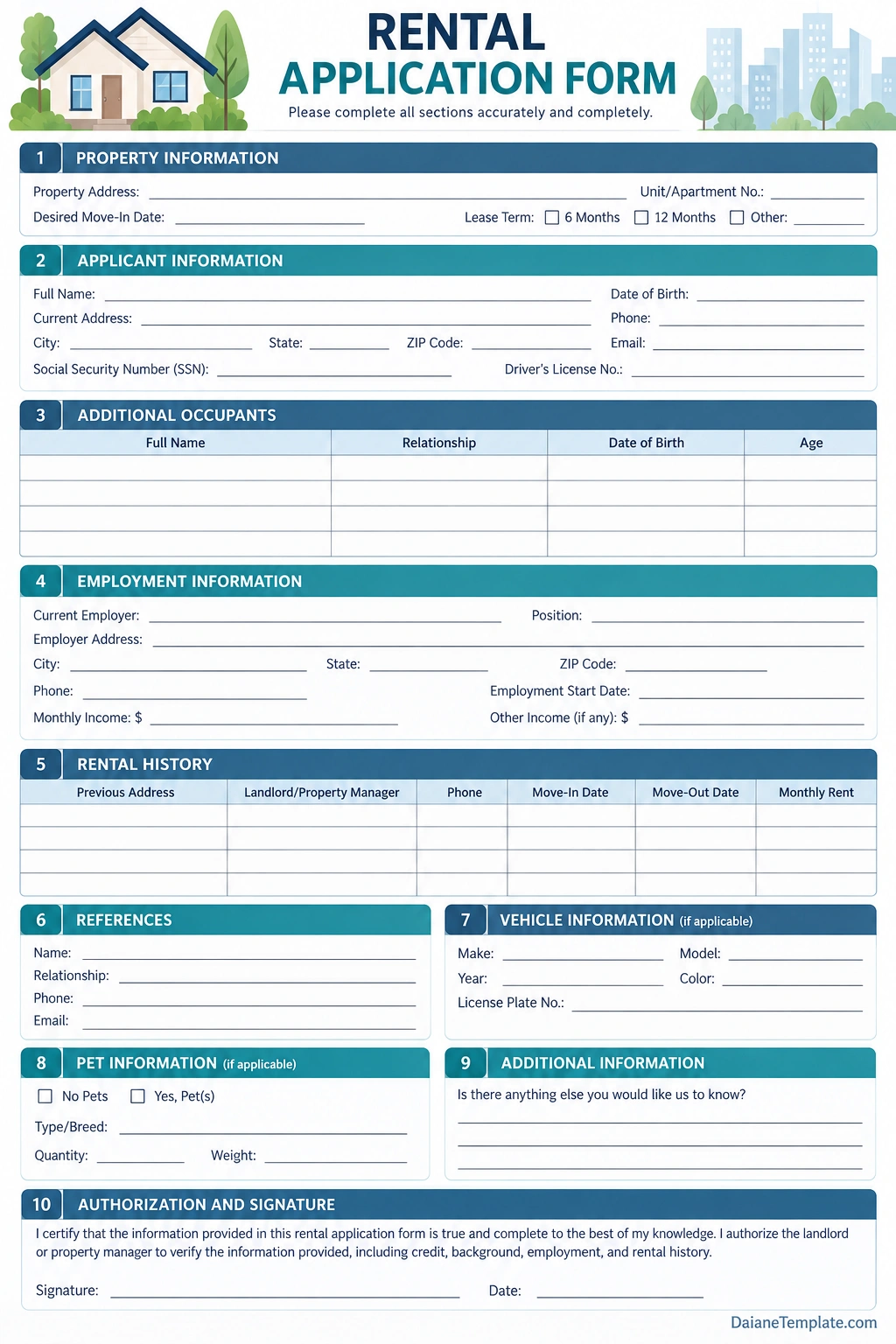
Rental History Section
A rental history section allows an applicant to provide information about previous residences. This can help a landlord understand the applicant’s prior rental experience and provide contact information for previous landlords or property managers when appropriate.
Common fields may include:
- Previous rental address
- Landlord or property manager name
- Landlord contact information
- Previous move-in date
- Previous move-out date
- Monthly rent
Applicants should make reasonable efforts to provide accurate rental history. Missing or inconsistent information may require clarification during the application process.
References
A rental application may include a section for personal, professional, or rental references, depending on the landlord’s screening process and applicable rules.
A reference can potentially provide additional information about an applicant’s reliability or history. Applicants should ask references for permission before providing their contact information and should ensure the information is accurate.
Vehicle Information
Some rental properties have parking restrictions or require information about vehicles. In these situations, the application may include fields for the vehicle make, model, year, color, and license plate number.
This information can help property managers administer parking arrangements when relevant.
Pet Information
If the property permits pets, a rental application may include a section asking applicants to provide information about their pets. This may include the type or breed, number of pets, size, or other relevant details.
Pet-related requirements should be handled consistently and in accordance with applicable housing laws and property policies.
Authorization for Screening
Many rental application processes involve some form of tenant screening or verification. An application may therefore include an authorization section that explains what the applicant is authorizing, such as permitted verification of information provided in the application.
Any authorization language should be appropriate for the screening process and comply with applicable privacy, consumer reporting, housing, and other relevant requirements.
How to Create a Rental Application Form
Creating a rental application form is easier when the document is organized into clear sections. The goal is to collect useful information without making the application unnecessarily complicated.
1. Identify the Property
Begin with the property address, unit number, desired move-in date, and proposed lease term. This establishes which rental the application concerns.
2. Add Applicant Details
Provide fields for the applicant’s basic contact and identification information that is relevant and legally appropriate for the application process.
3. Include Household Information
Add a section for additional occupants when the landlord needs to know who is expected to live at the property.
4. Collect Employment Information
Include appropriate fields for current employment and income information if these details are part of the lawful screening criteria.
5. Add Rental History
Provide enough space for applicants to document previous rental addresses and relevant landlord or property manager information.
6. Add References
Include a reference section if references are part of the landlord’s standard application process.
7. Include Relevant Property-Specific Information
If applicable, add sections for vehicles, pets, parking, or other property requirements that are relevant to the rental.
8. Add Authorization and Signature Fields
Finish the form with appropriate authorization language, applicant certification, signature, and date fields. The exact wording should be reviewed for compliance with applicable requirements.
Rental Application Form vs. Lease Agreement
A rental application form and a lease agreement serve different purposes. The application is generally used to collect information from a prospective tenant before the rental relationship is finalized.
A lease agreement, on the other hand, establishes the contractual terms of the tenancy after the parties enter into the rental arrangement. It typically addresses matters such as rent, lease term, security deposit, maintenance responsibilities, rules, termination, and other conditions of occupancy.
Completing a rental application does not automatically create the same contractual relationship as signing a lease. The documents should therefore be kept separate and used for their intended purposes.
Tips for Creating a Clear Rental Application
A professional application should be easy to understand and straightforward to complete. The following practices can make the document more effective.
- Organize information into sections: Group related questions together so applicants can move through the form logically.
- Use clear labels: Every field should explain exactly what information is requested.
- Leave sufficient writing space: Printable forms should provide enough room for handwritten responses.
- Avoid unnecessary questions: Request information that is relevant to the legitimate screening process.
- Keep requirements consistent: Use consistent application criteria for similarly situated applicants.
- Explain authorization: Applicants should understand what they are authorizing when the form includes screening consent.
- Review the form regularly: Rental and housing requirements can change, so forms should be reviewed periodically.
Common Mistakes to Avoid
A poorly designed rental application can create confusion for both landlords and applicants. Several common problems are worth avoiding.
- Leaving out important property identification details.
- Using vague or confusing questions.
- Requesting excessive information that is not relevant to the screening process.
- Failing to provide enough space for rental history.
- Not including a clear authorization section when screening requires one.
- Using inconsistent application requirements for different applicants.
- Failing to review the form for applicable housing and privacy requirements.
- Assuming that a template automatically complies with every local legal requirement.
Using a Printable Rental Application Form Template
A printable rental application form template provides a convenient starting point for organizing tenant information. Instead of designing every section from scratch, landlords can use a structured layout containing common application categories.
A printable template can include sections for property information, applicant details, additional occupants, employment, rental history, references, vehicles, pets, additional information, and authorization.
Templates can be particularly useful for independent landlords and property managers who want a consistent application format. However, the template should be customized as necessary to reflect the property’s legitimate requirements and the laws applicable to the location.
Rental Application Checklist for Landlords
Before using a rental application, landlords and property managers can review the following checklist:
- Property address and unit information are included.
- Applicant contact information is clearly requested.
- Additional occupants can be identified when appropriate.
- Employment information is included when relevant.
- Rental history has sufficient space.
- References can be provided when part of the screening process.
- Vehicle information is included if relevant to the property.
- Pet information is included if relevant and legally appropriate.
- Screening authorization language is properly structured.
- Signature and date fields are included.
- The form requests only appropriate and relevant information.
- The application process is applied consistently.
- The form has been reviewed for applicable legal requirements.
Tips for Applicants Completing a Rental Application
Prospective tenants can also take several steps to make the application process smoother.
- Provide accurate information throughout the application.
- Prepare employment and rental history details before starting.
- Confirm that reference contact information is current.
- Answer every required question clearly.
- Ask the landlord to clarify anything that is unclear.
- Keep a copy of the completed application when appropriate.
- Be prepared to provide supporting documentation if lawfully requested.
Final Thoughts
A rental application form provides a structured way for landlords and property managers to collect information from prospective tenants before entering into a lease. By organizing applicant details, employment information, rental history, references, and other relevant information in one place, the form can make the screening process more consistent and manageable.
A well-designed application should be clear, practical, and focused on information that is legitimately relevant to the rental decision. Landlords should also make sure their application process complies with applicable housing, privacy, consumer reporting, and other legal requirements.
For landlords who need a convenient starting point, a rental application form template can simplify the process of creating a professional application. With appropriate customization and careful review, a structured application can help both landlords and prospective tenants move through the rental process with clearer expectations and better organization.
Download: Rental Application Form
