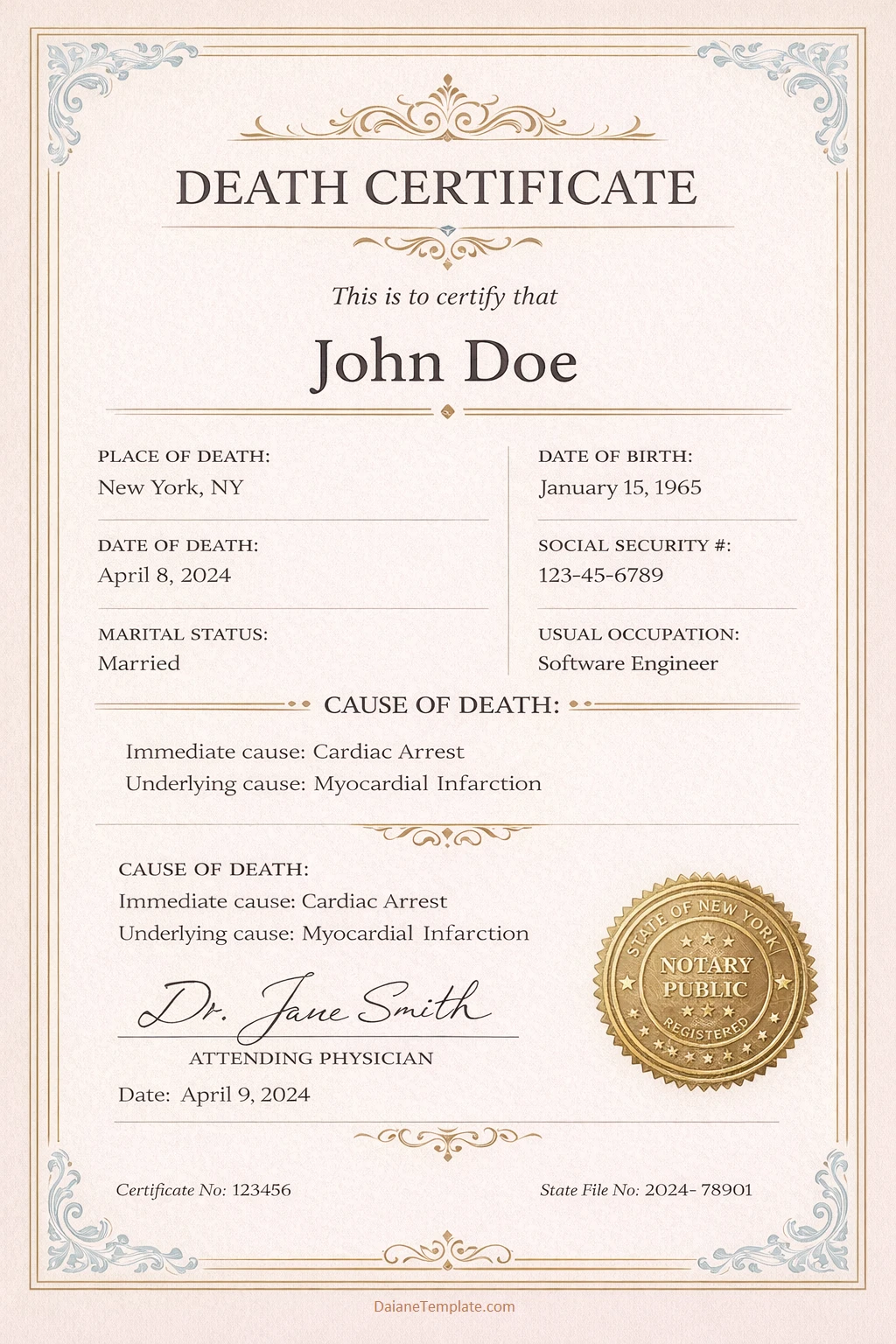
What Is a Death Certificate?
A death certificate is an essential legal document that serves as an official record of an individual’s death. It contains vital information such as the deceased person’s full name, date of birth, date of death, place of death, and cause of death.
This document is issued by the vital records office in the state or country where the death occurred. It is a critical piece of paperwork that provides proof of the person’s passing.
Why Do You Need a Death Certificate?
The need for a death certificate arises in various personal, legal, and administrative situations where proof of an individual’s death is required. Whether you are a family member, executor of an estate, or beneficiary of a deceased person, obtaining a death certificate is essential for the following reasons:
Settling Estates and Inheritance
One of the primary reasons why you need a death certificate is to settle the deceased person’s estate and distribute their assets according to their will or the law. When someone passes away, their financial affairs, properties, and debts must be managed and resolved. A death certificate serves as legal documentation that confirms the person’s passing and allows for the proper administration of their estate.
- Probate Proceedings: In cases where the deceased person had a will, the probate court requires a death certificate to validate the will and appoint an executor to carry out the deceased person’s wishes. The executor uses the death certificate to prove their authority to act on behalf of the estate.
- Estate Distribution: Beneficiaries named in the will or determined by law need a death certificate to claim their inheritance and receive their share of the estate. Without a death certificate, the distribution of assets and settlement of debts may be delayed or hindered.
- Debt Settlement: Creditors of the deceased person must be notified of their death, and debts must be settled from the estate. A death certificate is required to demonstrate that the person has passed away and to authorize the payment of outstanding debts.
Accessing Insurance and Benefits
Another critical reason for needing a death certificate is to access various insurance benefits and financial entitlements that may be available to the deceased person’s beneficiaries. Life insurance policies, pension plans, and government benefits typically require a death certificate to process claims and disburse payments to the rightful recipients.
- Life Insurance Claims: Insurance companies require a death certificate to verify the policyholder’s death and initiate the payout of the policy benefits to the named beneficiaries. Without this document, the claim process may be delayed, and beneficiaries may not receive the funds promptly.
- Pension and Retirement Benefits: Pension providers and retirement plans demand a death certificate to confirm the death of the plan participant and determine the distribution of retirement benefits to surviving spouses, dependents, or designated beneficiaries. This document is essential for establishing eligibility for survivor benefits.
- Social Security and Government Benefits: When a person receiving Social Security benefits passes away, their dependents or survivors may be entitled to survivor benefits or other government assistance. A death certificate is necessary to notify the Social Security Administration and apply for the appropriate benefits.
Legal Documentation and Proof of Death
Furthermore, a death certificate serves as legal documentation and proof of an individual’s death in various official transactions and processes. Whether you are closing accounts, transferring ownership of property, or updating legal documents, having a death certificate is essential for demonstrating that the person has deceased and enabling the necessary changes to be made.
- Account Closures: Banks, financial institutions, and service providers require a death certificate to close the deceased person’s accounts, cancel subscriptions, and terminate contracts. This document is needed to verify the account holder’s death and prevent unauthorized access to their accounts.
- Property Transfers: When transferring ownership of real estate or other assets owned by the deceased person, a death certificate is required to update property titles, deeds, and other legal documents. This ensures that the assets are properly transferred to the designated beneficiaries or heirs.
- Name Changes and Legal Proceedings: In certain legal proceedings, such as changing a beneficiary designation or initiating a wrongful death lawsuit, a death certificate is necessary to substantiate claims, establish legal rights, and provide evidence of the individual’s passing.
Preventing Fraud and Identity Theft
Lastly, obtaining a death certificate is crucial for preventing fraud, identity theft, and misuse of the deceased person’s personal information. By officially documenting the person’s death and notifying relevant authorities and organizations, you can safeguard their identity, financial accounts, and sensitive data from being exploited or misused.
- Identity Verification: A death certificate helps verify the deceased person’s identity and prevent unauthorized individuals from using their personal information for fraudulent purposes, such as opening new accounts or applying for credit in their name.
- Public Records Update: Updating public records with the official death certificate ensures that government agencies, credit bureaus, and other organizations are aware of the person’s passing and can take appropriate measures to prevent identity theft or fraudulent activities.
- Protecting Privacy: By providing a death certificate to relevant entities and organizations, you can protect the deceased person’s privacy, prevent unwanted solicitations, and avoid potential risks associated with identity theft or financial fraud.
Who Provides the Original Death Certificate?
The original death certificate is typically issued by the vital records office or registrar in the state, county, or country where the death occurred. This office is responsible for maintaining official records of births, deaths, marriages, and divorces within its jurisdiction. The process of obtaining a death certificate varies depending on the location and requirements of the issuing authority.
Vital Records Office
The vital records office, also known as the department of health or registrar of vital statistics, is the primary agency responsible for issuing and maintaining death certificates. This office operates at the state or county level and oversees the registration of vital events, including births and deaths. When someone passes away, their death must be registered with the vital records office in the jurisdiction where the death occurred.
To obtain the original death certificate, you will need to submit a request to the vital records office and provide the necessary information and documentation required to process the request. This may include completing an application form, providing proof of your relationship to the deceased person, and paying the applicable fees for obtaining certified copies of the death certificate.
Funeral Home or Mortuary
In some cases, the funeral home or mortuary handling the final arrangements for the deceased person may also play a role in providing the original death certificate. Funeral directors are responsible for completing the death certificate with accurate information about the deceased person’s passing, including the cause of death and other relevant details. Once the death certificate is completed and signed by the attending physician or medical examiner, it is typically submitted to the vital records office for official registration and issuance of certified copies.
Funeral homes may assist family members in obtaining certified copies of the death certificate by submitting the necessary paperwork to the vital records office on their behalf. However, family members need to verify the process with the funeral home and ensure that all required information and documentation are provided to facilitate the timely issuance of the death certificate.
Medical Examiner’s Office
In cases where the cause of death is under investigation or requires further examination, the medical examiner’s office or coroner may be involved in providing information for the death certificate. Medical examiners are responsible for conducting autopsies, determining the cause of death, and completing the medical portion of the death certificate with accurate and detailed information.
The medical examiner’s office works in collaboration with the vital records office to ensure that the death certificate is properly completed and registered. If there are any discrepancies or uncertainties regarding the cause of death, additional investigations or consultations may be necessary to finalize the information on the death certificate and issue certified copies to the family members or authorized individuals.
Online Services and Third-Party Providers
In today’s digital age, many states and counties offer online services for requesting and obtaining death certificates. Online platforms provided by the vital records office or third-party providers allow individuals to submit requests, pay fees, and receive certified copies of death certificates through secure electronic channels.
These online services streamline the process of obtaining death certificates and provide convenience for individuals who may not be able to visit the vital records office in person. By using secure online portals, requestors can track the status of their requests, receive notifications on the processing of their applications, and securely download or receive certified copies of the death certificate by mail.
Authorized Agents and Representatives
In some situations, individuals may designate authorized agents or representatives to obtain death certificates on their behalf. This is commonly done by appointing an executor of the estate, a legal representative, or a designated individual with written authorization to request and receive certified copies of the death certificate.
Authorized agents must provide proof of their authority to act on behalf of the deceased person or their estate, such as a copy of the will, letters testamentary, power of attorney, or court-issued documents appointing them as the executor or representative. By presenting the necessary documentation and identification, authorized agents can obtain the required number of certified copies of the death certificate for estate administration, legal proceedings, or other purposes.
Who Can Obtain a Death Certificate?
The process of obtaining a death certificate is governed by specific rules and regulations to ensure that only authorized individuals can request and receive certified copies of the document. The following parties are typically eligible to obtain a death certificate:
Immediate Family Members
Immediate family members of the deceased person, including spouses, children, parents, and siblings, are usually entitled to request and obtain certified copies of the death certificate. These family members have a direct relationship to the deceased and may require the document for legal, financial, or personal reasons.
- Spouses: The spouse of the deceased person is commonly authorized to obtain the death certificate as they have a legal relationship with the deceased through marriage. Spouses may need the document for estate settlement, insurance claims, or other administrative purposes.
- Children: Children of the deceased, whether biological, adopted, or stepchildren, are typically eligible to request the death certificate to address legal matters related to their parent’s passing. Children may use the document for inheritance, social security benefits, or other needs.
- Parents: Parents of the deceased person, including biological parents, adoptive parents, or legal guardians, may obtain certified copies of the death certificate to handle estate matters, notify government agencies, or fulfill legal obligations following their child’s death.
Legal Representatives and Executors
Legal representatives and executors of the deceased person’s estate have the authority to request and receive certified copies of the death certificate for estate administration and settlement purposes. These individuals are appointed to manage the deceased person’s affairs, pay debts, distribute assets, and ensure that the estate is handled according to the law.
- Legal Representatives: Attorneys, estate planners, or other legal professionals representing the deceased person’s estate may obtain the death certificate to facilitate legal proceedings, resolve disputes, and carry out the terms of the deceased person’s will or estate plan.
- Executors: Executors named in the deceased person’s will or appointed by the probate court have the legal authority to request and obtain certified copies of the death certificate. Executors use the document to demonstrate their authority to act on behalf of the estate and fulfill their duties under the law.
Beneficiaries and Heirs
Beneficiaries and heirs named in the deceased person’s will or determined by law as rightful recipients of the estate assets may also be eligible to obtain certified copies of the death certificate. These individuals have a vested interest in the estate and may require the document to claim their inheritance or beneficiary rights.
- Beneficiaries: Individuals designated in the deceased person’s will to receive specific assets, properties, or funds may need the death certificate to prove their entitlement to the inheritance. Beneficiaries use the document to demonstrate their status as legal heirs and claim their share of the estate.
- Heirs-at-Law: In cases where there is no will or the will does not specify beneficiaries, heirs-at-law who inherit under the state’s intestacy laws may request the death certificate to establish their legal right to the deceased person’s estate. Heirs-at-law include surviving spouses, children, parents, and other relatives entitled to inherit under the law.
Government Agencies and Legal Entities
Government agencies, courts, and legal entities may also be authorized to request and receive certified copies of a death certificate for official purposes, such as issuing benefits, processing legal documents, or conducting investigations. These entities have a legitimate interest in obtaining the document to carry out their statutory duties.
- Social Security Administration: The Social Security Administration requires a death certificate to stop benefit payments, notify survivors of their eligibility for survivor benefits, and update its records with the deceased person’s information. The death certificate is essential for verifying the person’s passing and managing social security benefits.
- Insurance Companies: Insurance providers need a death certificate to process life insurance claims, annuity payments, and other insurance benefits payable to the designated beneficiaries. The document serves as proof of the policyholder’s death and enables insurers to fulfill their contractual obligations.
- Probate Courts: Probate courts may request a death certificate to validate the authenticity of a will, appoint an executor, or resolve disputes related to the deceased person’s estate. The document is used in probate proceedings to verify the deceased person’s passing and authorize estate administration.
How Long Does It Take to Get a Death Certificate?
The processing time for obtaining a death certificate varies depending on several factors, including the jurisdiction where the death occurred, the completeness of the application, the volume of requests received by the vital records office, and any additional requirements or circumstances related to the death. While the timeframe for receiving a death certificate may differ, there are general guidelines that can help estimate how long it takes to obtain this vital document.
How to Get a Death Certificate
Obtaining a death certificate involves several steps that must be followed to request, process, and receive the document from the vital records office or issuing authority. By following the proper procedures and providing the necessary information, requestors can ensure a smooth and efficient process for obtaining the death certificate for legal, administrative, or personal purposes.
Step 1: Determine the Jurisdiction
The first step in obtaining a death certificate is to determine the jurisdiction where the death occurred. The vital records office responsible for issuing death certificates varies depending on the state, county, or country where the death took place. Knowing the correct jurisdiction ensures that you submit your request to the appropriate office for processing.
Whether the death occurred in a hospital, nursing home, private residence, or other location, it is essential to identify the specific location and jurisdiction where the death was registered. If the death occurred outside the United States or in a foreign country, additional steps may be necessary to obtain an international death certificate through consular services or other channels.
Step 2: Gather Required Information
Before requesting a death certificate, gather all necessary information and documentation needed to complete the application accurately. You will typically need to provide details about the deceased person, such as their full name, date of birth, date of death, place of death, and any other relevant information required by the vital records office.
In addition to information about the deceased person, you may also need to provide proof of your relationship to the deceased, identification, and any supporting documentation required to verify your eligibility to request the death certificate. Having these documents ready when submitting your application can expedite the processing of your request and ensure that you receive the certified copies promptly.
Step 3: Fill Out the Application
Complete the application form for the death certificate provided by the vital records office or available online through their website. Ensure that all fields are filled out accurately and legibly, with correct information about the deceased person and the requester. Include any required details, supporting documentation, and payment for the issuance of certified copies.
When filling out the application, be thorough and precise in providing the requested information to avoid delays or discrepancies in processing your request. Double-check the accuracy of the data entered on the form, review the instructions for completion, and follow any guidelines or requirements specified by the vital records office to ensure that your application is processed efficiently.
Step 4: Submit the Application
Once you have completed the application form and gathered all necessary documentation, submit your request for the death certificate to the vital records office by mail, in person, or through online channels, depending on the available options provided by the issuing authority. Include the application form, supporting documents, and any required fees with your submission.
If applying by mail, ensure that it is sent to the correct address and includes all relevant materials to process your request. If applying in person, visit the vital records office during its business hours and bring the completed application form, identification, and payment for the issuance of certified copies. Online submission may involve creating an account, uploading documents, and paying fees electronically through the office’s website.
Step 5: Pay the Required Fees
Most vital records offices charge a fee for obtaining certified copies of a death certificate, with the amount varying depending on the jurisdiction and the number of copies requested. Make sure to include payment for the required fees with your application, either by check, money order, credit card, or other accepted forms of payment specified by the office.
Verify the fee schedule, payment methods, and any additional charges for expedited services or rush processing if needed. Be prepared to cover the cost of each certified copy of the death certificate requested, as well as any applicable fees for processing, shipping, or other services provided by the vital records office.
Step 6: Receive the Death Certificate
Once your application is processed and approved by the vital records office, you will receive the certified copies of the death certificate either by mail, in person, or through electronic delivery, depending on the method chosen and available options. The certified copies are official documents that can be used for legal, administrative, or personal purposes as needed.
Upon receiving the death certificate, review the information for accuracy and ensure that all details are correct before using the document for its intended purposes. Keep the certified copies in a safe and secure location, as they contain sensitive information about the deceased person and are essential for estate settlement, insurance claims, government benefits, and other transactions requiring proof of death.
Death Certificate Template – DOWNLOAD
