The Master Settlement Agreement (MSA) is a landmark legal agreement reached in 1998 between attorneys general from 46 U.S. states, the District of Columbia, five U.S. territories, and major tobacco manufacturers. It established important financial obligations and restrictions on tobacco advertising, marketing, and promotional activities in the United States.
The agreement was created after numerous states filed lawsuits against tobacco companies to recover public healthcare costs associated with smoking-related illnesses. These lawsuits raised concerns about tobacco advertising practices, public health, and the impact of cigarette consumption on younger generations.
The Master Settlement Agreement introduced significant changes to the tobacco industry’s marketing practices. It restricted youth-targeted advertising, prohibited cartoon characters in tobacco promotions, limited sponsorship activities, and required participating manufacturers to make substantial payments to settling states.
In this guide, you will learn what the Master Settlement Agreement is, why it was established, who participated, and how its provisions affected tobacco manufacturers, public health, and state governments.
What Is the Master Settlement Agreement?
The Master Settlement Agreement is a legal settlement signed on November 23, 1998, between 46 state governments, the District of Columbia, five U.S. territories, and participating tobacco product manufacturers.
The agreement resolved numerous lawsuits filed by states seeking compensation for healthcare expenses associated with smoking-related diseases. It also established nationwide restrictions on certain tobacco advertising, marketing, and promotional practices.
The original participating manufacturers included four major American tobacco companies:
- Philip Morris Incorporated
- R.J. Reynolds Tobacco Company
- Brown & Williamson Tobacco Corporation
- Lorillard Tobacco Company
Additional tobacco manufacturers joined the agreement in subsequent years. The MSA therefore became a broader settlement framework involving numerous participating manufacturers.
Four states, Florida, Minnesota, Mississippi, and Texas, had already negotiated separate tobacco settlements before the 1998 agreement.
Why Was the Master Settlement Agreement Created?
The Master Settlement Agreement was established after states raised concerns about the financial and public health consequences of tobacco consumption. State governments argued that smoking-related illnesses created substantial expenses for public healthcare programs.
Several states filed lawsuits against major tobacco manufacturers to recover these costs and address alleged industry practices involving cigarette advertising, marketing, and public information about smoking.
Recover Healthcare Expenses
One major objective was to recover some of the public funds spent treating smoking-related illnesses. State governments sought financial compensation for healthcare expenses associated with tobacco consumption.
Reduce Youth Smoking
Another important objective was to reduce tobacco use among young people. Concerns about youth exposure to cigarette advertising and promotional campaigns encouraged states to seek stronger marketing restrictions.
Change Tobacco Marketing Practices
The agreement aimed to change how participating tobacco manufacturers advertised and promoted their products. It introduced restrictions intended to prevent marketing activities from targeting young people directly or indirectly.
Support Public Health Programs
The MSA also established funding commitments for public health initiatives, including tobacco prevention and education programs. These provisions were intended to support efforts to reduce smoking and communicate the health risks of tobacco use.
Who Signed the Master Settlement Agreement?
The original Master Settlement Agreement involved state and territorial governments and four major tobacco manufacturers. The participating governments were represented by their respective attorneys general.
State and Territorial Governments
The agreement included 46 states, the District of Columbia, and five U.S. territories. These governments participated in litigation seeking compensation for public healthcare costs associated with tobacco-related illnesses.
Original Participating Tobacco Manufacturers
Four major tobacco companies signed the original agreement in November 1998. They accepted financial obligations and restrictions on their advertising and promotional activities.
Other tobacco manufacturers subsequently joined the agreement as additional participating manufacturers.
Key Provisions of the Master Settlement Agreement
The Master Settlement Agreement introduced several important provisions affecting tobacco manufacturers. These requirements addressed advertising, marketing, sponsorships, product promotion, and financial responsibilities.
1. Prohibition on Youth-Targeted Advertising
One of the most important provisions prohibits participating tobacco manufacturers from directly or indirectly targeting young people through tobacco advertising, marketing, or promotional activities.
The agreement also prohibits activities primarily intended to initiate, maintain, or increase youth smoking within the settling states.
2. Ban on Cartoon Characters
The MSA prohibits participating manufacturers from using cartoon characters in tobacco product advertising, promotions, packaging, or labeling, subject to the agreement’s provisions.
This restriction addressed concerns that cartoon imagery could make cigarette products more appealing to children and teenagers.
3. Restrictions on Brand Sponsorships
The agreement restricts tobacco brand-name sponsorships of certain events and activities. It prohibits sponsorships involving concerts, major professional team sports, events with significant youth audiences, and events featuring underage paid participants.
These restrictions were intended to limit the association between cigarette brands and entertainment or sporting activities popular with younger audiences.
4. Ban on Outdoor Advertising
The MSA prohibits specified forms of outdoor tobacco advertising, including billboards and certain advertisements in public locations such as stadiums, shopping malls, and video game arcades.
It also addresses advertising on public transportation and other locations covered by the agreement.
5. Restrictions on Product Placement
Participating manufacturers are prohibited from making payments to promote tobacco products through product placement in various forms of entertainment and media.
This provision addresses the promotion of tobacco brands in movies, television programs, theatrical productions, music performances, videos, and video games.
6. Restrictions on Branded Merchandise
The agreement prohibits the distribution and sale of certain merchandise carrying tobacco product brand names or logos. Examples include T-shirts, caps, backpacks, and other promotional products.
This provision limits the use of everyday merchandise as a way to promote cigarette brands.
7. Restrictions on Free Samples
The MSA restricts the distribution of free tobacco product samples. Under the agreement, participating manufacturers generally cannot distribute free samples except in qualifying adult-only facilities where underage individuals are excluded.
8. Financial Payment Obligations
Participating manufacturers must make annual payments to the settling states. These payments are subject to the agreement’s calculation methods, adjustments, reductions, and other applicable provisions.
The financial obligations were intended to provide compensation to state governments and support the broader objectives of the settlement.
9. Public Disclosure of Tobacco Industry Documents
The agreement requires participating manufacturers to make certain tobacco-related documents available to the public through an online document repository.
This provision supports transparency by making relevant industry materials accessible to researchers, public health organizations, and members of the public.
How Did the Master Settlement Agreement Affect Tobacco Companies?
The Master Settlement Agreement significantly changed the legal and commercial environment for participating tobacco manufacturers. Companies became subject to financial obligations and restrictions that affected their marketing strategies and promotional activities.
Increased Financial Responsibilities
Participating manufacturers became responsible for making annual payments to settling states. These payments created long-term financial obligations connected to cigarette sales and the settlement’s payment formulas.
Changes in Advertising Strategies
Tobacco manufacturers had to adjust their advertising and promotional practices to comply with the agreement. Certain marketing channels, sponsorships, and promotional activities were restricted or prohibited.
Greater Legal and Regulatory Oversight
The agreement created additional compliance responsibilities. Participating manufacturers must follow applicable settlement requirements, while state attorneys general and other authorized parties have roles in monitoring and enforcing relevant provisions.
How Did the Master Settlement Agreement Affect Public Health?
The MSA was designed partly to address public health concerns associated with tobacco consumption. Its provisions focused particularly on reducing youth exposure to tobacco marketing and supporting tobacco prevention initiatives.
Reduced Youth Exposure to Tobacco Promotions
Restrictions on cartoon characters, youth-targeted advertising, promotional merchandise, and certain sponsorship activities were intended to reduce the appeal and visibility of cigarette brands among young people.
Funding for Tobacco Prevention
The settlement established financial commitments supporting tobacco control, public education, and prevention activities. These initiatives provide resources for communicating the health risks of smoking.
Greater Public Awareness
The agreement also contributed to broader public attention surrounding tobacco advertising, industry practices, and smoking-related health concerns.
However, the MSA was only one part of a wider tobacco control effort. Its provisions should not be viewed as the sole reason for changes in smoking rates or youth tobacco use.
What Happened to the Settlement Payments?
The Master Settlement Agreement requires participating tobacco manufacturers to make annual payments to the settling states. These payments are calculated according to the agreement’s financial provisions and may be affected by several adjustments.
State governments receive the settlement funds and determine how to allocate them under applicable state laws and budget decisions.
Depending on the state, the money may support:
- Public healthcare programs
- Tobacco prevention and education initiatives
- Healthcare research and community programs
- Public health infrastructure
- Other state budget priorities
The allocation of settlement funds is not identical across all participating states. Each state may establish its own approach to using the money.
Master Settlement Agreement vs. Standard Settlement Agreement
The Master Settlement Agreement differs from an ordinary settlement agreement because of its nationwide scope, number of participating parties, and long-term industry obligations.
- Parties involved: The MSA involved multiple state governments, U.S. territories, and numerous tobacco manufacturers.
- Purpose: It addressed public healthcare costs and tobacco industry marketing practices.
- Financial obligations: It established substantial annual payment requirements for participating manufacturers.
- Industry restrictions: It introduced specific advertising, marketing, and promotional restrictions.
- Long-term impact: Its provisions created continuing obligations and compliance requirements.
A standard settlement agreement usually resolves a dispute between specific parties and contains terms tailored to their particular circumstances.
Printable Master Settlement Agreement Template
A printable Master Settlement Agreement template can help readers understand how a formal settlement document is organized. It can also serve as an educational worksheet for studying the parties, purpose, financial provisions, obligations, and signatures associated with a settlement arrangement.
A useful printable agreement form should include clearly labeled sections and sufficient blank space for recording relevant information. A portrait layout is particularly suitable for a formal agreement because it resembles the appearance of a traditional legal document.
The following template uses a professional navy blue, white, and light gray design. It includes sections for the agreement date, state parties, tobacco company parties, purpose, key terms, and signature details.
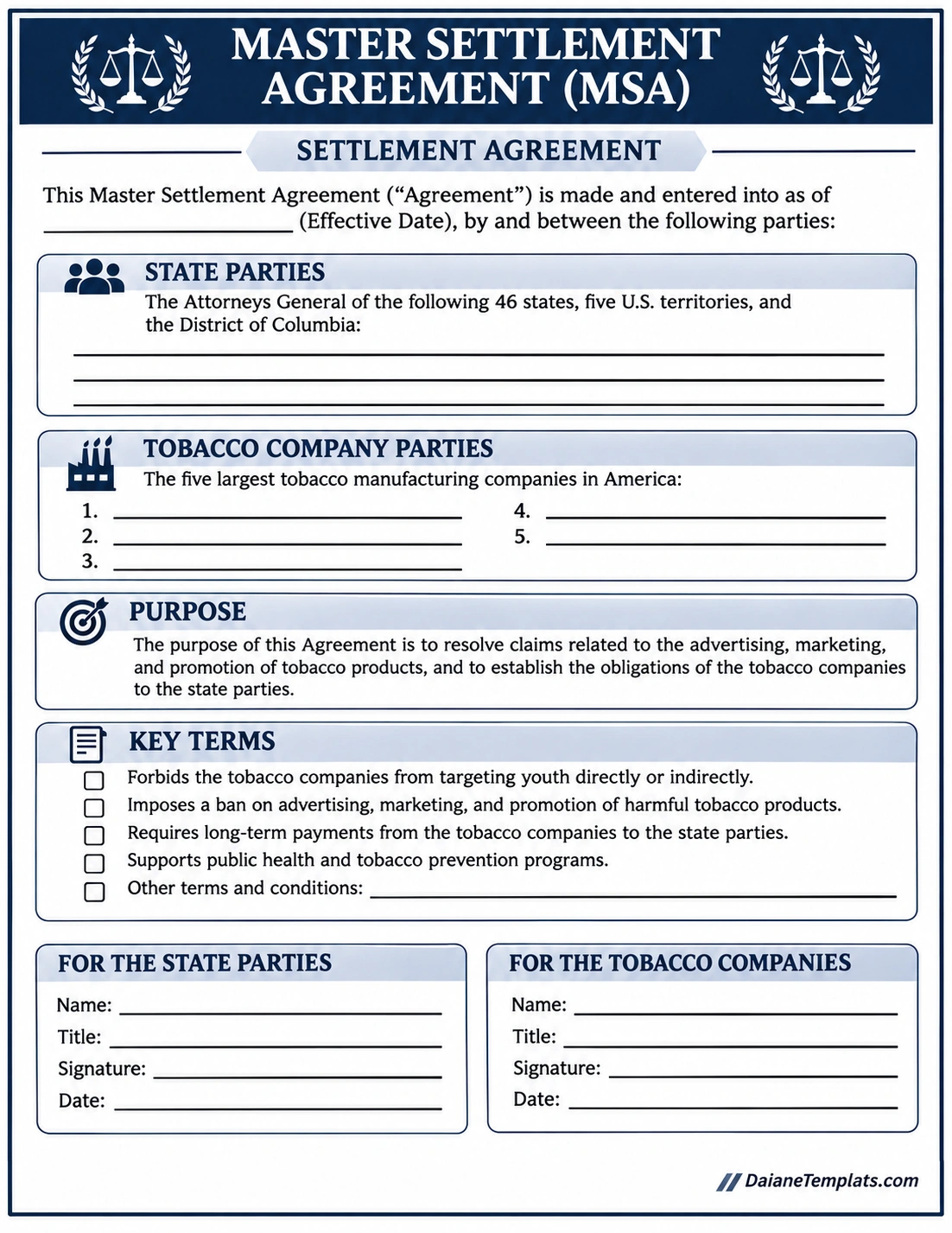
This blank agreement worksheet is intended for educational and organizational purposes. It is not the original 1998 Tobacco Master Settlement Agreement, an official government document, or a substitute for legal drafting and review.
Frequently Asked Questions
What is the main purpose of the Master Settlement Agreement?
The main purpose of the Master Settlement Agreement was to resolve lawsuits filed by participating states against tobacco manufacturers, recover healthcare costs associated with smoking-related illnesses, and establish restrictions on tobacco advertising and marketing practices.
When was the Master Settlement Agreement signed?
The original Tobacco Master Settlement Agreement was signed on November 23, 1998.
How many states participated in the MSA?
Forty-six states participated in the original MSA. The District of Columbia and five U.S. territories also joined. Florida, Minnesota, Mississippi, and Texas had negotiated separate settlements before the MSA.
Which tobacco companies signed the original agreement?
The four original participating manufacturers were Philip Morris Incorporated, R.J. Reynolds Tobacco Company, Brown & Williamson Tobacco Corporation, and Lorillard Tobacco Company. Additional manufacturers joined later.
Does the Master Settlement Agreement prohibit all tobacco advertising?
No. The MSA prohibits or restricts specific advertising, marketing, and promotional practices. These include youth targeting, cartoon advertising, certain sponsorships, outdoor advertising, and particular forms of product placement. It is not a blanket prohibition on every form of tobacco advertising.
Does the MSA prohibit tobacco companies from targeting young people?
Yes. The agreement prohibits participating manufacturers from directly or indirectly targeting youth through advertising, marketing, or promotional activities.
How much money did tobacco companies agree to pay?
The agreement established substantial annual payments to settling states. The commonly cited base-payment figures exceed $200 billion through the first 25 years, although actual payments are subject to adjustments and other provisions in the agreement.
What do states use MSA payments for?
States determine how to allocate their settlement funds. Uses vary and may include healthcare programs, tobacco prevention, public education, research, and other state budget priorities.
Is the Master Settlement Agreement still in effect?
Yes. The MSA continues to establish obligations for participating manufacturers, including applicable financial payments and restrictions on tobacco marketing and promotional activities.
Where can I find the original Master Settlement Agreement?
The original agreement is available through government and legal document repositories. The National Association of Attorneys General also provides information about the MSA and its implementation.
Can I use a printable Master Settlement Agreement template as a legal contract?
A general printable template can help organize information or support educational activities. However, it is not an official copy of the 1998 MSA and should not be treated as a legally sufficient agreement without appropriate legal drafting and review.
Conclusion
The Master Settlement Agreement of 1998 was a landmark legal settlement that changed the relationship between state governments and the American tobacco industry. It addressed healthcare costs associated with smoking-related illnesses while establishing important restrictions on tobacco advertising, marketing, and promotional activities.
Its provisions introduced long-term financial responsibilities for participating manufacturers and aimed to reduce youth exposure to tobacco marketing. The agreement also supported public health and tobacco prevention initiatives through financial commitments and disclosure requirements.
Understanding the Master Settlement Agreement provides valuable insight into tobacco regulation, public health policy, and large-scale legal settlements. A printable agreement worksheet can also help organize the main parties, provisions, and responsibilities in a clear and accessible format.
Download: Master Settlement Agreement Template
