A distributor settlement agreement is a written contract used by a supplier, manufacturer, or business and its distributor to resolve disputes or outstanding obligations arising from their distribution relationship. It can establish how the parties will handle unpaid invoices, product returns, remaining inventory, contract termination, and other unresolved matters.
When a distribution relationship ends or a disagreement occurs, verbal promises may not be enough to protect either party. A written settlement agreement helps document the decisions both businesses have accepted and explains what each party must do to complete the settlement.
Whether you are a manufacturer resolving a dispute with a distributor or a distributor negotiating the end of a business relationship, understanding the key provisions can help you prepare a clearer agreement. This guide explains what a distributor settlement agreement should contain, how to prepare one, and what to review before signing.
What Is a Distributor Settlement Agreement?
A distributor settlement agreement is a formal written arrangement between a supplier or manufacturer and a distributor. It records the terms the parties have negotiated to resolve specific disputes, financial obligations, or other issues connected with their distribution relationship.
The agreement may be used when a distribution contract is terminated, when one party claims that the other has breached the original contract, or when both parties want to settle outstanding matters without continuing a dispute.
Depending on the circumstances, a settlement may address:
- Outstanding invoices and unpaid commissions
- Unsold inventory and product returns
- Damaged, defective, or obsolete goods
- Termination of distribution rights
- Outstanding delivery and service obligations
- Disputed claims or alleged contract breaches
- Confidential information and business records
- Final responsibilities after the relationship ends
The purpose is to create a clear record of the settlement terms. It does not automatically replace every provision of the original distribution contract unless the agreement specifically states how the two documents relate.
When Is a Distributor Settlement Agreement Needed?
Businesses may use a distributor settlement agreement in several situations. The appropriate terms depend on the reason for the settlement and the obligations that remain unresolved.
1. Termination of a Distribution Agreement
A manufacturer may decide to end a distributor relationship because of a business restructuring, changes in sales strategy, poor performance, or the expiration of the original contract. The parties may need to agree on final payments, inventory handling, customer transitions, and the effective termination date.
2. Unpaid Invoices or Financial Disputes
A distributor may have outstanding payments for products already delivered. Alternatively, the parties may disagree about commissions, rebates, discounts, credit notes, or other amounts. A settlement agreement can specify the amount accepted by both parties and establish a payment schedule.
3. Unsold or Returned Inventory
When a distribution relationship ends, the distributor may still hold products that have not been sold. The agreement can explain whether the distributor may return the products, sell remaining stock during a limited period, or receive compensation under agreed conditions.
4. Alleged Breach of Contract
Disputes may arise when one party believes the other has failed to meet its contractual responsibilities. Examples include missed delivery deadlines, failure to meet agreed sales targets, unauthorized sales outside an assigned territory, or disagreements about exclusivity.
A negotiated settlement can define how the dispute will be resolved without necessarily requiring the parties to pursue lengthy litigation.
5. Transition to a New Distributor
A supplier may appoint a replacement distributor after ending an existing relationship. In that situation, the settlement may address customer records, pending orders, product warranties, marketing materials, and the transfer of relevant business information.
Essential Terms to Include in a Distributor Settlement Agreement
A well-organized distributor settlement agreement should describe the parties, explain the matters being resolved, and state the responsibilities each party accepts. The following provisions are commonly worth considering.
1. Identification of the Parties
Begin by identifying the supplier or manufacturer and the distributor. Use each party’s complete legal business name and include relevant contact information.
This section may contain:
- Legal company name
- Registered business address
- Company registration details, where appropriate
- Name and title of each authorized representative
- Contact information
- Date the agreement is made
2. Background and Purpose of the Settlement
Briefly explain the original distribution relationship and why the parties are entering into the settlement. Identify the original distribution agreement by its date and title, if applicable.
Keep this section factual and neutral. If the parties disagree about what happened, avoid language that unintentionally admits liability unless that is an intentional and reviewed part of the settlement.
3. Outstanding Payments and Financial Obligations
Financial terms should be specific enough to prevent misunderstandings. State the amount to be paid, the responsible party, the payment deadline, and the accepted payment method.
Consider addressing:
- Unpaid invoices
- Outstanding commissions or rebates
- Agreed settlement amounts
- Payment installments, if applicable
- Interest or late-payment consequences, where agreed and permitted
- Payment confirmation and receipts
If the parties dispute the amount owed, explain how the agreed settlement figure was determined and whether it resolves the identified financial claims.
4. Inventory and Product Returns
Inventory provisions are particularly important when a distribution relationship is ending. Identify which products are affected and explain how the parties will handle them.
The agreement may specify:
- Which products are eligible for return
- Acceptable product condition and packaging
- Inspection and approval procedures
- Return shipping responsibilities
- Deadlines for collecting or returning inventory
- Refunds, credits, or other agreed compensation
- Responsibility for damaged or defective goods
Whenever possible, attach an inventory schedule listing product names, quantities, identifying codes, and agreed values. This makes the settlement easier to verify.
5. Termination of Distribution Rights
If the settlement ends the distribution relationship, state the effective termination date. Explain whether the distributor must stop using the supplier’s trademarks, marketing materials, product listings, or sales authorization after that date.
If a limited sell-off period is allowed, specify its duration, permitted sales channels, geographic restrictions, and any conditions that apply.
6. Release of Claims
A release of claims explains which disputes or legal claims the parties agree to settle. It is important to define the scope carefully rather than using broad language that may create uncertainty.
For example, the parties may intend to release certain claims arising from the distribution relationship up to the settlement date. They may also wish to preserve obligations that remain outstanding under the settlement itself.
Any release should be reviewed carefully to ensure it does not unintentionally waive rights or claims that the parties intend to preserve. The wording and legal effect can vary depending on applicable law.
7. Confidentiality and Business Information
The parties may need to protect confidential information exchanged during the distribution relationship or settlement process. This can include customer lists, pricing arrangements, product information, sales records, and business strategies.
If confidentiality obligations are included, define what information is protected, who may receive it, any permitted disclosures, and how long the obligation will continue.
8. Final Provisions and Signatures
Include any additional provisions needed to explain how the agreement will operate. Depending on the transaction, these may address governing law, dispute resolution, notices, amendments, entire agreement terms, and electronic signatures.
Both parties should sign through representatives who have authority to bind their respective businesses. Include printed names, titles, and signing dates.
How to Prepare a Distributor Settlement Agreement
Preparing the agreement carefully can help reduce uncertainty and make it easier for both parties to complete their obligations.
Step 1: Review the Original Distribution Contract
Read the original distribution agreement and any amendments before negotiating a settlement. Check provisions covering termination, payment obligations, inventory, exclusivity, warranties, confidentiality, and dispute resolution.
Step 2: Identify All Outstanding Issues
Prepare a list of unresolved matters. Review invoices, delivery records, inventory reports, correspondence, sales statements, and other relevant documents. Both parties should understand which issues are being addressed.
Step 3: Negotiate Practical Settlement Terms
Discuss the proposed financial arrangements, product returns, deadlines, and responsibilities. Make sure each obligation is realistic and that both parties understand what will happen if a deadline is missed.
Step 4: Draft the Agreement in Clear Language
Organize the terms into separate sections. Use specific amounts, dates, product descriptions, and responsibilities rather than vague statements. If necessary, attach schedules for payments, inventory, or unresolved orders.
Step 5: Review Before Signing
Check the entire document for missing information, inconsistent dates, unclear obligations, and unintended releases of claims. Each party should have enough time to review the agreement and obtain independent legal advice where appropriate.
Step 6: Sign and Keep Copies
Follow the signing requirements that apply to the parties and the relevant jurisdiction. Give each party a complete signed copy and retain supporting records of payments, returns, and other settlement actions.
Printable Distributor Settlement Agreement Template
A printable distributor settlement agreement template can help businesses organize the main terms of a settlement before preparing a final contract. It provides a structured place to record the parties’ information, outstanding payments, inventory arrangements, termination terms, and signatures.
A blank form is particularly useful during preliminary discussions because it helps identify which matters have been resolved and which still require negotiation.
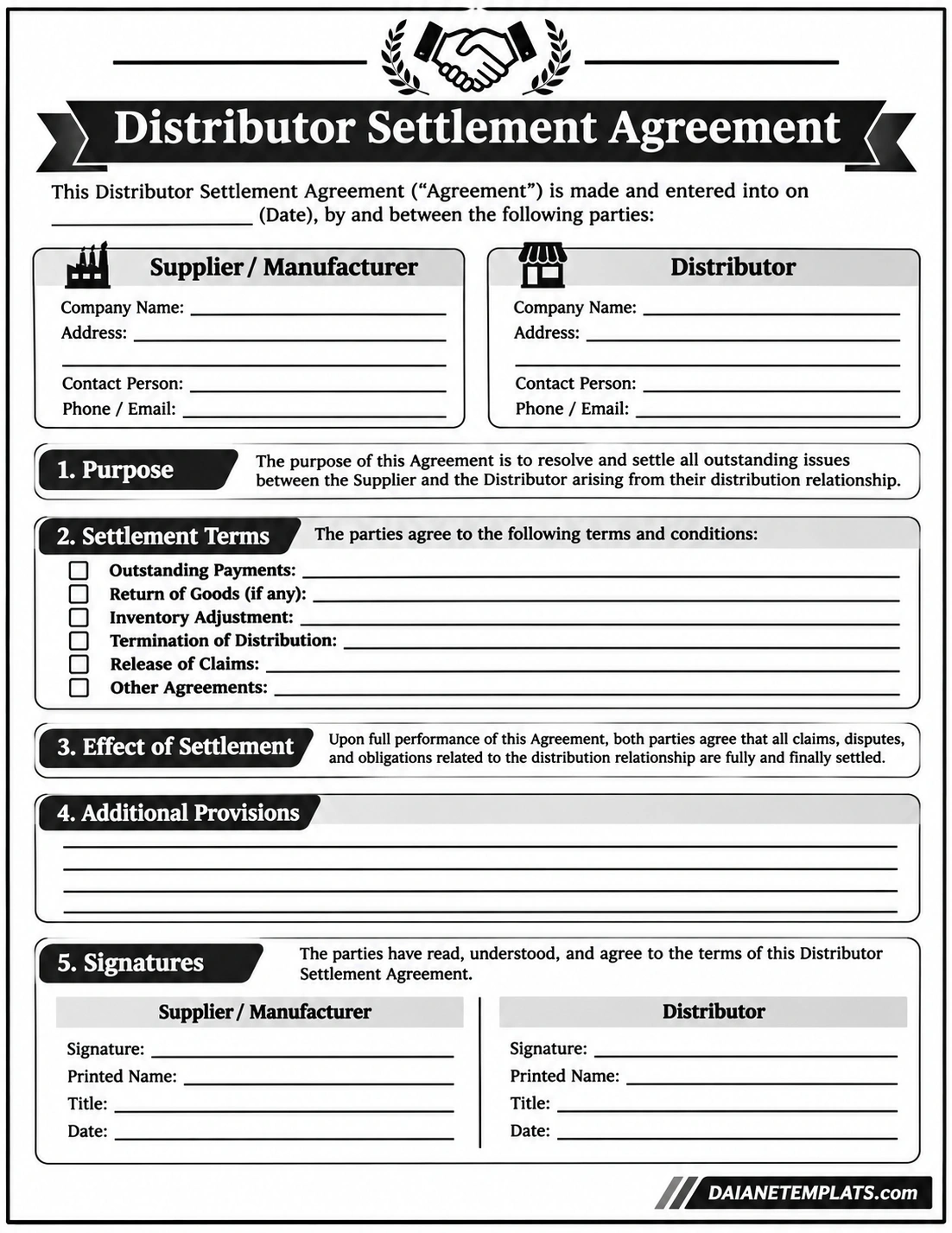
Use the template as an organizational starting point rather than assuming it is a complete legal contract. Adapt the provisions to the actual transaction, review the original distribution agreement, and check applicable legal requirements before signing.
Common Mistakes to Avoid
Even when both businesses want to resolve a dispute quickly, unclear settlement terms can create new problems. Avoid these common mistakes:
- Using vague payment terms: State the exact amount, payment deadline, and payment method.
- Ignoring remaining inventory: Document product quantities, condition, return arrangements, and deadlines.
- Failing to define the termination date: Specify when distribution rights and related permissions end.
- Using an overly broad release: Clearly identify which claims are settled and which obligations remain in effect.
- Overlooking customer and order transitions: Explain how pending orders, warranties, and customer matters will be handled.
- Forgetting confidentiality obligations: Address the handling of sensitive business information when necessary.
- Signing without proper authority: Confirm that each representative is authorized to sign for the business.
- Failing to keep supporting records: Retain signed copies, payment confirmations, return documents, and relevant correspondence.
Frequently Asked Questions About Distributor Settlement Agreements
1. What is the purpose of a distributor settlement agreement?
Its purpose is to document how a supplier and distributor will resolve outstanding issues arising from their business relationship. It may cover payments, inventory, contract termination, disputed claims, and other agreed responsibilities.
2. Is a distributor settlement agreement legally binding?
It may be legally binding if it meets the applicable requirements for contract formation and enforceability. The result depends on the wording, circumstances, and governing law. Both parties should obtain legal advice before relying on the document.
3. Is a distributor settlement agreement the same as a distribution agreement?
No. A distribution agreement generally establishes the terms of an ongoing commercial relationship, such as territory, pricing, sales responsibilities, and distribution rights. A distributor settlement agreement usually resolves disputes or outstanding obligations connected with that relationship.
4. Can a distributor settlement agreement include unpaid invoices?
Yes. It can identify outstanding invoices and state the agreed amount, payment schedule, due dates, and consequences of nonpayment. Supporting financial records should be reviewed before the parties confirm the settlement amount.
5. Can a distributor settlement agreement terminate the original contract?
Yes, if the parties clearly agree to terminate the original distribution contract and the termination terms are legally effective. The settlement should identify the original contract and specify the effective termination date and any obligations that continue afterward.
6. Should inventory returns be included in the settlement?
They should be addressed whenever either party still holds products connected with the distribution relationship. Specify eligible products, quantities, condition requirements, return deadlines, shipping responsibilities, and any agreed refund or credit.
7. Does a distributor settlement agreement need to be notarized?
Notarization requirements depend on applicable law, the type of transaction, and any specific contractual or filing requirements. Do not assume notarization is always required or never required. Check the relevant rules before signing.
8. Can the parties modify a distributor settlement agreement after signing?
Changes may be possible if the parties follow the agreement’s amendment provisions and applicable contract law. Any modification should be documented in writing and signed by authorized representatives when required.
9. Can a distributor settlement agreement include a release of liability?
It can include a release of specified claims, subject to applicable law and the parties’ intentions. The release should clearly define the claims, parties, relevant period, and any exceptions. Broad release language should be reviewed by a qualified attorney.
Conclusion
A distributor settlement agreement provides a structured way for suppliers and distributors to resolve outstanding business issues and document their final responsibilities. By addressing payments, inventory, termination, claims, confidentiality, and other relevant terms, both parties can reduce uncertainty and establish a clear path toward completing the settlement.
Before signing, review the original distribution contract, verify all financial and inventory details, and make sure every obligation is clearly written. A printable distributor settlement agreement template can help organize the process, but the final document should be tailored to the specific business relationship and reviewed under the applicable law.
Download: Distributor Settlement Agreement Template
