A marriage settlement agreement is a written agreement between spouses that outlines how certain financial, property, and personal responsibilities will be handled. Depending on the circumstances and applicable state law, it may address property ownership, debt allocation, spousal support, and other arrangements during marriage or in connection with separation or divorce.
Having important agreements in writing can help couples understand their rights and responsibilities. It can also reduce uncertainty if circumstances change or disagreements arise in the future. However, a marriage settlement agreement should be carefully prepared because its legal effect depends on the terms, timing, circumstances, and laws that apply.
In this guide, you will learn what a marriage settlement agreement means, what provisions it may include, how to prepare one, and what to review before signing. You will also find practical guidance for using a printable marriage settlement agreement template.
What Is a Marriage Settlement Agreement?
A marriage settlement agreement is a written arrangement between spouses concerning specific rights, responsibilities, or financial matters connected with their marriage. It may establish how property is owned or divided, how debts are handled, and whether one spouse will provide financial support to the other under agreed circumstances.
The exact meaning of the term is not uniform across all U.S. jurisdictions. In some situations, people use it to describe a marital agreement made during marriage. In other situations, they may use it when referring to a settlement reached as part of a separation or divorce.
Related agreements include:
- Prenuptial agreement: An agreement made before marriage that addresses financial and property matters during marriage or in the event of divorce or death.
- Postnuptial agreement: An agreement made after marriage that addresses financial or property arrangements between spouses.
- Marital settlement agreement: An agreement commonly used during separation or divorce to resolve matters such as property division, debts, and spousal support.
These documents are related, but they are not automatically interchangeable. Their purpose, legal requirements, and enforceability may differ depending on state law and the circumstances in which they are signed.
Why Do Couples Use a Marriage Settlement Agreement?
Couples may create a marriage settlement agreement to establish clear expectations and reduce uncertainty about financial responsibilities. A written agreement can be useful when spouses have different assets, business interests, financial obligations, or expectations about how property should be managed.
Clarifying Property Ownership
A marriage settlement agreement can identify which assets belong to each spouse and how certain property will be treated. This may be particularly important when one spouse owns a business, real estate, investments, or valuable personal property before marriage.
Establishing Financial Responsibilities
Spouses may use an agreement to explain how they will manage household expenses, shared debts, financial contributions, and other obligations. Clear terms can help prevent misunderstandings about who is responsible for particular payments.
Addressing Future Separation or Divorce
Some marital agreements establish how certain financial matters should be handled if the marriage ends. Depending on applicable law, provisions may address property division, debt responsibilities, and spousal support.
Protecting Business and Family Interests
When a spouse owns a business or expects to receive an inheritance, the couple may want to clarify how those interests will be treated. An agreement can document their intentions, although enforceability and the treatment of future appreciation or income depend on applicable law and the specific wording.
What Should a Marriage Settlement Agreement Include?
The contents of a marriage settlement agreement depend on the couple’s goals and the legal purpose of the document. A well-organized agreement should identify both spouses, explain the matters being addressed, and describe the responsibilities each person accepts.
1. Information About Both Spouses
Begin by identifying the parties clearly. Include accurate information so there is no confusion about who is entering into the agreement.
- Full legal name of each spouse
- Current residential or mailing address
- Date of marriage
- State and location of residence
- Date the agreement is prepared
- Relevant case information, if the agreement is connected with a pending divorce
2. Background and Purpose
This section explains why the spouses are entering into the agreement. It may describe their marital status, their intention to establish financial arrangements, or the circumstances surrounding a separation or divorce.
Use clear and factual wording. If the agreement relates to an existing divorce case, identify the relevant proceeding and original agreements where appropriate.
3. Division and Ownership of Property
Property provisions explain how assets are owned, allocated, or transferred. Depending on the agreement’s purpose, the parties may distinguish between separate property and marital or community property.
Assets that may need to be addressed include:
- Residential property and other real estate
- Bank accounts and savings
- Retirement accounts and pension benefits
- Business interests and investments
- Vehicles and other valuable assets
- Furniture, jewelry, and personal belongings
- Inheritance or gifts, where relevant
Describe important assets specifically. Include ownership details, agreed values where appropriate, and any required transfer or documentation deadlines.
4. Debts and Financial Obligations
A marriage settlement agreement may explain how spouses will handle existing and future financial obligations. These may include mortgages, vehicle loans, credit card balances, personal loans, and other liabilities.
For each obligation, identify the account or debt, the person responsible for payment, and any agreed payment arrangements. Remember that an agreement between spouses does not automatically change a lender’s rights under a loan or credit contract. Contact the creditor if an account or loan needs to be refinanced or transferred.
5. Spousal Support or Alimony
If the agreement addresses spousal support, it should explain whether payments will be made and under what conditions. Depending on the arrangement, include the payment amount, frequency, start date, duration, and circumstances that may change or end the obligation.
If the spouses intend to waive spousal support, that decision should be stated clearly and reviewed under applicable law. Support waivers can have significant financial consequences, so both parties should understand the terms before signing.
6. Children and Parenting Arrangements
If the agreement is connected with separation or divorce and the spouses have children, it may address parenting responsibilities and financial support. Relevant matters can include:
- Legal custody and decision-making responsibilities
- Physical custody or residential arrangements
- Parenting time and visitation schedules
- Holiday and school-break arrangements
- Child support and payment responsibilities
- Health insurance and medical expenses
- Education and childcare costs
Child-related provisions must comply with applicable law and may be reviewed by a court. Parents cannot necessarily make every decision binding simply by including it in a private agreement. Courts generally consider the children’s best interests when reviewing custody and parenting arrangements.
7. Additional Provisions
Depending on the situation, the agreement may include additional terms covering insurance, taxes, attorney fees, confidentiality, dispute resolution, name changes, or other responsibilities.
It may also explain how amendments must be made, which state’s law governs the agreement, and how notices should be delivered. Include only provisions that are relevant and appropriate for the parties’ circumstances.
How to Create a Marriage Settlement Agreement
Preparing a marriage settlement agreement requires careful consideration of both spouses’ financial circumstances and intentions. Follow these steps to organize the process.
Step 1: Identify the Purpose of the Agreement
Determine whether the document is intended to function as a prenuptial agreement, postnuptial agreement, or marital settlement agreement related to separation or divorce. This distinction is important because different legal rules may apply.
Step 2: Gather Financial Information
Collect relevant information about income, property, savings, investments, debts, business interests, and other financial obligations. Accurate and complete financial disclosure helps both spouses understand the arrangement they are considering.
Step 3: Discuss and Agree on the Terms
Review each issue separately and discuss the proposed arrangements. Both spouses should have enough time to ask questions, consider alternatives, and understand the potential consequences. Avoid making decisions under pressure.
Step 4: Prepare the Written Document
Organize the agreement into clear sections. Use specific descriptions, dates, amounts, and responsibilities. Avoid vague language that could lead to different interpretations later.
Step 5: Obtain Independent Legal Advice
Each spouse should have the opportunity to consult an independent family law attorney. Legal review is especially important when the agreement involves significant assets, business interests, retirement benefits, children, or a waiver of financial rights.
Step 6: Sign and Keep Copies
Follow the signing, witnessing, notarization, and other formal requirements that apply in the relevant jurisdiction. Each spouse should receive a complete copy of the signed agreement and keep supporting financial records.
Printable Marriage Settlement Agreement Template
A printable marriage settlement agreement template can help spouses organize their proposed terms in one document. It provides a convenient starting point for recording personal information, property arrangements, financial responsibilities, additional provisions, and signatures.
A blank form can also help couples identify which matters have already been discussed and which still need attention. However, a general template may not include every provision required for a specific type of marital agreement or under a particular state’s laws.
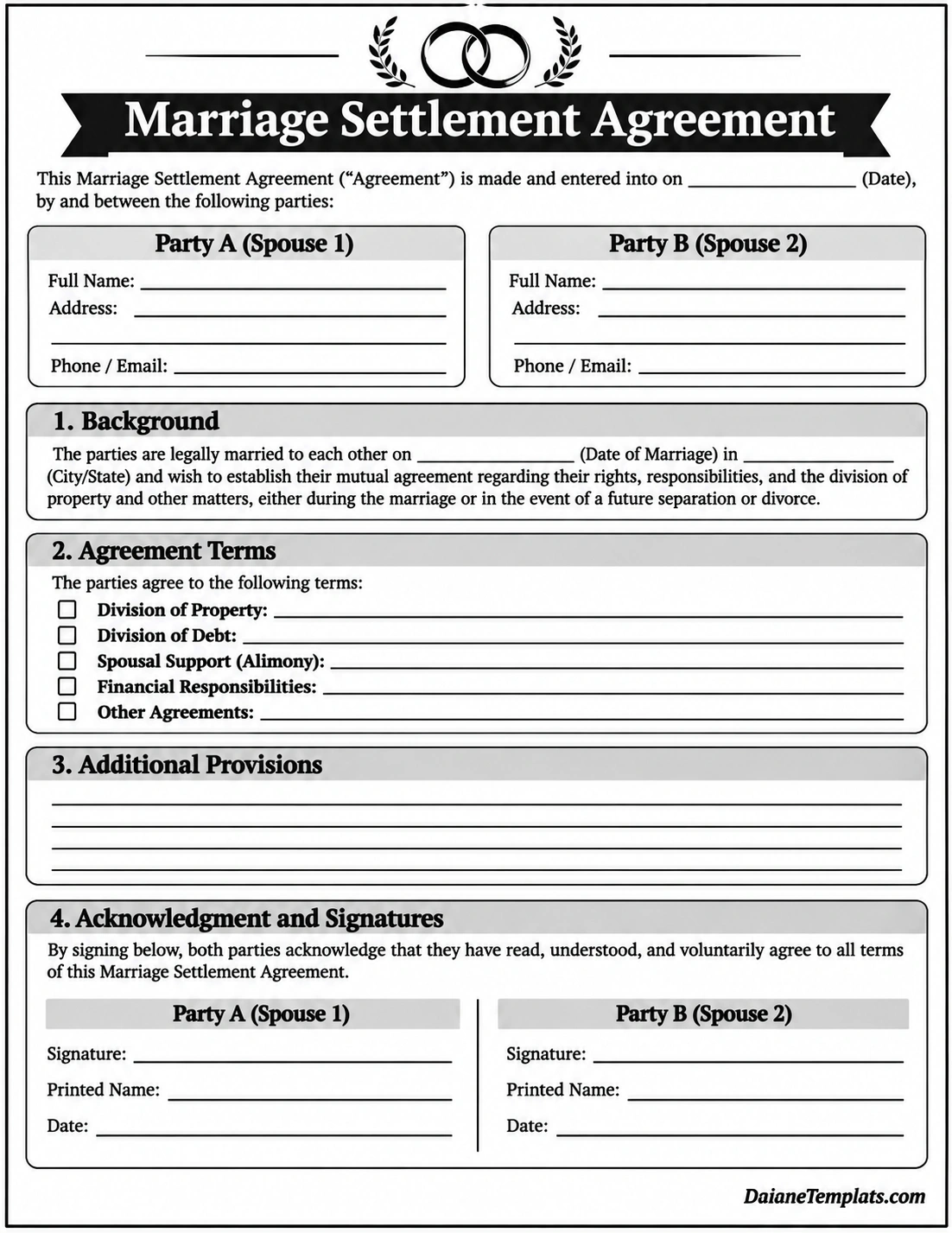
Before using a printable marriage settlement agreement form, confirm that it matches the purpose of your agreement. A form designed for a general marital arrangement may not be suitable for a divorce settlement or a prenuptial agreement. Adapt the document to the circumstances and obtain legal review before signing.
Common Mistakes to Avoid
Even when both spouses agree on the general arrangement, small omissions can create significant problems. Review the following issues before finalizing the document.
- Using the wrong type of agreement: Confirm whether you need a prenuptial, postnuptial, or divorce-related marital settlement agreement.
- Leaving property descriptions incomplete: Identify important assets clearly and explain how they will be treated.
- Failing to disclose financial information: Incomplete disclosure may affect the agreement’s enforceability.
- Ignoring existing debts: State how each relevant obligation will be handled and check lender requirements.
- Using unclear support provisions: Specify payment amounts, timing, duration, and relevant conditions.
- Signing under pressure: Both spouses should have adequate time and a voluntary opportunity to review the document.
- Ignoring state-specific requirements: Execution and enforceability rules can differ by jurisdiction.
- Not obtaining legal advice: Independent review can help each spouse understand the rights and obligations involved.
Frequently Asked Questions About Marriage Settlement Agreements
1. What is the purpose of a marriage settlement agreement?
A marriage settlement agreement documents arrangements between spouses concerning property, financial responsibilities, debts, support, or other marital matters. Its specific purpose depends on whether it is made before marriage, during marriage, or as part of a separation or divorce.
2. Is a marriage settlement agreement legally binding?
It may be legally binding if it satisfies the applicable legal requirements. Enforceability can depend on financial disclosure, voluntary consent, proper execution, fairness considerations, and state law. A signed document is not automatically enforceable in every situation.
3. Is a marriage settlement agreement the same as a prenuptial agreement?
Not necessarily. A prenuptial agreement is specifically made before marriage. The term marriage settlement agreement may be used more broadly for certain arrangements between spouses, including agreements made during marriage or in connection with divorce. The document’s timing and purpose determine which rules may apply.
4. Is a marriage settlement agreement the same as a divorce settlement agreement?
They may overlap, but the terms are not always identical. A divorce or marital settlement agreement generally resolves issues arising from the end of a marriage, such as property division, debts, custody, and support. A broader marital agreement may address financial arrangements while the marriage continues.
5. Can spouses create a marriage settlement agreement without a lawyer?
Spouses may be able to prepare a written agreement themselves, depending on the type of agreement and applicable law. However, independent legal advice is strongly recommended because the document may affect important financial and property rights.
6. Does a marriage settlement agreement need to be notarized?
Notarization requirements vary depending on the jurisdiction and type of agreement. Some agreements require notarized signatures or other formalities, while others may have different execution requirements. Check local law before signing.
7. Can a marriage settlement agreement be changed after signing?
Changes may be possible if the agreement and applicable law allow them. Amendments generally need to follow the required formalities and should be documented in writing. A court-approved divorce order may require a separate legal process to modify.
8. Can a marriage settlement agreement address property acquired before marriage?
Yes. A marital agreement may address how premarital property will be treated, subject to applicable law. The spouses should identify the assets clearly and explain whether ownership, income, appreciation, or other interests are covered.
9. Can a marriage settlement agreement include child custody and child support?
An agreement connected with separation or divorce may include proposed parenting and child support arrangements. However, these provisions are subject to applicable law and court review. The children’s best interests remain an important consideration.
Conclusion
A marriage settlement agreement can help spouses document important arrangements involving property, debts, financial responsibilities, and other marital matters. When the terms are clear and properly prepared, the agreement can provide a useful record of each spouse’s rights and obligations.
Start by identifying the purpose of the agreement, gathering accurate financial information, and discussing the proposed terms carefully. Use a printable marriage settlement agreement template as an organizational starting point, not as a substitute for legal advice. Before signing, make sure the document reflects both spouses’ intentions and complies with the laws that apply to their situation.
Download: Marriage Settlement Agreement Template
