A parenting agreement is a written plan that explains how separated or divorced parents will share responsibilities and make decisions about raising their child. It helps establish clear expectations for parenting time, living arrangements, education, healthcare, communication, and child-related expenses. A well-prepared agreement can reduce misunderstandings and provide children with greater stability as family circumstances change.
Whether you are preparing for separation, working through a divorce, or updating an existing co-parenting arrangement, a parenting agreement can help both parents focus on their child’s needs. It provides a practical framework for handling everyday schedules, major decisions, holidays, and unexpected changes.
In this guide, you will learn what a parenting agreement should include, how to create one, and which issues parents should discuss before finalizing the plan. You will also find a sample structure, practical tips, and frequently asked questions to help you prepare a clear and child-focused agreement.
What Is a Parenting Agreement?
A parenting agreement is a written arrangement that describes how parents will care for their child when they live separately. It outlines each parent’s responsibilities and explains how they will coordinate daily care, parenting time, and important decisions.
The agreement may be created voluntarily by the parents, with assistance from a mediator, or as part of a divorce or family-law process. Depending on the jurisdiction and how the agreement is finalized, it may be an informal written plan or part of a legally recognized parenting or custody order.
A parenting agreement is sometimes called a co-parenting agreement, parenting plan, or custody agreement. These terms can have different legal meanings depending on local law, so parents should confirm which document is appropriate for their circumstances.
Why Is a Parenting Agreement Important?
A clear parenting agreement can make co-parenting more predictable and reduce disagreements about everyday responsibilities. It also gives both parents a shared reference point when making decisions that affect their child.
1. Provides Stability for the Child
Children often benefit from predictable routines and clear expectations. A parenting plan can establish regular schedules for school days, weekends, holidays, transportation, and transitions between households.
2. Clarifies Each Parent’s Responsibilities
When responsibilities are clearly defined, parents can better understand who handles school communication, medical appointments, extracurricular activities, transportation, and other practical matters.
3. Reduces Misunderstandings
Written arrangements help prevent disagreements caused by different assumptions. For example, specifying pickup times, exchange locations, and procedures for schedule changes can make transitions easier to manage.
4. Supports Better Decision-Making
A parenting agreement can explain how parents will make major decisions about education, healthcare, and other important aspects of their child’s upbringing. It can also establish a process for resolving disagreements.
5. Encourages Constructive Communication
Agreeing on communication methods and response expectations can help parents exchange necessary information without involving the child in adult disputes.
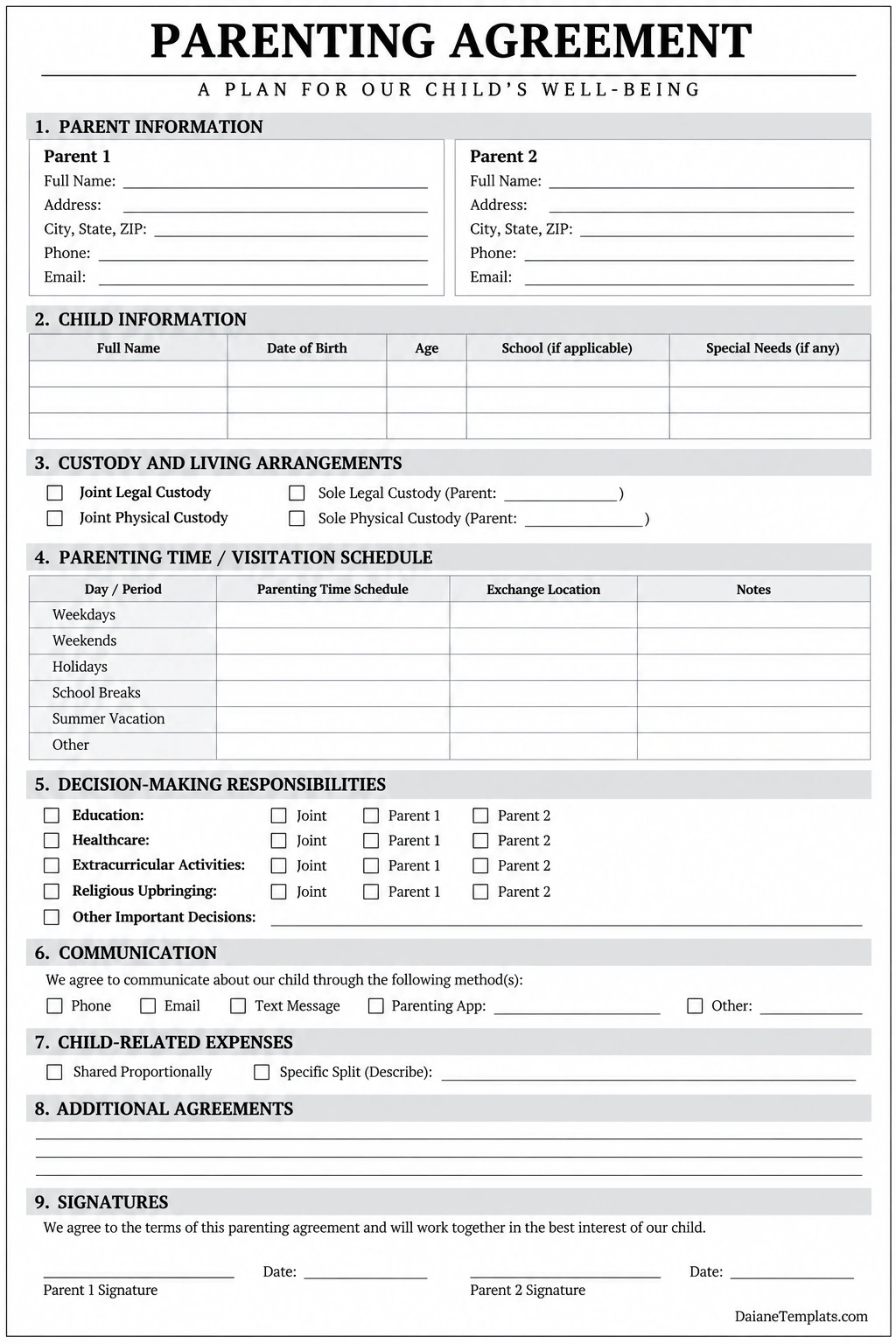
What Should a Parenting Agreement Include?
Every family has different needs, so the details should reflect the child’s age, school schedule, health needs, family circumstances, and applicable legal requirements. Consider including the following sections.
Parent and Child Information
List each parent’s name and contact details, along with the child’s name and relevant identifying information. If there are multiple children, clarify whether the same arrangements apply to all children or whether individual schedules are needed.
Legal and Physical Custody Arrangements
Where applicable, explain how legal decision-making authority and physical care arrangements will work. Legal custody generally concerns major decisions, while physical custody or parenting time concerns where the child lives and spends time. The terminology and legal definitions vary by jurisdiction.
Parenting Time Schedule
Set out the regular schedule for weekdays, weekends, school breaks, and other periods. Include clear start and end times, pickup and drop-off arrangements, and a process for handling delays or changes.
Holiday and Vacation Arrangements
Specify how holidays, birthdays, school vacations, and other important occasions will be shared. Parents may alternate certain holidays each year or establish a schedule that reflects family traditions and the child’s needs.
Education and Healthcare Decisions
Explain how parents will handle school enrollment, educational support, medical appointments, treatment decisions, and access to important records. Clarify which decisions require consultation or joint agreement, subject to any existing legal order.
Communication Between Parents
Identify acceptable communication methods, such as email, text messages, phone calls, or a co-parenting application. Parents may also agree on reasonable response times and how urgent matters should be communicated.
Communication Between Parent and Child
When appropriate, describe how the child can maintain contact with the other parent during parenting time. Any arrangements should be age-appropriate and consistent with the child’s safety, privacy, and established legal requirements.
Child-Related Expenses
Clarify how parents will handle expenses such as school supplies, childcare, extracurricular activities, medical costs, and transportation. The agreement should distinguish shared expenses from obligations already addressed by a child support order or applicable law.
Dispute Resolution and Plan Updates
Include a process for discussing disagreements and reviewing the agreement as the child’s needs change. Some parents use mediation or professional assistance when they cannot reach an agreement independently.
How to Create a Parenting Agreement Step by Step
Creating a parenting agreement requires practical planning and a willingness to prioritize the child’s well-being. The following steps can help parents develop a more complete and workable arrangement.
Step 1: Identify the Child’s Needs
Consider the child’s age, school commitments, medical needs, activities, friendships, and daily routines. Younger children may need different transition arrangements from teenagers, while children with additional support needs may require more detailed planning.
Step 2: Discuss Parenting Responsibilities
Review how each parent will handle everyday care, school communication, appointments, transportation, and extracurricular activities. Focus on responsibilities that must be coordinated rather than assuming one parent will automatically manage every task.
Step 3: Develop a Realistic Schedule
Create a parenting time schedule that accounts for work hours, school locations, travel distances, and the child’s routine. A schedule should be specific enough to reduce confusion but flexible enough to address reasonable changes.
Step 4: Establish Decision-Making Rules
Determine how major decisions will be made and what information each parent should share before a decision is reached. Clarify how urgent decisions will be handled and what happens when parents disagree.
Step 5: Agree on Communication Methods
Choose a reliable way to share school updates, health information, schedule changes, and expense records. Keep messages respectful and focused on the child rather than past relationship conflicts.
Step 6: Address Expenses Clearly
Document how parents will discuss, approve, share, and reimburse child-related expenses. Include any relevant limits, receipts, payment deadlines, or procedures for unexpected costs. Ensure that the arrangement is consistent with applicable child support rules and court orders.
Step 7: Review the Complete Agreement
Read the entire document together, checking for vague language, conflicting schedules, and missing responsibilities. Make sure both parents understand the terms and can realistically follow them.
Step 8: Confirm Legal Requirements
Before signing or relying on the agreement, check the requirements in your jurisdiction. A court may need to review or approve certain parenting arrangements, especially when the agreement is connected to a divorce or custody proceeding. Consider consulting a qualified family-law professional.
Parenting Agreement Sample
The following sample provides a general structure for a written co-parenting agreement. It is an informational example, not a jurisdiction-specific legal document. Adapt the terms to your circumstances and obtain legal advice where appropriate.
Sample Co-Parenting Agreement
1. Parent Information
Parent 1: [Full Name]
Parent 2: [Full Name]
2. Child Information
Child’s Name: [Full Name]
Date of Birth: [Date]
3. Purpose
The parents intend to cooperate in supporting their child’s health, education, safety, and overall well-being. This agreement describes their proposed parenting responsibilities and arrangements.
4. Parenting Time
The regular parenting schedule will be as follows: [Describe weekdays, weekends, exchange times, and locations]. Changes to the schedule will be communicated as early as reasonably possible and handled in accordance with any applicable court order.
5. Major Decisions
The parents will follow the applicable custody order and agree on a process for making decisions concerning education, healthcare, and other major matters. Any required consultation or joint decision-making will be handled according to applicable law.
6. Communication
The parents will communicate about the child’s needs through [agreed method]. They will share important school, medical, and schedule information in a timely and respectful manner.
7. Child-Related Expenses
The parents will handle eligible child-related expenses according to [agreed arrangement], subject to any existing child support order and applicable law.
8. Dispute Resolution and Review
If a disagreement arises, the parents will attempt to discuss the issue constructively and consider mediation or other appropriate assistance when necessary. They will review the agreement when significant changes in the child’s needs or circumstances occur.
9. Signatures
Parent 1 Signature: ____________________ Date: __________
Parent 2 Signature: ____________________ Date: __________
Important: This sample does not guarantee legal enforceability. Existing court orders and local family law may control the required terms, approval process, and available remedies.
Tips for Making a Parenting Agreement Work
A written agreement is most useful when it is clear, realistic, and focused on the child’s needs. Consider these practical tips before finalizing your plan.
- Be specific: Include exact times, locations, responsibilities, and procedures rather than relying on vague phrases.
- Prioritize the child: Evaluate arrangements according to the child’s safety, development, stability, and individual needs.
- Keep communication respectful: Use neutral language and avoid involving the child in parental disagreements.
- Plan for changes: Establish a process for illness, travel delays, school events, and schedule adjustments.
- Document important decisions: Keep written records of agreed changes and relevant child-related information.
- Respect privacy: Share sensitive information only with appropriate people and through suitable channels.
- Review the arrangement periodically: Children’s needs change as they grow, so schedules and responsibilities may need updating.
- Seek professional support when needed: Mediation, legal advice, or qualified family support may help when discussions become difficult.
Common Parenting Agreement Mistakes to Avoid
Some agreements create additional conflict because they leave important details unclear or fail to account for changing circumstances.
- Using vague scheduling terms: Specify dates, times, exchange locations, and procedures for changes.
- Ignoring holidays and school breaks: Include a plan for special occasions and vacation periods.
- Leaving decision-making unclear: Explain how parents will handle major decisions and disagreements.
- Overlooking expenses: Address how additional costs will be communicated, approved, and documented.
- Using the child as a messenger: Parents should communicate directly about adult responsibilities whenever appropriate.
- Failing to check legal requirements: A generic template may not satisfy local law or an existing court order.
- Making unrealistic commitments: Create arrangements that reflect actual schedules, resources, and practical limitations.
Frequently Asked Questions About Parenting Agreements
What is the purpose of a parenting agreement?
A parenting agreement explains how parents will share parenting responsibilities after separation or divorce. It can cover parenting time, decision-making, communication, expenses, and other arrangements that support the child’s well-being.
Is a parenting agreement legally binding?
Its legal status depends on local law, how it was created, and whether court approval is required or has been obtained. A privately signed document may not have the same legal effect as an approved court order. Consult a qualified family-law professional for advice about your situation.
What is the difference between a parenting agreement and a custody agreement?
The terms can overlap. A custody agreement often focuses on custody and parenting time, while a parenting agreement or parenting plan may also address communication, expenses, decision-making, and other practical co-parenting responsibilities. Legal terminology varies by jurisdiction.
Can parents create a parenting agreement without going to court?
In some circumstances, parents can negotiate a written agreement privately or with a mediator. However, court approval may be required for certain arrangements, and existing orders must be followed unless properly changed. Check the rules that apply to your case.
What happens if one parent does not follow the agreement?
The available options depend on whether the document is informal, legally enforceable, or part of a court order. Parents may begin by documenting the issue and attempting to resolve it through the agreed process. If the dispute continues, legal advice may help clarify the appropriate next steps.
Can a parenting agreement be changed later?
Yes, arrangements may need to change as a child grows or family circumstances shift. Parents can discuss proposed changes and document mutually agreed updates. If a court order governs the arrangement, formal approval or a court modification may be necessary.
Should a parenting agreement include child support?
It may address how parents will handle child-related expenses, but child support is often governed by separate legal rules or orders. Any financial terms should comply with applicable law and should not conflict with an existing order.
Do parents need a lawyer to write a parenting agreement?
Not every family is required to use a lawyer, but legal guidance can help clarify rights, obligations, and local requirements. Professional advice is especially valuable when parents disagree, safety concerns exist, or the agreement will be submitted to a court.
Conclusion
A parenting agreement provides a structured way for separated or divorced parents to coordinate responsibilities and make decisions about their child’s upbringing. By clarifying parenting schedules, decision-making, communication, and expenses, parents can reduce misunderstandings and create more predictable routines.
Start by identifying your child’s needs, discussing practical responsibilities, and writing clear terms that both parents can understand. Review the agreement as circumstances change, follow any existing court orders, and confirm the applicable legal requirements before relying on the document. A thoughtful, child-focused plan can support more cooperative co-parenting and greater stability for the family.
Download: Parenting Agreement Template
