A personal guarantee is an agreement in which an individual agrees to become personally responsible for another party’s debt or financial obligation if that party fails to meet its obligations. It is commonly used when a lender or creditor wants additional protection before extending credit or financing to a business.
For businesses with limited credit history, insufficient collateral, or a relatively new operating history, a personal guarantee may make it easier to obtain financing or favorable credit terms. The lender receives additional assurance because the guarantor may become personally liable if the primary borrower defaults.
However, signing a personal guarantee can create significant financial responsibility for the guarantor. Before signing one, it is important to understand the guaranteed obligations, the scope of liability, the duration of the guarantee, and the circumstances that could trigger enforcement.
This guide explains what a personal guarantee is, how it works, what it commonly includes, its advantages and risks, and what to review before signing a personal guarantee agreement.
What Is a Personal Guarantee?
A personal guarantee is a contractual promise made by an individual to satisfy specified obligations of another party if that party fails to do so. The primary borrower may be a business, organization, or another legal entity, while the guarantor is an individual who accepts personal responsibility under the agreement.
For example, a business may apply for a loan but have limited assets or credit history. The lender may require the business owner or another individual to provide a personal guarantee. If the business does not repay the debt as required, the lender may have rights against the guarantor according to the terms of the guarantee and applicable law.
The exact rights and responsibilities depend on the written agreement and the laws governing it. A personal guarantee should therefore be reviewed carefully before it is signed.
How Does a Personal Guarantee Work?
A personal guarantee typically connects three parties: the borrower, the lender or creditor, and the guarantor.
- Borrower: The individual or business primarily responsible for the debt or obligation.
- Lender or creditor: The party providing financing, credit, goods, services, or another form of credit.
- Guarantor: The individual who agrees to provide additional assurance that the borrower’s obligations will be satisfied.
The borrower remains primarily responsible for the debt. However, the guarantor accepts an additional obligation that may become enforceable if the borrower defaults or another triggering event occurs.
The agreement should clearly describe when the guarantor’s responsibility begins, what obligations are covered, and how long the guarantee remains effective.
Why Do Lenders Require a Personal Guarantee?
Lenders generally want to reduce the risk associated with extending credit. A business may have limited assets, a short operating history, or insufficient credit information. A personal guarantee can provide an additional layer of protection.
Limited Business Credit History
A new business may not have a long record of borrowing and repayment. A personal guarantee can give the lender additional confidence when evaluating the credit application.
Insufficient Collateral
Some businesses do not have enough assets to satisfy a lender’s collateral requirements. A personal guarantee may provide another form of security for the creditor.
Higher Credit Risk
If a lender considers a borrower to have a higher level of credit risk, it may require additional assurances before approving financing or extending credit.
Business Financing
Personal guarantees are commonly associated with certain small-business loans, lines of credit, leases, vendor accounts, and other commercial arrangements. The requirements vary between lenders and transactions.
Personal Guarantee Template
A personal guarantee template can provide a structured starting point for documenting the relationship between a borrower, lender, and guarantor. A typical template may contain information about the parties, guaranteed obligations, duration, governing law, and signatures.
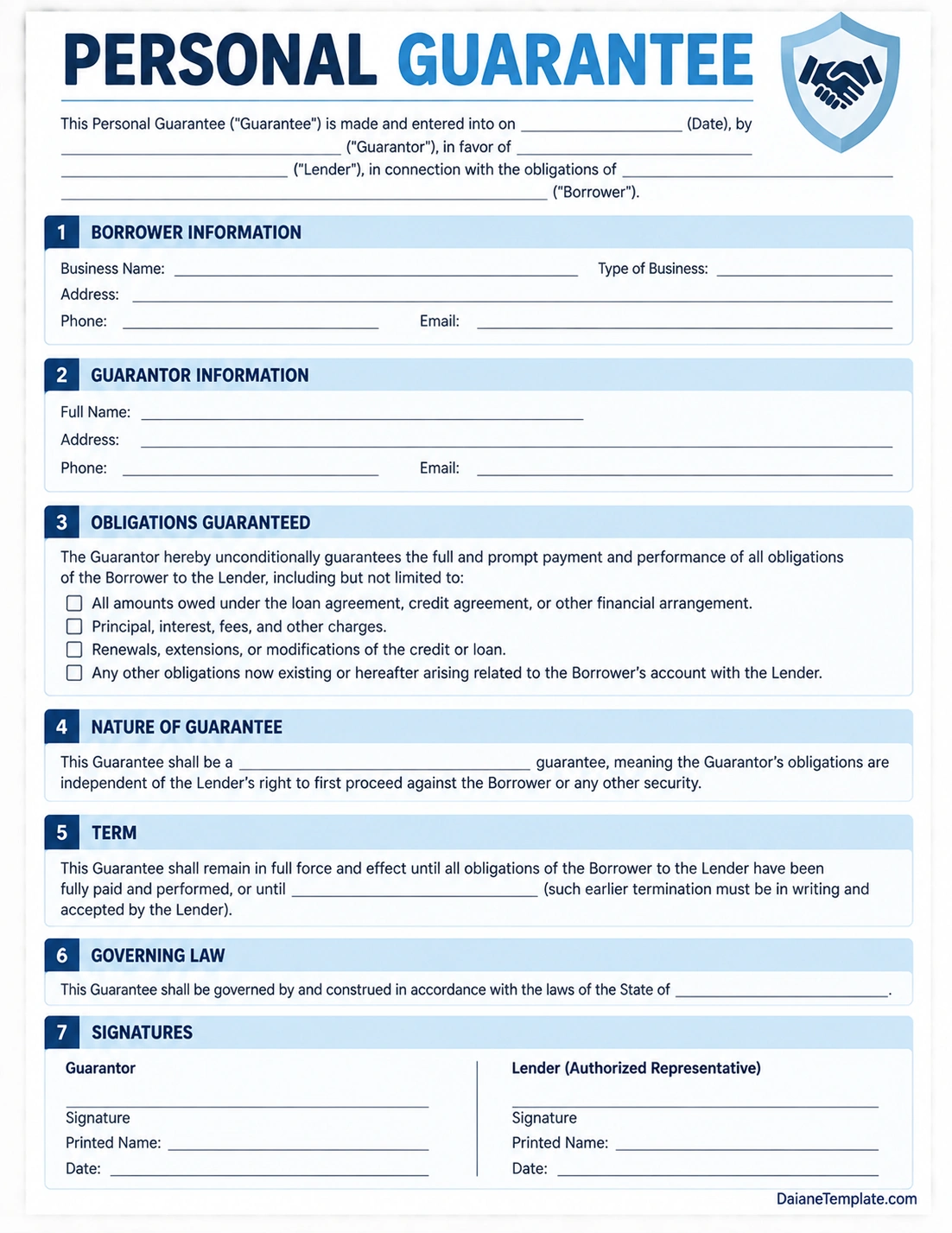
What Should a Personal Guarantee Include?
The contents of a personal guarantee depend on the transaction and applicable law. A carefully drafted agreement should clearly identify the parties and define the guarantor’s responsibilities.
1. Guarantor Information
The agreement should identify the individual providing the guarantee. This may include the guarantor’s legal name, address, and other identifying or contact information required by the parties.
2. Borrower Information
The borrower should be clearly identified, particularly when the borrower is a business or other legal entity. The agreement may include the business’s legal name and address.
3. Lender or Creditor Information
The lender or creditor should also be identified. This establishes who receives the benefit of the guarantee and who may have rights under the agreement.
4. Guaranteed Obligations
The agreement should specify which obligations are covered. These may include principal, interest, fees, expenses, or other amounts, depending on the underlying transaction.
5. Scope of Liability
One of the most important provisions is the extent of the guarantor’s liability. The guarantee may be limited to a specific amount or obligation, or it may cover broader obligations described in the agreement.
6. Duration
The agreement should explain when the guarantee begins and when it ends. Some guarantees apply to a specific transaction, while others may remain effective for a defined period or until certain obligations are fully satisfied.
7. Default and Enforcement
The agreement may describe what happens if the borrower fails to meet its obligations. The specific enforcement rights depend on the agreement and applicable law.
8. Governing Law
A personal guarantee may identify the state or jurisdiction whose laws govern the agreement. This provision can be important when the parties are located in different jurisdictions.
9. Signatures
The guarantor and other required parties should sign the agreement according to the applicable requirements. The agreement may also include dates and other execution details.
Types of Personal Guarantees
Personal guarantees can take different forms depending on the underlying transaction and the terms negotiated between the parties.
Limited Personal Guarantee
A limited guarantee restricts the guarantor’s responsibility in some way. The limitation may relate to a maximum dollar amount, a specific portion of the debt, a defined period, or particular obligations.
Unlimited Personal Guarantee
An unlimited guarantee may expose the guarantor to a broader range of obligations described in the agreement. The guarantor may be responsible for more than the original principal depending on applicable terms, such as interest, fees, or enforcement costs.
Continuing Personal Guarantee
A continuing guarantee may apply to multiple transactions or future obligations between the borrower and creditor. The exact scope should be reviewed carefully because the guarantor’s responsibility may extend beyond one original transaction.
Personal Guarantee vs. Business Guarantee
A personal guarantee involves an individual accepting responsibility for another party’s obligations. A business guarantee, by contrast, may involve one business entity guaranteeing the obligations of another entity.
The key distinction is who provides the guarantee and whose assets may potentially be exposed if the guaranteed obligations are not satisfied. A personal guarantee can create a direct financial risk for the individual guarantor.
Personal Guarantee vs. Collateral
A personal guarantee and collateral provide different forms of protection to a lender.
Collateral generally involves a specific asset that secures an obligation. Depending on the agreement and applicable law, the creditor may have rights in that asset if the borrower defaults.
Personal guarantee involves a person’s contractual promise to satisfy specified obligations. It does not necessarily identify a particular asset as security, although enforcement of a valid obligation may potentially affect the guarantor’s personal assets depending on applicable law and circumstances.
Advantages of a Personal Guarantee
A personal guarantee can provide benefits to both borrowers and lenders when used appropriately.
- Improves access to financing: A guarantee may help a business qualify for credit when its own financial history is limited.
- Provides additional lender protection: The lender receives an additional contractual commitment from an individual.
- May support new businesses: Owners of newer businesses may use a guarantee to strengthen a financing application.
- Can help negotiate credit terms: In some situations, additional security may support discussions about financing or payment arrangements.
- Clarifies responsibilities: A written agreement establishes the parties’ respective obligations and expectations.
Risks of Signing a Personal Guarantee
The primary risk is that the guarantor may become personally responsible for obligations that the borrower fails to satisfy. This can create significant financial exposure.
Personal Assets May Be at Risk
Depending on the agreement, enforcement process, and applicable law, a guarantor’s personal assets may potentially be exposed to collection efforts if the guaranteed obligation is not paid.
The Borrower’s Default Can Affect the Guarantor
The guarantor may have no control over the borrower’s financial decisions. Even if the guarantor is not involved in the day-to-day operation of the business, the guarantee may still create financial responsibility.
Liability May Be Broader Than Expected
A guarantee can sometimes cover interest, fees, costs, renewals, or other obligations in addition to the original principal. The exact language should be reviewed before signing.
Future Transactions May Be Covered
A continuing guarantee may extend to future obligations. Do not assume that a guarantee applies only to the original transaction without reviewing its terms.
What to Review Before Signing a Personal Guarantee
Because a personal guarantee can create substantial obligations, the guarantor should carefully review the document before signing it.
- Identify the exact borrower and creditor.
- Confirm which debt or obligations are guaranteed.
- Check whether there is a maximum liability amount.
- Review whether interest, fees, and collection costs are included.
- Determine whether the guarantee is limited or unlimited.
- Check whether the guarantee is continuing.
- Review the start date and termination conditions.
- Understand what constitutes a default.
- Review the creditor’s enforcement rights.
- Check the governing law and dispute provisions.
- Keep a complete copy of the signed agreement.
If the financial exposure is significant, consider having the agreement reviewed by a qualified attorney before signing. Legal consequences can vary considerably depending on the wording of the guarantee and the applicable jurisdiction.
How to Create a Personal Guarantee Agreement
Identify All Parties
Begin by clearly identifying the borrower, lender or creditor, and guarantor. Use the parties’ correct legal names where appropriate.
Describe the Underlying Obligation
Explain the loan, credit arrangement, lease, purchase agreement, or other obligation that the guarantee relates to. Avoid vague descriptions that could create uncertainty about what is covered.
Define the Guarantee
State the guarantor’s promise and clearly describe the obligations covered by the guarantee.
Define the Limits
If the guarantee is intended to be limited, clearly identify the applicable amount, obligations, time period, or other restrictions.
Include Termination Provisions
Explain when the guarantee ends or what conditions must occur before the guarantor is released from future obligations.
Add Governing Law and Signatures
Include applicable governing-law provisions and the necessary signature fields. Each party should understand the document before signing it.
Tips for Using a Personal Guarantee Template
- Start with a reliable structure: Use a template to organize the main sections of the agreement.
- Customize the details: Replace generic fields with accurate party and transaction information.
- Define liability clearly: Make the scope of the guarantee easy to identify.
- Do not overlook future obligations: Check whether the guarantee covers renewals or additional credit.
- Review every clause: Do not sign simply because the document appears standard.
- Keep signed copies: Store the final agreement and related documents securely.
- Obtain legal advice when appropriate: Professional review can be especially important for substantial financial commitments.
Common Mistakes to Avoid
Signing Without Understanding the Liability
A guarantor should understand the potential financial exposure before agreeing to the guarantee. Never assume that personal responsibility is limited unless the written agreement clearly says so.
Ignoring the Fine Print
Definitions, payment terms, default provisions, fees, and termination clauses can materially affect the guarantor’s obligations.
Assuming the Guarantee Ends Automatically
Some guarantees may continue until specific conditions are met. Review the termination language rather than assuming that repayment of one installment or one transaction automatically releases the guarantor.
Failing to Keep Documentation
Keep copies of the signed guarantee, underlying agreement, amendments, notices, and relevant payment records. Organized documentation can be valuable if questions arise later.
Frequently Asked Questions About Personal Guarantees
What is a personal guarantee?
A personal guarantee is an agreement in which an individual promises to be responsible for specified obligations of another party if that party fails to satisfy them, subject to the terms of the agreement and applicable law.
Why would a business need a personal guarantee?
A business may be asked to provide a personal guarantee when it has limited credit history, insufficient collateral, or other factors that increase the lender’s perceived risk. The guarantee provides an additional layer of protection for the creditor.
Who can provide a personal guarantee?
An individual who is legally able to enter into the agreement may potentially act as a guarantor. Lenders often request guarantees from business owners, directors, or other individuals with a financial relationship to the borrower.
Does a personal guarantee affect personal assets?
Potentially. If the borrower defaults and the guarantee is enforceable, the guarantor may face personal liability. The extent of that liability depends on the agreement, enforcement process, and applicable law.
Can a personal guarantee be limited?
Yes. Depending on the transaction, a guarantee may be limited by amount, duration, transaction, or type of obligation. Any limitation should be clearly stated in the written agreement.
What is the difference between a guarantor and a borrower?
The borrower is primarily responsible for the debt or obligation. The guarantor provides an additional contractual promise to satisfy specified obligations if the borrower fails to do so, subject to the terms of the guarantee.
Can a personal guarantee cover future debt?
It can, depending on the agreement. A continuing guarantee may cover future transactions or obligations. This is why guarantors should carefully review provisions concerning renewals, additional credit, and future obligations.
Should I sign a personal guarantee?
That depends on the specific transaction and your willingness to accept the potential financial risk. Before signing, review the scope of liability, termination provisions, default conditions, and applicable law. For significant commitments, consider obtaining independent legal advice.
Can I use a personal guarantee template?
A template can help organize common sections and provide a starting point for drafting. However, a template should be adapted to the specific transaction and reviewed for compliance with applicable legal requirements.
Is a personal guarantee legally binding?
A properly formed personal guarantee may create legally enforceable obligations, but enforceability depends on the agreement, applicable law, and specific circumstances. Professional legal advice is appropriate when the potential liability is significant.
Conclusion
A personal guarantee provides a lender or creditor with an additional layer of protection by allowing an individual to accept responsibility for specified obligations of a borrower. It can help businesses with limited credit history or collateral obtain financing or credit that might otherwise be more difficult to secure.
At the same time, a personal guarantee can expose the guarantor to significant financial risk. Before signing, carefully review the guaranteed obligations, liability limits, duration, default provisions, enforcement rights, and termination conditions.
A well-organized personal guarantee template can help structure the agreement, but it should not be treated as a substitute for legal advice. When substantial personal liability is involved, having the final agreement reviewed by a qualified attorney can help ensure that the guarantor understands the commitment before signing.
Disclaimer: This article provides general educational information about personal guarantees and is not legal advice. Laws and enforceability requirements vary by jurisdiction and individual circumstances. Consult a qualified attorney for advice about a specific personal guarantee agreement.
Download: Personal Guarantee Template
