A spelling test is a simple but effective way to help students improve their spelling, recognize word patterns, and develop stronger writing skills. Whether used in an elementary classroom, at home, or during independent study, a spelling test gives learners an opportunity to practice writing words correctly and demonstrate what they have learned.
Teachers and parents can use a spelling test worksheet to make assessments more organized and consistent. With clearly numbered answer spaces, student information fields, and enough room for writing, a printable spelling test makes it easier to evaluate progress and identify words that need additional practice.
In this guide, you will learn what a spelling test is, how it works, what to include in a test paper, and how to use printable spelling worksheets effectively. You will also find practical ideas for creating engaging spelling activities for different learning levels.
What Is a Spelling Test?
A spelling test is an assessment in which students listen to words spoken by a teacher, parent, or instructor and write each word correctly on a sheet of paper. It measures a student’s ability to recognize sounds, remember letter combinations, and apply spelling rules.
A spelling test worksheet, also called a spelling test paper, is a blank or structured sheet that students use to record their answers. Most worksheets include numbered lines or boxes where learners can write each dictated word.
Spelling tests are commonly used in elementary schools, but they can also benefit older students and English language learners. Regular practice helps students become more familiar with vocabulary, improve written communication, and build confidence when writing independently.
What Should a Spelling Test Worksheet Include?
A good spelling test worksheet should be simple, easy to read, and practical for classroom use. Its layout should give students enough room to write without unnecessary distractions.
Here are the most useful elements to include in a printable spelling test:
- Worksheet title: A clear heading such as Spelling Test or Weekly Spelling Test.
- Student name: A designated space for the student’s full name.
- Date: A field to record when the assessment takes place.
- Grade or class: An optional section for identifying the student’s learning level.
- Numbered answer spaces: Clearly numbered lines or boxes for each spelling word.
- Score section: A space for recording the final result.
- Teacher comments: An optional area for feedback and improvement suggestions.
For younger learners, larger writing spaces and fewer questions may be more appropriate. Older students can work with longer word lists and more challenging vocabulary.
Free Printable Spelling Test Templates
Using a printable spelling test template can save preparation time while providing a consistent format for classroom assessments. Different worksheet layouts can serve different teaching purposes, from traditional dictation tests to more comprehensive spelling practice activities.
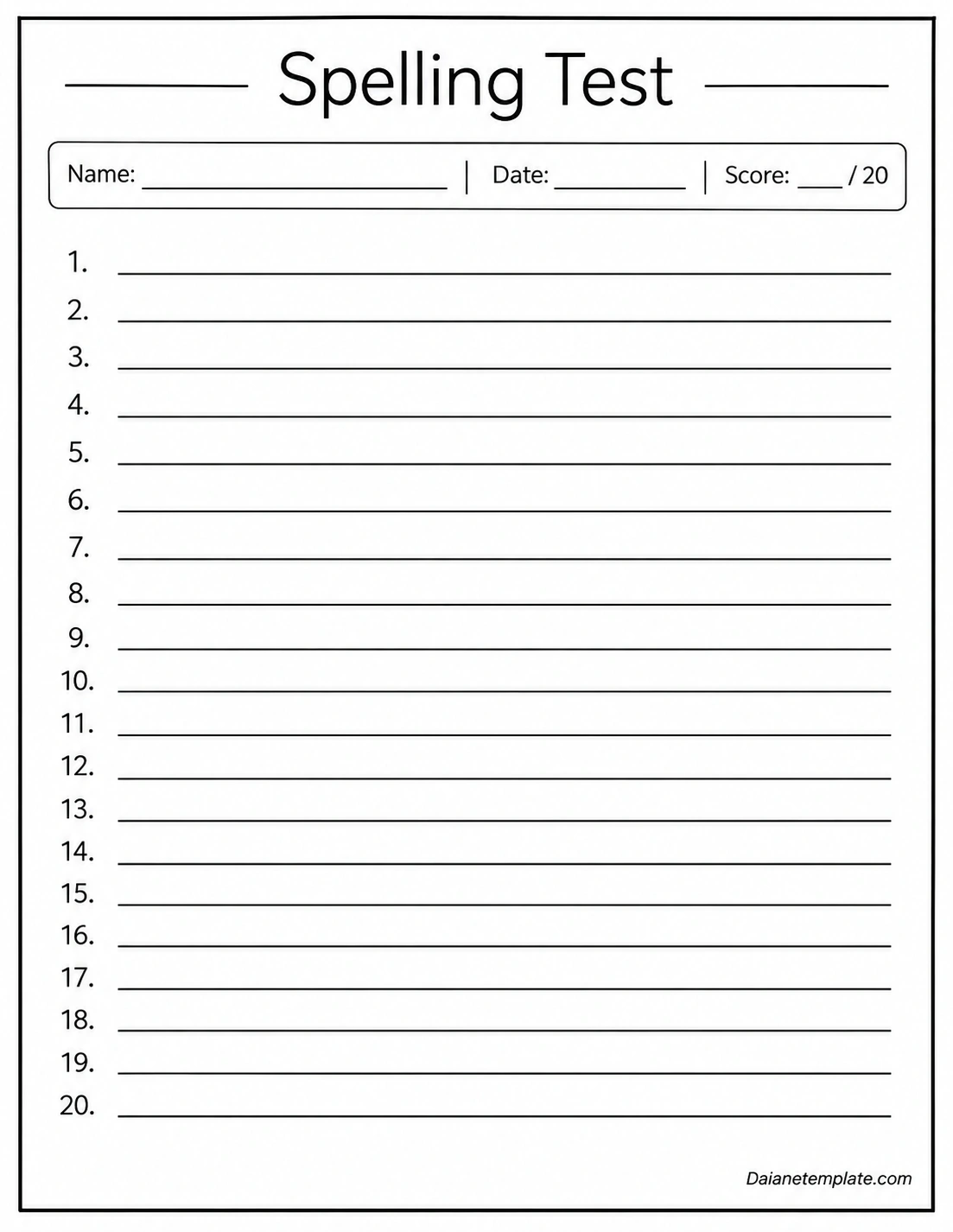
1. Basic Spelling Test Template
A basic spelling test template is ideal for regular classroom assessments. It usually includes a student information section, a numbered list of answer lines, and a space for the final score.
Teachers can dictate 10, 15, or 20 words depending on the student’s grade level and learning objectives. Students simply listen carefully and write each word on the corresponding line.
This format works particularly well for weekly vocabulary assessments, elementary school spelling lessons, and homeschool activities.
2. Weekly Spelling Test Worksheet
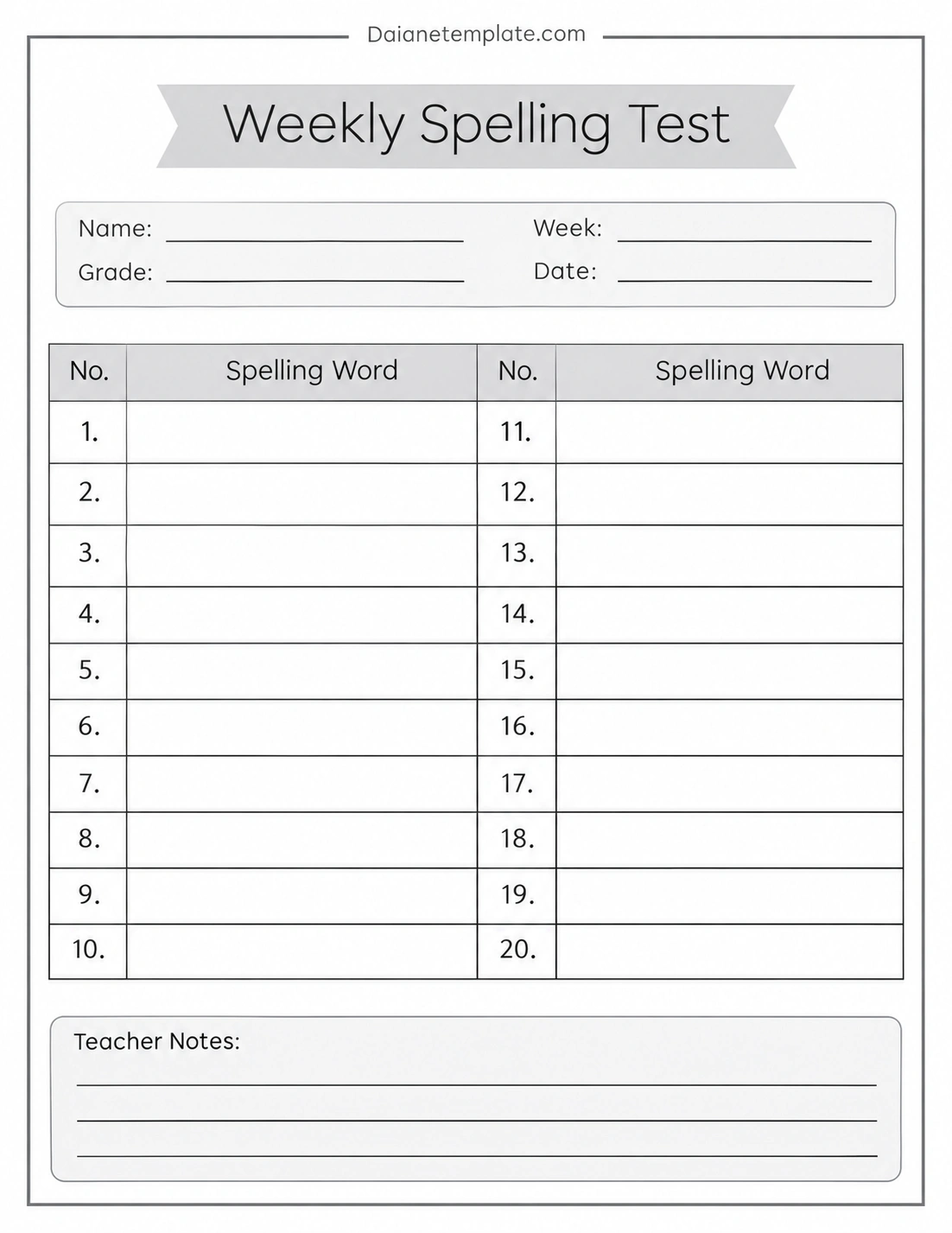
A weekly spelling test worksheet helps teachers organize recurring vocabulary assessments. Instead of preparing a new format every week, educators can reuse the same printable layout with a different word list.
A two-column design is especially useful when testing 20 words because it keeps the worksheet compact while maintaining sufficient writing space.
This worksheet can also include a teacher notes section for recording common spelling mistakes, individual learning needs, or recommendations for future lessons.
3. Spelling Practice Test Worksheet
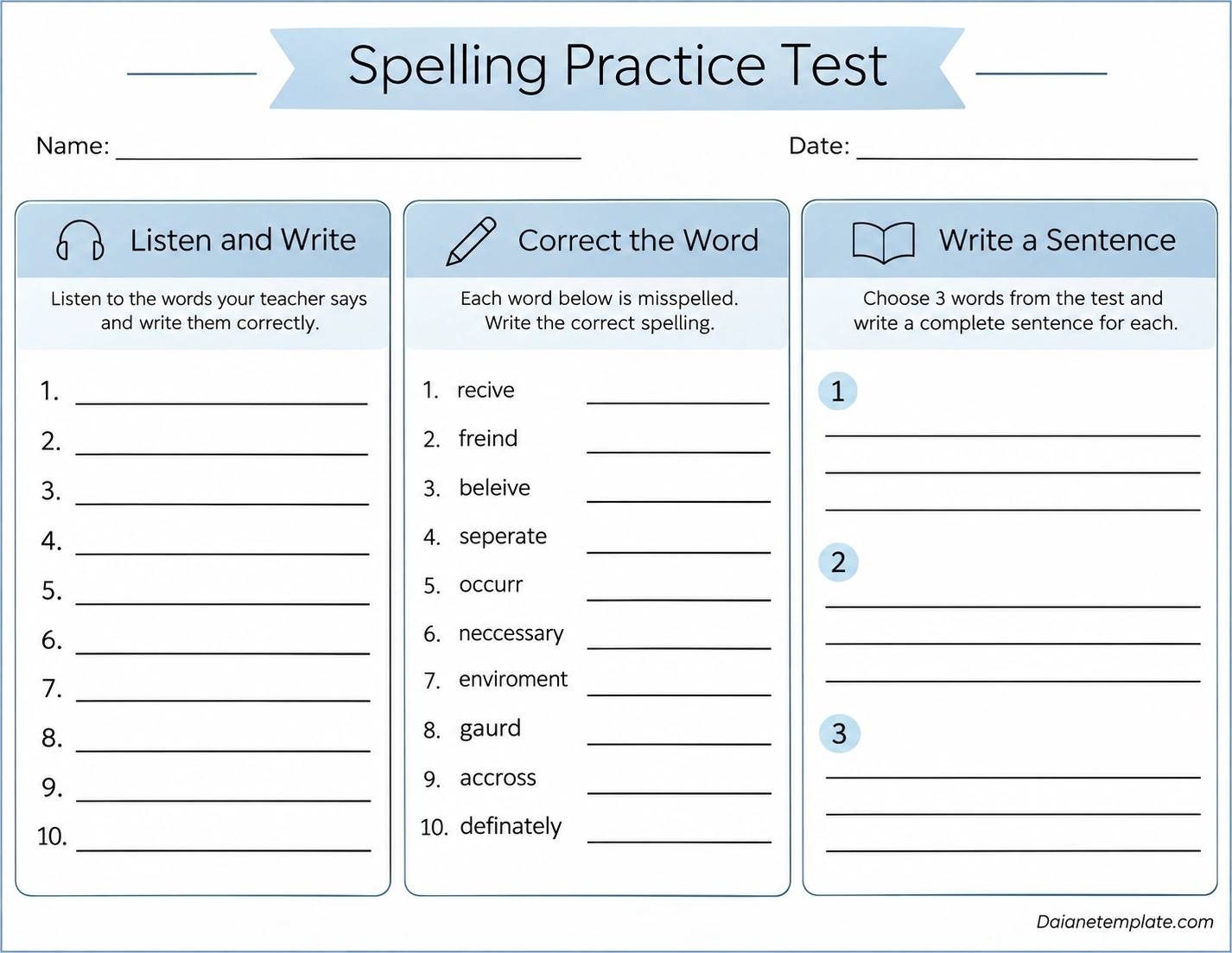
A spelling practice test offers more than a traditional dictation exercise. It can combine listening, word correction, and sentence writing to help students understand how spelling works in different contexts.
For example, students can complete three activities:
- Listen and write: Listen to dictated words and write the correct spelling.
- Correct the word: Identify spelling mistakes and rewrite the words correctly.
- Write a sentence: Choose vocabulary words and use them in complete sentences.
These activities encourage students to apply their spelling knowledge rather than simply memorize a list of words.
How to Give a Spelling Test
Administering a spelling test does not need to be complicated. A consistent process helps students understand expectations and allows teachers to assess their performance fairly.
Step 1: Prepare the Word List
Select words that match the students’ grade level and current lessons. Include vocabulary they have already studied so the test measures their understanding rather than unfamiliar material.
Step 2: Provide the Worksheet
Give each student a blank spelling test paper. Make sure the worksheet has enough numbered spaces for the entire word list.
Step 3: Read Each Word Clearly
Say each word slowly and clearly. For younger students, you can repeat the word and use it in a simple sentence to provide additional context.
Step 4: Allow Time for Answers
Give students enough time to write each word before moving to the next question. Avoid rushing because the goal is to evaluate spelling knowledge accurately.
Step 5: Review and Score the Test
After completing the assessment, check each answer against the correct spelling. Record the score and identify patterns in the mistakes to guide future lessons.
Spelling Test Ideas for Different Grade Levels
Spelling assessments should match the student’s age, vocabulary, and reading ability. Adjusting the difficulty makes the activity more useful and encourages steady improvement.
Kindergarten and First Grade
Young learners benefit from short spelling lists containing familiar words. Focus on simple letter sounds, basic phonics, and commonly used vocabulary.
Suitable activities include:
- Writing simple three-letter words.
- Matching sounds with letters.
- Practicing short vowel patterns.
- Writing familiar classroom objects.
Second and Third Grade
Students at this level can begin working with longer words and common spelling patterns. Introduce word families, consonant blends, and basic spelling rules.
Useful activities include plural forms, simple contractions, and words with common vowel combinations.
Fourth and Fifth Grade
Older elementary students can practice more challenging vocabulary, prefixes, suffixes, and words with silent letters. Sentence writing can also help assess whether students understand how to use vocabulary correctly.
Tips to Help Students Improve Their Spelling
Consistent practice is one of the best ways to develop strong spelling skills. However, repeating word lists is not the only effective learning method. Combining different activities can make spelling lessons more engaging.
- Read regularly: Reading books exposes students to new vocabulary and correct word patterns.
- Practice writing: Encourage students to write sentences using recently learned words.
- Group similar words: Organize vocabulary by spelling patterns, prefixes, or suffixes.
- Use repetition: Review difficult words several times throughout the week.
- Identify mistakes: Help students understand why a word was spelled incorrectly.
- Make learning interactive: Use word games, flashcards, and spelling challenges.
- Celebrate progress: Recognize improvement instead of focusing only on perfect scores.
Teachers can also keep previous spelling tests to monitor progress over time. Comparing results helps identify areas where students may need additional instruction.
How to Use a Printable Spelling Test
A printable spelling test is easy to use at school or at home. Most worksheets can be printed on standard US Letter paper and completed with an ordinary pencil or pen.
Follow these simple steps:
- Choose a spelling test template that matches your assessment needs.
- Print enough copies for all students.
- Prepare a list of spelling words before the assessment.
- Distribute the worksheets and ask students to complete their information.
- Dictate the words and allow time for each answer.
- Collect the worksheets and check the spelling.
- Record scores and review incorrect answers together.
For homeschool families, the same process can be used as part of a weekly language arts routine. Parents can adjust the number of words according to their child’s learning progress.
Frequently Asked Questions About Spelling Tests
1. What is the purpose of a spelling test?
The purpose of a spelling test is to evaluate how accurately students can recognize and write words. It also helps teachers identify spelling difficulties and determine which vocabulary skills need more practice.
2. How many words should be included in a spelling test?
The number depends on the student’s age and learning level. A short test with 5 to 10 words may work for younger learners, while older elementary students may complete assessments with 15 to 20 words or more.
3. What is a spelling test worksheet?
A spelling test worksheet is a printable or digital document containing spaces where students write words dictated by a teacher or parent. It commonly includes numbered answer lines, student information, and a score section.
4. How often should students take a spelling test?
Many teachers administer spelling tests weekly after students have practiced a vocabulary list. However, the frequency can be adjusted according to the curriculum and individual learning needs.
5. Can spelling tests be used for homeschool learning?
Yes. Spelling tests are useful for homeschool education because parents can prepare word lists, assess spelling progress, and provide additional practice whenever necessary.
6. What makes a good spelling test template?
A good spelling test template has a clear layout, readable text, numbered answer spaces, and sufficient room for writing. Optional fields for student names, dates, scores, and teacher comments make it more practical.
7. What is the difference between a spelling test and a spelling practice worksheet?
A spelling test primarily measures how well students can spell words independently. A spelling practice worksheet focuses on developing skills through activities such as word matching, correcting mistakes, completing sentences, and writing vocabulary.
Conclusion
A spelling test is a valuable educational tool for measuring vocabulary knowledge and improving students’ writing accuracy. With regular assessments and meaningful practice, students can gradually develop stronger spelling skills and become more confident writers.
Using a printable spelling test template makes the assessment process easier for teachers, parents, and homeschool educators. Whether you prefer a basic spelling test paper, a weekly assessment sheet, or an interactive spelling practice worksheet, choosing the right format can make learning more organized and effective.
Start with a simple worksheet, select age-appropriate vocabulary, and encourage students to learn from their mistakes. Consistent practice can make a meaningful difference in their spelling development.
Download: Spelling Test Template
