A punch list is a detailed record of unfinished work, defects, corrections, and minor tasks that must be completed before a construction project is considered finished. It helps contractors, project managers, owners, and inspectors identify outstanding items and track them through completion.
Near the end of a construction project, even small issues can affect quality, functionality, appearance, or final approval. A well-organized punch list provides a clear way to document these items, assign responsibility, set target dates, and verify that corrections have been completed.
Whether you are managing a residential renovation, commercial building, tenant improvement, or larger construction project, a structured punch list can make project closeout more organized and reduce confusion about what remains to be done.
What Is a Punch List?
A punch list is a checklist of remaining construction work or corrections that need to be addressed before project completion or handover. The items are usually identified during a final inspection or walkthrough.
A punch list may include relatively minor issues such as touch-up painting, damaged finishes, missing hardware, incomplete installations, cleaning, labeling, or adjustments. It can also include more significant deficiencies that must be resolved before the work can be accepted.
A typical construction punch list may record:
- Item number
- Location or area
- Description of the unfinished work or issue
- Priority level
- Responsible contractor or subcontractor
- Target completion date
- Current status
- Notes or comments
- Completion verification
The exact format depends on the project, contract, and parties involved.
Why Is a Punch List Important?
The final stage of a construction project often involves many small details. Without a centralized record, these items can be overlooked, duplicated, or misunderstood.
Keeps Outstanding Work Organized
A punch list places unfinished tasks in one location. Instead of relying on emails, conversations, photographs, or memory, the project team can use a single record to identify what still needs attention.
Assigns Responsibility
Each item can be assigned to the appropriate contractor, subcontractor, trade, or team member. This creates clearer accountability and helps prevent uncertainty about who is responsible for completing the work.
Tracks Completion
A status field allows the team to identify whether an item is open, in progress, or completed. This makes it easier for project managers to monitor closeout progress.
Supports Quality Control
Documenting deficiencies provides a systematic way to review the finished work against project expectations, specifications, drawings, and applicable requirements.
Helps With Project Closeout
A completed punch list can contribute to an organized handover process. Depending on the contract, resolving outstanding items may be necessary before final acceptance, closeout, or other contractual milestones.
Punch List Template
A punch list template provides a standardized format for documenting remaining construction tasks and tracking them until completion. A printable template can be particularly useful during physical walkthroughs and inspections.
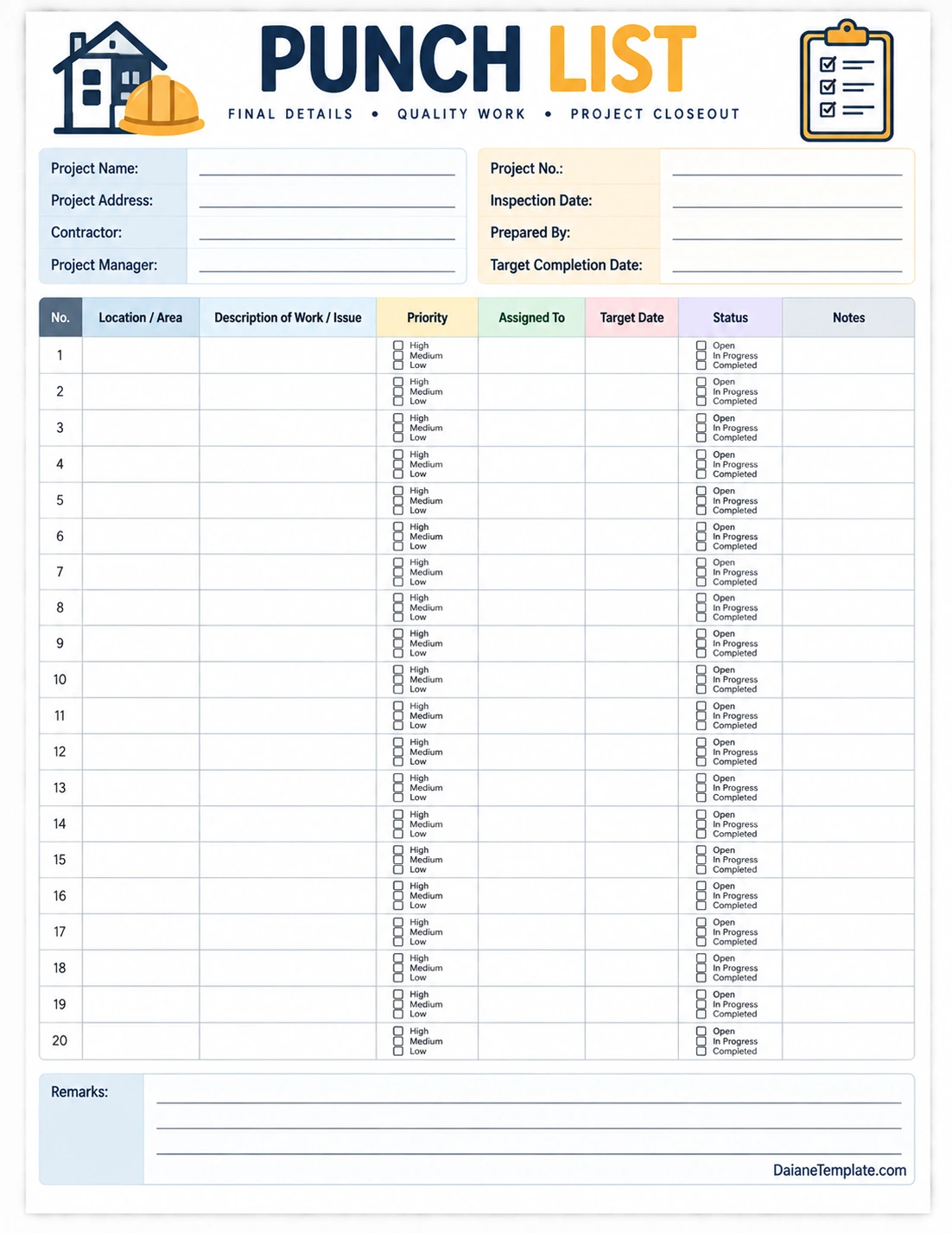
What Should a Punch List Include?
A useful punch list should contain enough information for someone to understand exactly what needs to be corrected without requiring additional explanation.
Project Information
Start with basic project details such as the project name, project address, project number, contractor, project manager, inspection date, and target completion date.
These details help identify the document and provide context when multiple projects are being managed at the same time.
Location or Area
Identify where each issue is located. A precise location makes it easier for the responsible person to find and correct the item.
For example, instead of writing “paint issue,” a more useful entry might identify a particular room, wall, floor, unit, or other specific area.
Description of Work or Issue
Describe the outstanding work clearly. The description should explain what is incomplete, damaged, incorrect, or otherwise requires attention.
Specific descriptions reduce misunderstandings and make it easier to verify whether the item has actually been resolved.
Priority
Some projects benefit from categorizing items according to priority. A simple system might identify items as high, medium, or low priority.
Priority levels should reflect the project’s actual requirements and should not replace contractual definitions or formal deficiency procedures where those apply.
Assigned To
Record the person, contractor, subcontractor, or trade responsible for addressing the issue. Clear assignment helps prevent items from being overlooked.
Target Date
A target completion date can help the project team coordinate the remaining work and monitor progress toward project closeout.
Status
Common status categories include open, in progress, and completed. A status field provides a quick overview of the current state of the project punch list.
Notes
A notes section can be used for additional instructions, follow-up information, inspection observations, or details that do not fit elsewhere on the form.
How to Create a Construction Punch List
Creating a punch list is most effective when the project team conducts a systematic inspection rather than trying to identify issues randomly.
1. Schedule a Final Walkthrough
Conduct a detailed walkthrough of the relevant areas. Depending on the project, the inspection may involve the owner, contractor, architect, project manager, superintendent, or other authorized parties.
2. Inspect Each Area Systematically
Work through the building or project area by area. A consistent inspection route makes it less likely that rooms, finishes, installations, or other components will be skipped.
3. Document Every Outstanding Item
Record unfinished work, visible defects, missing components, damage, adjustments, and other items requiring correction. Use clear descriptions rather than vague comments.
4. Assign Responsibility
Identify who is expected to address each item. Assigning responsibility at the time the issue is documented can save time later.
5. Set Target Dates
Where appropriate, establish target completion dates that align with the project’s closeout schedule and contractual requirements.
6. Verify Completed Work
After corrections are made, review the work and update the status. Do not mark an item complete until the responsible party or authorized reviewer has confirmed that the required work has been addressed.
Punch List Inspection Checklist
A final inspection should cover the areas that are relevant to the specific project. Depending on the scope, a construction punch list inspection may include:
- Walls and ceilings
- Paint and finishes
- Flooring
- Doors and hardware
- Windows
- Cabinetry and millwork
- Lighting fixtures
- Electrical components
- Plumbing fixtures
- HVAC components
- Safety-related items
- Labels and signage
- Equipment and appliances
- Exterior finishes
- Site cleanup
- Required documentation
The inspection criteria should always be adapted to the actual project scope, contract documents, plans, specifications, and applicable requirements.
How to Prioritize Punch List Items
Not every outstanding item has the same urgency. Prioritizing tasks can help the project team focus attention where it is needed most.
High-Priority Items
High-priority items may include issues that affect safety, essential functionality, major contractual requirements, or the ability to use or accept the completed space.
Medium-Priority Items
Medium-priority items may include deficiencies that should be corrected before closeout but do not prevent basic use of the completed area.
Low-Priority Items
Low-priority items may include minor cosmetic corrections or other relatively small tasks. Even minor issues should still be documented and handled according to the project’s requirements.
Punch List vs. Inspection Checklist
A punch list and an inspection checklist are related but serve different purposes.
An inspection checklist is generally used to guide an inspection and ensure that specific areas or criteria are reviewed. A punch list focuses on the outstanding deficiencies or tasks discovered during the inspection that require correction.
In practice, an inspection checklist can help identify the issues that are later entered into the punch list.
Punch List vs. Snag List
The terms “punch list” and “snag list” are often used to describe similar concepts. A punch list is commonly used in U.S. construction terminology, while “snag list” is frequently used in other English-speaking construction markets.
Both generally refer to outstanding defects, incomplete work, or corrections that need to be addressed before a project reaches an appropriate completion or handover stage.
How to Manage a Punch List Efficiently
A punch list becomes more useful when it is actively managed rather than treated as a static document.
- Use specific descriptions: Clearly explain what needs to be corrected.
- Identify exact locations: Make each issue easy to find.
- Assign every item: Avoid leaving responsibility unclear.
- Set realistic target dates: Coordinate deadlines with the overall closeout schedule.
- Update status regularly: Keep the list current as work progresses.
- Use photographs when helpful: Visual documentation can clarify the location or nature of an issue.
- Conduct follow-up inspections: Verify completed work instead of relying only on verbal confirmation.
- Keep documentation organized: Maintain relevant records with the project closeout documents.
Common Punch List Mistakes
Using Vague Descriptions
Descriptions such as “fix wall” or “check door” may not provide enough information. Explain the specific condition that needs attention.
Failing to Identify the Location
Without a clear location, workers may spend unnecessary time searching for the issue. Include a room, floor, unit, elevation, grid reference, or other useful identifier when appropriate.
Not Assigning Responsibility
An unassigned item can remain open because everyone assumes someone else is responsible. Assign each task to the appropriate party.
Failing to Update the Status
An outdated punch list can create confusion about what remains unfinished. Update the status after each meaningful stage of work.
Closing Items Without Verification
An item should not be marked complete simply because someone says the work has been performed. Where appropriate, an authorized person should verify that the correction meets the project requirements.
Adding New Items Without Tracking Them
During follow-up inspections, new deficiencies may be discovered. Add them to the appropriate record instead of relying on separate informal notes.
Benefits of a Printable Punch List
A printable punch list can be especially useful during on-site inspections and walkthroughs. It gives inspectors and project teams a physical document that can be marked while moving through the project.
- Provides a structured inspection record
- Makes outstanding tasks easier to organize
- Provides space for handwritten notes
- Helps assign responsibility
- Supports status tracking
- Makes follow-up inspections easier
- Provides a convenient project closeout reference
For larger projects, digital project management systems may provide additional features such as photographs, notifications, automated assignments, and audit histories. A printable form can still be useful for field inspections and quick documentation.
Frequently Asked Questions About Punch Lists
What is a punch list in construction?
A punch list is a record of incomplete work, defects, corrections, and other outstanding tasks that need to be addressed before an appropriate project completion or closeout milestone.
What should be included in a punch list?
A punch list commonly includes the item number, location, description of the issue, priority, responsible party, target date, status, and notes. Project information and verification details may also be included.
Who creates the punch list?
The punch list may be created by a contractor, project manager, owner, architect, inspector, superintendent, or another authorized project participant. The responsible parties depend on the project’s contract and management structure.
When should a punch list be created?
A punch list is typically developed during inspections or walkthroughs near the end of a construction project. Additional items may be added during follow-up inspections if new deficiencies are discovered.
What is the purpose of a punch list?
The purpose is to clearly document outstanding work, assign responsibility, track corrections, verify completion, and support an organized project closeout process.
Is a punch list the same as a construction checklist?
No. A construction checklist may guide an inspection or process, while a punch list specifically records outstanding issues and tasks that require correction or completion.
What does “punch list complete” mean?
It generally means the documented outstanding items have been addressed and verified according to the applicable project requirements. The exact meaning can depend on the contract and project closeout procedures.
Can a punch list be used for residential projects?
Yes. Punch lists can be useful for homes, renovations, remodeling projects, commercial buildings, tenant improvements, and many other types of construction work.
Can a printable punch list be used on a construction site?
Yes. A printable punch list can be used during site walkthroughs to record locations, issues, assignments, target dates, status, and notes. The format should be adapted to the project’s specific requirements.
Conclusion
A punch list provides a practical way to organize the final tasks and corrections required before a construction project reaches an appropriate closeout stage. By documenting each issue, identifying its location, assigning responsibility, setting target dates, and tracking completion, the project team can create a clearer and more accountable closeout process.
A well-maintained punch list is more than a simple checklist. It can support quality control, improve communication, reduce confusion, and provide a documented record of outstanding work and completed corrections.
Whether you are managing a residential renovation or a large commercial project, using a clear punch list template can make final inspections and project closeout more organized and manageable.
Download: Punch List Template
