A Pinewood Derby car is more than a small wooden racing vehicle. For Cub Scouts, building and racing a Pinewood Derby car can be a fun hands-on activity that combines creativity, craftsmanship, problem-solving, and friendly competition. Starting with a simple block of wood, Scouts can create a unique car, learn how wheels and weight affect motion, and experience basic engineering and physics in a practical way.
The activity also encourages patience and teamwork. Designing a car requires planning, while cutting, sanding, painting, and assembling the vehicle gives Scouts an opportunity to develop practical skills. Once the cars reach the track, participants can enjoy the excitement of racing while learning about good sportsmanship and following competition rules.
What Is a Pinewood Derby Car?
A Pinewood Derby car is a small model race car typically made from a lightweight wooden block and assembled with small wheels and axles. The car does not use a motor, battery, or fuel. Instead, it travels down a sloped track using gravity.
The basic concept is simple: the car begins at the top of the track and gravity pulls it downhill. Factors such as weight distribution, wheel alignment, axle preparation, friction, and the shape of the car can influence how smoothly it travels.
Although the finished car may look simple, building one involves several areas of STEM learning. Scouts can explore concepts such as potential energy, kinetic energy, friction, balance, aerodynamics, measurement, and structural design.
Why Build a Pinewood Derby Car?
A Pinewood Derby project provides an opportunity to learn by doing. Instead of simply reading about engineering concepts, Scouts can see how design decisions affect the performance of an actual vehicle.
- Creativity: Scouts can choose their own car shape, colors, theme, and decorative details.
- Craftsmanship: Cutting, sanding, painting, and assembling the car develop hands-on skills.
- Problem-solving: Builders must consider how different design choices affect the finished car.
- STEM learning: The project introduces basic ideas about gravity, friction, motion, weight, and balance.
- Planning: A design sketch helps organize the building process before work begins.
- Sportsmanship: Racing provides an opportunity to practice cooperation, fairness, and respect.
- Family involvement: Adults can help Scouts learn safe tool use and construction techniques.
How to Plan a Pinewood Derby Car
Good planning can make the construction process easier. Before cutting the wooden block, decide what type of car you want to create and how the finished design will look.
Choose a Car Design
Start by selecting a simple shape that matches the builder’s skill level. A classic race car, sports car, wedge, hot rod, truck-inspired design, or completely original shape can all provide a good starting point.
For younger Scouts, a relatively simple shape may be easier to cut and sand. More detailed designs can be attempted when the builder has more experience with measuring, shaping, and finishing wood.
Create a Design Sketch
Sketching the car before construction helps turn an idea into a practical plan. Consider drawing the car from the side and top, and mark the approximate location of the wheels and major design features.
A printable Pinewood Derby car template can make this planning stage easier by providing areas for measurements, design ideas, color choices, and different views of the car.
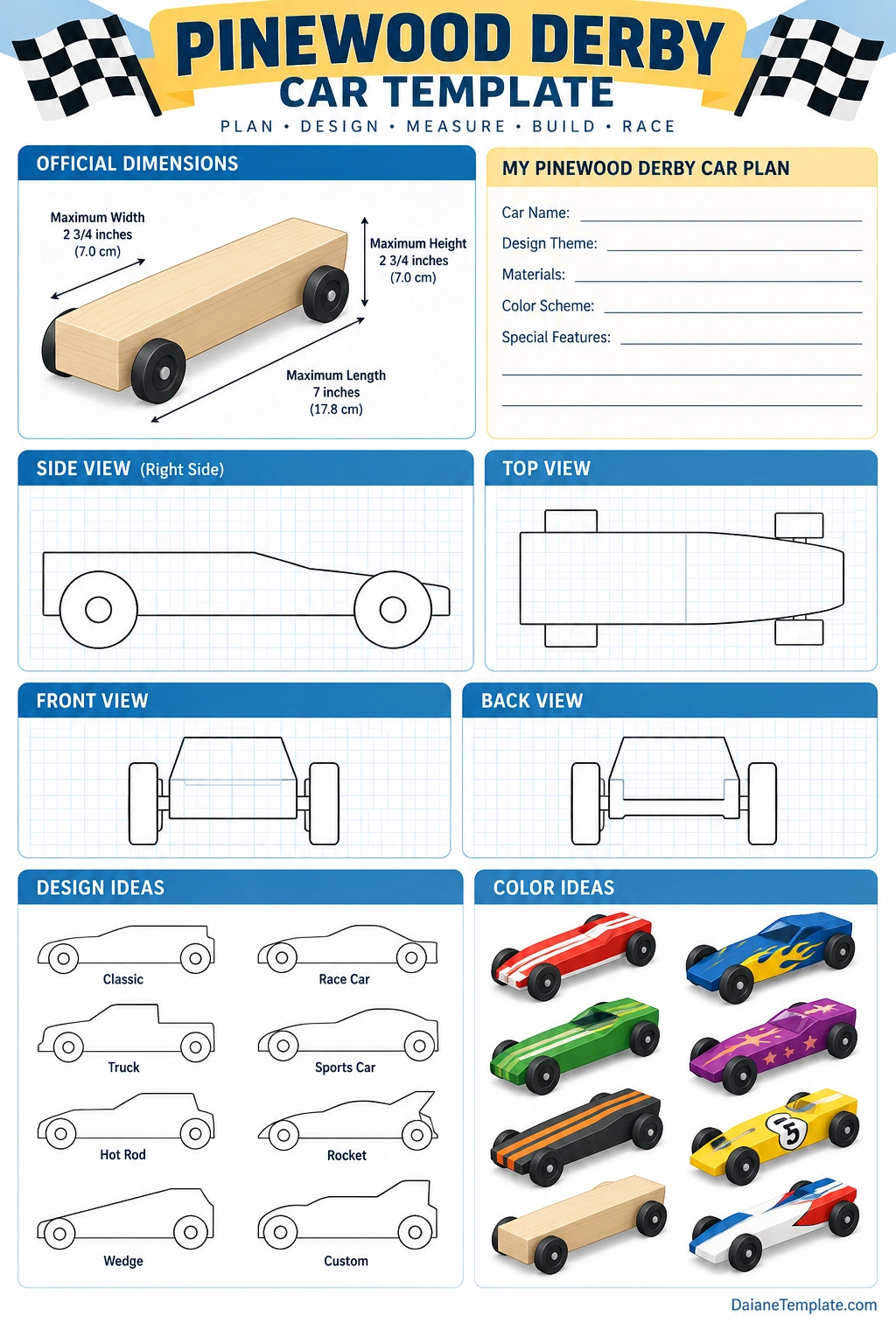
Important Pinewood Derby Car Measurements
Measurements are an important part of building a Pinewood Derby car. However, there is not necessarily one universal set of dimensions for every Pinewood Derby event. Local Cub Scout packs, councils, organizations, and race committees may establish their own specifications.
Before cutting or modifying the wood block, check the official rules for your specific event. Common requirements may address the maximum length and width of the car, wheel and axle specifications, overall weight, wheel placement, and clearance underneath the car.
Check the Official Race Rules
Always use the rules supplied by the organization hosting the race as the final authority. A car that meets the requirements of one event may not automatically meet the requirements of another.
- Maximum overall length
- Maximum overall width
- Maximum permitted weight
- Wheel and axle requirements
- Wheel placement and spacing
- Track clearance requirements
- Permitted materials and modifications
- Restrictions on lubricants or other performance modifications
Checking the rules before construction can prevent the disappointment of discovering that a finished car needs to be modified before race day.
How to Build a Pinewood Derby Car
1. Mark the Design
Transfer your chosen design onto the wooden block. Use a ruler, pencil, and template to create accurate reference lines. Measure carefully before making permanent cuts.
2. Cut the Basic Shape
Once the design has been marked, carefully cut away the excess wood. The exact tools available may vary, but adult supervision is important whenever Scouts are working with saws or other cutting equipment.
The goal is not necessarily to create the most complicated shape. A clean and carefully finished design can be more practical than a highly detailed shape that is difficult to construct accurately.
3. Sand the Car
Sanding removes rough edges and helps create the final shape. Begin with a suitable coarser sandpaper when necessary and gradually move toward a finer grit for a smoother surface.
Pay particular attention to areas around the wheels and axles. The body should be smooth without removing material that is needed to maintain strength or comply with the race rules.
4. Install the Axles and Wheels
Wheel and axle alignment can have an important effect on how smoothly the car travels. The wheels should be installed according to the event rules, and the axles should be positioned carefully.
A poorly aligned wheel can create additional friction and cause the car to move unevenly. Take time to check the alignment rather than rushing through the final assembly.
5. Add Paint and Decorations
Painting is one of the most creative parts of a Pinewood Derby project. Choose colors that match the car’s theme and apply thin, even coats. Allow each coat to dry properly before adding another layer or additional details.
Simple decorations such as stripes, numbers, flames, racing graphics, or a custom emblem can give the car a distinctive appearance. Make sure decorations do not violate the event’s weight or dimensional requirements.
Understanding the Physics of a Pinewood Derby Car
A Pinewood Derby race provides a simple way to explore basic physics. Because the car is powered by gravity, the starting position gives the vehicle potential energy. As the car moves down the sloped track, that energy is converted into motion.
Gravity
Gravity pulls the car down the inclined track. The steeper the track and the height of the starting position, the more gravitational potential energy is available at the beginning of the race.
Friction
Friction can slow a Pinewood Derby car. Contact between the wheels, axles, and track can create resistance. A smooth and properly aligned wheel system can help the car travel more efficiently.
Weight Distribution
Where the car’s weight is positioned can affect how it behaves on the track. Builders can learn about balance and weight distribution by experimenting with different designs while staying within the race rules.
Aerodynamics
At Pinewood Derby speeds, aerodynamic effects may be less important than factors such as alignment and friction, but the shape of the car can still provide an interesting introduction to airflow and streamlined design.
Pinewood Derby Car Design Ideas
There are many ways to make a Pinewood Derby car visually interesting. The best design often depends on the builder’s interests and the amount of time available for construction.
- Classic race car
- Sports car
- Hot rod
- Rocket-inspired car
- Truck-inspired design
- Wedge-shaped race car
- Futuristic vehicle
- Favorite-color themed car
- Team or pack-themed car
- Original custom design
Encourage Scouts to create a design that reflects their own ideas. The project is about learning and participating, not simply producing the most elaborate-looking vehicle.
Tips for Building a Better Pinewood Derby Car
- Start with the rules: Know the race requirements before modifying the wood block.
- Plan before cutting: A clear sketch can prevent unnecessary mistakes.
- Measure carefully: Small measurement errors can affect the finished car.
- Focus on alignment: Properly aligned wheels can help reduce unnecessary friction.
- Keep the design practical: A simple, well-finished car can be easier to construct and test.
- Test the car: If practice runs are available, observe how the car behaves on the track.
- Make adjustments carefully: Change one factor at a time when testing different setups.
- Allow enough drying time: Paint and finishes should be completely dry before final assembly.
- Work safely: Adults should supervise cutting, drilling, and other potentially hazardous tasks.
- Enjoy the process: The building experience is an important part of the activity.
Common Pinewood Derby Car Mistakes
Several common mistakes can make the building process more difficult. Avoiding them can save time and help create a better experience for the Scout.
Ignoring the Race Rules
One of the biggest mistakes is building the car without checking the event requirements. Rules can vary, so review the current specifications before construction and again before race day.
Rushing the Construction
Trying to finish the car too quickly can lead to rough sanding, inaccurate measurements, poor paint application, or wheel alignment problems. Give each stage enough time.
Overcomplicating the Design
A highly detailed design may look impressive but can be difficult to build. Choose a design that matches the builder’s age, experience, available tools, and time.
Forgetting About Safety
Tools such as saws, drills, and other workshop equipment should be used with appropriate adult supervision. Safety should always take priority over speed or competition.
Making the Pinewood Derby a Positive Experience
The Pinewood Derby can be about much more than which car reaches the finish line first. The activity gives Scouts an opportunity to make decisions, solve problems, work with their hands, and learn from mistakes.
Adults can support the project by teaching safe tool use, helping with difficult construction steps, and asking questions rather than taking over the entire project. Whenever possible, let the Scout make the design and creative decisions.
The race itself can also reinforce positive values. Encouraging participants to congratulate one another, respect the rules, handle victories graciously, and respond positively to losses helps make the event enjoyable for everyone.
Pinewood Derby Car Checklist
Use this checklist to prepare for a Pinewood Derby project:
- Review the official race rules.
- Choose a car design.
- Sketch the design and check measurements.
- Prepare the wooden block and construction materials.
- Cut the basic shape safely.
- Sand and smooth the body.
- Check wheel and axle alignment.
- Install the wheels and axles according to the rules.
- Paint and decorate the car.
- Check the final weight and dimensions.
- Test the car if practice is available.
- Make any permitted final adjustments.
- Bring the completed car to race day.
Conclusion
Building a Pinewood Derby car is a creative and educational project that combines craftsmanship, engineering, physics, and friendly competition. From the first design sketch to the final race, Scouts can learn valuable lessons about planning, measurement, problem-solving, teamwork, and sportsmanship.
Whether the finished vehicle is a simple classic racer or an imaginative custom design, the most important part is the experience of creating something by hand and learning along the way. With careful planning, safe construction, attention to the official race rules, and a positive attitude, a Pinewood Derby project can become a memorable activity for Scouts and their families.
Download: Pinewood Derby Car Template
