A payment plan agreement is a written arrangement that allows a person or business to repay a debt through scheduled installments instead of paying the entire amount at once. The agreement documents the amount owed, payment schedule, interest, fees, responsibilities, and other terms agreed upon by the parties.
A clear payment arrangement can benefit both the creditor and the debtor. The creditor receives a structured plan for collecting the amount owed, while the debtor has a defined schedule that explains when and how payments should be made.
Whether the arrangement involves a personal debt, business obligation, medical balance, service invoice, loan, or another financial obligation, putting the terms in writing can reduce misunderstandings and create a clear record of the agreement.
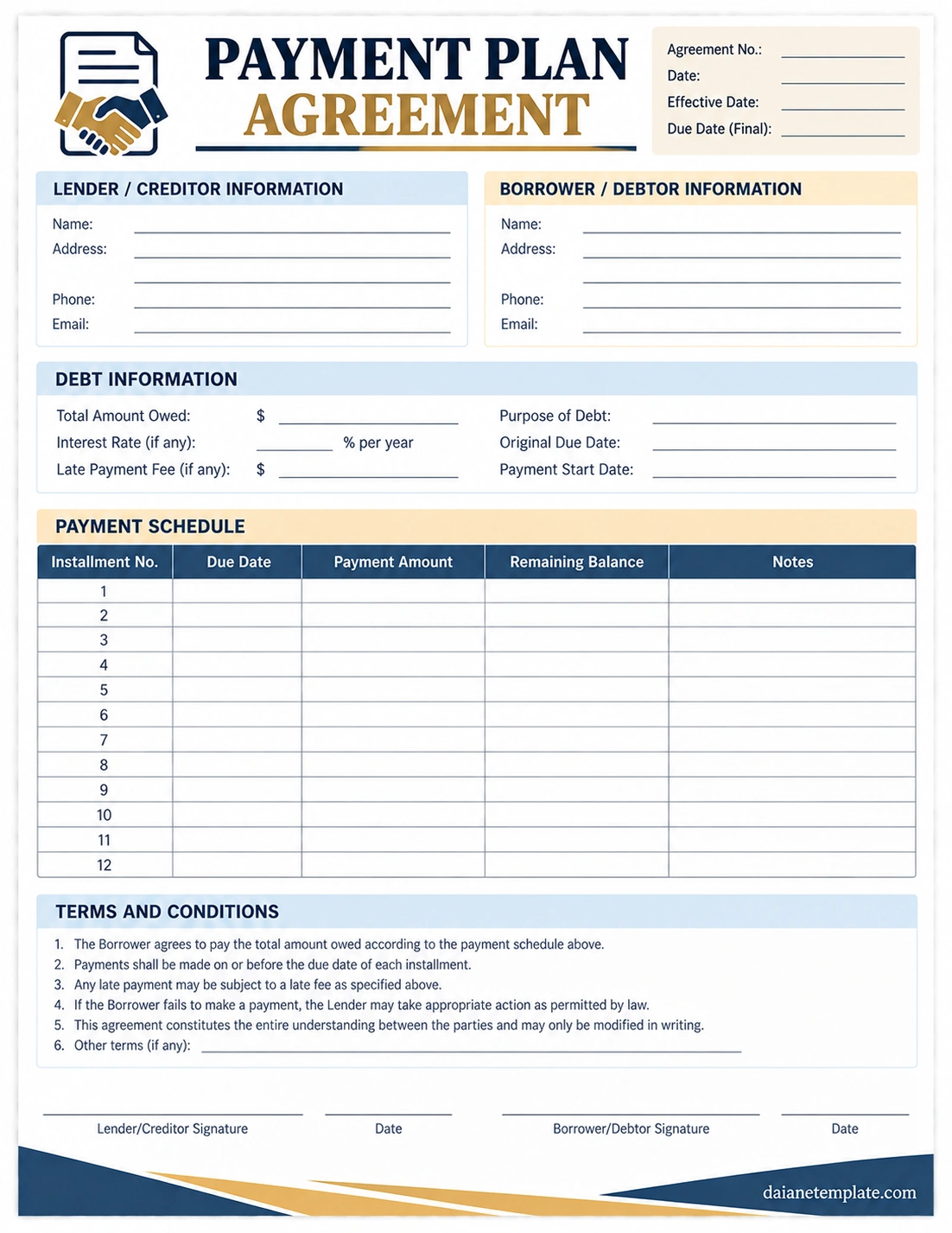
What Is a Payment Plan Agreement?
A payment plan agreement is a written document that establishes how an outstanding balance will be repaid over a specified period. Instead of requiring one immediate payment, the parties agree to divide the balance into multiple installments.
The agreement can specify the amount owed, number of payments, payment frequency, due dates, interest rate, late fees, accepted payment methods, and other conditions.
Depending on the underlying debt and applicable law, the agreement may be used to document a new repayment arrangement or modify an existing payment obligation. The legal effect of the document depends on factors such as its wording, the parties’ agreement, applicable law, and the circumstances of the transaction.
Why Is a Payment Plan Agreement Important?
A written payment plan creates a shared understanding of the repayment arrangement. This can be especially useful when the parties have different expectations about the amount owed or when payments will continue for several months.
Creates Clear Payment Terms
The agreement identifies when payments are due and how much the debtor is expected to pay. This makes the repayment schedule easier to follow.
Documents the Amount Owed
The document can identify the original balance, applicable interest, fees, credits, and other amounts used to calculate the repayment obligation.
Reduces Misunderstandings
Verbal arrangements can be difficult to remember or prove later. A written agreement gives both parties a common reference point.
Provides a Payment Schedule
A structured schedule shows each installment date and amount. This helps the debtor plan payments and helps the creditor track the outstanding balance.
Creates a Record of the Arrangement
Keeping a signed copy of the agreement provides documentation of the terms accepted by the parties.
What Should a Payment Plan Agreement Include?
The specific contents can vary depending on the type of debt and the circumstances. However, a well-organized payment plan agreement commonly includes the following sections.
1. Creditor Information
Identify the person or business receiving the payments. Include the creditor’s name, address, phone number, email address, or other appropriate contact information.
2. Debtor Information
Identify the person or business responsible for making the payments. Include the debtor’s relevant contact information so the parties can communicate about the agreement.
3. Agreement Date
State the date on which the payment arrangement is created. If the agreement becomes effective on another date, identify the effective date separately.
4. Description of the Debt
Explain the obligation being repaid. Depending on the situation, this could be an unpaid invoice, loan balance, personal debt, service charge, purchase balance, or another financial obligation.
5. Total Amount Owed
Clearly state the balance that is subject to the payment plan. If the amount includes interest, fees, credits, or previous payments, explain how the final balance was determined.
6. Interest Rate
If interest applies, state the applicable rate and how it will be calculated. Any interest provision should comply with applicable laws and the underlying agreement.
7. Payment Schedule
The payment schedule is one of the most important parts of the agreement. It should clearly identify when payments are due and how much the debtor must pay.
A payment schedule may include:
- Installment number
- Payment due date
- Payment amount
- Principal amount
- Interest amount, when applicable
- Remaining balance
- Payment status
- Notes
8. Payment Method
Identify how payments should be made. Common options may include bank transfer, check, electronic payment, automatic payment, or another agreed method.
9. Late Payment Terms
If late payments may result in fees, additional interest, or another consequence, describe the applicable terms clearly. Any late-payment provision should comply with the agreement and applicable law.
10. Early Payment or Prepayment
If the debtor can pay the balance early, the agreement can explain whether prepayment is permitted and whether any conditions apply.
11. Default Terms
Explain what may happen if the debtor fails to make payments according to the agreed schedule. The consequences should be specific and consistent with applicable legal requirements.
12. Modification Terms
State how changes to the payment arrangement should be made. Requiring modifications to be documented in writing can help both parties maintain an accurate record.
13. Signatures
Include signature and date fields for the parties. Signatures can demonstrate that the parties reviewed and accepted the written terms, subject to applicable legal requirements.
How to Create a Payment Plan Agreement
Creating a payment plan agreement is easier when the debt and repayment terms are clearly established before drafting the document.
Determine the Outstanding Balance
Start by calculating the amount currently owed. Review invoices, previous payments, interest, fees, credits, and other relevant records.
Both parties should have the same understanding of the balance being placed under the payment plan.
Agree on the Repayment Period
Determine how long the debtor will have to repay the balance. A repayment period may be based on the size of the debt, the debtor’s ability to make payments, and the creditor’s requirements.
Choose the Payment Frequency
Payments may be scheduled weekly, biweekly, monthly, quarterly, or according to another mutually agreed schedule.
Choose dates that are practical and clearly defined. Avoid vague terms such as “pay at the end of the month” when a specific due date can be stated.
Calculate the Installment Amount
Divide the balance according to the agreed repayment structure. If interest or other charges apply, make sure the payment calculation reflects those terms accurately.
Document the Agreement
Put the complete arrangement into writing. Include the parties, debt information, payment schedule, applicable charges, default terms, and other important conditions.
Review Before Signing
Both parties should carefully review the agreement before signing. Check names, dates, amounts, installment calculations, interest, fees, and other important details.
Example of a Payment Plan Structure
A simple payment plan might document a total balance and divide it into equal monthly installments. For example, the agreement could identify the total amount owed, the first payment date, the monthly installment amount, the number of payments, and the expected final payment date.
For a more detailed arrangement, each installment can be listed in a payment schedule showing the due date, payment amount, and remaining balance.
The exact calculation depends on whether the arrangement includes interest, fees, changing installment amounts, or other conditions.
Payment Plan Agreement vs. Loan Agreement
A payment plan agreement and a loan agreement can overlap, but they often serve different purposes.
A loan agreement generally establishes the terms under which money is lent to a borrower. It may cover the original loan amount, interest, repayment schedule, collateral, default provisions, and other lending terms.
A payment plan agreement can instead focus on how an existing balance will be repaid over time. For example, a creditor and debtor may establish an installment arrangement for an outstanding invoice or existing debt.
The appropriate document depends on the underlying transaction and the terms the parties need to establish.
Payment Plan Agreement vs. Promissory Note
A promissory note generally contains a written promise by one party to pay a specified amount according to stated terms. A payment plan agreement focuses more specifically on the structure and conditions of repayment.
In some situations, the documents may be used together or may contain overlapping information. The appropriate structure depends on the transaction, applicable law, and the parties’ objectives.
Tips for Creating a Clear Payment Agreement
- State the total balance clearly: Make sure both parties understand the amount being repaid.
- Use specific due dates: List exact payment dates rather than vague time periods.
- Show the installment amount: Make each required payment easy to identify.
- Explain interest: State whether interest applies and how it is calculated.
- Document fees: Identify any permitted late fees or other charges.
- Explain default: Describe what happens if payments are missed.
- Keep records: Save the signed agreement and payment confirmations.
- Document changes: Put modifications to the repayment arrangement in writing.
- Use realistic payment terms: The schedule should be practical for the debtor while meeting the creditor’s requirements.
Common Payment Plan Agreement Mistakes
Leaving the Balance Unclear
A payment plan should identify exactly how much is owed. If the starting balance is unclear, disagreements can arise later about the amount that remains unpaid.
Using Vague Due Dates
Statements such as “pay monthly” do not establish a complete schedule. Whenever possible, identify specific payment dates.
Failing to Explain Interest
If interest applies, the agreement should clearly state the rate and relevant calculation method rather than leaving the parties to make different assumptions.
Ignoring Late Payments
The agreement should explain the consequences of missed or late payments when applicable. Any fees or other consequences should be lawful and clearly disclosed.
Not Updating the Agreement
If the parties agree to change the payment amount, due date, or repayment period, document the modification rather than relying solely on a verbal conversation.
Failing to Keep Payment Records
Both parties should maintain records of payments. Receipts, confirmations, account statements, or payment logs can help demonstrate which installments have been completed.
How to Track Payments Under an Agreement
A payment plan is easier to manage when every installment is recorded. The payment schedule can be used as a simple tracking tool throughout the repayment period.
For each payment, consider recording:
- Payment date
- Scheduled payment amount
- Actual payment amount
- Payment method
- Remaining balance
- Receipt or transaction reference
- Notes about late or partial payments
Consistent record keeping can help both parties determine whether the repayment plan is being followed.
When Should You Use a Payment Plan Agreement?
A written payment arrangement may be useful whenever a creditor and debtor agree that an outstanding balance will be repaid through installments.
Potential situations include:
- Personal debt repayment
- Business debt repayment
- Unpaid invoices
- Service balances
- Private loans
- Purchase balances
- Medical payment arrangements
- Tuition or educational balances
- Settlement payment schedules
- Other agreed installment arrangements
The appropriate document and terms depend on the underlying obligation. Some types of debt may be subject to specific laws, disclosure requirements, or contractual rules.
Frequently Asked Questions About Payment Plan Agreements
What is the purpose of a payment plan agreement?
The purpose of a payment plan agreement is to document how an outstanding balance will be repaid over time. It establishes the payment amount, due dates, repayment period, interest, fees, and other agreed terms.
Is a payment plan agreement legally binding?
A payment plan agreement can form a binding contract when the applicable requirements for a contract are satisfied. However, enforceability depends on factors such as the agreement’s wording, the parties’ circumstances, the type of debt, and applicable law. A template should not be assumed to create the same legal effect in every jurisdiction.
What should a payment plan agreement include?
A payment plan agreement commonly includes creditor and debtor information, the amount owed, interest, payment dates, installment amounts, payment methods, late-payment terms, default provisions, modification terms, and signatures.
Can a payment plan include interest?
Yes, a payment arrangement may include interest when permitted and agreed upon by the parties. The applicable interest rate and calculation should be clearly stated and should comply with relevant legal requirements.
Can a payment plan agreement be changed?
The parties can potentially modify a payment arrangement when they agree to new terms. Changes should be documented in writing and signed or otherwise formally accepted when appropriate.
What happens if a payment is missed?
The consequences of a missed payment depend on the agreement and applicable law. The document may specify late fees, additional interest, a revised schedule, acceleration provisions, or other permitted remedies.
Can a payment plan agreement be used for personal debt?
Yes. A payment plan can be used to document an agreed installment arrangement for certain personal debts. The agreement should accurately describe the underlying obligation and repayment terms.
Can a business use a payment plan agreement?
Yes. Businesses may use installment agreements for certain outstanding invoices, commercial debts, service balances, or other obligations. Business payment arrangements should reflect the underlying transaction and any applicable contractual requirements.
Should both parties sign a payment plan agreement?
Having both parties sign the agreement can provide a clear record that they reviewed and accepted the written terms. Signature requirements and formalities can vary depending on the type of agreement and applicable law.
Final Thoughts
A payment plan agreement provides a structured way to document how an outstanding debt will be repaid through scheduled installments. By clearly stating the amount owed, payment dates, installment amounts, interest, fees, and other conditions, the agreement can help both parties understand their responsibilities.
The most useful payment agreements are specific and easy to follow. They avoid vague repayment terms, clearly identify the outstanding balance, and provide a practical schedule that both parties can reference throughout the repayment period.
A payment plan agreement template can make the drafting process easier by providing organized sections for creditor and debtor information, debt details, payment schedules, terms and conditions, and signatures. However, the template should be customized to the specific transaction rather than used without reviewing the applicable requirements.
Because contract requirements and debt-related laws can vary by jurisdiction and type of transaction, important or high-value agreements may benefit from review by a qualified legal professional before they are signed.
Download: Payment Plan Agreement Template
