A Room Rental Agreement is a written contract between a landlord and a tenant that establishes the terms for renting a specific room within a property. Unlike an agreement for an entire house or apartment, it focuses on the tenant’s use of an individual room and explains how shared areas, rent, utilities, responsibilities, and house rules will be handled.
Putting the rental arrangement in writing gives both parties a clear reference for their rights and responsibilities. It can help reduce misunderstandings about rent payments, security deposits, shared spaces, guests, maintenance, privacy, and the length of the tenancy.
A well-organized room rental contract should reflect the actual living arrangement and comply with applicable landlord-tenant laws. The agreement can be relatively simple for a straightforward arrangement, while shared housing with multiple occupants may require more detailed terms.
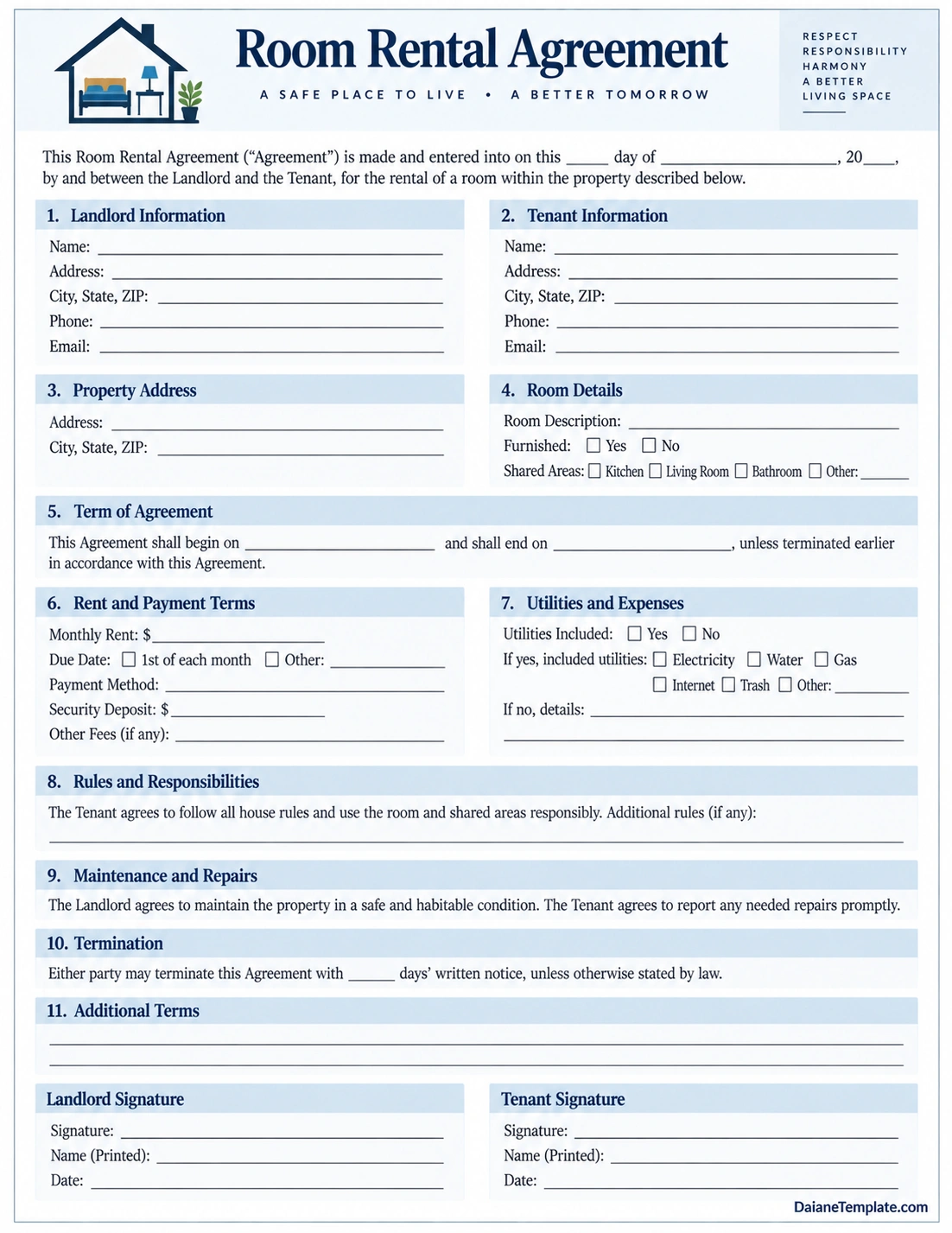
What Is a Room Rental Agreement?
A Room Rental Agreement is a contract used when a tenant rents an individual bedroom or other designated room within a residential property. The landlord may live at the property, or multiple tenants may share common areas such as a kitchen, bathroom, living room, laundry area, or entryway.
The agreement identifies the room being rented and establishes the conditions under which the tenant may occupy it. It may also explain which parts of the property are shared and which areas are private.
Depending on the arrangement and local law, the agreement may function as a lease or another form of residential rental contract. The legal terminology and requirements can vary by jurisdiction.
Why Is a Room Rental Agreement Important?
Shared housing can create questions that do not always arise when someone rents an entire property. For example, tenants may need to understand who can use shared spaces, how utilities are divided, whether guests are allowed, and who is responsible for maintenance.
A written room rental agreement helps establish these expectations before the tenancy begins.
A room rental contract can help:
- Identify the landlord and tenant.
- Describe the specific room being rented.
- Define access to shared areas.
- Establish the rent amount and payment due date.
- Document security deposit terms.
- Explain how utilities and other expenses are handled.
- Set reasonable property and house rules.
- Clarify maintenance and repair responsibilities.
- Establish the rental term and applicable termination procedures.
- Provide a written record of the parties’ agreed terms.
Clear documentation does not eliminate every possible disagreement, but it can reduce disputes caused by different assumptions about the rental arrangement.
What Should a Room Rental Agreement Include?
The specific requirements depend on the property, rental arrangement, and applicable law. However, several sections are commonly useful in a room rental contract.
Landlord Information
The agreement should identify the landlord or property owner and provide appropriate contact information. This may include the landlord’s name, mailing address, telephone number, and email address.
If the property is managed by a property manager or another authorized representative, the agreement can identify that person and explain how the tenant should communicate about rental matters.
Tenant Information
Include the full name and contact information of the tenant who will occupy the room. If more than one person will be renting the room, the agreement should clearly identify each authorized occupant.
Only individuals identified or otherwise authorized under the agreement should occupy the rented space, subject to applicable law and the terms of the tenancy.
Property and Room Details
Clearly identify the rental property and the particular room covered by the agreement. A useful description may include the property address, room location, room number or other identifying description, and whether the room is furnished or unfurnished.
The agreement should also identify shared spaces available to the tenant, such as the kitchen, bathroom, living room, laundry area, parking area, or outdoor spaces.
Rental Term
Specify when the tenancy begins and whether it is for a fixed period or continues on a periodic basis. If the agreement has a specific end date, include that date.
Renewal procedures and notice requirements may also be addressed where appropriate. Any termination provisions should be consistent with applicable landlord-tenant laws.
Rent and Payment Terms
The agreement should clearly state the rent amount and when it is due. It can also identify the accepted payment method and any other payment-related requirements permitted by law.
For example, the contract may specify whether rent is due on the first day of each month or another agreed date. If there are permitted late-payment charges or other fees, the applicable terms should be stated clearly and comply with local requirements.
Security Deposit
If a security deposit is required, the agreement should state the amount and explain the applicable rules for handling and returning it. Deposit requirements, limits, deductions, and deadlines can vary significantly by location.
The agreement should not attempt to override mandatory legal protections concerning security deposits.
Utilities and Shared Expenses
Utilities are an important part of a shared housing arrangement. The Room Rental Agreement should explain which utilities are included in the rent and which expenses the tenant must pay separately.
Possible utilities and shared expenses include:
- Electricity.
- Water.
- Natural gas.
- Internet service.
- Trash collection.
- Heating or cooling costs.
- Shared household supplies, where applicable.
If a utility is shared among several occupants, explain how the cost is allocated. For example, the agreement may specify an agreed percentage, a fixed contribution, or another lawful method.
House Rules and Shared Areas
Room rentals often involve shared living spaces, so house rules can be particularly useful. The rules should be reasonable, clearly communicated, and consistent with applicable law.
A room rental agreement may address:
- Quiet hours.
- Use of the kitchen.
- Bathroom arrangements.
- Cleaning responsibilities.
- Laundry use.
- Smoking restrictions.
- Pet policies.
- Guest policies.
- Parking arrangements.
- Use of common outdoor areas.
Rules should distinguish between the tenant’s private room and common areas so that everyone understands what spaces they may use and under what conditions.
Privacy and Access to the Rented Room
The tenant’s room is generally treated differently from shared areas. The agreement should explain any lawful rules concerning access to the rented room by the landlord or authorized persons.
Landlord access is often regulated by local law, including requirements concerning notice and permitted reasons for entry. A rental agreement should reflect those legal requirements rather than attempting to remove rights that cannot legally be waived.
Maintenance and Repairs
The contract should clarify how maintenance issues should be reported and which responsibilities belong to the landlord and tenant.
The landlord may have responsibilities relating to the property’s required condition and major repairs, while the tenant may be responsible for ordinary cleanliness and reporting problems promptly. The exact responsibilities depend on the rental arrangement and applicable law.
Tenants should generally report leaks, electrical problems, broken fixtures, water damage, or other significant issues as soon as reasonably possible through the agreed communication method.
Furnished vs. Unfurnished Room Rentals
If the room is furnished, the agreement can include a list of furniture and other items provided with the rental. This may include a bed, desk, chair, dresser, lamp, shelving, or other furnishings.
A written inventory can make it easier to document the condition of provided items at the beginning and end of the tenancy. For valuable or numerous items, a separate inventory or condition report may be attached to the agreement.
Guests and Additional Occupants
Guest policies should be clearly communicated before the tenant moves in. The agreement may explain reasonable expectations regarding overnight guests, guest frequency, shared-space use, and situations requiring landlord approval, subject to applicable law.
Guest rules should not be confused with unauthorized permanent occupants. If another person is expected to live at the property, the parties should determine whether that person must be formally added to the rental arrangement.
Termination of a Room Rental Agreement
The agreement should explain how the tenancy may end and what notice is required. The applicable notice period can depend on the type of tenancy, the reason for termination, and local landlord-tenant law.
A termination section may address:
- End of a fixed rental term.
- Notice for ending a periodic tenancy.
- Termination for a material breach when permitted by law.
- Move-out procedures.
- Return of keys or access devices.
- Final inspection.
- Security deposit procedures.
Any termination provision should be reviewed against the laws applicable to the property.
How to Create a Room Rental Agreement
Identify the Parties
Start by recording the landlord’s and tenant’s legal names and contact information. If other occupants are authorized, identify them according to the arrangement.
Describe the Rental Space
Specify the property address, rented room, furnished status, and shared areas. Avoid descriptions that could leave uncertainty about which space the tenant is renting.
Set the Financial Terms
Record the rent, payment due date, security deposit, utility arrangements, and any other permitted charges. Make sure the terms comply with applicable law.
Establish Living Arrangements
Document practical rules concerning common areas, guests, cleaning, noise, pets, smoking, parking, and other relevant aspects of shared living.
Review and Sign
Both parties should review the complete agreement before signing. Any changes should be made clearly and agreed upon by the parties. Each party should retain a copy of the signed document.
How to Use a Room Rental Agreement Template
A Room Rental Agreement Template provides a structured starting point for documenting a room rental arrangement. It can help organize common information such as landlord and tenant details, property information, room description, rental term, rent, utilities, rules, maintenance, termination, and signatures.
Before using a template, customize it for the actual property and tenancy. Complete all relevant fields and remove provisions that do not apply. Additional terms may be added when necessary.
A template should not be treated as a substitute for understanding local rental laws. Requirements for leases, deposits, disclosures, notices, occupancy, and tenant protections vary by jurisdiction.
Common Room Rental Agreement Mistakes
- Not identifying the exact room: Clearly describe the private space being rented.
- Ignoring shared areas: Specify which common spaces the tenant may use.
- Leaving utility costs unclear: Explain which utilities are included and how shared expenses are divided.
- Failing to document the security deposit: State the deposit amount and applicable terms.
- Using vague house rules: Write practical expectations in clear language.
- Forgetting maintenance responsibilities: Explain how repair requests should be reported.
- Ignoring local requirements: Make sure the agreement complies with applicable landlord-tenant law.
- Failing to keep signed copies: Both parties should retain the executed agreement and relevant attachments.
Room Rental Agreement Checklist
Before finalizing the agreement, review these essential details:
- Landlord’s name and contact information.
- Tenant’s name and contact information.
- Complete rental property address.
- Specific room being rented.
- Furnished or unfurnished status.
- Shared areas available to the tenant.
- Start date and rental term.
- Monthly or periodic rent amount.
- Payment due date and method.
- Security deposit information.
- Utility and shared expense arrangements.
- House and property rules.
- Maintenance and repair responsibilities.
- Guest and additional occupant provisions.
- Termination and notice requirements.
- Required signatures and dates.
Conclusion
A Room Rental Agreement creates a clear written framework for renting an individual room within a property. By documenting the rental space, rent, security deposit, utilities, shared areas, house rules, maintenance responsibilities, and termination procedures, both landlords and tenants can begin the arrangement with a clearer understanding of their responsibilities.
A Room Rental Agreement Template can make the process easier by providing an organized structure for the most important rental terms. However, the document should always be customized to the actual living arrangement and reviewed for compliance with applicable local laws.
For unusual, high-value, or legally complex rental situations, obtaining advice from a qualified local legal professional can help ensure that the agreement appropriately addresses the rights and obligations of both parties.
Download: Room Rental Agreement Template
