A Professional Services Agreement is a written contract between a service provider and a client that defines the terms of their working relationship. It explains what services will be provided, how and when the provider will be paid, the expected timeline, each party’s responsibilities, and other conditions that apply to the project.
Whether the work involves consulting, marketing, design, technology, accounting, legal support, engineering, or another professional service, a clear agreement can help both parties understand their obligations before work begins. By putting important details in writing, a Professional Services Agreement can reduce misunderstandings and provide a framework for handling changes, delays, payment issues, intellectual property, confidentiality, and termination.
What Is a Professional Services Agreement?
A Professional Services Agreement is a contract that establishes the relationship between a professional service provider and a client. The provider agrees to perform specified services, while the client agrees to meet defined obligations, such as providing information, approving work, and making payments according to the agreed terms.
The agreement creates a shared understanding of the project before significant work begins. Instead of relying only on emails, conversations, proposals, or informal promises, both parties have a central document describing the arrangement.
The exact contents can vary depending on the industry, project size, jurisdiction, and nature of the services. Some agreements are relatively simple, while complex engagements may include detailed schedules, statements of work, service levels, milestones, and additional legal provisions.
Why Is a Professional Services Agreement Important?
A well-prepared service agreement helps establish clear expectations from the beginning. This can be particularly important when a project involves multiple deliverables, recurring services, significant fees, confidential information, or intellectual property.
A Professional Services Agreement can help both parties:
- Clearly define the services being provided.
- Establish payment rates, schedules, and invoicing requirements.
- Set project start and completion dates.
- Identify the responsibilities of the client and service provider.
- Clarify ownership and permitted use of work product.
- Address confidentiality and sensitive information.
- Establish procedures for changing the scope of work.
- Describe termination requirements.
- Provide a written reference if disagreements arise.
The agreement does not eliminate every possible dispute, but clear terms can make the parties’ expectations easier to understand and manage.
What Should a Professional Services Agreement Include?
There is no single format that works for every professional engagement. However, several provisions are commonly considered when preparing a professional services contract.
1. Names and Contact Information
Begin by identifying the parties entering into the agreement. Include the legal name of the service provider and client, along with relevant business or contact information.
If a party is a company or other legal entity, the agreement should identify the entity accurately. This helps avoid confusion about who is actually entering into the contract.
2. Scope of Services
The scope of services explains exactly what the provider has agreed to do. This is one of the most important parts of the agreement because vague descriptions can create different interpretations of what the project includes.
A useful scope section may identify:
- Specific services to be performed.
- Expected deliverables.
- Project milestones.
- Number of revisions or review rounds, when applicable.
- Services that are specifically excluded.
- Applicable standards or specifications.
For larger projects, the detailed scope may be placed in a separate Statement of Work (SOW) that becomes part of the agreement.
3. Payment Terms
The agreement should explain how the client will compensate the service provider. Depending on the engagement, payment may be based on a fixed project fee, hourly rate, retainer, milestone payments, or another agreed pricing structure.
Payment provisions may address the agreed rates, invoice schedule, payment due dates, deposits, reimbursable expenses, taxes, late-payment provisions, and the process for disputing an invoice.
4. Project Timeline and Term
The contract should establish when the agreement begins and, when appropriate, when the services are expected to end. A project may also include specific milestones or deadlines.
It is useful to distinguish between firm deadlines and estimated dates. Some professional projects depend on client approvals, third-party information, or circumstances outside the provider’s control.
5. Client Responsibilities
Successful projects often depend on cooperation from both parties. The client may need to provide documents, access, information, approvals, feedback, or other resources.
Clearly identifying these responsibilities helps establish that project deadlines and deliverables may depend on timely client cooperation.
6. Intellectual Property
Intellectual property provisions address ownership and permitted use of materials created or supplied during the engagement. Depending on the project, this may include designs, written content, software, reports, photographs, trademarks, documents, data, or other work product.
The agreement should distinguish between materials created specifically for the client and materials that the provider already owned before the project. It may also address licenses, usage rights, portfolio rights, third-party materials, and the point at which ownership or usage rights transfer.
7. Confidentiality
A confidentiality provision can establish how non-public information shared during the engagement should be handled. This may include business information, customer information, financial information, technical information, processes, or other confidential materials.
The provision may also describe permitted disclosures, exclusions from confidential information, and how information should be handled after the relationship ends.
8. Warranties and Disclaimers
Depending on the nature of the services, the agreement may contain representations, warranties, disclaimers, or performance-related provisions. These terms should be written carefully because their legal effect can vary depending on the applicable law and circumstances.
9. Limitation of Liability
A limitation of liability provision may establish limits on certain types or amounts of damages that one party could seek from the other. These provisions can be legally significant and may be subject to restrictions under applicable law.
Because liability provisions can have substantial consequences, both parties should understand exactly what is covered and what exceptions may apply.
10. Termination
The termination section explains how the agreement can end. It may specify termination for convenience, termination for breach, notice periods, payment obligations, and responsibilities that continue after termination.
For ongoing services, termination provisions are especially useful because they establish a predictable process for ending the relationship.
Professional Services Agreement vs. Statement of Work
A Professional Services Agreement and a Statement of Work serve different but complementary purposes.
The main agreement generally establishes the broader legal and commercial relationship. It may contain provisions concerning payment, confidentiality, intellectual property, liability, dispute resolution, and termination.
A Statement of Work typically provides detailed information about a particular project, such as the specific services, deliverables, milestones, deadlines, and project-specific fees.
Using a master agreement together with separate Statements of Work can be useful when a client and provider expect to work together on multiple projects.
How to Create a Professional Services Agreement
Creating an effective agreement starts with identifying the practical details of the engagement before drafting the contract.
Define the Business Relationship
Identify who the parties are, what services will be provided, and the general purpose of the engagement. Make sure the legal names of the parties are accurate.
Describe the Work in Specific Terms
List the services and deliverables as clearly as possible. Avoid relying on broad phrases such as “provide consulting services” without explaining what those services actually involve.
Establish the Commercial Terms
Document the price, payment schedule, invoicing process, expenses, and other financial conditions that apply to the engagement.
Address Project Dependencies
Consider what the provider needs from the client and what events could affect deadlines. Clearly documenting these dependencies can help prevent disputes about delays.
Review Legal and Risk Provisions
Consider confidentiality, intellectual property, liability, termination, dispute resolution, applicable law, and other provisions relevant to the engagement.
Tips for Writing a Clear Service Agreement
- Use specific language: Describe deliverables and responsibilities rather than relying on vague promises.
- Separate included and excluded services: Make it clear what falls outside the original scope.
- Document change procedures: Explain how additional work or changes will be approved and priced.
- Make payment requirements easy to understand: State when invoices are issued and when payments are due.
- Keep related documents organized: Clearly identify proposals, Statements of Work, schedules, and attachments incorporated into the agreement.
- Check consistency: Make sure dates, prices, names, definitions, and references agree throughout the document.
- Review applicable requirements: Contract rules can differ depending on the jurisdiction and type of service.
Common Mistakes to Avoid
Even a professional-looking contract can create problems if important terms are unclear or inconsistent. Common issues include an overly broad scope of work, missing payment deadlines, undefined deliverables, unclear ownership of intellectual property, and failure to explain how changes will be handled.
Another common problem is treating a template as a complete legal solution without adapting it to the actual transaction. A template can provide a useful starting structure, but the provisions should reflect the specific relationship and applicable requirements.
How to Use a Professional Services Agreement Template
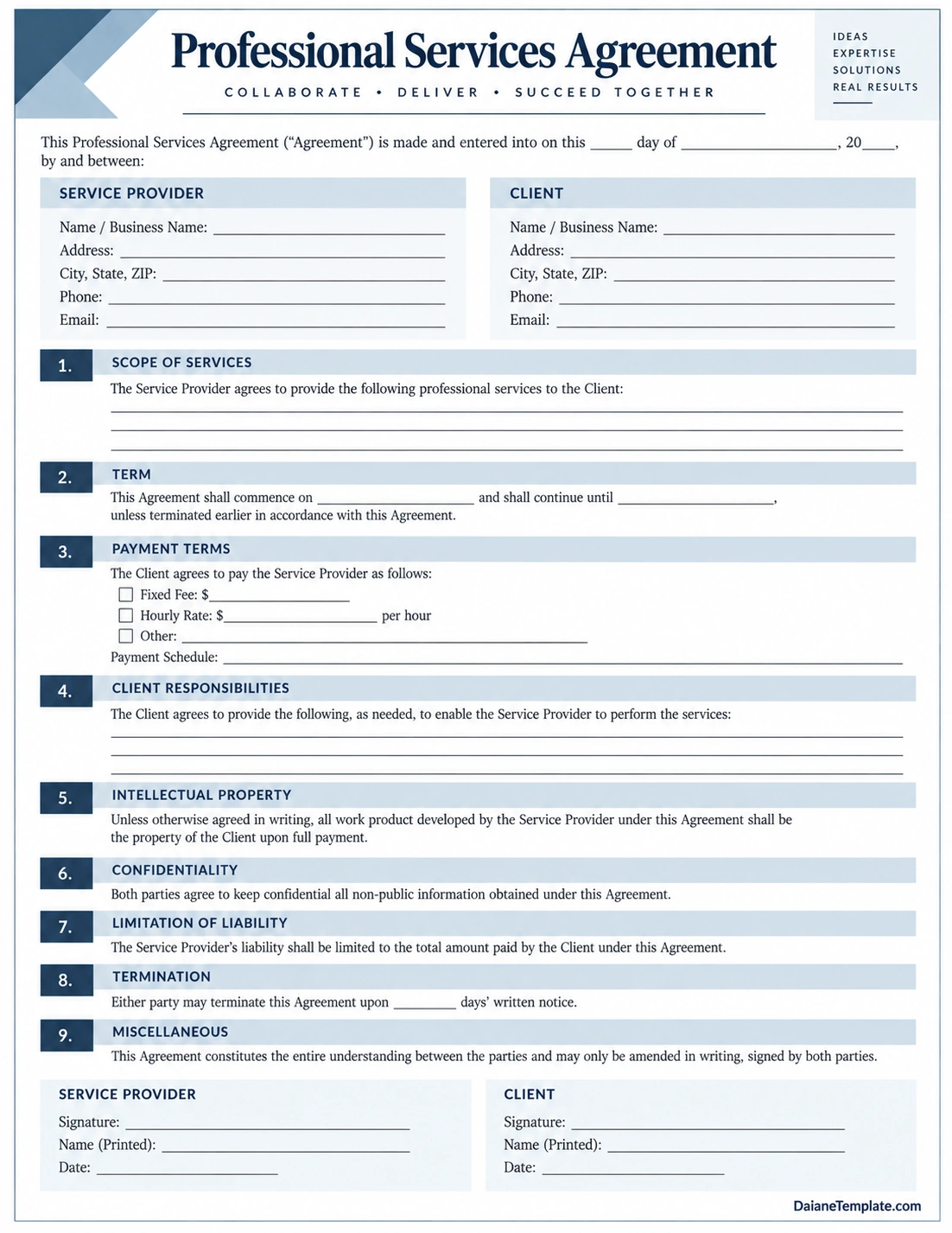
A Professional Services Agreement Template can provide a convenient starting point for organizing the terms of a professional engagement. The template can help ensure that common topics such as services, payment, responsibilities, confidentiality, intellectual property, termination, and signatures are considered.
Before signing, replace placeholders with accurate information and adjust the provisions to match the actual project. Any attachments or Statements of Work should also be reviewed to ensure that they do not conflict with the main agreement.
For contracts involving significant financial, intellectual property, regulatory, employment, liability, or other legal risks, consider having a qualified attorney review the agreement before it is executed.
Professional Services Agreement Checklist
Before finalizing the contract, use the following checklist to review the key information:
- Parties are correctly identified.
- Services and deliverables are clearly described.
- Project dates and milestones are documented.
- Fees and payment terms are specified.
- Client responsibilities are identified.
- Change-order or additional-work procedures are addressed.
- Intellectual property rights are explained.
- Confidentiality requirements are included where appropriate.
- Termination terms are clear.
- Liability and other risk provisions have been reviewed.
- Applicable governing law and dispute provisions are addressed where appropriate.
- All required signatures and dates are included.
Conclusion
A Professional Services Agreement provides a structured way for a service provider and client to define their professional relationship. By clearly documenting the scope of work, payment terms, timelines, responsibilities, intellectual property, confidentiality, termination, and other important conditions, the agreement can help establish expectations before work begins.
A good agreement should reflect the actual project rather than simply copying generic language from a template. The more clearly the parties understand what they are agreeing to, the easier it can be to manage the engagement and address changes that arise during the project.
This article and template are provided for general informational purposes and are not a substitute for legal advice. Contract requirements and enforceability can vary by jurisdiction and circumstances, so appropriate professional legal advice should be considered when needed.
Download: Professional Services Agreement Template
