Leaving a job can be a challenging experience, whether the departure happens through a company restructuring, position elimination, or mutual agreement. In some situations, an employer offers a severance agreement to explain the terms of an employee’s departure and provide financial or other benefits in exchange for certain commitments.
A severance agreement is an important employment document because it can affect an employee’s compensation, benefits, legal rights, and future obligations. It may include severance pay, continued insurance coverage, confidentiality provisions, and a release of certain legal claims. Both employers and employees should understand these terms before signing.
Whether you are an employer preparing a separation document or an employee reviewing an offer, understanding how a severance agreement works can help you make informed decisions. This guide explains common agreement terms, important clauses, negotiation considerations, and practical steps to review a severance package.
What Is a Severance Agreement?
A severance agreement is a written contract between an employer and an employee that establishes the terms of their employment separation. It generally explains what the employer will provide after the employee leaves and what obligations the employee agrees to follow.
In many cases, the employer offers severance benefits in exchange for the employee’s agreement to release certain legal claims related to their employment or separation. The exact rights being released and the benefits provided depend on the agreement and applicable employment laws.
A severance agreement may be used when an employee leaves because of:
- Company restructuring or organizational changes.
- Position elimination or workforce reduction.
- Business closure or department downsizing.
- Mutual agreement between the employer and employee.
- Termination under circumstances where the employer offers severance benefits.
- Other employment separation arrangements negotiated by the parties.
A severance agreement is not necessarily required every time employment ends. Employers may offer one voluntarily, or a particular employment contract, company policy, collective agreement, or applicable law may create specific obligations.
Why Is a Severance Agreement Important?
A written separation agreement helps both parties understand their responsibilities after employment ends. It provides a documented record of the benefits, conditions, and commitments associated with the departure.
For employers, a properly prepared agreement can help manage separation procedures, clarify post-employment obligations, and reduce uncertainty about potential disputes. For employees, it can provide financial support and explain important rights and responsibilities during the transition.
Benefits for Employers
- Clarifies separation terms: Documents the agreed departure date, payments, and other arrangements.
- Addresses potential legal claims: May include a legally enforceable release of certain claims, subject to applicable law.
- Protects confidential information: Reinforces appropriate obligations concerning company information and trade secrets.
- Supports an organized transition: Establishes expectations for returning company property and transferring responsibilities.
- Reduces uncertainty: Provides a written record of the parties’ agreed terms.
Benefits for Employees
- Provides financial assistance: May offer a lump-sum payment or continued salary for a specified period.
- Explains benefit arrangements: Identifies any continued insurance coverage or other benefits.
- Offers transition support: May include career counseling, résumé assistance, or outplacement services.
- Clarifies future obligations: Explains confidentiality, property return, and other post-employment responsibilities.
- Creates a written agreement: Documents the employer’s commitments and the employee’s agreed terms.
What Should a Severance Agreement Include?
The contents of a severance agreement vary depending on the employer, employee, circumstances, and applicable law. However, many agreements contain several common sections.
1. Identification of the Parties
The agreement should identify the employer and employee using their correct legal names. It may also include the company address, employee position, and effective date of the document.
2. Employment Separation Date
This section identifies the date employment officially ends. It may also explain whether the employee will work through the separation date, receive payment instead of working notice, or remain available during a transition period.
3. Severance Pay and Compensation
The agreement should clearly describe the financial benefits the employee will receive. Depending on the arrangement, these may include:
- A lump-sum severance payment.
- Salary continuation for a specified period.
- Payment of accrued but unused vacation, where applicable.
- Previously earned wages or other outstanding compensation.
- Eligible bonuses, commissions, or incentive payments.
The document should identify the payment amount, payment method, expected date, and any applicable deductions or withholding. It should also distinguish severance benefits from wages or other amounts the employee has already earned.
4. Continued Benefits and Insurance
Some employers offer continued benefits for a limited period after employment ends. These arrangements may involve health insurance contributions, other insurance benefits, or assistance with benefit transitions.
The agreement should explain which benefits continue, how long they remain available, who pays the premiums, and whether the employee must take additional steps to maintain coverage. Benefit continuation is subject to the applicable plan terms and legal requirements.
5. Release of Claims
A release of claims is often one of the most important sections of a severance agreement. It describes the legal claims the employee agrees to release in exchange for the severance benefits.
The scope of a release can vary significantly. It may address certain claims related to employment, compensation, or separation. However, not every legal right can be waived, and some claims or protected activities may remain outside the release under applicable law.
Employees should review this section carefully and seek legal advice if they are unsure what rights they may be giving up.
6. Confidentiality Provisions
A confidentiality clause may explain how the employee must protect sensitive company information after leaving the organization. This can include trade secrets, customer information, internal business records, and other confidential materials.
The clause should be clear about what information is protected and should not be interpreted as preventing legally protected disclosures, reporting, or communications with government agencies.
7. Return of Company Property
The agreement may require the employee to return company-owned items by a specified date. These items can include:
- Laptops, phones, and other electronic devices.
- Identification cards, keys, and access badges.
- Documents, files, and business records.
- Company credit cards and equipment.
- Other property belonging to the employer.
The employer may also provide instructions for returning equipment and removing company information from personal devices, where permitted by law and company policy.
8. Non-Disparagement Provisions
A non-disparagement clause may address statements about the employer, employee, or other parties. Its wording should be reviewed carefully because certain restrictions may be limited by employment laws and protections for employees.
In the United States, for example, some employees have legally protected rights to discuss workplace conditions, report misconduct, or participate in protected activities. An agreement should not improperly restrict those rights.
9. General Terms and Conditions
The final section may contain additional legal provisions, such as governing law, the entire agreement clause, written amendment requirements, severability, and procedures for resolving disputes.
Both parties should review these provisions to understand how the agreement will operate and which jurisdiction’s laws may apply.
Sample Severance Agreement Structure
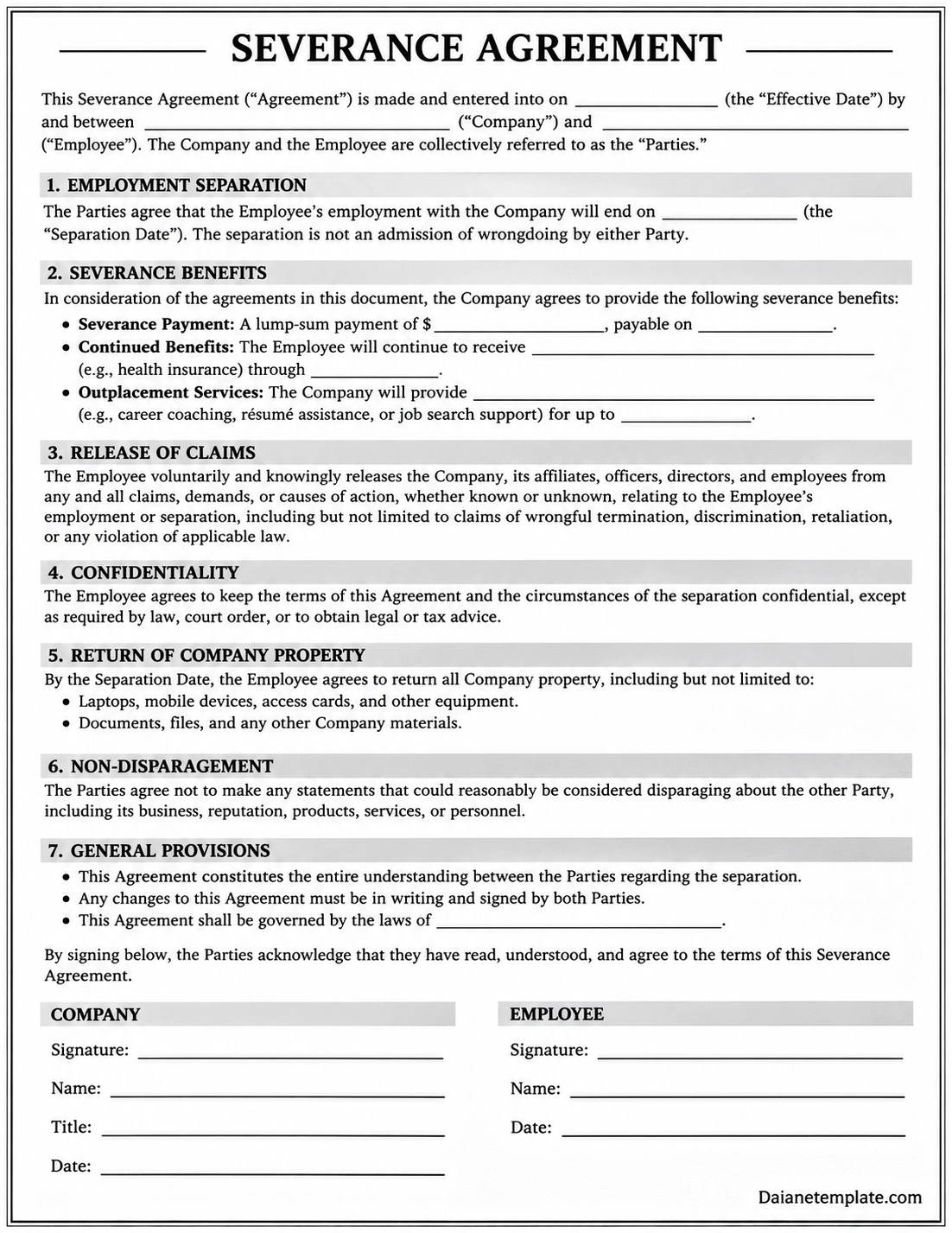
A severance agreement template can help employers organize the main terms of an employment separation. The following simplified example illustrates a typical document structure. It is for general informational purposes and should not be treated as a ready-to-sign legal contract.
Severance Agreement Sample
SEVERANCE AGREEMENT
Effective Date: [Date]
This Severance Agreement (“Agreement”) is entered into by and between [Company Legal Name] (“Company”) and [Employee Full Name] (“Employee”). The parties agree to the following terms regarding the Employee’s separation from employment.
1. Employment Separation
The Employee’s employment with the Company will end effective [Separation Date]. The parties acknowledge that this Agreement establishes certain terms related to the Employee’s departure.
2. Severance Benefits
Subject to the terms of this Agreement, the Company agrees to provide the following benefits:
- Severance payment of [Amount], payable according to the schedule described in this Agreement.
- Continued benefits, if applicable, through [Date] and subject to the relevant plan terms.
- Outplacement or career transition assistance, if applicable, for [Period].
3. Release of Claims
In exchange for the severance benefits, the Employee agrees to release only those claims that may lawfully be released under applicable law and that are specifically described in the final Agreement. Nothing in this provision is intended to waive rights that cannot legally be waived.
4. Confidential Information
The Employee agrees to continue protecting the Company’s confidential information and trade secrets in accordance with applicable law and any surviving contractual obligations. This provision does not restrict legally protected disclosures or communications with government agencies.
5. Return of Company Property
The Employee agrees to return Company property in their possession by [Return Date], following the Company’s reasonable return procedures.
6. Additional Terms
Any additional terms, including applicable non-disparagement provisions, governing law, and dispute resolution procedures, will be set out in the final Agreement and must comply with applicable law.
7. Acknowledgment and Signatures
By signing, the parties acknowledge that they have reviewed the Agreement and understand its terms. Any legally required review or revocation period will be observed.
Company Representative: [Name and Title]
Signature: __________________________
Date: __________________________
Employee: [Full Name]
Signature: __________________________
Date: __________________________
This sample is intentionally simplified. A real severance agreement may require additional clauses, specific legal disclosures, and jurisdiction-specific language. Have an employment attorney review the document before using it.
How to Review a Severance Agreement Before Signing
Employees should take time to understand the entire agreement before accepting a severance offer. Signing may involve giving up certain legal claims or accepting continuing obligations.
Use the following steps as a practical review checklist.
1. Check the Severance Payment
Confirm the amount, payment schedule, tax withholding, and conditions for receiving the payment. Compare the offer with your employment contract, company policy, and any applicable legal entitlements.
2. Review Health and Other Benefits
Understand when current benefits end and whether the employer is offering any continuation assistance. Ask about insurance premiums, enrollment deadlines, and alternative coverage options.
3. Understand the Release of Claims
Read the release section carefully. Identify which claims are covered, which rights are excluded, and whether the agreement contains any restrictions that could affect future employment or legal action.
4. Check Confidentiality and Other Restrictions
Review confidentiality, non-disparagement, cooperation, and other post-employment clauses. Make sure you understand their scope and whether they are consistent with applicable legal protections.
5. Confirm the Review Period
Check whether the agreement provides time to consider the offer and whether a revocation period applies after signing. Do not assume that every agreement has the same deadline.
6. Seek Independent Legal Advice
An employment attorney can explain the agreement’s legal consequences, identify potential concerns, and help you evaluate whether the offered benefits are appropriate for your circumstances.
Can You Negotiate a Severance Agreement?
In many situations, an employee can ask the employer to negotiate the terms of a severance package. Whether the employer agrees depends on the circumstances, company policies, and applicable law.
Possible negotiation points include:
- Higher severance pay: Request an adjustment to the financial compensation.
- Extended benefits: Ask whether health insurance or other benefits can continue for a longer period.
- Additional transition support: Request career counseling, résumé assistance, or outplacement services.
- Reference arrangements: Ask for an agreed employment reference or confirmation of employment details.
- Payment timing: Discuss whether the payment schedule can be adjusted.
- Clause revisions: Request clarification or changes to provisions that are overly broad or unclear.
When negotiating, communicate professionally and keep a written record of proposed changes. Do not rely on verbal promises that are not included in the final agreement.
Common Mistakes to Avoid When Preparing or Signing a Severance Agreement
Severance agreements can have important financial and legal consequences. Avoiding common mistakes can help both employers and employees manage the separation process more carefully.
- Signing without reading: Review every section instead of focusing only on the payment amount.
- Ignoring the release of claims: Understand which legal rights may be affected.
- Overlooking payment details: Confirm the amount, timing, deductions, and conditions.
- Accepting unclear benefit terms: Ask for specific information about insurance and other benefits.
- Using overly broad restrictions: Ensure confidentiality and non-disparagement clauses respect applicable legal protections.
- Missing important deadlines: Keep track of signing, review, and revocation periods.
- Relying on an unsuitable template: Adapt the document to the relevant jurisdiction and circumstances.
- Failing to get legal advice: Seek professional guidance when the agreement involves significant compensation or potential legal claims.
Frequently Asked Questions About Severance Agreements
What is the purpose of a severance agreement?
A severance agreement establishes the terms of an employee’s departure. It may provide financial benefits, explain post-employment obligations, and include a release of certain legal claims in exchange for the agreed benefits.
Is a severance agreement legally binding?
A severance agreement may become legally binding when it is properly formed and signed, provided its terms meet applicable legal requirements. However, certain provisions may be unenforceable if they violate employment laws or restrict rights that cannot legally be waived.
Is an employee required to sign a severance agreement?
Not necessarily. Whether an employee must sign depends on the circumstances and applicable law. However, an employer may condition certain additional severance benefits on the employee accepting a valid agreement. Employees should understand which payments or benefits are already legally owed before deciding.
Can you negotiate a severance agreement?
Yes, severance terms may be negotiable. Employees can request changes to payment amounts, benefit continuation, reference arrangements, deadlines, or contract language. The employer is not necessarily required to accept every proposed change.
What is a release of claims in a severance agreement?
A release of claims is a provision in which an employee agrees not to pursue certain legal claims against the employer in exchange for the agreed consideration. The scope and enforceability of the release depend on applicable law.
How much severance pay should an employee receive?
There is no universal severance amount. Compensation may depend on employment contracts, company policies, length of service, position, negotiation, and local legal requirements. Some employers use a formula based on years of service, while others offer a fixed amount.
Can an employee change their mind after signing?
It depends on the agreement and applicable law. Some agreements provide a revocation period, and certain laws require specific review and cancellation rights for particular employees. Employees should check the exact deadlines and procedures before signing.
Does a severance agreement affect unemployment benefits?
It may affect the timing or eligibility for unemployment benefits depending on the jurisdiction and how severance payments are structured. Employees should check with the relevant unemployment agency rather than assuming that receiving severance automatically disqualifies them.
Does a severance agreement prevent an employee from reporting illegal activity?
A severance agreement generally cannot lawfully prevent protected reports to government agencies or other legally protected disclosures. The exact protections depend on the jurisdiction and circumstances. Employees should seek legal advice if a clause appears to restrict these rights.
Should an employee consult a lawyer before signing?
Legal advice is especially helpful when the agreement includes a broad release of claims, significant financial benefits, confidentiality restrictions, or other continuing obligations. An employment attorney can explain the terms and identify potential risks.
Final Thoughts
A severance agreement is an important document that defines the terms of an employment separation. It can provide financial support and transition benefits for employees while helping employers document their commitments and address certain legal risks.
Before preparing or signing an agreement, carefully review the payment terms, benefits, release of claims, confidentiality provisions, and other post-employment obligations. Clear wording and accurate information help both parties understand what they are agreeing to.
Because employment laws differ by jurisdiction, a generic severance agreement template should only be used as a starting point. Having the final document reviewed by a qualified employment attorney can help ensure that the agreement is appropriate, fair, and legally compliant.
Download: Severance Agreement Template
