When a problem occurs, it is tempting to fix whatever is immediately visible and move on. However, treating only the symptom often means the same problem will return later. Root cause analysis provides a structured way to investigate why a problem happened, identify the fundamental cause, and develop solutions that reduce the chance of recurrence.
Root cause analysis, often abbreviated as RCA, is used across many environments, including business operations, manufacturing, healthcare, technology, project management, quality control, and customer service. Rather than asking only, “What went wrong?” RCA encourages teams to ask, “Why did it happen?” and “What needs to change so it does not happen again?”
Whether you are investigating a process failure, recurring customer complaint, production issue, missed deadline, or system error, a structured RCA process can turn a frustrating problem into an opportunity for measurable improvement.
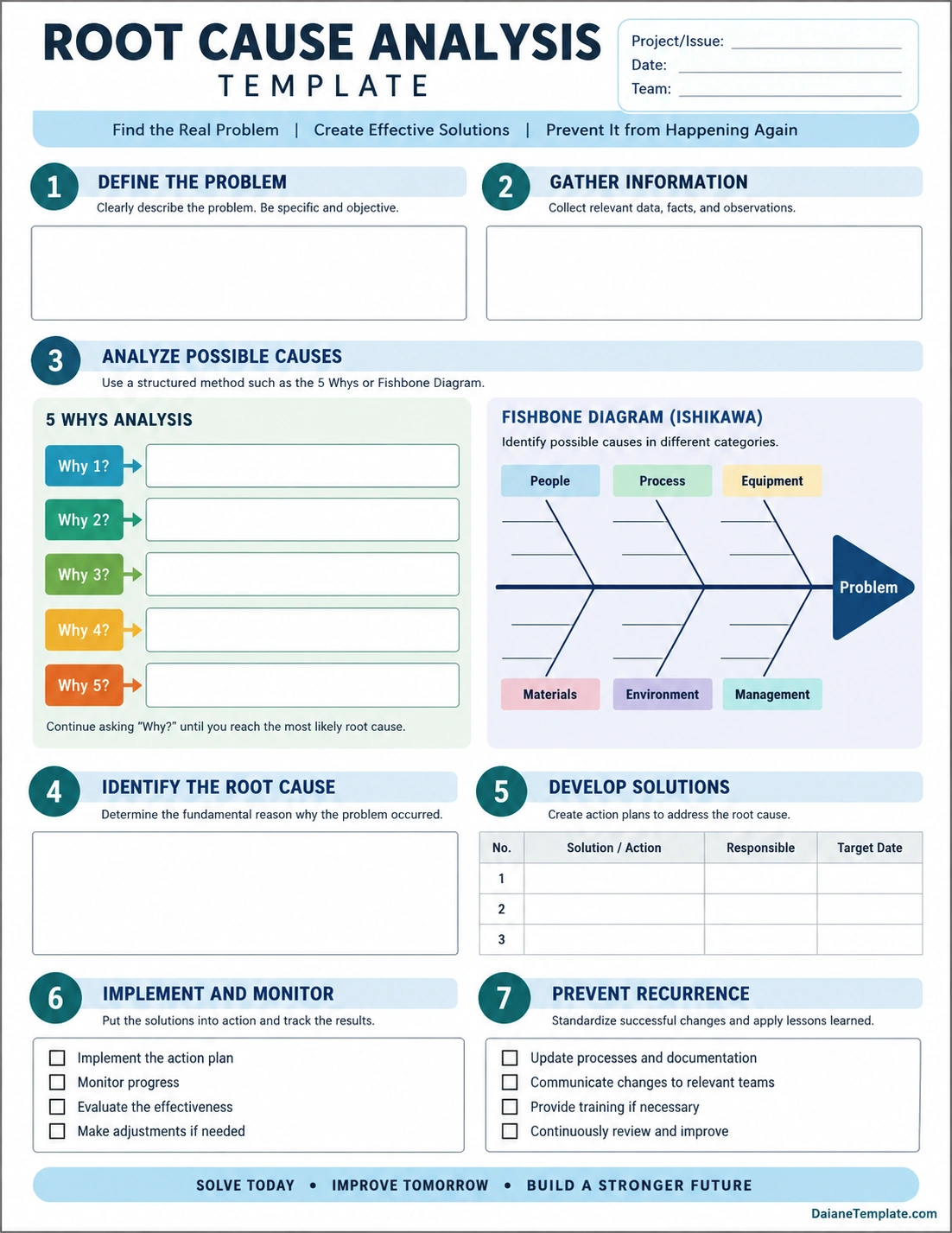
What Is Root Cause Analysis?
Root cause analysis is a systematic problem-solving method used to identify the underlying reasons a problem occurred. The objective is not simply to correct the immediate issue but to understand and address the conditions that allowed the issue to occur.
For example, imagine a company discovers that several customer orders were shipped late. A quick solution might be to ask employees to work faster. However, a deeper investigation could reveal that orders are being delayed because information is manually transferred between systems, creating a bottleneck.
In this situation, “employees are working too slowly” would not necessarily be the root cause. The underlying process problem may be responsible for the recurring delays.
A successful RCA therefore moves from the visible symptom toward the fundamental cause and then connects that cause to an appropriate corrective action.
Why Is Root Cause Analysis Important?
Organizations often spend considerable time reacting to problems. If the underlying cause is never addressed, however, the same issue can continue consuming resources.
A well-conducted root cause analysis can help organizations:
- Identify the fundamental reason behind a problem.
- Reduce recurring errors and failures.
- Improve business processes and workflows.
- Strengthen quality control and operational consistency.
- Reduce wasted time, resources, and effort.
- Improve customer satisfaction.
- Support better decision-making.
- Create opportunities for continuous improvement.
- Establish preventive actions instead of repeated temporary fixes.
RCA is particularly useful when a problem is recurring, costly, disruptive, or difficult to explain. It can also be valuable when an apparently simple problem has multiple contributing factors.
The Difference Between a Symptom and a Root Cause
One of the most important concepts in root cause analysis is distinguishing between a symptom, an immediate cause, and a root cause.
Symptom
A symptom is the visible indication that something has gone wrong. For example, a machine stops unexpectedly, a customer receives the wrong product, or a project misses its deadline.
Immediate Cause
The immediate cause is the direct event or condition that produced the problem. For example, a machine may stop because a component overheated.
Root Cause
The root cause is the fundamental condition that allowed the problem to occur or continue. The investigation might discover that the component overheated because preventive maintenance was not performed according to the required schedule.
Addressing the symptom may restore normal operations temporarily. Addressing the root cause can help prevent the same failure from happening again.
How to Perform a Root Cause Analysis
A useful RCA process does not need to be complicated. The following steps provide a practical framework for investigating problems systematically.
1. Clearly Define the Problem
Begin by describing exactly what happened. Avoid vague statements such as “the process is bad” or “the team made a mistake.” Instead, describe the problem using specific and observable information.
A good problem statement should explain:
- What happened?
- When did it happen?
- Where did it happen?
- How frequently does it occur?
- What was the expected result?
- What was the actual result?
- What impact did the problem create?
A precise problem statement gives the investigation a clear direction and prevents the team from investigating unrelated issues.
2. Gather Relevant Information
Next, collect facts about the problem. Depending on the situation, useful information may include process records, system logs, production data, customer feedback, inspection results, timelines, photographs, or employee observations.
Try to separate verified facts from assumptions. The goal is to understand what actually happened rather than immediately deciding why it happened.
3. Identify Possible Causes
Once the available information has been collected, brainstorm potential causes. Consider the people, processes, equipment, materials, environment, technology, policies, and management systems involved.
At this stage, avoid immediately selecting one explanation. A problem can have several contributing factors, and exploring multiple possibilities can prevent premature conclusions.
4. Use the 5 Whys Technique
The 5 Whys technique is one of the simplest tools for root cause analysis. It involves repeatedly asking “Why?” to move from an observed problem toward a deeper underlying cause.
For example:
- Problem: A customer order was shipped late.
- Why 1? The order was not processed on time.
- Why 2? The required information was missing.
- Why 3? The information was not automatically transferred from the sales system.
- Why 4? The two systems were not properly integrated.
- Why 5? The integration requirement was not included in the original process design.
The exact number of questions does not always need to be five. The important principle is to continue asking why until the investigation reaches a controllable and meaningful underlying cause.
5. Use a Fishbone Diagram
A Fishbone Diagram, also called an Ishikawa Diagram or cause-and-effect diagram, helps organize possible causes into categories.
Common categories can include:
- People
- Process
- Equipment
- Materials
- Environment
- Management
This approach is especially useful when a problem may have several contributing factors. Instead of focusing on one explanation, the team can visually examine different areas that may have influenced the outcome.
6. Determine the Root Cause
After analyzing the evidence and possible causes, identify the cause or causes that best explain why the problem occurred.
A useful root cause should be supported by evidence rather than intuition alone. It should also be specific enough that the organization can take meaningful action against it.
Ask questions such as:
- Does the evidence support this cause?
- Would removing this cause prevent the problem from recurring?
- Is this actually a cause, or is it another symptom?
- Can the organization influence or control this factor?
- Are there additional contributing causes?
7. Develop Corrective Actions
Once the root cause has been identified, create an action plan that directly addresses it. Each action should have a clear owner and target date.
Effective corrective actions may include updating procedures, improving system controls, changing workflows, modifying equipment, improving documentation, providing training, or introducing automated checks.
Whenever possible, design solutions that make the desired behavior easier and reduce dependence on memory or individual attention.
8. Implement and Monitor the Solution
Implement the corrective actions and monitor whether they actually solve the problem. A solution should not be considered successful simply because the team completed the action plan.
Define measurable indicators where appropriate. Compare results before and after implementation and look for evidence that the original problem has decreased or disappeared.
9. Prevent Recurrence
The final stage is to make successful improvements part of the normal process. Update procedures, documentation, training materials, checklists, system controls, or quality standards as necessary.
Lessons learned should also be communicated to relevant teams so that similar problems can be prevented elsewhere in the organization.
Common Root Cause Analysis Tools
5 Whys
The 5 Whys method is simple, fast, and practical for problems with a relatively straightforward cause-and-effect relationship.
Fishbone Diagram
The Fishbone Diagram is useful for organizing multiple possible causes and encouraging a broader investigation.
Pareto Analysis
Pareto analysis helps teams identify which categories or causes contribute most significantly to a problem. It can be useful when an organization has many potential issues but limited resources for corrective action.
Fault Tree Analysis
Fault Tree Analysis uses a logical structure to explore how different conditions or failures can combine to produce an unwanted event. It is often useful for more complex technical or safety-related investigations.
Common Mistakes to Avoid During RCA
Even a structured investigation can produce weak results if the team approaches it incorrectly. Avoid these common mistakes:
- Stopping at the first explanation: The first cause discovered may only be an immediate cause.
- Blaming individuals too quickly: Human error can sometimes be a symptom of inadequate processes, training, tools, or controls.
- Using assumptions instead of evidence: Verify important conclusions with data whenever possible.
- Focusing only on one department: Problems often cross organizational or process boundaries.
- Creating corrective actions unrelated to the cause: Every action should connect logically to an identified cause.
- Failing to monitor results: An implemented solution still needs to be evaluated.
- Ignoring prevention: The goal is not only to fix today’s problem but also to reduce the likelihood of recurrence.
Tips for an Effective Root Cause Analysis
Keep the investigation focused on facts, evidence, and process improvement. A few practical habits can make RCA more effective:
- Write a specific and measurable problem statement.
- Gather evidence before forming conclusions.
- Involve people who understand the affected process.
- Consider multiple possible causes.
- Use the 5 Whys when the cause-and-effect relationship is relatively simple.
- Use a Fishbone Diagram when several categories may contribute to the problem.
- Distinguish contributing factors from the fundamental root cause.
- Assign clear owners and deadlines to corrective actions.
- Measure whether the solution actually works.
- Document lessons learned and update the relevant process.
Using a Root Cause Analysis Template
A root cause analysis template can make the investigation easier to organize and document. Instead of starting with a blank page, a structured worksheet provides dedicated areas for defining the problem, gathering information, analyzing possible causes, identifying the root cause, planning corrective actions, and preventing recurrence.
A practical RCA template can also improve consistency when different teams investigate different problems. Everyone can follow the same basic structure while adapting the analysis to the specific situation.
For recurring operational problems, keeping completed RCA worksheets can create a useful record of past issues, solutions, and lessons learned.
Conclusion
Root cause analysis is a practical approach to solving problems at their source rather than repeatedly treating their symptoms. By clearly defining the problem, gathering evidence, examining possible causes, identifying the fundamental cause, implementing corrective actions, and monitoring the results, organizations can create more reliable and sustainable improvements.
Whether you use the 5 Whys, a Fishbone Diagram, Pareto analysis, or another RCA method, the most important principle is to investigate systematically and base conclusions on evidence. A well-structured root cause analysis can turn recurring problems into opportunities to improve processes, systems, and long-term performance.
Download: Root Cause Analysis Template
