A power of attorney revocation form is a written document used by a principal to formally cancel a previously granted power of attorney. It communicates that the agent’s authority is being revoked and provides a clear record that the principal no longer intends for that person to act on their behalf under the previous power of attorney.
Revoking a power of attorney can be important when the principal no longer wants the agent to have authority, when the purpose of the original document has ended, when a different agent is being appointed, or when circumstances surrounding the original authorization have changed. A written revocation can also help notify organizations and other third parties that may have previously relied on the original power of attorney.
However, the legal requirements for revoking a power of attorney can vary by jurisdiction and by the type of power of attorney involved. Some situations may involve additional signing, witnessing, notarization, recording, or notice requirements. For that reason, a general revocation form should be reviewed against the applicable law before it is used.
What Is a Power of Attorney Revocation Form?
A power of attorney revocation form is a formal written statement that identifies a previously created power of attorney and states that the principal is revoking the authority granted to the agent.
The person who originally granted the authority is generally called the principal, while the person who received authority is commonly called the agent or attorney-in-fact.
A revocation document commonly identifies:
- The principal
- The agent whose authority is being revoked
- The original power of attorney
- The date of the original document
- The effective date of the revocation
- The powers or authority being terminated
- Notice to relevant third parties
- The principal’s signature and date
Why Revoke a Power of Attorney?
A principal may decide to revoke a power of attorney for many different reasons. The decision may be based on a change in circumstances rather than any wrongdoing by the agent.
The Agent Is No Longer Needed
A power of attorney may have been created for a specific task or period. Once that purpose has been completed, the principal may no longer want the agent to continue acting under the authorization.
The Principal Wants a Different Agent
A principal may decide to appoint someone else to handle their affairs. In that situation, it is important to understand how the new document interacts with the old one and whether a separate revocation is appropriate under applicable law.
The Relationship Has Changed
Changes in personal, professional, or family relationships may lead a principal to reconsider who should have authority to act on their behalf.
The Principal No Longer Trusts the Agent
If the principal no longer wants a particular person to have authority over their affairs, formally documenting the revocation can help communicate that decision to the agent and relevant third parties.
The Agent Is Unable or Unwilling to Continue
An agent may become unavailable, unwilling to serve, or otherwise unable to continue performing the role. Depending on the circumstances, the principal may need to revoke the existing authority and appoint another agent.
What Does a Power of Attorney Revocation Do?
The primary purpose of a revocation is to formally communicate that the principal is ending the authority previously granted under the identified power of attorney.
For example, the Superior Court of California, County of Santa Clara explains that a power of attorney can be canceled in writing and advises providing the cancellation or new power of attorney to institutions such as banks or stockbrokers that had the old document.
The practical effect of a revocation can depend on the jurisdiction, the type of power of attorney, and whether a third party has already relied on the original document. Some laws address the effect of termination on people who acted without actual knowledge that the authority had ended.
Important Information to Include
A well-organized power of attorney revocation form should identify the original authorization as clearly as possible. This reduces uncertainty about which document is being canceled.
Principal Information
Include the principal’s full legal name and appropriate contact information. The principal is the person who originally granted the power of attorney.
Agent Information
Identify the agent whose authority is being revoked. Including the agent’s full name and available contact information can make the notice easier to identify and deliver.
Original Power of Attorney Information
Identify the original power of attorney by its date and type. If the original document has a document number, recording information, or other identifying information, those details may also be useful when applicable.
Revocation Statement
The document should clearly state that the principal revokes, cancels, or terminates the identified power of attorney and the authority granted to the agent.
Effective Date
State when the revocation is intended to take effect, subject to any requirements imposed by applicable law.
Signature and Date
The principal should sign and date the document according to the applicable requirements. Depending on the jurisdiction and document involved, additional formalities may apply.
How to Revoke a Power of Attorney
The specific process should be determined by the law governing the power of attorney. A general process may involve several practical steps.
1. Identify the Original Power of Attorney
Locate a copy of the existing power of attorney and review its terms. Check whether it contains instructions concerning revocation, successor agents, notices, or other relevant procedures.
2. Prepare the Revocation
Prepare a written revocation that clearly identifies the principal, agent, and original power of attorney. Avoid vague language that could create uncertainty about which authority is being canceled.
3. Follow Required Formalities
Check whether the revocation must be notarized, witnessed, recorded, or executed in another specific manner. Requirements differ depending on the jurisdiction and type of power of attorney.
4. Notify the Agent
Provide the agent with notice of the revocation. Keeping evidence of delivery can be useful for recordkeeping.
5. Notify Relevant Third Parties
Identify organizations that may have relied on the original power of attorney. Depending on the situation, these may include financial institutions, government agencies, insurance companies, businesses, healthcare organizations, or other entities.
California court guidance specifically advises providing written cancellation or the new power of attorney to institutions that had the old document.
6. Keep Copies of the Documents
Keep copies of the signed revocation, delivery records, notices, and relevant correspondence. These records can help demonstrate that the principal took steps to communicate the termination.
Power of Attorney Revocation Form Template
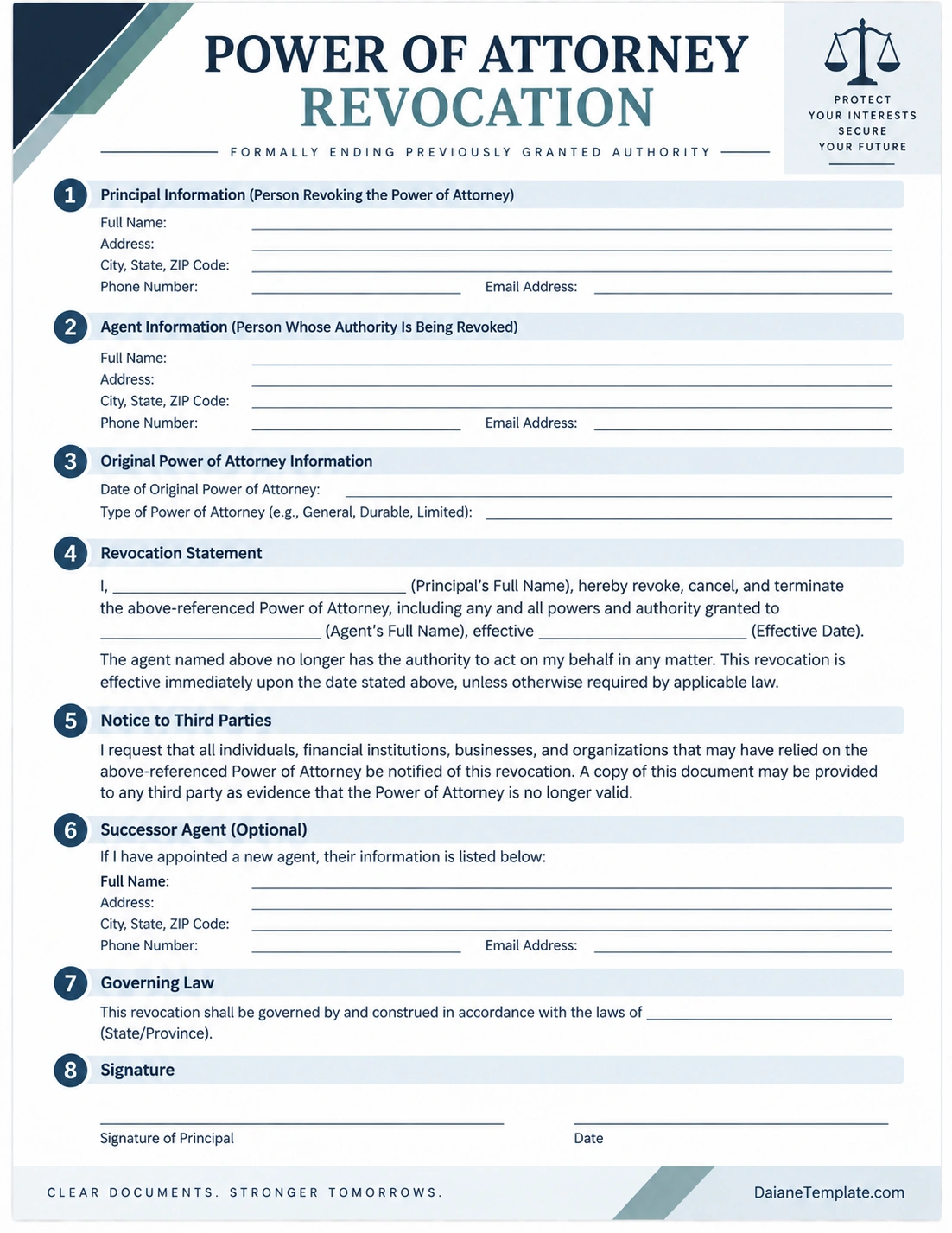
A power of attorney revocation form template can provide a structured starting point for documenting the principal’s decision. A practical form may include sections for principal information, agent information, details of the original power of attorney, a formal revocation statement, third-party notice, successor agent information, governing law, and signatures.
The template should not be treated as a universal legal form. Before signing, compare its requirements with the laws and formalities applicable to the specific power of attorney.
Notifying Third Parties About the Revocation
Simply preparing a revocation may not be enough from a practical standpoint. Organizations that have previously received or relied on the power of attorney may need to be informed that the agent’s authority has changed.
Consider identifying relevant third parties that may have received the original document, such as:
- Banks and financial institutions
- Investment or brokerage firms
- Insurance companies
- Government agencies
- Healthcare organizations, when applicable
- Businesses or organizations involved in transactions handled by the agent
- Other institutions known to have relied on the original power of attorney
The appropriate notification process depends on the organization and applicable law. Some institutions may have their own procedures or documentation requirements.
What Happens After a Power of Attorney Is Revoked?
After a valid revocation takes effect, the former agent generally should no longer exercise authority under the revoked power of attorney. However, the practical effect on third parties can depend on whether they have received notice and what the applicable law provides.
For example, Texas statutory materials address circumstances in which termination may not be effective against a person who, without actual knowledge of the termination, acts in good faith in reliance on a power of attorney.
This is one reason timely notification can be important. The principal should consider informing organizations that may continue to recognize the old document and should keep records showing when notice was provided.
Revoking a Durable Power of Attorney
A durable power of attorney is designed to continue under circumstances specified by applicable law, including situations involving incapacity. Revocation of a durable power of attorney can therefore require particular attention to the governing document and local requirements.
For example, Texas materials distinguish a statutory durable power of attorney from a medical power of attorney and explain that a statutory durable power of attorney concerns certain property-related authority rather than healthcare decisions.
Because durable powers of attorney can involve significant legal authority, anyone preparing a revocation should verify the applicable requirements rather than assuming that a generic form will satisfy every jurisdiction.
Common Mistakes to Avoid
Revoking an important legal authorization requires careful attention to detail. The following mistakes can create unnecessary uncertainty.
- Failing to identify the original document: Include enough information to distinguish the power of attorney being revoked.
- Using vague language: State clearly that the authority is being revoked or terminated.
- Ignoring formal requirements: Check whether witnesses, notarization, recording, or other procedures apply.
- Failing to notify relevant institutions: Organizations that previously relied on the document may need to receive notice.
- Not keeping proof of notice: Retain copies of notices and delivery records.
- Assuming a new power of attorney automatically solves everything: Determine whether the old document must also be expressly revoked.
- Using the wrong type of form: A healthcare authorization and a financial or property power of attorney may be governed by different rules.
Revocation Form vs. New Power of Attorney
A revocation form and a new power of attorney serve different purposes. A revocation communicates that an existing authority is being canceled, while a new power of attorney appoints or authorizes an agent under a new document.
In some circumstances, creating a new power of attorney may affect an earlier document, but the legal effect depends on the governing law and the wording of the documents. Some jurisdictions expressly address whether a later power of attorney revokes an earlier one and under what circumstances.
For that reason, it is important to review both documents and applicable law when replacing an agent.
Tips for Using a Power of Attorney Revocation Form
- Use the principal’s correct legal name.
- Identify the former agent accurately.
- Reference the date and type of the original power of attorney.
- State the revocation clearly.
- Use the required signing formalities for the applicable jurisdiction.
- Provide notice to the former agent.
- Notify relevant third parties that may have relied on the original document.
- Keep signed copies and evidence of delivery.
- Review any replacement power of attorney separately.
- Seek legal advice when the situation involves substantial assets, incapacity, disputes, or uncertainty about the applicable requirements.
Is a Power of Attorney Revocation Form Legally Binding?
A revocation can have legal effect when it is properly executed and used in accordance with the applicable law. However, there is no single universal procedure that applies to every power of attorney in every jurisdiction.
For example, California court guidance states that a power of attorney can be canceled in writing and that institutions holding the old document should be provided with the cancellation or new power of attorney. Other jurisdictions may impose different requirements.
Therefore, a general template should be viewed as a drafting aid rather than a guarantee that the document satisfies every legal requirement. When the authority concerns significant financial, property, healthcare, or legal matters, professional legal advice can help determine the appropriate procedure.
Final Thoughts on Power of Attorney Revocation Forms
A power of attorney revocation form provides a clear written way to document the principal’s decision to end previously granted authority. By identifying the original power of attorney, stating the revocation clearly, following applicable formalities, and notifying relevant parties, the principal can create a stronger administrative record of the change.
Because power of attorney laws and procedures vary by jurisdiction and by document type, a generic revocation form should be customized and reviewed before it is signed. A properly prepared document, combined with timely notice to the appropriate parties, can help reduce confusion about whether a former agent still has authority to act.
Download: Power of Attorney Revocation Form
