A settlement agreement of divorce is a written document that explains how spouses will resolve important matters when ending their marriage. It can cover property division, debt responsibilities, child custody, parenting time, child support, and spousal support. By reaching an agreement, spouses may be able to settle some or all of their divorce issues without asking a judge to decide every detail.
Creating a clear divorce settlement agreement can make the process more organized and help both spouses understand their rights and responsibilities after separation. However, an agreement should be carefully prepared, reviewed, and submitted according to the rules of the state where the divorce is filed.
What Is a Settlement Agreement of Divorce?
A settlement agreement of divorce is a written arrangement between two spouses that outlines the terms they have agreed to follow during and after their divorce. It is also commonly called a marital settlement agreement, divorce settlement agreement, or marital separation agreement.
The document records decisions about financial matters, property, debts, children, and other responsibilities. Instead of leaving every disputed issue for a court hearing, spouses can negotiate terms and put their mutual decisions in writing.
Depending on state law and the circumstances of the case, the agreement may be submitted to the court for review and incorporated into the final divorce judgment. Once approved or made part of a court order, its terms may become legally enforceable.
What Should a Divorce Settlement Agreement Include?
A complete divorce settlement agreement should address the issues that apply to the spouses’ situation. The exact requirements vary by state, but most agreements cover several important areas.
1. Information About Both Spouses
Start by identifying both parties and providing basic information about the marriage and divorce case. This section helps make it clear who is entering into the agreement.
- Full legal name of each spouse
- Current mailing address for each party
- Date of marriage
- Date of separation, if applicable
- County and state where the divorce case is filed
- Court case number, if one has been assigned
2. Division of Marital Property
Property division explains how the spouses will distribute assets acquired during the marriage. Depending on applicable law, the agreement may need to distinguish marital property from separate property.
Common assets to address include:
- Family home and other real estate
- Vehicles, boats, and recreational property
- Bank accounts and savings
- Retirement accounts and pensions
- Investments and business interests
- Furniture, appliances, jewelry, and personal belongings
Be specific about who receives each asset, whether one spouse must make an equalization payment, and when any required transfer must take place. For valuable assets, consider obtaining an appropriate valuation before agreeing on the division.
3. Division of Debts and Financial Obligations
A divorce settlement should explain how shared debts and financial obligations will be handled. These may include mortgages, vehicle loans, credit card balances, personal loans, and other liabilities.
For each debt, identify the account or obligation, the agreed responsible party, the payment arrangement, and any deadline for refinancing or transferring the account. An agreement between spouses does not automatically release either person from a lender’s contract. Contact the lender to understand what is required to remove a spouse from a joint account or loan.
4. Child Custody and Parenting Time
If the spouses have children, the agreement should include a practical parenting plan. It should explain how important decisions will be made and how the children will spend time with each parent.
Consider including:
- Legal custody and decision-making responsibilities
- Physical custody or residential arrangements
- Regular weekday and weekend parenting schedules
- Holiday and school-break schedules
- Vacation arrangements and travel notices
- Transportation and exchange arrangements
- Communication between parents and children
- Procedures for handling future scheduling disagreements
Parenting arrangements should focus on the children’s needs and applicable best-interest standards. A court may review the proposed plan and is not necessarily required to approve every term simply because both parents agree.
5. Child Support
The child support section should explain the financial support arrangement for the children. Depending on state requirements, it may identify the paying parent, payment amount, payment frequency, start date, and method of payment.
It may also address health insurance, childcare expenses, school costs, extracurricular activities, and medical expenses not covered by insurance. Child support rules and calculation guidelines differ by state. Parents should check the applicable guidelines before agreeing on an amount.
6. Spousal Support or Alimony
Spousal support, sometimes called alimony or maintenance, refers to financial payments one spouse may make to the other after separation or divorce.
If support is agreed upon, the document should clearly state:
- Whether support will be paid
- The amount of each payment
- How frequently payments must be made
- The date payments begin
- The expected duration of payments
- Any conditions that may end or change the obligation
If neither spouse will receive support, the agreement should state that decision clearly and use wording appropriate under the relevant state law. Because support waivers can have significant long-term consequences, both parties should understand the effect before signing.
7. Additional Terms and Responsibilities
Some divorces involve arrangements that do not fit neatly into the main sections. Additional provisions may cover tax-related responsibilities, insurance, name changes, attorney fees, personal property exchanges, or deadlines for completing specific obligations.
Use clear language and realistic deadlines. Avoid vague statements such as “the parties will divide the remaining property fairly.” Instead, identify the property and explain exactly what each spouse has agreed to do.
How to Create a Settlement Agreement of Divorce
Preparing an agreement requires more than filling in names and signing a document. Both spouses should understand their financial circumstances and carefully consider the long-term effects of each decision.
Step 1: Gather Financial Information
Collect accurate information about income, expenses, property, bank accounts, retirement benefits, loans, and other financial obligations. Full financial disclosure helps both spouses make informed decisions and reduces the risk of overlooking important assets or debts.
Step 2: Discuss and Negotiate the Terms
Review each issue separately and identify where you already agree. Discuss unresolved matters calmly and consider mediation if direct negotiations become difficult. Do not feel pressured to accept terms that you do not understand or have not had enough time to review.
Step 3: Put Every Agreement in Writing
Write down the decisions in clear, specific language. Include payment amounts, due dates, property descriptions, responsibilities, and completion deadlines where applicable. Make sure the document covers every issue that must be resolved in your case.
Step 4: Review the Document Carefully
Check names, dates, financial figures, account information, and all agreed terms. Both spouses should have an opportunity to review the complete document. Independent legal advice is especially important when the agreement involves significant assets, retirement benefits, children, or spousal support.
Step 5: Sign and Follow the Court’s Filing Requirements
Follow the signing, notarization, disclosure, and filing requirements that apply in your state and court. Some courts provide required forms or specific language that must accompany a marital settlement agreement.
Submitting a signed agreement does not necessarily mean the divorce is final. The court may need to review the paperwork and issue a final judgment or order. Check the local court’s instructions before assuming that the agreement has been accepted.
Printable Settlement Agreement of Divorce Template
A printable settlement agreement of divorce template can help spouses organize the main terms of their proposed arrangement. A blank form is useful for listing the parties, recording important decisions, and identifying sections that still need to be discussed.
The template below is a general organizational worksheet. It is not an official court form and may not contain every provision required by your state. Use it as a starting point, then compare it with your local court’s requirements and obtain legal advice when appropriate.
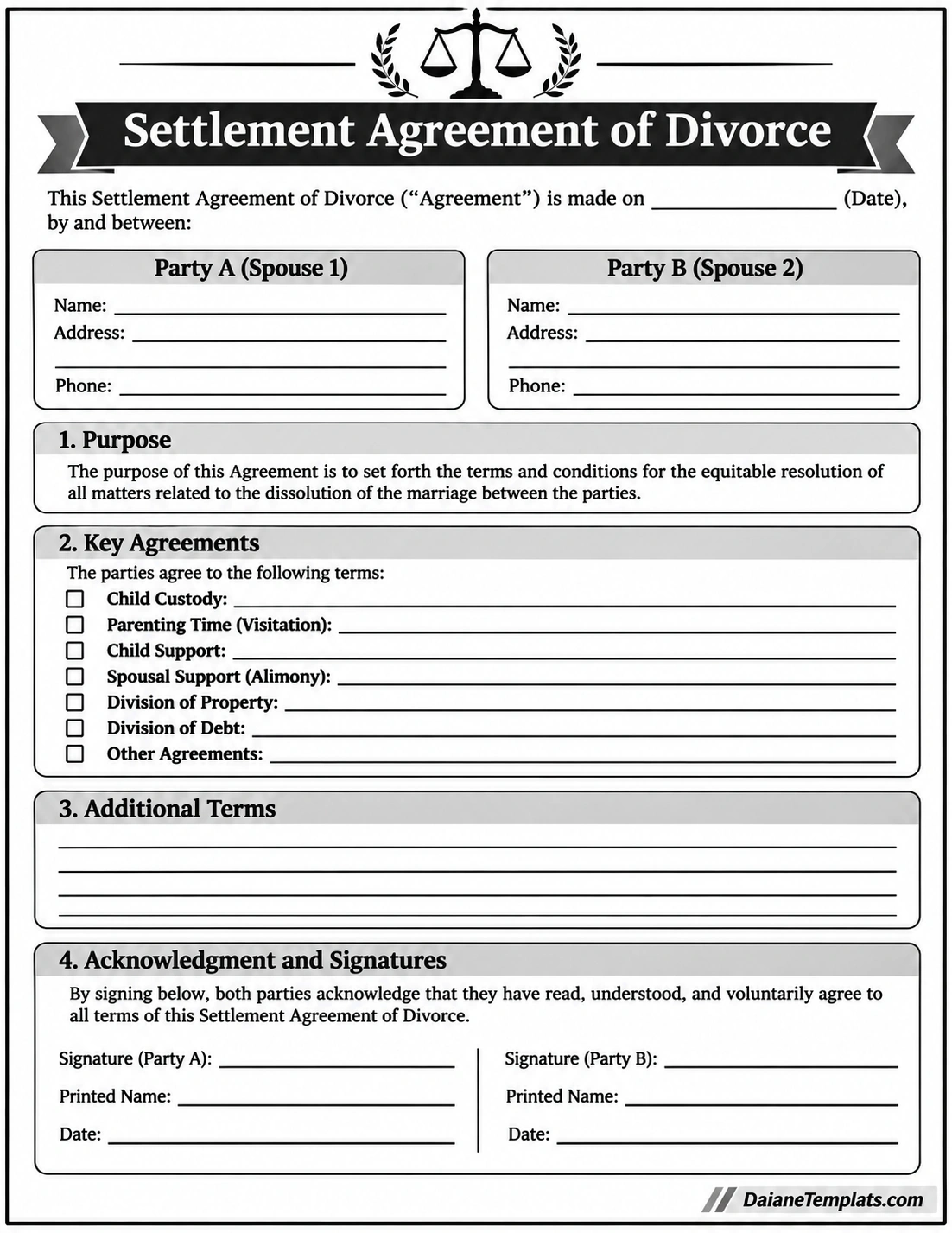
Before using a blank divorce settlement form, consider whether it addresses all relevant matters, including property, debts, parenting arrangements, and financial support. Add state-specific provisions or required court forms where necessary. Do not assume that signing a general template alone makes the divorce legally final.
Common Mistakes to Avoid
A poorly prepared agreement can create confusion and disagreements long after the divorce. Pay attention to these common mistakes before signing.
- Leaving important terms unclear: Specify who is responsible for each payment, transfer, or task.
- Overlooking assets or debts: Review financial records and disclose relevant information before negotiating.
- Ignoring retirement accounts: Some retirement benefit transfers require separate documents or court orders.
- Using an unrealistic parenting schedule: Consider school, work, transportation, holidays, and the children’s routines.
- Assuming child support is entirely negotiable: State guidelines and court review may apply.
- Signing under pressure: Both spouses should understand the terms and agree voluntarily.
- Skipping local court requirements: A court may require additional forms, disclosures, or specific wording.
Frequently Asked Questions About Divorce Settlement Agreements
1. What is the difference between a divorce settlement agreement and a divorce decree?
A divorce settlement agreement records the terms the spouses have negotiated. A divorce decree, or final judgment, is the court’s official decision that legally ends the marriage. Depending on the case and state procedure, the settlement agreement may be incorporated into or attached to the final judgment.
2. Is a settlement agreement of divorce legally binding?
It may be legally binding, but the effect depends on state law, how the agreement was prepared and signed, and whether court approval is required. When its terms are incorporated into a court order, they may be enforceable through the court. Get advice about the legal effect of your specific document before relying on it.
3. Do both spouses have to sign a divorce settlement agreement?
Generally, a negotiated agreement requires both spouses to accept and sign its terms. The exact signing and filing requirements vary by jurisdiction. A spouse who does not agree may need to resolve disputed issues through negotiation, mediation, or court proceedings.
4. Can we create our own divorce settlement agreement without a lawyer?
Some spouses prepare their own agreements, particularly when the divorce is uncontested and their circumstances are straightforward. However, state-specific rules may require particular language or additional documents. Legal review is advisable when the agreement involves children, substantial assets, complex debts, or retirement benefits.
5. Does a divorce settlement agreement need to be notarized?
Notarization requirements depend on the state, court forms, and type of document. Some agreements may require notarized signatures, while others may not. Check the instructions for the court handling your divorce before signing.
6. Can a divorce settlement agreement be changed after signing?
It depends on the terms, applicable law, and whether the agreement has become part of a court order. Property division provisions may be difficult to change, while certain child-related or support provisions may be modifiable under specific circumstances. A court order generally cannot be changed simply through an informal conversation between former spouses.
7. What happens if one spouse does not follow the agreement?
If an agreement has been incorporated into a court order, the other spouse may be able to ask the court to enforce the relevant terms. The available procedure depends on the order and state law. Keep copies of the signed agreement, court orders, payment records, and relevant communications.
8. Can we use a free printable divorce settlement agreement template?
A free printable template can help organize proposed terms and prepare for discussions. However, a general template may not satisfy your state’s legal requirements or address every issue in your case. Review the document against local court instructions before using it for an actual divorce filing.
Conclusion
A well-prepared settlement agreement of divorce gives spouses a written record of how they plan to resolve important matters after ending their marriage. By addressing property, debts, child custody, parenting time, child support, and spousal support in clear language, both parties can better understand their responsibilities and reduce the potential for future misunderstandings.
Take time to gather financial information, discuss each issue carefully, and review the complete document before signing. A printable divorce settlement agreement template can be a helpful starting point, but it should always be adapted to the applicable state laws and court requirements. When important legal or financial interests are involved, consider consulting a qualified family law attorney.
Download: Settlement Agreement of Divorce Template
