A patient registration form is a document used by healthcare providers to collect essential information from a new or returning patient. It commonly includes personal details, contact information, medical history, insurance information, emergency contacts, and required consent or acknowledgment fields.
Accurate registration information helps a healthcare practice establish the patient’s account, connect the patient with the appropriate medical record, support billing and insurance processes, and provide clinicians with important background information for care. A clear registration process can also reduce duplicate data entry and make the patient’s first interaction with a healthcare office more organized.
Whether used by a doctor’s office, medical clinic, dental practice, specialist, outpatient facility, or other healthcare organization, a well-designed patient registration form provides a practical starting point for collecting information needed for administrative and clinical workflows.
What Is a Patient Registration Form?
A patient registration form is a standardized document that collects information needed to register a patient with a healthcare provider. It is often completed before or during a patient’s first appointment and may be updated when important information changes.
The form typically creates or confirms the patient’s administrative record and helps the healthcare organization connect the patient with the appropriate medical information. Depending on the practice, registration may be completed on paper, through an online portal, or using a combination of both methods.
A new patient registration form may contain more detailed questions than a form used for an established patient because a new patient needs to provide information that the healthcare organization does not already have.
Why Is Patient Registration Important?
Patient registration is an important part of the healthcare administrative process. Accurate information can help staff communicate with patients, process insurance claims, maintain records, and prepare clinicians for appointments.
A structured registration process can help with:
- Patient identification: Establishes basic information needed to create or locate the correct patient record.
- Communication: Provides current phone, email, address, and preferred contact information.
- Medical background: Gives the healthcare team relevant information about medical history, medications, and allergies.
- Insurance processing: Collects information that may be needed for eligibility checks and claims processing.
- Emergency communication: Records an emergency contact when appropriate.
- Administrative efficiency: Gives staff a standardized way to collect important information.
- Care coordination: Can provide information about primary care providers, pharmacies, and other relevant healthcare relationships.
What Information Should a Patient Registration Form Include?
The exact information required varies by healthcare organization, specialty, location, and purpose. A registration form should collect information that is relevant to the patient’s care and administrative needs.
Patient Personal Information
The first section generally collects basic identifying and contact information. Common fields include:
- Full legal name
- Date of birth
- Address
- Phone number
- Email address
- Preferred contact method
- Relevant demographic information required by the practice
Healthcare organizations should request only the information needed for legitimate administrative, clinical, legal, or operational purposes.
Emergency Contact Information
An emergency contact section can provide the name, relationship, and contact information of a person the healthcare organization may contact when appropriate.
The practice should establish its own procedures for when and how emergency contact information may be used.
Insurance Information
Insurance information can help healthcare staff verify coverage and process claims. Depending on the practice and payer, the form may request information such as the insurance provider, member identification number, group number, policy number, and policyholder relationship.
Patients should provide current insurance information and notify the healthcare provider when their coverage changes.
Medical History
A patient registration form may include a basic medical history section to collect information that can be relevant to the patient’s care.
Depending on the type of practice, questions may address previous diagnoses, current medications, allergies, previous treatments, or other relevant medical history.
Medical history questions should be appropriate for the healthcare setting. A specialty clinic may need different information from a primary care practice, dental office, or physical therapy clinic.
Medication and Allergy Information
Current medications and known allergies can be important information for healthcare professionals. A form may provide space for patients to list medications, dosage information, and known allergies.
Patients should provide accurate information and tell their healthcare provider about any changes. Registration information does not replace a clinician’s medication reconciliation or medical assessment.
Primary Care and Pharmacy Information
Some healthcare practices request the name and contact information of the patient’s primary care provider or preferred pharmacy. This information may support communication and coordination when appropriate.
Consent and Acknowledgment
Healthcare organizations may include acknowledgment or consent sections as part of their registration process. The exact documents and language required depend on the healthcare organization, services provided, and applicable laws and regulations.
Types of Patient Registration Forms
Different healthcare settings may use different versions of registration forms depending on the information they need to collect.
New Patient Registration Form
A new patient registration form is designed for individuals who are establishing care with a healthcare provider for the first time. It commonly includes demographic, contact, insurance, medical history, and emergency contact information.
Returning Patient Registration Form
An established patient may need a shorter form to confirm that existing information remains accurate. Staff may ask the patient to update their address, phone number, insurance, emergency contact, medications, or other relevant information.
Medical Office Registration Form
A medical office registration form is generally designed for physician practices and outpatient clinics. Its contents may vary according to the type of care provided.
Specialty Patient Registration Form
Specialty practices may require additional questions that are specific to their services. For example, a specialty clinic may collect information related to previous treatments, referring providers, or condition-specific history.
Dental Patient Registration Form
A dental registration form may combine general patient information with dental history, insurance details, emergency contacts, and other information relevant to dental care.
How to Create a Patient Registration Form
Creating a registration form starts with identifying the information the healthcare organization actually needs. The goal is to make the form comprehensive enough to support the workflow without overwhelming patients with unnecessary questions.
1. Identify the Required Information
List the administrative and clinical information needed for registration. Consider the practice’s patient population, services, billing process, and recordkeeping requirements.
2. Organize the Form Into Sections
Group related questions together. For example, patient contact information can appear in one section, insurance information in another, and medical history in another.
A logical structure makes the form easier to complete and easier for staff to review.
3. Use Clear Questions
Write questions in straightforward language. Patients should be able to understand what information belongs in each field without needing extensive instructions.
4. Provide Enough Writing Space
Paper forms should provide adequate space for handwritten responses. Online forms should provide appropriately sized fields for longer answers such as medical history or medication information.
5. Include Appropriate Review and Consent Fields
If the healthcare organization requires acknowledgments, authorizations, or signatures, place them in a clearly labeled section. Use language approved by the organization and appropriate to the applicable requirements.
6. Review the Form Before Use
Test the form with administrative staff and, when possible, users who represent the intended patient population. Look for confusing questions, missing fields, unnecessary information, and privacy concerns.
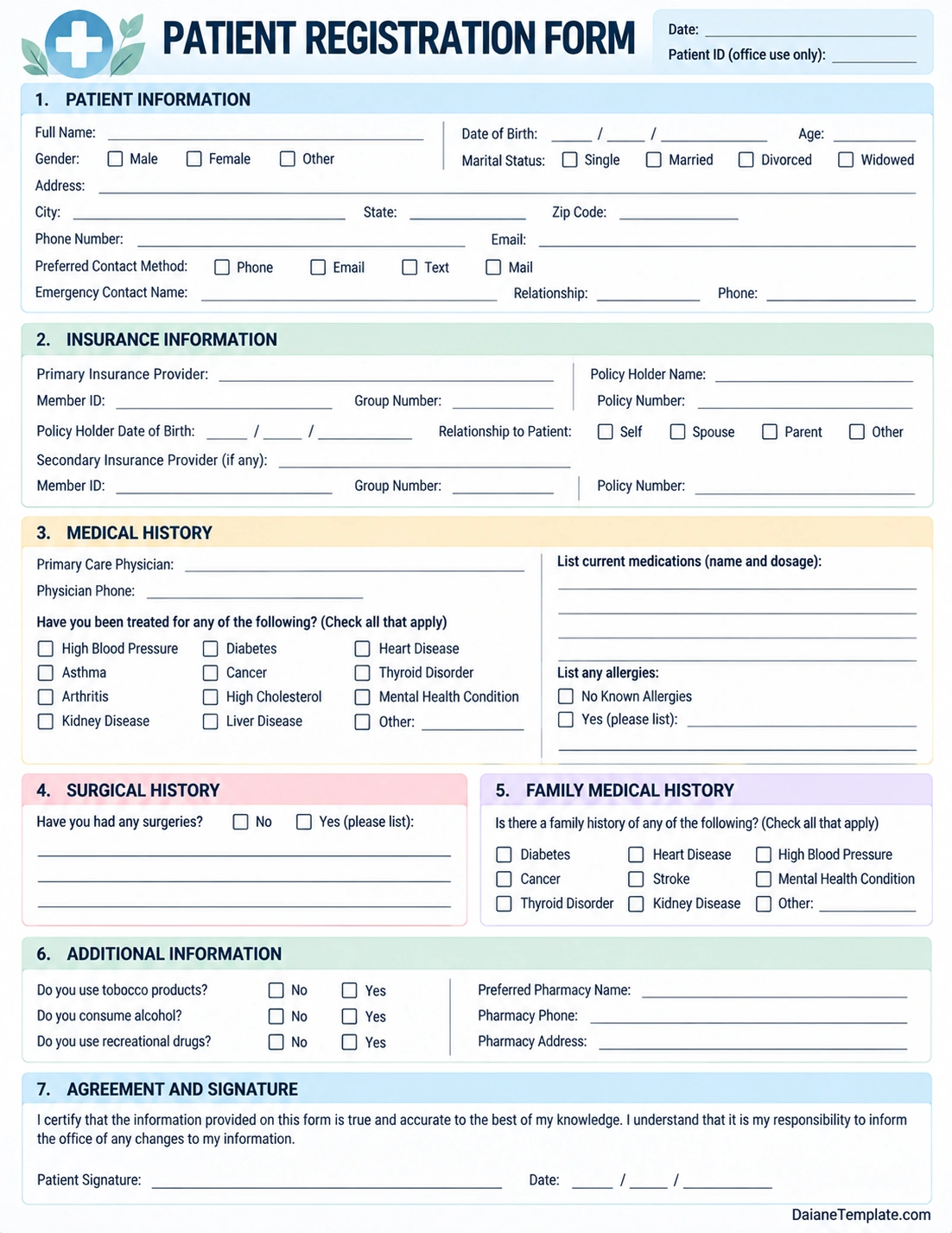
Patient Registration Form Example
A practical patient registration form can combine personal information, insurance details, medical history, emergency contact information, pharmacy details, and acknowledgment fields into one organized document.
A printable template can be useful for healthcare offices that still collect information on paper or need a reference for designing a digital registration workflow.
Tips for Designing an Effective Patient Registration Form
A good patient registration form should be easy to understand, organized, and appropriate for the healthcare setting. The following practices can improve the registration experience.
- Keep the layout organized: Use clear headings and group related information together.
- Use plain language: Avoid unnecessary medical or administrative jargon.
- Make important fields easy to find: Clearly label information that staff need for registration and care.
- Allow sufficient space: Give patients enough room to provide complete answers.
- Separate optional and required information: Make it clear which fields must be completed.
- Review information regularly: Encourage patients to update information when circumstances change.
- Protect sensitive information: Follow appropriate privacy and security procedures for patient information.
- Test the form: Ask staff and representative users to identify confusing or unnecessary sections.
Paper vs. Digital Patient Registration Forms
Healthcare organizations may use paper forms, digital registration forms, or a combination of both. Each approach has different operational considerations.
Paper Registration Forms
Paper forms can be convenient for patients who prefer handwriting or for facilities that do not use fully digital registration workflows. They can also serve as a simple backup when electronic systems are unavailable.
However, paper documents require appropriate storage, handling, access controls, and disposal procedures because they may contain sensitive patient information.
Digital Registration Forms
Digital forms can reduce manual data entry and may allow information to flow more efficiently into administrative or electronic health record systems when properly integrated.
Digital registration also requires appropriate security, authentication, access controls, data handling, and compliance procedures.
Patient Registration and Medical Records
Patient registration and medical records are related but serve different purposes. Registration primarily establishes and updates information needed to identify and administer the patient’s account. The medical record contains clinical information generated and maintained as part of the patient’s care.
Accurate registration information can help ensure that the correct patient is associated with the appropriate record. However, healthcare organizations should have appropriate identity verification and record-matching procedures to reduce the risk of duplicate or incorrectly matched records.
Common Mistakes to Avoid
Small problems in a registration form can create unnecessary work for both patients and staff. Avoid these common issues:
- Asking for unnecessary information: Excessive questions can make the registration process longer without adding meaningful value.
- Using unclear terminology: Patients may provide incomplete or incorrect information when questions are difficult to understand.
- Combining unrelated questions: Grouping information logically makes the form easier to complete.
- Leaving insufficient writing space: Patients need enough room for longer responses.
- Failing to update the form: Outdated fields may no longer match the organization’s workflow or requirements.
- Ignoring accessibility: Forms should be designed with the needs of the intended patient population in mind.
- Inadequate privacy practices: Patient information should be handled according to applicable privacy and security requirements.
- Not confirming changes: Important changes to contact, insurance, or medical information should be appropriately reviewed and recorded.
Privacy and Security Considerations
Patient registration forms can contain sensitive personal and health information. Healthcare organizations should therefore establish appropriate procedures for collecting, storing, accessing, transmitting, and disposing of these records.
In the United States, healthcare organizations may be subject to privacy and security requirements such as HIPAA, depending on their role and circumstances. Other jurisdictions may have additional or different requirements.
A template should not be assumed to satisfy every legal or regulatory requirement. Healthcare organizations should adapt their registration materials to their specific services, jurisdiction, policies, and compliance obligations.
How Often Should Patient Information Be Updated?
Patient information should be reviewed periodically and whenever relevant circumstances change. Contact information, insurance coverage, medications, emergency contacts, and other details may change over time.
Many healthcare organizations ask established patients to confirm their information during appointments. A practice may also use an update form rather than requiring patients to complete the entire registration form again.
Keeping administrative information current can reduce communication problems and help staff maintain accurate records.
Frequently Asked Questions About Patient Registration Forms
What is the purpose of a patient registration form?
The purpose of a patient registration form is to collect information needed to establish or update a patient’s account and support healthcare administration. It may include contact information, insurance details, medical history, emergency contacts, and other relevant information.
What information is usually included on a patient registration form?
A typical form may include the patient’s name, date of birth, address, phone number, email, emergency contact, insurance information, medical history, medications, allergies, pharmacy information, and appropriate acknowledgment or signature fields.
Why is accurate patient registration important?
Accurate registration information can help healthcare staff identify the correct patient, communicate effectively, process administrative and insurance information, and connect the patient with the appropriate medical record.
Do existing patients need to complete a patient registration form?
Established patients may not need to complete the entire form again. However, healthcare practices commonly ask patients to confirm or update information when relevant details change.
Can a patient registration form be completed online?
Yes. Many healthcare organizations use digital registration forms or patient portals. Digital registration can streamline data collection, but the system should be designed and managed with appropriate privacy, security, accessibility, and compliance considerations.
Is a patient registration form the same as a medical history form?
No. A patient registration form generally focuses on information needed to establish or update the patient’s administrative record, while a medical history form focuses more specifically on clinical background. The two forms may be combined depending on the healthcare organization’s workflow.
Can a patient registration form be used for every medical practice?
A general template can provide a starting point, but registration requirements vary by healthcare specialty, organization, location, and services. A practice should customize the form to collect the information it legitimately needs.
Conclusion
A patient registration form provides a structured way for healthcare organizations to collect essential patient information at the beginning of the care relationship. By organizing personal details, contact information, insurance information, medical history, emergency contacts, and appropriate acknowledgments, the form can support a more efficient registration process.
An effective form should be clear, relevant, easy to complete, and appropriate for the healthcare setting. It should also be supported by procedures that protect sensitive information and keep patient records accurate and up to date.
Whether used as a paper document or the foundation for a digital registration workflow, a well-organized patient registration form template can help healthcare practices create a consistent starting point for patient intake and administrative recordkeeping.
Download: Patient Registration Form
