A reference letter for an employee is a formal letter written by a manager, supervisor, employer, or professional colleague to describe an employee’s work history, skills, character, and accomplishments. It can help a prospective employer understand what a candidate was like in a previous workplace and provide context beyond a resume or job application.
A strong employee reference letter can highlight professional strengths, reliability, work ethic, communication skills, leadership abilities, and specific achievements. Depending on the situation, a professional reference may also be requested for a rental application, college program, professional certification, volunteer opportunity, or other important application.
Because the letter represents the writer’s professional opinion, it should be accurate, specific, and based on firsthand knowledge. The best references provide useful examples rather than simply describing the employee with general positive adjectives.
What Is a Reference Letter for an Employee?
A reference letter for an employee is a written recommendation that provides information about a person’s professional background and qualities. It is usually prepared by someone who has worked directly with the employee and can provide credible information about their performance.
The letter may confirm the employee’s job title, employment period, responsibilities, accomplishments, and professional qualities. It can also explain why the writer believes the employee would be a strong candidate for a particular opportunity.
Unlike a resume, which is written by the applicant, an employee reference letter provides an assessment from another person. This outside perspective can help a recipient better understand the candidate’s abilities and professional character.
Why Is an Employee Reference Letter Important?
A well-written professional reference can give a prospective employer additional insight into a candidate’s experience and working style. It can also reinforce information presented in a resume, application, or interview.
An employee reference letter can:
- Confirm professional experience: It can verify the writer’s knowledge of the employee’s role and employment history.
- Highlight skills: The writer can describe relevant technical and interpersonal abilities.
- Show work ethic: Specific examples can demonstrate reliability, initiative, and professionalism.
- Describe achievements: The letter can identify meaningful contributions made by the employee.
- Provide character insight: A professional reference can describe qualities such as integrity, dependability, and teamwork.
- Support a hiring decision: Relevant information may help an employer evaluate whether the candidate fits the position.
- Strengthen an application: A credible recommendation can complement other application materials.
Who Can Write a Reference Letter for an Employee?
The best writer is someone who has sufficient firsthand knowledge of the employee’s work and can provide an honest and relevant assessment.
Potential reference writers include:
- Direct managers
- Supervisors
- Department managers
- Company executives
- Former employers
- Team leaders
- Senior colleagues who worked closely with the employee
- Professional mentors
A reference from someone who directly supervised the employee is often particularly useful because that person may be able to provide specific examples of performance, responsibilities, and accomplishments.
What Should a Reference Letter for an Employee Include?
A professional reference letter should contain enough information to establish credibility and explain why the employee is being recommended. The exact structure can vary depending on the purpose of the letter.
Writer’s Information
Begin with the writer’s name, professional title, organization, and contact information when appropriate. This establishes the writer’s relationship to the employee and gives the recipient a way to verify the reference if necessary.
Date and Recipient
Include the date and, when known, the name and professional details of the person or organization receiving the letter. If the recipient is unknown, a professional general greeting can be used.
Relationship With the Employee
Explain how the writer knows the employee and how long they worked together. This information helps the reader understand the basis for the recommendation.
Employee’s Position and Responsibilities
Briefly describe the employee’s role and major responsibilities. Focus on responsibilities that are relevant to the opportunity for which the employee is being recommended.
Professional Skills and Strengths
Identify the employee’s most relevant qualities and abilities. Depending on the position, these might include communication, organization, leadership, problem-solving, technical expertise, customer service, teamwork, or project management.
Specific Achievements
Whenever possible, include one or two concrete examples of the employee’s contributions. Specific accomplishments are usually more persuasive than a list of generic compliments.
Recommendation
Conclude with a clear statement of support. Explain that you recommend the employee for the relevant opportunity and briefly summarize why you believe they would be a strong candidate.
How to Write a Reference Letter for an Employee
Writing an effective professional reference does not require excessive length. A focused letter that provides specific and relevant information can be more useful than a long letter filled with general statements.
1. Understand the Purpose
Before writing, determine what the employee is applying for and what type of reference is required. A letter for a management position may emphasize leadership, while a reference for a technical role may focus on specialized skills and problem-solving.
2. Confirm Your Relationship With the Employee
Explain your professional relationship clearly. State your position, the employee’s position, and the approximate period during which you worked together.
3. Identify the Employee’s Strongest Qualities
Choose qualities that are relevant to the opportunity. Instead of describing the employee as simply “excellent,” explain what they did well and how their actions benefited the team or organization.
4. Provide Specific Examples
Specific examples make a reference more credible. For example, rather than saying an employee has strong leadership skills, describe a project they successfully coordinated or a situation in which they helped a team achieve an important goal.
5. Connect the Experience to the Opportunity
Explain why the employee’s experience and strengths would be valuable in the new position or program. This makes the recommendation more relevant to the recipient.
6. End With a Strong Recommendation
Close the letter with a concise statement supporting the employee’s application. Offer appropriate contact information if you are willing to provide additional professional information.
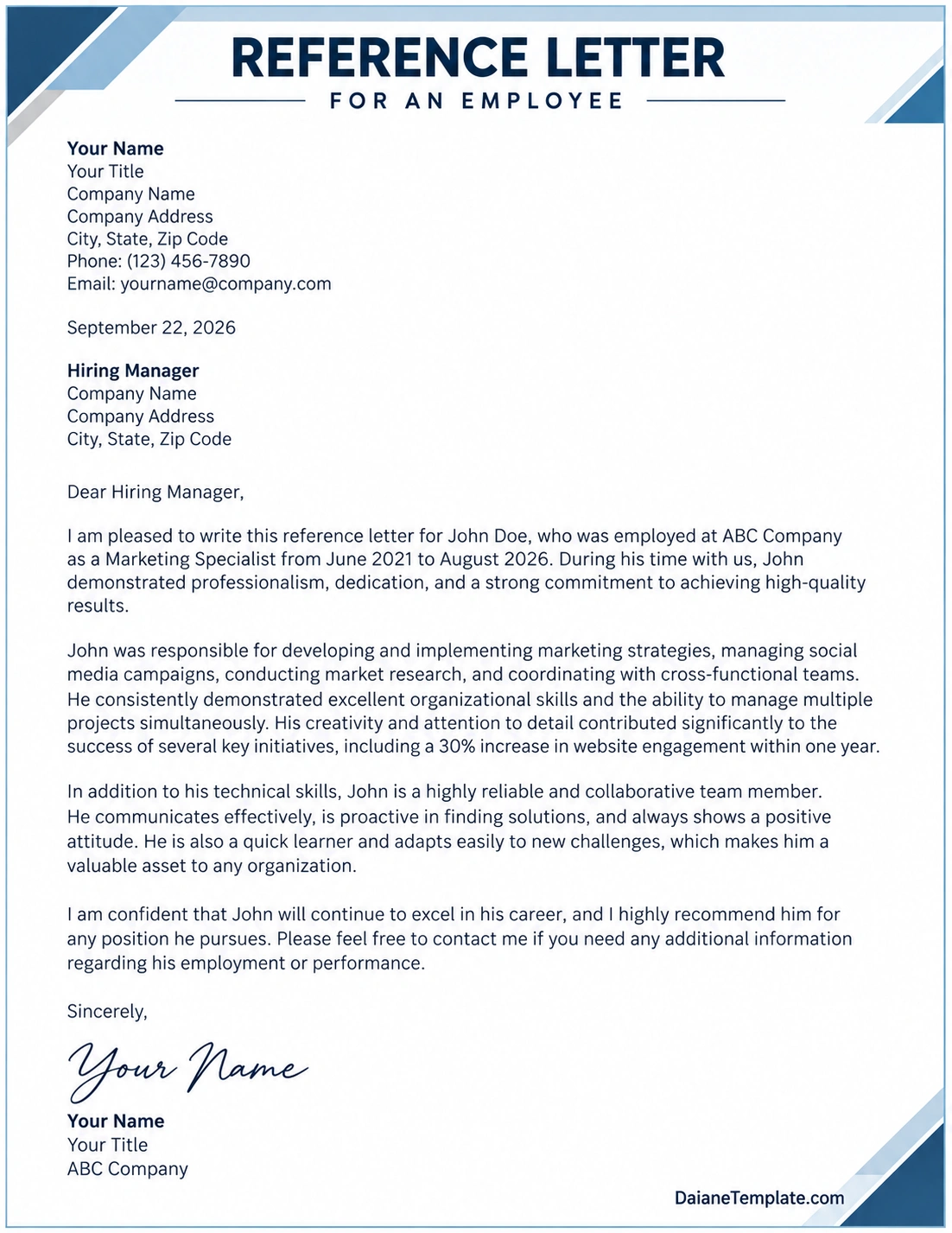
Reference Letter for an Employee Example
A typical employee reference letter combines the writer’s professional relationship with the candidate, an overview of the employee’s responsibilities, specific strengths, relevant accomplishments, and a clear recommendation.
The document should have a professional appearance and a logical structure so the recipient can quickly identify the employee’s experience and the writer’s reasons for recommending them.
What Qualities Should an Employee Reference Highlight?
The most useful qualities depend on the employee’s role and the opportunity they are pursuing. Choose characteristics that can be supported by the writer’s actual experience with the employee.
Common qualities include:
- Reliability: Consistently completing responsibilities and meeting commitments.
- Professionalism: Maintaining appropriate conduct and communication in the workplace.
- Communication: Sharing information clearly with colleagues, customers, and stakeholders.
- Teamwork: Cooperating effectively with other employees and contributing to shared goals.
- Leadership: Guiding projects, supporting colleagues, or taking responsibility for important tasks.
- Problem-solving: Analyzing challenges and developing practical solutions.
- Adaptability: Responding effectively to changing priorities or working conditions.
- Initiative: Taking appropriate action without requiring constant supervision.
- Integrity: Demonstrating honesty, responsibility, and sound professional judgment.
Reference Letter vs. Employment Verification Letter
A reference letter and an employment verification letter serve different purposes. An employment verification letter generally confirms factual information such as a person’s job title, employment dates, or current employment status.
A reference letter goes further by providing an assessment of the employee’s skills, performance, character, and professional qualities.
For example, an employment verification letter might confirm that an employee worked as a project coordinator from 2022 to 2025. A reference letter might explain that the employee successfully managed multiple projects, communicated effectively with clients, and consistently met deadlines.
Reference Letter vs. Recommendation Letter
The terms reference letter and recommendation letter are often used interchangeably, although their emphasis can vary.
A reference letter generally provides an assessment of someone’s background, character, or professional abilities. A recommendation letter often focuses more directly on why the individual should be selected for a particular position, program, or opportunity.
In employment situations, the two formats can overlap significantly. The most important consideration is whether the letter provides relevant, credible, and specific information about the candidate.
Tips for Writing a Strong Employee Reference
Use these practical tips to make the letter more useful and professional:
- Be specific: Support positive statements with real examples whenever possible.
- Stay relevant: Focus on skills and experiences related to the opportunity.
- Be honest: Do not make claims that you cannot reasonably support.
- Keep it concise: A focused reference is usually easier to read and evaluate.
- Use a professional tone: Avoid excessive emotion or informal language.
- Proofread carefully: Correct grammar, spelling, names, dates, and job titles before sending the letter.
- Protect confidential information: Do not include unnecessary confidential or sensitive employment information.
- Follow company policies: Some organizations have specific procedures governing employee references.
Common Mistakes to Avoid
A reference letter can lose credibility when it contains vague claims, excessive praise, or irrelevant information. Avoid these common mistakes:
- Using generic praise: Statements such as “They are a great employee” provide little useful evidence.
- Including unrelated information: Focus on qualities that matter to the recipient.
- Exaggerating accomplishments: The reference should accurately reflect the employee’s experience.
- Writing too much: Avoid lengthy descriptions that repeat the same point.
- Ignoring the recipient’s needs: Tailor the letter to the position, program, or application when appropriate.
- Including confidential information: Share only information that is appropriate and authorized.
- Forgetting contact information: If appropriate, provide a professional way for the recipient to follow up.
Can an Employee Reference Letter Be Used for Other Purposes?
Although employment is one of the most common reasons for requesting a professional reference, the same type of letter may sometimes be useful in other contexts.
Rental Applications
A professional reference can provide information about an applicant’s employment history, reliability, and professional character when a landlord requests supporting documentation.
College or Educational Programs
An employee or supervisor may provide a reference for an educational program when the applicant’s professional experience and qualities are relevant to the application.
Professional Programs and Certifications
Some professional programs, licenses, or certifications may request references that demonstrate an applicant’s experience, competence, or professional conduct.
The letter should always be adapted to the specific purpose rather than using exactly the same document for every application.
How Long Should an Employee Reference Letter Be?
Most professional reference letters can be effective at around one page. The appropriate length depends on the employee’s experience, the purpose of the letter, and the amount of relevant information available.
The goal is not to make the letter as long as possible. Instead, provide enough specific information to establish the writer’s credibility, describe the employee’s strengths, and support the recommendation.
Frequently Asked Questions About Reference Letters for Employees
What is a reference letter for an employee?
A reference letter for an employee is a formal document in which a manager, supervisor, employer, or professional colleague describes an employee’s work experience, skills, character, accomplishments, and professional qualities.
Who should write an employee reference letter?
A manager, supervisor, former employer, or other professional who has firsthand knowledge of the employee’s work can write the letter. The writer should be able to provide an honest and relevant assessment.
What should be included in an employee reference letter?
The letter should generally include the writer’s professional relationship with the employee, the employee’s role and responsibilities, relevant skills, specific accomplishments, professional qualities, and a clear recommendation.
How long should a reference letter for an employee be?
A professional reference letter is often about one page long. The ideal length depends on the purpose of the letter and how much relevant information needs to be communicated.
Can a former manager write a reference letter?
Yes. A former manager can provide a useful reference when they have sufficient firsthand knowledge of the employee’s work and are willing and authorized to provide the reference.
Is a reference letter the same as an employment verification letter?
No. An employment verification letter generally confirms factual employment information, while a reference letter provides an assessment of the employee’s skills, performance, character, or professional qualities.
Can an employee use the same reference letter for different applications?
A general reference can sometimes be reused, but tailoring the letter to the specific opportunity is usually more effective. Relevant skills and achievements should be emphasized based on the recipient’s needs.
Conclusion
A reference letter for an employee can provide valuable insight into a candidate’s professional background, skills, work ethic, character, and achievements. Unlike a resume, it offers an assessment from someone who has firsthand experience working with the employee.
The strongest references are specific, honest, relevant, and concise. They explain the writer’s relationship with the employee, describe meaningful strengths and accomplishments, and clearly communicate why the employee is recommended for the opportunity.
Whether the letter is being prepared for a prospective employer, rental application, college program, professional certification, or another purpose, a well-structured employee reference letter can provide useful context and strengthen an application when it accurately reflects the individual’s professional experience.
Download: Reference Letter Template for an Employee
