A pay-for-delete letter is a written request used by a consumer to negotiate with a creditor or debt collector about the possible removal of a collection account from their credit reports in exchange for payment or settlement of the debt. It is generally used as a negotiation tool, not as a guaranteed method for removing negative information.
Before using a pay-for-delete letter, it is important to understand what information appears on your credit reports and whether the account is accurate. Accurate negative information generally cannot simply be removed because a consumer asks for it to be deleted. The Consumer Financial Protection Bureau (CFPB) explains that most negative information generally remains on a credit report for seven years, although some types can remain longer.
For that reason, a pay-for-delete request should be approached as a negotiation with a debt collector or creditor rather than as a guaranteed credit-repair strategy. If information on your credit report is inaccurate, the appropriate approach may instead be to dispute the error with the credit reporting company and the company that furnished the information.
What Is a Pay-for-Delete Letter?
A pay-for-delete letter is a written proposal asking a creditor or collection agency to consider removing a collection account from one or more credit reports if the consumer makes an agreed payment.
The basic concept is straightforward: the consumer offers to resolve the outstanding debt, while asking the company to agree to a particular treatment of the account’s credit reporting in return.
However, there is an important distinction between paying a collection account and having the collection account deleted. Paying a collection does not automatically mean that the collection entry will disappear from a credit report. The CFPB describes a paid collection as an account that went into collections and was subsequently paid in full or settled, with the paid debt generally reflected as having a zero balance.
How Does a Pay-for-Delete Request Work?
A pay-for-delete negotiation generally begins with reviewing the collection account and determining who currently owns or services the debt. The consumer then sends a written proposal explaining the amount they are willing to pay and the credit-reporting treatment they are requesting.
If the collection agency agrees, the parties may establish payment terms and documentation for the arrangement. If the agency declines, the consumer can consider other lawful ways to resolve the debt or address inaccurate information.
A pay-for-delete request is therefore best understood as a negotiation. A creditor or collection agency may accept, reject, or modify the proposal, and there is no guarantee that a negative account will be removed simply because payment is offered.
When Should You Consider a Pay-for-Delete Letter?
A pay-for-delete letter may be considered when you have identified a legitimate collection account and want to negotiate how the account will be handled while resolving the debt.
Before sending one, consider the following:
- Confirm that the account belongs to you.
- Review the reported balance and account information.
- Identify the company currently collecting the debt.
- Review your credit reports for accuracy.
- Determine what payment you can realistically afford.
- Understand the proposed agreement before sending payment.
- Keep copies of all correspondence and documentation.
If you believe the collection account contains inaccurate information, do not assume that payment is the appropriate first step. Consumers have the right to dispute inaccurate information with the relevant credit reporting company and the company that furnished the information.
What Should a Pay-for-Delete Letter Include?
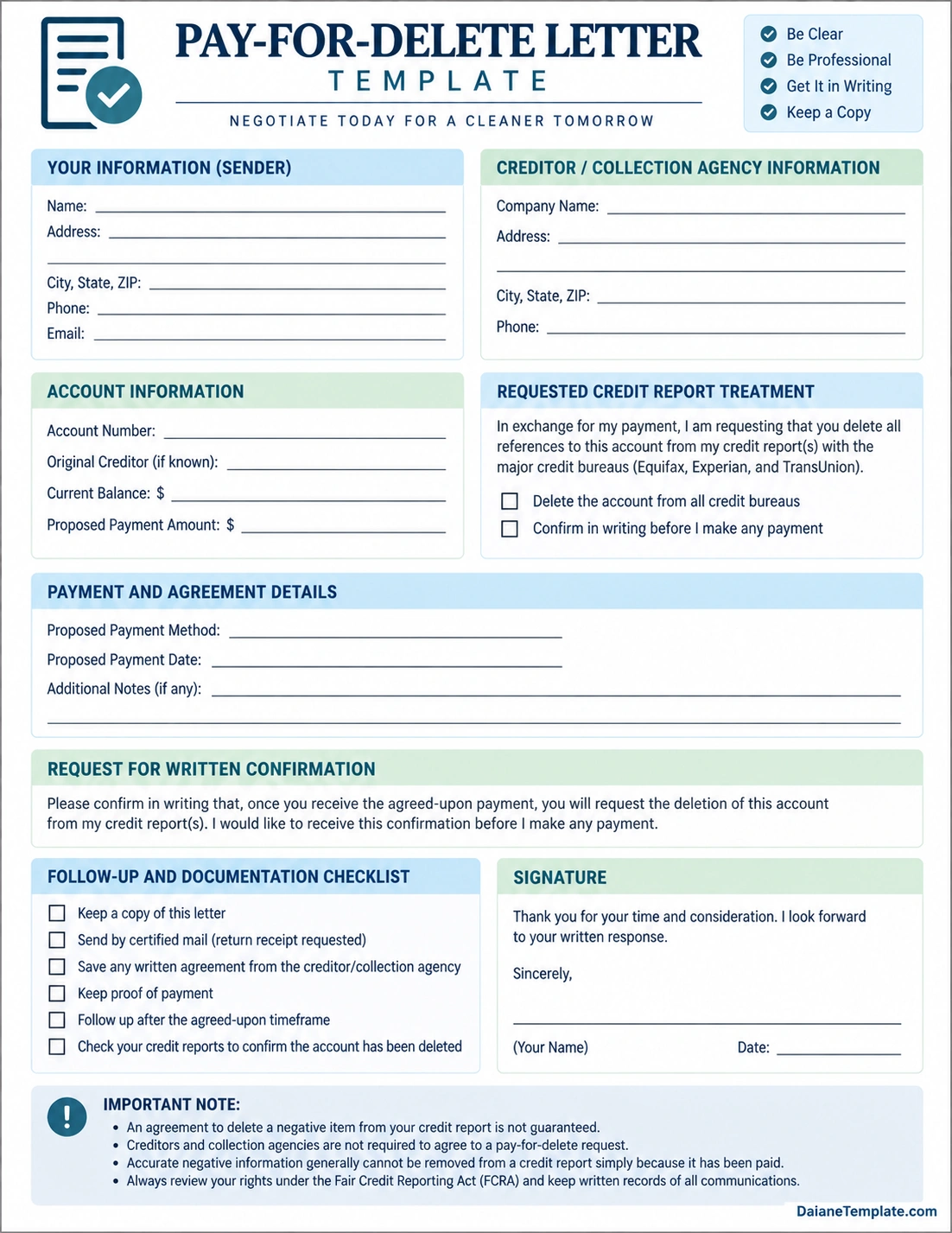
A clear letter makes it easier for the recipient to understand exactly what you are proposing. A practical pay-for-delete letter template can include the following sections.
1. Your Contact Information
Begin with your name, mailing address, phone number, and email address. Include only information reasonably necessary for the recipient to identify the account and communicate with you.
2. Creditor or Collection Agency Information
Identify the creditor or collection agency you are contacting. Use the company’s name and the mailing address listed in its official correspondence or account records.
3. Account Information
Identify the collection account using an appropriate account or reference number. You may also include the original creditor, if known, along with the current balance.
4. Proposed Payment
Clearly state the amount you are proposing to pay and, if applicable, whether the amount represents payment in full or a settlement amount.
5. Requested Credit-Report Treatment
Explain what you are requesting in exchange for payment. If your proposal specifically asks for deletion of the collection account from consumer credit reports, state that request clearly.
Do not describe deletion as an automatic legal entitlement. A company may not agree to the request, and accurate negative information is not generally required to be removed simply because it has been paid.
6. Written Confirmation
If the other party agrees to your proposal, request written documentation describing the agreement before making payment whenever possible. The written terms should clearly identify what each party has agreed to do.
7. Signature and Date
Finish the letter with your name, signature, and date. Keep a complete copy of the letter and any supporting documents for your records.
Why Get the Agreement in Writing?
Written documentation can help prevent misunderstandings about the terms of a negotiated settlement. A phone conversation may not provide the same level of clarity as a written agreement that identifies the payment amount and the agreed treatment of the account.
Keep copies of letters, emails, payment records, agreements, and other communications. If you communicate by telephone, consider keeping a written record of the date, company representative, and substance of the conversation, subject to applicable recording and privacy laws.
It is especially important to understand the agreement before making a payment. Do not assume that paying the requested amount automatically creates an agreement to delete the account.
Pay-for-Delete vs. Disputing a Credit Report Error
These are two different approaches and should not be confused.
Pay-for-Delete Negotiation
A pay-for-delete request concerns a negotiation over an account that may be legitimate. The consumer proposes payment or settlement and asks the creditor or collector to consider a particular credit-reporting action.
Credit Report Dispute
A dispute is appropriate when information on a credit report is inaccurate, incomplete, duplicated, belongs to someone else, or otherwise contains an error that can be challenged.
The CFPB recommends disputing inaccurate information with both the credit reporting company and the company that supplied the information. Supporting documentation can be included with the dispute.
These two situations should not be treated the same way. If an account is inaccurate, the consumer should use the applicable dispute process rather than making a payment merely to obtain removal of information that should be corrected or removed because it is inaccurate.
What Happens After You Send a Pay-for-Delete Letter?
There are several possible outcomes after sending a negotiation letter.
- The company accepts: The company may agree to the proposed terms.
- The company makes a counteroffer: The collector may propose a different payment or other terms.
- The company declines: The company may refuse the requested credit-report treatment.
- The company does not respond: You may need to follow up through an appropriate communication channel.
Do not interpret silence as acceptance. If the requested deletion or other credit-report treatment is important to the negotiation, look for explicit written terms rather than relying on assumptions.
Important Things to Check Before Paying a Collection
Before sending money, make sure you understand the debt and the party requesting payment. Debt collectors generally must provide validation information about a debt, including information that helps consumers recognize the debt and understand how to dispute it.
Review information such as:
- Name of the original creditor.
- Current amount claimed.
- Account or reference number.
- Payment history or relevant account information.
- Name and contact information of the collector.
- Any written settlement or payment proposal.
If you do not recognize the debt or believe the amount is incorrect, investigate the issue before deciding how to proceed. An unfamiliar creditor name does not necessarily mean the debt is fraudulent because accounts can be sold or transferred to collection companies, but consumers should investigate information they believe is incorrect.
Does a Pay-for-Delete Letter Guarantee a Higher Credit Score?
No. A pay-for-delete letter does not guarantee that a collection account will be deleted or that a consumer’s credit score will increase by a particular amount.
Credit scores are calculated using information in credit reports, and different scoring models can produce different scores.
The effect of resolving a collection can therefore depend on the specific credit reports, scoring model, lender, and other information in the consumer’s credit history. Avoid promises that a pay-for-delete agreement will produce a specific score increase.
Common Mistakes to Avoid
When preparing a pay-for-delete letter, avoid making assumptions about what payment will accomplish.
- Assuming deletion is guaranteed: A request is a negotiation, not a guaranteed outcome.
- Paying before confirming the terms: Whenever possible, understand the agreement before making payment.
- Ignoring inaccurate information: Errors should generally be addressed through the appropriate dispute process.
- Failing to keep records: Save letters, agreements, receipts, and other communications.
- Making unsupported credit-score claims: No letter can guarantee a particular score increase.
- Using vague language: Clearly identify the account, proposed payment, and requested action.
- Assuming a paid collection automatically disappears: Payment and deletion are not necessarily the same thing.
Tips for Writing an Effective Pay-for-Delete Letter
A professional and concise letter is generally easier for a creditor or collection agency to review. Consider these practical tips:
- Keep the letter factual and professional.
- Clearly identify the account in question.
- State the proposed payment amount.
- Clearly describe the requested credit-report treatment.
- Request written confirmation of any agreement.
- Avoid unnecessary personal information.
- Keep a complete copy of everything you send.
- Keep proof of any payment you make.
- Review your credit reports afterward to check for updates.
Using a Pay-for-Delete Letter Template
A pay-for-delete letter template can help organize the important information before you contact a creditor or collection agency. A useful template may include sections for your information, creditor details, account information, proposed payment, requested credit-report treatment, written confirmation, follow-up documentation, and signature.
A template should be customized to the specific account and negotiation. It should not be treated as a substitute for understanding your rights, the debt, or the terms of any settlement agreement.
If the situation involves a disputed debt, potential identity theft, significant financial consequences, or complicated legal issues, consider obtaining advice from an appropriate consumer-law or financial professional.
Pay-for-Delete Letter Checklist
Before sending your letter, review the following checklist:
- Verify the account information.
- Confirm the name of the creditor or collection agency.
- Review your credit reports.
- Determine whether the information appears accurate.
- Decide what payment you can reasonably offer.
- Clearly state your proposed terms.
- Request written confirmation of any agreement.
- Keep a copy of the letter.
- Keep records of all communications.
- Keep proof of payment if you make a payment.
- Review your credit reports afterward for updates.
Conclusion
A pay-for-delete letter can be used as a negotiation tool when attempting to resolve a collection account and request specific credit-report treatment. However, it is important to understand that deletion is not guaranteed, and accurate negative information generally cannot simply be removed because a consumer pays the debt.
The best approach is to review the account carefully, distinguish legitimate collection information from reporting errors, understand the proposed payment terms, request any negotiated agreement in writing, and maintain complete records throughout the process.
For inaccurate credit-report information, consumers have separate dispute rights and can challenge errors with the relevant credit reporting companies and furnishers. A carefully prepared letter and a clear understanding of the underlying situation can help consumers communicate their proposal more effectively while avoiding unrealistic expectations about the outcome.
Download: Pay-for-Delete Letter Template
