A Scholarship Recommendation Letter is a formal letter written by a teacher, professor, employer, mentor, counselor, or another qualified person who knows a scholarship applicant well. Its purpose is to provide an independent perspective on the applicant’s academic abilities, character, achievements, motivation, skills, and potential.
While a scholarship application may include grades, test scores, activities, awards, and personal statements, a recommendation letter can add context that those documents cannot always provide. A strong letter uses specific examples to explain how the applicant performs, contributes, handles challenges, and demonstrates qualities that may be relevant to the scholarship.
For the scholarship committee, the letter can provide another perspective on the applicant’s qualifications and help demonstrate how the student’s experiences and characteristics relate to the goals or criteria of the scholarship program.
What Is a Scholarship Recommendation Letter?
A scholarship recommendation letter is a supporting document that evaluates a student’s qualifications from the perspective of someone who has directly observed the student’s work, behavior, academic progress, leadership, service, or other relevant activities.
The person writing the letter is often referred to as the recommender. The recommender should ideally have enough firsthand knowledge of the applicant to provide specific and credible observations rather than simply repeating information from the student’s resume.
Depending on the scholarship, a recommendation may be requested from a teacher, professor, school counselor, employer, supervisor, community leader, coach, or another person who can provide meaningful insight into the applicant’s qualifications.
Why Is a Scholarship Recommendation Letter Important?
A recommendation letter can complement the information provided elsewhere in a scholarship application. Instead of simply listing achievements, the recommender can explain the qualities behind those achievements and provide examples of how the applicant applies their skills.
- Provides a third-party perspective: The committee can hear directly from someone familiar with the applicant.
- Adds personal context: The recommender can explain qualities that may not be obvious from grades or a resume.
- Highlights specific strengths: Academic ability, leadership, persistence, communication, service, or other qualities can be illustrated.
- Provides supporting examples: Concrete experiences can make statements about the applicant more meaningful.
- Connects qualifications to the scholarship: Relevant qualities can be discussed in relation to the scholarship’s stated criteria.
- Demonstrates potential: The recommender can describe why the applicant is prepared for future academic or professional opportunities.
Who Should Write a Scholarship Recommendation Letter?
The best recommender is usually someone who knows the applicant well and can provide specific, honest observations about their abilities and character.
Teacher or Professor
A teacher or professor can discuss academic performance, classroom participation, intellectual curiosity, research ability, writing skills, problem-solving, and interactions with classmates.
School Counselor
A counselor may be able to provide broader context about the student’s academic journey, extracurricular involvement, goals, and development.
Employer or Supervisor
For applicants with work experience, an employer or supervisor may discuss responsibility, communication, initiative, teamwork, leadership, reliability, and professional development.
Mentor or Community Leader
A mentor or community leader may be appropriate when they have directly observed the applicant’s leadership, volunteer work, community involvement, or commitment to a particular cause or field.
The scholarship’s instructions should always be checked first because some programs specify who may or may not provide a recommendation.
What Should a Scholarship Recommendation Letter Include?
A strong scholarship recommendation letter should be focused, specific, and relevant to the scholarship. Although formatting requirements vary, most effective letters contain several key components.
Recommender Introduction
The opening should identify the recommender and explain their relationship with the applicant. It can briefly state the recommender’s position, organization, and the length or nature of their relationship with the student.
This establishes why the recommender is qualified to comment on the applicant’s abilities and character.
Applicant Identification
Clearly identify the student being recommended and, when appropriate, the scholarship for which they are applying. This prevents confusion when a committee is reviewing many applications.
Academic Qualifications
If relevant to the scholarship, discuss the applicant’s academic strengths. Rather than simply repeating a grade point average or list of courses, explain how the student demonstrates academic ability.
Examples might include strong analytical skills, curiosity, research ability, persistence with difficult subjects, thoughtful classroom participation, or exceptional work on a particular project.
Character and Personal Qualities
A recommendation letter can provide meaningful insight into qualities such as integrity, responsibility, resilience, discipline, empathy, initiative, dependability, and willingness to help others.
These qualities are more persuasive when supported by a specific example rather than presented as a long list of positive adjectives.
Achievements and Contributions
Discuss achievements that are relevant to the scholarship and explain why they matter. The strongest examples demonstrate what the student accomplished, how they approached the challenge, and what the experience reveals about their abilities.
Future Potential
The recommender can describe the applicant’s readiness for future academic, professional, or community opportunities. This section should be based on observations and relevant evidence rather than unsupported predictions.
Clear Recommendation
The letter should conclude with a direct statement recommending the applicant for consideration. The recommender can also provide contact information and invite the scholarship committee to reach out with additional questions if appropriate.
How to Write a Scholarship Recommendation Letter
Writing a recommendation letter becomes easier when the process is organized around evidence rather than general praise.
Review the Scholarship Requirements
Before writing, review the scholarship’s eligibility requirements, selection criteria, submission instructions, word limits, and deadline. Understanding what the scholarship values can help the recommender select relevant examples.
Gather Information About the Applicant
The student can provide useful background information, such as a resume, academic information, personal statement, list of achievements, scholarship description, career goals, and details about relevant activities.
This information should support the recommender’s firsthand observations rather than replace them.
Identify Two or Three Strong Examples
Choose a small number of meaningful examples that demonstrate the applicant’s strongest qualities. A detailed example is generally more useful than a long list of unsupported claims.
For instance, instead of simply describing a student as a strong leader, explain a situation in which the student organized a project, solved a problem, helped a team, or took responsibility for an important task.
Connect Examples to Qualities
After describing an example, explain what it demonstrates. A project might show organization and problem-solving, while volunteer work might demonstrate initiative and commitment to the community.
Write in a Professional Tone
The letter should be professional, natural, and sincere. Avoid exaggerated claims that the recommender cannot support through firsthand experience.
Recommended Structure for a Scholarship Recommendation Letter
A simple structure can help the letter remain organized and easy to read.
- Opening: Introduce the recommender and applicant.
- Relationship: Explain how and how long the recommender has known the student.
- Academic strengths: Discuss relevant academic abilities and accomplishments.
- Character and skills: Describe important personal and professional qualities.
- Specific examples: Provide evidence that illustrates those qualities.
- Scholarship relevance: Explain how the applicant’s qualities relate to the scholarship criteria.
- Closing recommendation: Clearly recommend the student and provide contact information.
What Makes a Recommendation Letter Effective?
The strongest letters usually contain evidence that allows the reader to understand the applicant as an individual rather than simply seeing another list of accomplishments.
Specificity
Specific examples are more informative than generic statements. Describe what the student actually did, how they responded, and what the experience demonstrated.
Credibility
The recommender should write from direct experience. A letter is more credible when its observations clearly come from the recommender’s own interactions with the applicant.
Relevance
Focus on qualities and experiences that are relevant to the scholarship. Not every achievement needs to be included.
Balance
A recommendation letter can discuss multiple dimensions of the applicant, including academic performance, character, leadership, service, creativity, work ethic, or other relevant qualities.
Authentic Voice
The letter should sound like it was written by the actual recommender. A sincere and natural voice can make the recommendation more convincing than overly formal or exaggerated language.
Common Mistakes to Avoid
Even a positive recommendation can be less useful when it lacks detail or does not follow the scholarship’s requirements.
- Using vague praise without supporting examples.
- Repeating the student’s resume without adding new perspective.
- Writing about achievements the recommender did not personally observe.
- Making unsupported claims about the student’s future.
- Ignoring the scholarship’s specific requirements.
- Using an overly generic letter for every scholarship application.
- Including irrelevant personal information.
- Making the letter unnecessarily long.
- Failing to proofread names, dates, scholarship titles, and contact information.
- Missing the submission deadline or required submission method.
How Long Should a Scholarship Recommendation Letter Be?
There is no universal length for every scholarship recommendation letter. The scholarship provider may specify a word count, page limit, or other formatting requirement, and those instructions should take priority.
When no specific limit is provided, the recommender should aim for enough detail to provide meaningful evidence without unnecessary repetition. A focused letter containing several well-developed examples is generally more useful than a lengthy document filled with general statements.
Tips for Students Requesting a Recommendation
Students can make the process easier for their recommenders by providing useful information and sufficient time to prepare the letter.
- Ask someone who knows your work and character well.
- Ask well before the scholarship deadline whenever possible.
- Provide the scholarship requirements and submission instructions.
- Share your resume or academic information.
- Explain why you are applying for the scholarship.
- Provide information about relevant achievements or activities.
- Tell the recommender about your academic or career goals.
- Clearly communicate the deadline.
- Send a polite reminder as the deadline approaches if appropriate.
- Thank the recommender for their time and assistance.
How to Use a Scholarship Recommendation Letter Template
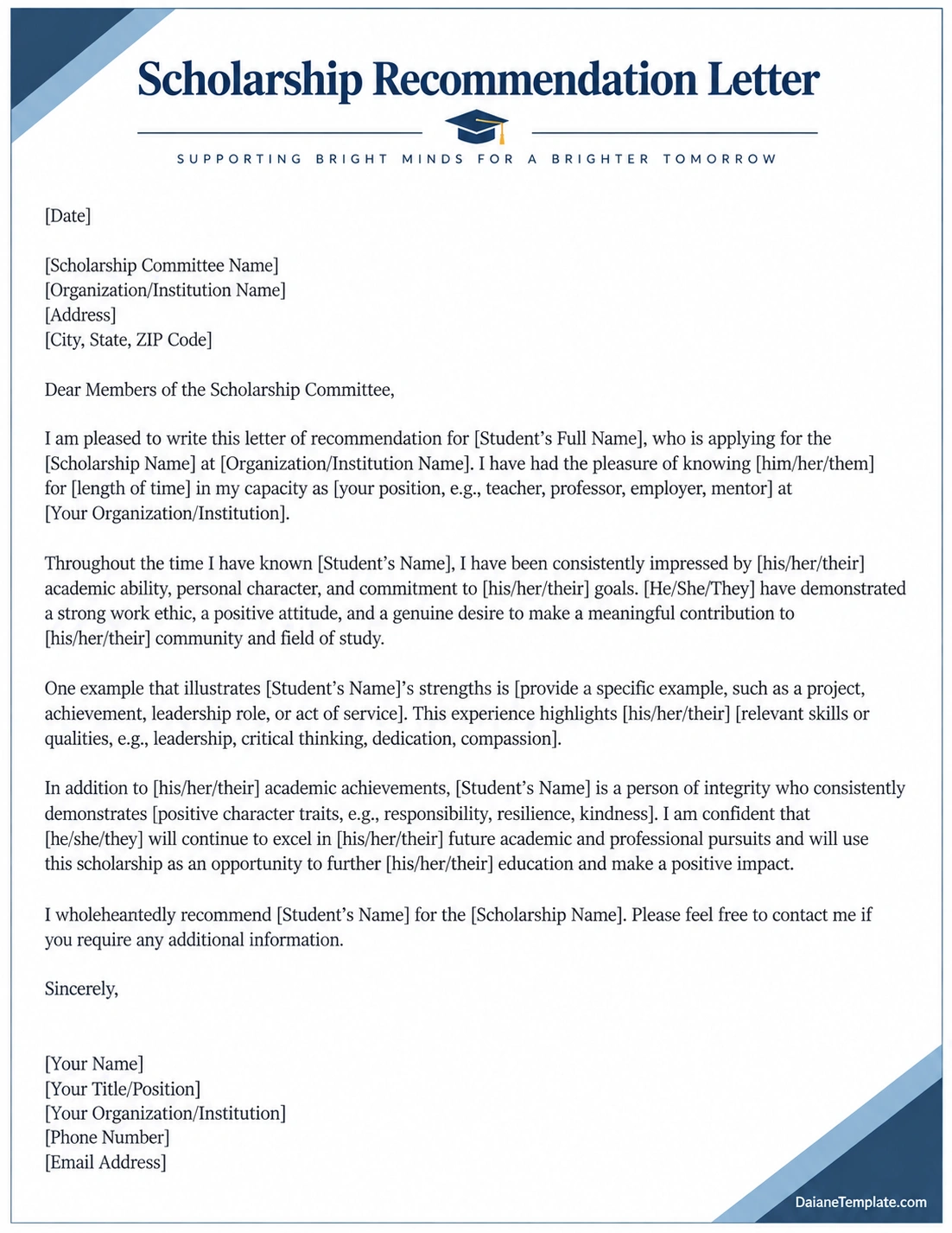
A Scholarship Recommendation Letter Template can provide a useful framework for organizing the letter while leaving room for the recommender’s personal observations.
Start with the date, scholarship committee or organization information, and a professional salutation. Introduce the student and explain the relationship between the recommender and applicant.
Next, discuss the student’s relevant academic qualities, character, skills, and achievements. Add specific examples that demonstrate these qualities instead of relying entirely on general descriptions.
Finish by explaining why the recommender supports the student’s application and provide appropriate contact information. Before submitting the letter, remove placeholder text and verify that the scholarship name, student name, organization, and other details are accurate.
Final Checklist for a Scholarship Recommendation Letter
Before submitting a recommendation, review the letter against the following checklist:
- The applicant’s name is correct.
- The scholarship name is correct.
- The recommender’s relationship with the applicant is clearly explained.
- The letter includes relevant academic or professional strengths.
- Important character traits are supported with examples.
- The examples are based on firsthand knowledge.
- The content relates to the scholarship requirements where appropriate.
- The recommendation is clearly stated.
- The contact information is accurate.
- The letter follows the required format and length.
- The submission deadline and method have been checked.
- The document has been proofread for grammar and spelling.
Conclusion
A Scholarship Recommendation Letter gives a scholarship committee an additional perspective on an applicant’s qualifications, character, motivation, skills, and potential. Its value comes from the recommender’s firsthand knowledge and ability to provide specific examples that complement the student’s application.
An effective recommendation letter should be relevant, credible, specific, and professionally written. Rather than simply repeating grades, awards, or activities, it should explain what those experiences reveal about the applicant and provide meaningful evidence of their strengths.
A Scholarship Recommendation Letter Template can make the writing process more organized by providing a practical structure for the introduction, qualifications, supporting examples, recommendation, and closing. The template should then be customized so the final letter accurately reflects the recommender’s genuine experience with the student and follows the scholarship provider’s requirements.
Download: Scholarship Recommendation Letter Template
