A product requirements document (PRD) is a central guide that explains what a product should do, why it is being built, and what requirements the development team needs to meet. It helps product managers, designers, developers, and other stakeholders work from the same understanding before and during product development.
A well-written PRD can reduce miscommunication, clarify priorities, define product functionality, and help prevent unnecessary scope changes. Whether you are developing a mobile app, website, SaaS platform, software feature, or digital product, a clear product requirements document provides a practical source of truth for the project.
This guide explains what a PRD is, what it should include, how to write one, and how to use a product requirements document template effectively.
What Is a Product Requirements Document?
A product requirements document is a structured document that describes a product’s purpose, users, features, requirements, and expected outcomes. It translates a product idea into clear information that different teams can use to plan, design, build, test, and launch the product.
The PRD usually begins with the product vision and problem being addressed. It then defines the target users, functional requirements, non-functional requirements, user stories, acceptance criteria, and success metrics.
Instead of explaining only what a product looks like, a PRD focuses on what the product needs to accomplish and how its functionality should behave.
Why Is a Product Requirements Document Important?
Product development often involves people with different responsibilities and perspectives. Without a shared reference document, teams may interpret requirements differently or make assumptions about the intended product.
A product requirements document helps establish a common understanding before development work begins.
- Aligns stakeholders: Product managers, designers, developers, testers, and business teams can work toward the same objectives.
- Clarifies requirements: The document explains the expected product functionality and important constraints.
- Reduces miscommunication: Written requirements provide a reference when questions arise.
- Controls scope: Clearly defined requirements make it easier to identify features that are outside the current project scope.
- Supports development: Developers can use the requirements to understand expected behavior and priorities.
- Improves testing: Acceptance criteria provide useful references for determining whether requirements have been met.
- Documents decisions: Important product decisions and assumptions can be recorded for future reference.
What Should a Product Requirements Document Include?
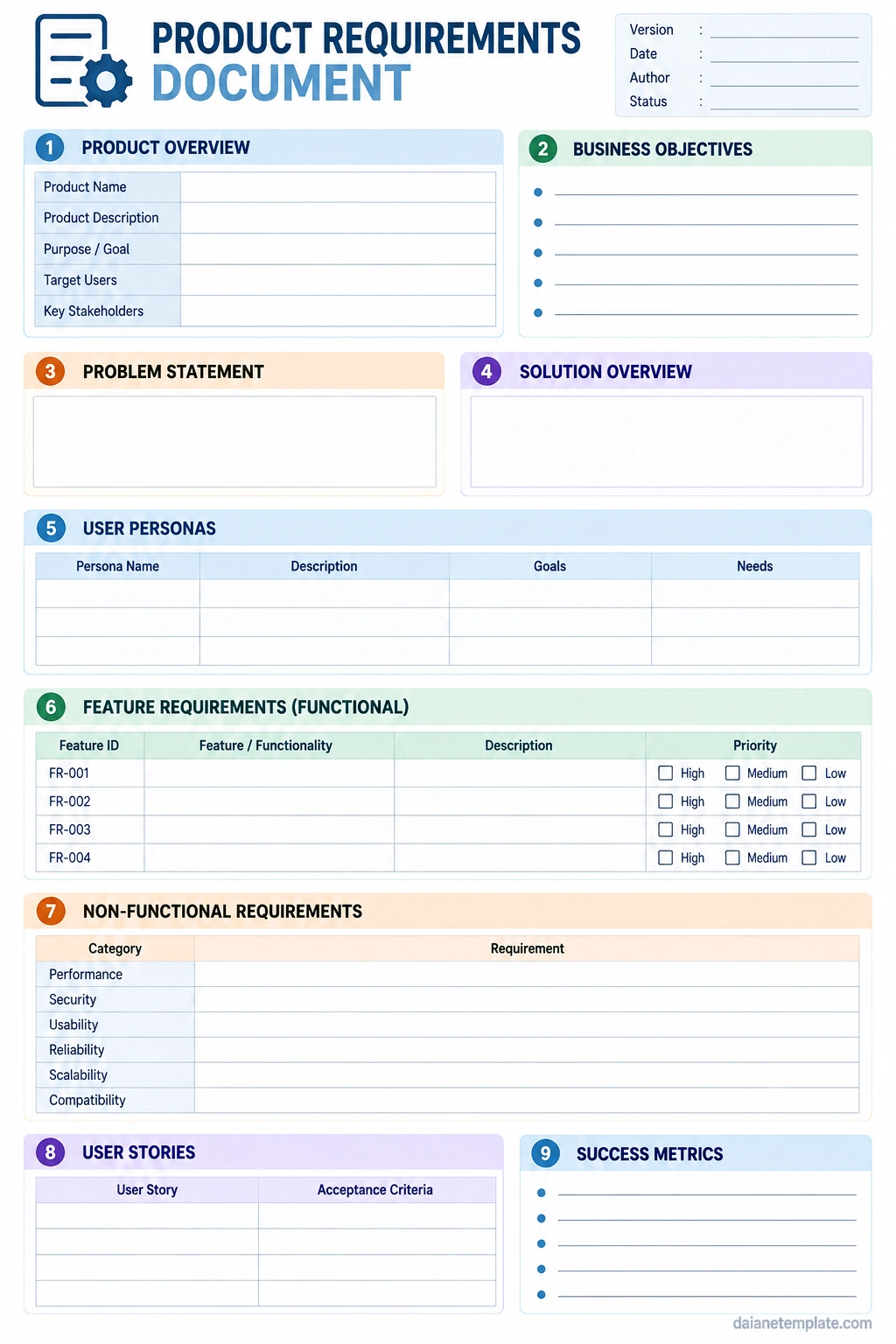
The exact structure of a PRD can vary depending on the product and organization. However, most effective product requirements documents contain several core sections.
1. Product Overview
The product overview introduces the product and provides basic project information. It should give readers enough context to understand what is being developed.
- Product name
- Product description
- Product purpose
- Target users
- Key stakeholders
- Product owner or responsible team
2. Business Objectives
This section explains why the product or feature is being developed. Business objectives should connect the product to measurable organizational goals whenever possible.
For example, an objective might be to improve user onboarding, reduce customer support requests, increase feature adoption, or make an existing workflow more efficient.
3. Problem Statement
The problem statement clearly identifies the user or business problem that the product is intended to solve. A strong problem statement prevents teams from focusing on features without understanding their purpose.
Keep the problem statement specific. Explain who experiences the problem, what difficulty they face, and why solving it matters.
4. Solution Overview
The solution overview provides a high-level explanation of how the proposed product or feature will address the identified problem. It does not need to describe every technical implementation detail.
The goal is to establish a shared understanding of the proposed solution before detailed requirements are defined.
5. User Personas
User personas describe the primary groups of people who will use the product. A persona can include information about user goals, needs, behaviors, and common challenges.
Understanding the intended users helps the team create requirements that solve real user problems rather than simply adding features.
Functional and Non-Functional Requirements
Requirements are commonly divided into functional requirements and non-functional requirements. Keeping these categories separate can make a PRD easier for development and testing teams to understand.
Functional Requirements
Functional requirements describe what the product or feature should do. They focus on specific behaviors, actions, and capabilities.
Examples include:
- Users can create an account.
- Users can reset a forgotten password.
- Users can search for products by keyword.
- The system sends an email after a successful registration.
- Administrators can edit or remove user records.
Each functional requirement should be clear enough that the development and testing teams can understand the expected behavior.
Non-Functional Requirements
Non-functional requirements describe qualities and performance expectations rather than specific product actions. They can cover areas such as performance, security, reliability, usability, scalability, and compatibility.
Examples include:
- The application should load within an established performance target under expected conditions.
- User data should be protected using appropriate security controls.
- The interface should work across supported devices and browsers.
- The system should support the expected number of concurrent users.
- The product should provide an accessible and consistent user experience.
How to Write User Stories in a PRD
User stories describe product requirements from the user’s perspective. They help teams understand who needs a capability, what they need, and why they need it.
A common user story format is:
As a [type of user], I want to [action], so that [benefit].
For example, a user story for an online account might be: “As a registered customer, I want to reset my password so that I can regain access to my account if I forget it.”
Good user stories should be specific, understandable, and connected to a genuine user need.
What Are Acceptance Criteria?
Acceptance criteria define the conditions that must be satisfied for a feature or user story to be considered complete. They make requirements more measurable and reduce ambiguity between product, development, and testing teams.
For example, acceptance criteria for a password reset feature might specify that:
- The user can request a password reset using a registered email address.
- The system sends a password reset link to the registered email.
- The reset link expires after the defined period.
- The user can create a new password that meets the required password rules.
- The user receives confirmation after successfully changing the password.
Clear acceptance criteria make it easier to determine whether the requested functionality has been implemented correctly.
How to Create a Product Requirements Document
Start With the Product Problem
Begin by identifying the problem before listing features. Understanding the problem helps the team determine which requirements are actually necessary.
Define the Target Users
Identify who will use the product and what they are trying to accomplish. Different user groups may have different needs, workflows, and priorities.
Set Clear Objectives
Define what the product should achieve. Where possible, connect objectives to measurable outcomes rather than vague statements.
Document the Requirements
List the functional and non-functional requirements in a structured format. Assign identifiers or priorities when this makes the project easier to manage.
Add User Stories and Acceptance Criteria
Use user stories to describe important user needs and acceptance criteria to define the expected results. This provides useful detail without turning the PRD into a technical implementation document.
Review With Stakeholders
Share the PRD with relevant stakeholders before development begins. Product managers, designers, developers, QA professionals, and business stakeholders may identify missing requirements or unclear assumptions.
Keep the Document Updated
A PRD should remain useful throughout the product lifecycle. When an important requirement changes, update the document and communicate the change to affected stakeholders.
Product Requirements Document vs. Product Specification
A product requirements document and a product specification can overlap, but they often serve different purposes depending on the organization.
A PRD generally focuses on the product problem, goals, users, functionality, requirements, and expected outcomes. A more detailed technical specification may focus on how the system will be implemented, including architecture, APIs, databases, technical dependencies, and engineering decisions.
The PRD therefore provides product direction, while technical documentation can provide deeper implementation guidance.
Tips for Writing an Effective PRD
- Use clear language: Avoid unnecessary jargon and ambiguous statements.
- Be specific: Describe expected behavior rather than using vague phrases such as “make it easy” or “make it fast.”
- Prioritize requirements: Identify which requirements are essential and which are secondary.
- Focus on user needs: Connect important features to user problems and desired outcomes.
- Separate requirements from solutions: Give the team enough product context without unnecessarily prescribing technical implementation.
- Use measurable criteria: When appropriate, define requirements that can be tested or verified.
- Keep the document organized: Use consistent headings, numbering, tables, and terminology.
- Review assumptions: Clearly identify assumptions, dependencies, and known limitations.
- Control scope: Record out-of-scope items when they are likely to cause confusion.
Common Product Requirements Document Mistakes
Even a detailed PRD can become ineffective if it is difficult to understand or maintain. Avoid these common mistakes:
- Writing requirements without clearly defining the underlying problem.
- Using vague or subjective language.
- Including unnecessary technical implementation details.
- Failing to identify the primary users.
- Leaving acceptance criteria undefined.
- Trying to include every possible feature in the initial release.
- Failing to communicate requirement changes.
- Creating a document that is so long that stakeholders stop using it.
The goal is not to create the longest possible document. The goal is to create a useful source of truth that provides enough detail for teams to make consistent decisions.
Using a Product Requirements Document Template
A product requirements document template can make the planning process faster by providing a consistent structure. Instead of creating the document from an empty page, product teams can begin with predefined sections for product information, objectives, user personas, requirements, user stories, and success metrics.
A printable PRD template can also be useful during planning meetings, workshops, brainstorming sessions, or product review discussions. Teams can use the template to organize ideas first and transfer finalized requirements into their preferred digital documentation system later.
When choosing a template, look for one that is flexible enough to support your project without forcing unnecessary sections into every product. The best structure depends on the complexity of the product, the size of the team, and the organization’s development process.
Frequently Asked Questions About Product Requirements Documents
What is the main purpose of a product requirements document?
The main purpose of a product requirements document is to establish a shared understanding of what a product should accomplish, who it serves, what functionality it needs, and how requirements can be evaluated.
Who writes a product requirements document?
A product manager or product owner often leads the PRD process, but creating a strong document is usually collaborative. Designers, developers, QA professionals, business stakeholders, and subject matter experts may contribute requirements, feedback, and clarification.
What is the difference between a PRD and user stories?
A PRD is a broader product document that can contain goals, problems, personas, requirements, user stories, acceptance criteria, and success metrics. User stories are individual descriptions of user needs within that larger product context.
Should a PRD include technical requirements?
A PRD can include relevant technical constraints or non-functional requirements, but it generally focuses on product requirements rather than detailed engineering implementation. Technical teams may maintain separate technical specifications when deeper implementation details are necessary.
How long should a product requirements document be?
There is no universal required length. A simple feature may need only a few pages, while a complex product may require substantially more documentation. The PRD should contain enough information to remove important ambiguity without adding unnecessary detail.
When should a product requirements document be created?
A PRD is typically developed during product planning and refined before and during development. Requirements may continue to evolve as new information becomes available, so the document should be updated when significant changes are approved.
Conclusion
A product requirements document provides a structured foundation for turning a product idea into a clearly defined development plan. By documenting the product purpose, business objectives, target users, functional requirements, non-functional requirements, user stories, acceptance criteria, and success metrics, a PRD helps teams work from a shared understanding.
A strong PRD does not need to be complicated. It needs to be clear, specific, organized, and useful to the people responsible for designing, building, testing, and launching the product. Using a product requirements document template can make the process easier while providing a consistent framework for product planning and collaboration.
Download: Product Requirements Document Template
