A promissory note is a written promise to repay money borrowed from another person, business, or lender. It records the amount owed, the repayment schedule, any applicable interest, and other conditions agreed upon by the borrower and lender. Using a clear promissory note template can help both parties understand their responsibilities and keep an accurate record of the loan.
Whether you are lending money to a friend, borrowing funds from a family member, or documenting a private loan, a written agreement can reduce misunderstandings. This guide explains what a promissory note is, what information to include, how to complete a printable form, and what to consider before signing.
What Is a Promissory Note?
A promissory note is a written financial document in which one party, called the borrower or maker, promises to pay a specified amount of money to another party, called the lender or payee. The document outlines the terms under which the debt must be repaid.
Depending on the applicable law and the terms included, a properly prepared promissory note may serve as evidence of a debt and help a lender pursue repayment if the borrower defaults. However, enforceability depends on the circumstances, the document’s wording, and the relevant legal requirements.
A promissory note commonly includes:
- The full legal names of the borrower and lender.
- The principal amount of the loan.
- The interest rate, if applicable.
- The repayment schedule and due dates.
- Any late fees or default provisions.
- The governing law, when appropriate.
- The signatures of the parties and any required witnesses or notary.
Free Printable Promissory Note Template
A printable promissory note template provides a convenient starting point for documenting a personal or business loan. Instead of drafting every section from scratch, you can use a structured form to organize the essential information and record the agreed repayment terms.
Use the template below as a reference when preparing your document. Complete every relevant field, remove provisions that do not apply, and review the final terms before signing. The form is a general example and may need to be adapted to your jurisdiction and transaction.
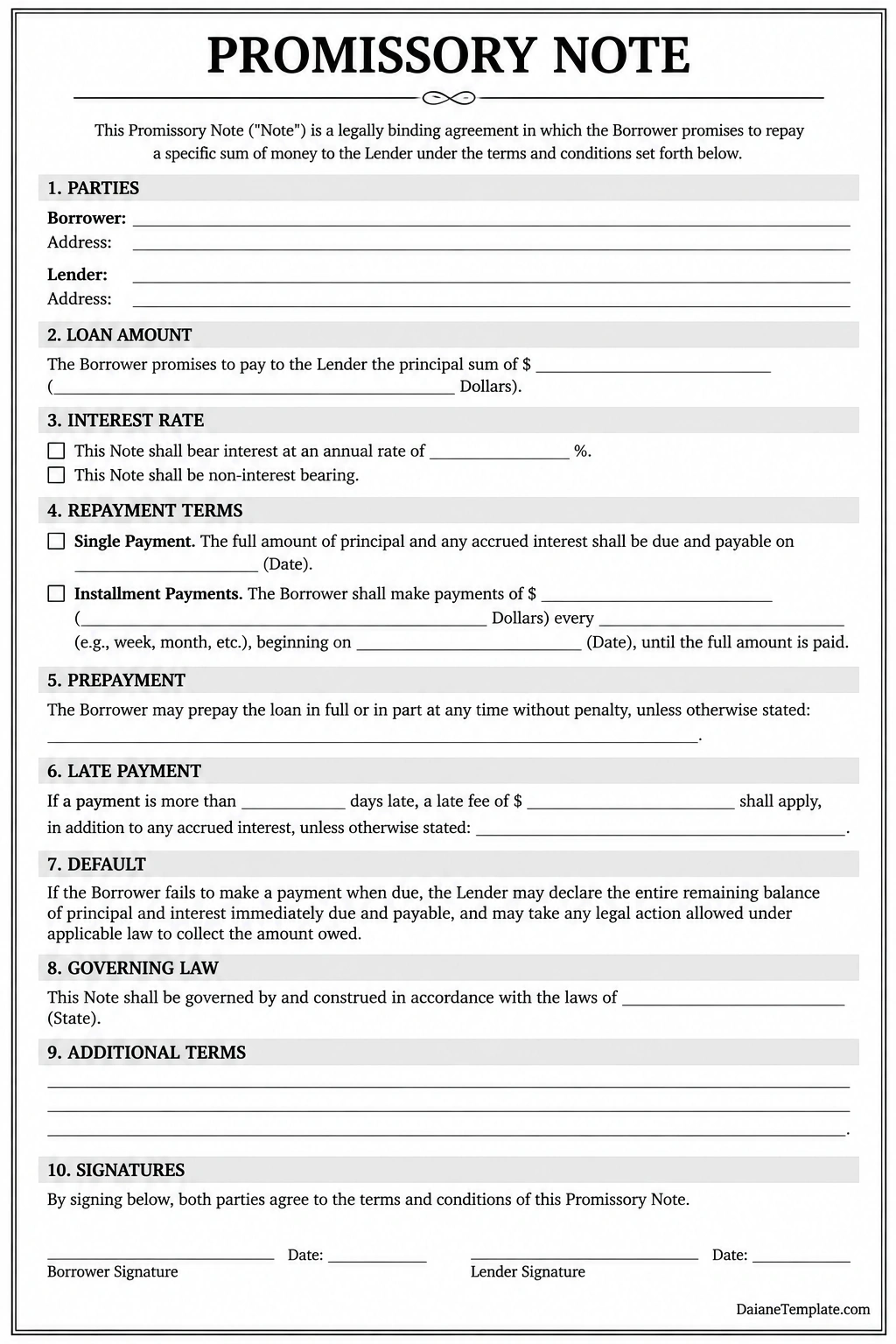
What Should a Promissory Note Include?
A useful promissory note should clearly explain who owes the money, how much must be repaid, and when payment is due. The following sections are commonly included in a written loan agreement.
1. Borrower and Lender Information
Identify both parties using their full legal names and current contact information. Include mailing addresses when appropriate. Accurate details help establish who is responsible for the debt and where formal notices should be sent.
2. Principal Loan Amount
State the original amount borrowed, known as the principal. For clarity, write the amount in numbers and words when practical. For example, a loan of $2,500 may be written as “Two Thousand Five Hundred Dollars ($2,500).” Make sure the amount matches the funds actually provided.
3. Interest Rate
Specify whether the loan carries interest. If interest applies, state the rate, how it is calculated, and whether it is annual or based on another period. If the loan is interest-free, say so explicitly. Any interest rate must comply with applicable laws, including rules that may limit the amount a lender can charge.
4. Repayment Schedule
Explain when and how the borrower must repay the loan. Common repayment arrangements include:
- Single payment: The borrower pays the outstanding amount on a specified date.
- Installment payments: The borrower pays a fixed amount at regular intervals, such as monthly.
- Payment on demand: Repayment becomes due following a demand, subject to the note’s terms and applicable law.
Include the first payment date, payment frequency, final due date, and acceptable payment method. If the loan uses installments, make sure the schedule explains how payments are applied to principal and interest.
5. Late Fees and Default Terms
If late fees or other consequences apply, describe them clearly. State when a payment becomes late, how any fee is calculated, and what happens if the borrower fails to pay. Late charges and default provisions must comply with applicable law and should not be assumed enforceable simply because they appear in a signed form.
6. Prepayment Conditions
Explain whether the borrower may repay the loan early without a penalty. If early repayment is allowed, clarify whether the borrower can pay part of the balance or the entire remaining amount. Clear prepayment terms help prevent disagreements when the borrower wants to settle the debt ahead of schedule.
7. Governing Law and Signatures
Identify the applicable governing law when appropriate. The borrower and lender should sign and date the completed document. Depending on the transaction and local requirements, witnesses, notarization, or additional formalities may be necessary.
How to Write a Promissory Note
Creating a promissory note does not have to be complicated. Follow these steps to prepare a document that clearly records the loan agreement.
Step 1: Confirm the Loan Details
Agree on the principal amount, interest rate, repayment dates, and payment method before completing the form. Both parties should understand the financial commitment and have an opportunity to ask questions.
Step 2: Enter the Parties’ Information
Write the borrower’s and lender’s full legal names and relevant contact details. Check the spelling and make sure the information identifies the correct individuals or legal entities.
Step 3: Document the Repayment Terms
Record the amount due, interest provisions, payment frequency, and final maturity date. Avoid vague statements such as “repay when possible.” Use specific dates and amounts wherever possible so both parties can determine when an obligation must be fulfilled.
Step 4: Review Additional Conditions
Consider whether the loan needs provisions covering early repayment, missed payments, notices, collateral, or other agreed conditions. A secured loan may require additional documentation and formalities. Do not assume that a general promissory note alone creates a valid security interest in property.
Step 5: Check, Sign, and Keep Copies
Read the entire document before signing. Correct errors, fill in applicable fields, and remove blank sections that could create confusion. Each party should receive a complete signed copy and retain records of loan disbursements and repayments.
Types of Promissory Notes
Different loans may require different types of promissory notes. The appropriate form depends on the purpose of the loan and the repayment arrangement.
Personal Promissory Note
A personal promissory note is commonly used when one individual lends money to another. It can help document loans between friends or family members by setting clear expectations and repayment dates.
Business Promissory Note
A business promissory note documents a loan involving a company, business owner, or commercial lender. It may include more detailed terms covering interest, default, payment schedules, and the parties’ legal capacities.
Secured Promissory Note
A secured promissory note relates to a loan supported by collateral. If the borrower defaults, the lender may have rights concerning that collateral, subject to the applicable agreement and legal requirements. Separate security documents, registrations, or other steps may be required.
Unsecured Promissory Note
An unsecured promissory note does not rely on specified collateral to secure repayment. The lender may still have legal remedies if the borrower fails to pay, but collecting the debt can be more difficult when the borrower lacks sufficient assets.
Promissory Note vs. Loan Agreement
A promissory note and a loan agreement both document borrowing arrangements, but they may serve different purposes. A promissory note generally focuses on the borrower’s promise to repay a defined amount under stated conditions. A loan agreement often describes a broader set of rights, obligations, representations, and procedures for the transaction.
For a straightforward loan, a promissory note may be sufficient if it meets the relevant legal requirements. More complex transactions, larger loans, business financing, or loans involving collateral may benefit from a separate, more comprehensive loan agreement. In some transactions, both documents are used together.
Tips for Using a Promissory Note Template
A template is a starting point, not a guarantee that the document will be legally enforceable. Use these practical tips to reduce errors and improve clarity.
- Be specific: Include clear amounts, dates, payment intervals, and interest terms.
- Use consistent figures: Check that the principal amount and installment calculations agree.
- Keep the wording understandable: Both parties should be able to explain their obligations in plain language.
- Avoid incomplete terms: Resolve important questions before signing instead of leaving essential provisions blank.
- Follow local law: Check applicable rules on interest, consumer lending, signatures, and debt collection.
- Keep payment records: Save receipts, bank transfer confirmations, and a record of the outstanding balance.
- Seek legal advice when needed: Consult a qualified lawyer for large loans, disputed terms, collateral, or unfamiliar legal requirements.
Common Mistakes to Avoid
Even a simple loan document can create problems if important details are missing. Avoid these common mistakes when preparing a promissory note:
- Failing to identify the borrower or lender accurately.
- Leaving the repayment date or payment schedule unclear.
- Including an interest rate that may violate applicable law.
- Using default or late-fee terms without defining how they work.
- Assuming a signature automatically makes every provision enforceable.
- Failing to provide both parties with a complete copy.
- Changing the terms later without properly documenting the agreement.
If the parties need to change the repayment schedule after signing, they should document the modification in writing and obtain any signatures required under the original agreement and applicable law.
Frequently Asked Questions About Promissory Notes
Is a promissory note legally binding?
A promissory note can be legally binding when it satisfies the applicable legal requirements and clearly establishes the borrower’s obligation to repay. Enforceability depends on factors such as the wording, the circumstances of the loan, and the governing law. A generic template does not guarantee enforceability.
Can I write my own promissory note?
Yes, you can prepare your own promissory note using a template as a guide. Include the parties’ information, principal amount, interest terms, repayment schedule, and signatures. For complex or high-value loans, consider having a qualified lawyer review the document before it is signed.
Does a promissory note need to be notarized?
Notarization is not universally required for every promissory note. The requirements depend on the jurisdiction, the transaction, and any related documents. Check local law to determine whether notarization or witnesses are necessary.
What happens if a borrower does not repay a promissory note?
If the borrower fails to pay, the lender may be able to pursue remedies allowed by the note and applicable law. Depending on the circumstances, this may involve sending a formal demand, negotiating a payment arrangement, or bringing a legal claim. Any collection action must follow the relevant legal procedures.
Can a promissory note be interest-free?
Yes. The parties can agree to an interest-free loan where permitted by applicable law. The document should explicitly state that no interest will be charged so that the repayment terms are clear.
What is the difference between a secured and an unsecured promissory note?
A secured promissory note is associated with collateral that may support repayment, while an unsecured promissory note does not specify collateral securing the debt. The lender’s rights and the steps needed to establish or enforce a security interest depend on applicable law and the related documents.
Can a promissory note be used between friends or family members?
Yes. A promissory note can document a loan between friends or family members. Putting the terms in writing can help both parties understand the repayment expectations and reduce the risk of misunderstandings.
Can I change a promissory note after signing?
The parties may be able to modify the terms by mutual agreement, but changes should be documented properly. Depending on the original note and applicable law, the modification may need to be signed by both parties or completed using a separate written amendment.
Conclusion
A promissory note is a practical way to document a borrower’s promise to repay a loan. By recording the principal amount, interest rate, repayment schedule, default provisions, and signatures, both parties can establish a clearer understanding of their financial obligations.
A free printable promissory note template can help organize the essential details, whether the loan is personal or business-related. Before signing, review every provision, confirm that the terms comply with applicable law, and keep a complete copy for your records. For complex transactions or significant amounts, professional legal advice can help ensure that the document is appropriate for your situation.
Download: Promissory Note Template
