A rent-to-own agreement provides a pathway to homeownership for people who need more time before purchasing a property. It combines a rental arrangement with an option, or in some cases an obligation, to buy the home at a later date. This arrangement can give a prospective buyer time to save for a down payment, improve their credit profile, and prepare for mortgage approval while living in the property.
For property owners, a rent-to-own arrangement can provide regular rental income and the possibility of a future sale. However, both parties need to understand the payment terms, purchase conditions, deadlines, and responsibilities before signing. A written agreement helps clarify expectations and reduce the risk of misunderstandings.
This guide explains what a rent-to-own agreement is, what to include in the document, how the arrangement works, and what both parties should review before entering into a contract.
What Is a Rent-to-Own Agreement?
A rent-to-own agreement is a written contract between a property owner and a tenant who may want to purchase the property in the future. The tenant rents the home for an agreed period and receives a contractual opportunity to buy it under specified conditions.
Depending on the contract, part of the rent or a separate option fee may be credited toward the future purchase price. These credits are not automatic. The agreement must clearly state whether they apply, how they are calculated, and what happens if the tenant does not purchase the property.
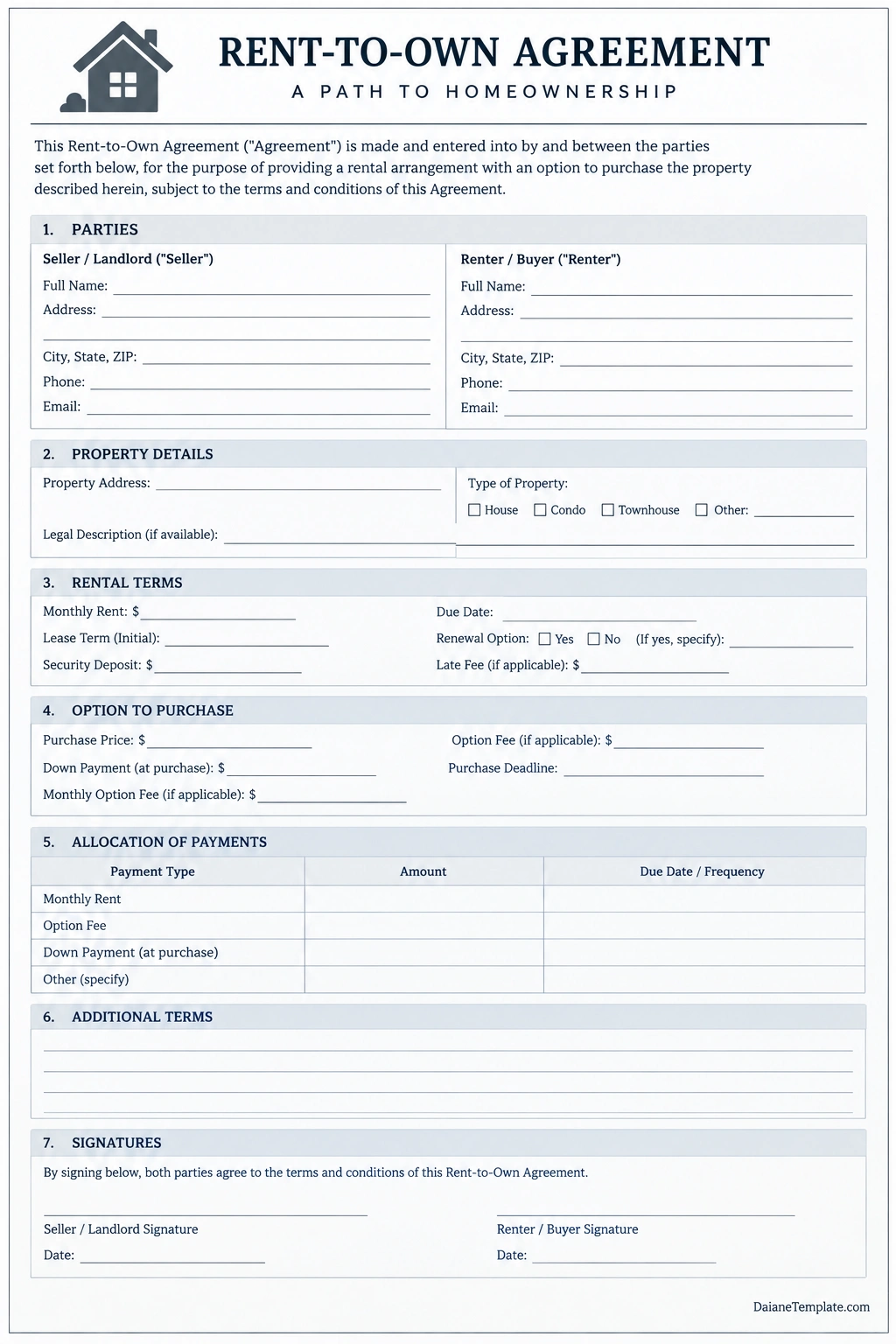
A rent-to-own contract typically covers:
- The names and contact details of the seller and renter-buyer.
- The property’s address and legal description, where applicable.
- The rental period, monthly rent, and payment due dates.
- The purchase price or the method used to determine it.
- Any option fee, purchase deposit, or rent credit.
- The deadline and procedure for exercising the purchase option.
- Maintenance responsibilities and other property obligations.
- Default, termination, and dispute-resolution terms.
- Signatures and dates for all required parties.
How Does a Rent-to-Own Agreement Work?
Although the details vary by contract and local law, most rent-to-own arrangements follow a series of steps. Both parties should understand each step before agreeing to the terms.
1. Agree on the Rental and Purchase Terms
The property owner and prospective buyer negotiate the monthly rent, length of the rental period, potential purchase price, and any fees. They should also decide whether the buyer has the option to purchase the property or is contractually required to do so.
2. Sign the Written Agreement
Both parties review and sign the rent-to-own contract. The document should identify the property, describe the rental arrangement, and explain exactly how the future purchase can proceed. Any promises made during negotiations should be included in writing.
3. Pay Rent and Meet the Contractual Requirements
The renter-buyer makes the required rental payments and follows the agreed property rules. If the contract provides rent credits, it should specify the amount or percentage credited toward the purchase and the conditions for receiving that credit.
4. Prepare for the Purchase
During the rental period, the prospective buyer may work toward mortgage approval, build savings, review their credit, and arrange an independent property inspection. A rent-to-own agreement does not guarantee that a lender will approve a mortgage, so financial preparation is important.
5. Exercise the Purchase Option
If the contract grants a purchase option, the renter-buyer must follow the specified process and deadline to exercise it. This may require written notice and other steps stated in the agreement. The parties then proceed with the purchase, subject to the contract and applicable law.
Types of Rent-to-Own Agreements
Before using a rent-to-own agreement template, identify which type of arrangement matches the parties’ intentions. The distinction can affect each party’s rights and financial risks.
Lease-Option Agreement
A lease-option agreement gives the tenant the right, but generally not the obligation, to purchase the property within a defined period. If the tenant chooses not to buy, the consequences depend on the contract and applicable law. An option fee or accumulated rent credits may be nonrefundable if the agreement clearly and lawfully provides for that result.
Lease-Purchase Agreement
A lease-purchase agreement generally combines a lease with a commitment to purchase the property under specified conditions. The exact obligations depend on the wording of the contract. Because this arrangement may create stronger obligations than a lease-option, both parties should obtain legal advice before signing.
Important: Contract names alone do not determine legal rights. The actual wording and applicable local law matter. Make sure the document accurately reflects whether the buyer has an option or a purchase obligation.
What to Include in a Rent-to-Own Agreement Template
A useful rent-to-own agreement template should provide enough detail for both parties to understand their obligations. Review each of the following sections before completing the document.
1. Parties and Property Information
Enter the full legal names and contact information of the property owner and renter-buyer. Identify the property by its complete address and include a legal description if required or appropriate. Confirm who has authority to enter into the agreement.
2. Rental Term and Monthly Payments
State the start date, end date, monthly rent, payment due date, accepted payment method, and any applicable late fees. Explain the process for renewals or extensions. The contract should also address any security deposit separately from purchase-related fees.
3. Purchase Price and Deadline
Specify the purchase price or explain how it will be calculated. Include the deadline for exercising the purchase option and any notice requirements. If the price is to be determined later, describe the method clearly enough to avoid uncertainty or disagreement.
4. Option Fee and Rent Credits
If the renter-buyer pays an option fee, state the amount, due date, and whether it will be credited toward the purchase price. If a portion of monthly rent will count toward the purchase, specify the exact amount or percentage, the eligibility conditions, and how the credits will be recorded.
Do not assume that every payment made during the rental period reduces the purchase price. The agreement should distinguish ordinary rent, security deposits, option fees, and purchase credits.
5. Repairs, Maintenance, and Utilities
Explain which party is responsible for routine maintenance, major repairs, utilities, property taxes, insurance, and other expenses. Responsibilities can vary by property type and local law. Avoid vague wording such as “the tenant handles all repairs” without defining its scope and confirming that the allocation is lawful.
6. Default and Termination
Describe what happens if rent is unpaid, either party breaches the agreement, the purchase option expires, or the buyer cannot complete the purchase. Include any required notices, cure periods, and procedures for ending the arrangement. Explain how fees and rent credits will be handled, subject to applicable law.
7. Signatures and Supporting Documents
Provide signature and date lines for all parties. Depending on the transaction, the parties may also need disclosures, property inspection records, an inventory of included items, or other supporting documents. Follow local requirements for witnessing, notarization, or recording when applicable.
Benefits of a Rent-to-Own Agreement
A rent-to-own arrangement can benefit both parties when the terms are fair, realistic, and clearly documented.
Benefits for the Renter-Buyer
- More preparation time: The rental period can provide time to build savings and prepare for a mortgage application.
- Potential purchase opportunity: The agreement may allow the buyer to purchase the home under terms agreed in advance.
- Clearer expectations: A detailed contract explains the rental arrangement and the conditions for a possible purchase.
- Possible rent credits: If expressly agreed, a portion of rent may count toward the purchase price.
Benefits for the Property Owner
- Rental income: The owner receives rent during the agreed rental period.
- Potential future sale: The arrangement may create a path toward selling the property to the tenant.
- Defined obligations: A written contract can clarify payments, maintenance duties, and purchase deadlines.
- Longer-term occupancy: A renter-buyer preparing to purchase may have an incentive to care for the property, although this is not guaranteed.
Risks and Important Considerations
Rent-to-own agreements also involve risks. Both parties should consider these before committing to the arrangement.
- Mortgage approval is not guaranteed: The renter-buyer may still be unable to obtain financing before the deadline.
- Fees and credits may be lost: Depending on the contract and local law, the buyer may not recover certain fees or rent credits if the purchase does not occur.
- Property value may change: A fixed purchase price can become less attractive if market values change significantly.
- Maintenance disputes may arise: Unclear repair obligations can lead to disagreements about costs and property condition.
- Contract terms may be restrictive: Deadlines, default clauses, and termination conditions can have significant financial consequences.
Before signing, consider an independent property inspection, a review of the seller’s authority to transfer the property, a realistic mortgage-readiness plan, and advice from a qualified real estate attorney. Do not rely solely on verbal assurances.
Tips for Using a Rent-to-Own Agreement Template
- Read every clause: Never sign a blank or incomplete agreement.
- Document every payment: Keep receipts and written records of rent, fees, and any purchase credits.
- Make deadlines specific: Use clear dates and explain how notices must be delivered.
- Clarify the purchase process: State how the buyer exercises the option and what steps follow.
- Check local requirements: Rental, real estate, consumer-protection, disclosure, and recording rules differ by jurisdiction.
- Keep a signed copy: Each party should retain the final agreement and all amendments.
- Seek professional review: Have a qualified local attorney review the document, especially if it creates an obligation to purchase or includes substantial nonrefundable fees.
Frequently Asked Questions
Is a rent-to-own agreement legally binding?
A rent-to-own agreement may be legally binding if it meets the applicable legal requirements. Enforceability depends on the contract’s wording, the transaction, and local law. Have the agreement reviewed by a qualified legal professional before signing.
Does rent automatically count toward the purchase price?
No. Rent counts toward the purchase price only when the agreement expressly provides for a rent credit or similar arrangement. The contract should explain the amount, calculation method, and conditions that apply.
What is the difference between a lease-option and a lease-purchase agreement?
A lease-option generally gives the tenant the right to buy without requiring the purchase. A lease-purchase agreement generally creates a commitment to purchase, subject to its terms. The actual legal effect depends on the wording and applicable law.
Can the renter-buyer walk away from a rent-to-own agreement?
That depends on the contract and local law. Ending the arrangement or choosing not to purchase may result in the loss of certain fees or credits, or could trigger other contractual consequences. Review the termination and default clauses before signing.
Who pays for repairs in a rent-to-own arrangement?
The agreement should identify who handles routine maintenance, major repairs, and other property expenses. Responsibilities vary by contract and jurisdiction, and some duties cannot legally be transferred to the tenant.
Can the purchase price change during the rental period?
The purchase price may be fixed or determined through a method specified in the agreement. If the parties want the price to change under certain circumstances, they should define the conditions and calculation method in writing.
Can I use a free rent-to-own agreement template?
Yes, a template can help organize the essential terms and serve as a drafting starting point. However, a generic form may not meet every local legal requirement or address the details of a particular property transaction. Customize it and obtain professional review when appropriate.
Conclusion
A rent-to-own agreement can provide a structured way for a renter to work toward homeownership while allowing a property owner to receive rental income and consider a future sale. Its success depends on clear payment terms, a well-defined purchase option or obligation, specific deadlines, and a practical allocation of responsibilities.
Use a rent-to-own agreement template to organize the key details, but do not treat it as a substitute for legal advice. Review every clause, verify the property’s details, understand the financial risks, and ensure the final agreement complies with applicable law before either party signs.
Download: Rent-To-Own Agreement Template
