A property management agreement is a written contract between a property owner and a property manager that defines how a property will be managed and what each party is responsible for. It provides a clear framework for services such as tenant screening, rent collection, property maintenance, leasing, inspections, and financial reporting.
Because property management involves ongoing responsibilities, payments, tenants, vendors, and potentially significant property-related decisions, having the terms in writing can help prevent misunderstandings. A well-organized property management agreement gives both parties a clear reference for the services being provided, management fees, contract duration, responsibilities, termination procedures, and other important terms.
Whether you own a single rental property or manage a larger portfolio, a property management contract can help establish expectations before the management relationship begins.
What Is a Property Management Agreement?
A property management agreement is a formal contract that authorizes a property manager to perform specified management services on behalf of a property owner. The agreement explains the authority given to the manager, the services included, the owner’s responsibilities, and the compensation arrangement.
The exact contents of a property management contract can vary depending on the type of property, location, services required, and agreement between the parties. Residential rentals, commercial properties, multifamily buildings, and vacation properties may require different provisions.
Common subjects covered in a property management agreement include:
- Property owner and property manager information
- Property description and address
- Term and duration of the agreement
- Property management services
- Tenant screening and placement
- Rent collection and lease administration
- Maintenance and repair coordination
- Property inspections
- Financial reporting
- Management fees and other charges
- Owner responsibilities
- Termination procedures
- Governing law
- Signatures of both parties
Why Use a Property Management Agreement?
Managing a rental property involves many recurring tasks, and assumptions can easily lead to disagreements. A written agreement helps establish who is responsible for each task and what the property manager is authorized to do.
Clarifies Management Responsibilities
The agreement can identify the specific services the property manager will provide. This may include advertising the property, screening prospective tenants, collecting rent, coordinating maintenance, handling tenant communications, conducting inspections, and preparing financial reports.
Clearly defining the services helps the owner understand what is included in the management arrangement and can also identify services that require additional fees.
Defines the Owner’s Responsibilities
Property management is not solely the manager’s responsibility. The owner may still need to provide property information, maintain adequate funds for approved expenses, respond to requests, and meet obligations related to the property.
Documenting these responsibilities can help prevent delays when the manager needs information, authorization, or funds to perform a particular task.
Establishes Fees and Compensation
A property management agreement should clearly explain how the manager will be compensated. Depending on the arrangement, fees may include a recurring management fee, leasing fee, maintenance coordination fee, renewal fee, or other agreed charges.
Written fee provisions make it easier for both parties to understand how compensation is calculated and when payments are due.
Key Elements of a Property Management Agreement
A comprehensive property management agreement should contain enough detail to accurately describe the relationship without creating unnecessary confusion. The following sections are commonly useful.
1. Property Owner and Property Manager Information
Start by identifying the parties entering into the agreement. Include the property owner’s name and contact information and the property manager’s business name, address, phone number, and email address when applicable.
Accurate identification is important because the contract should clearly establish who has entered into the management relationship.
2. Property Description
Identify the property covered by the agreement. Include the property address and, when appropriate, information such as the property type, unit numbers, or additional identifying details.
If the owner has multiple properties managed by the same company, each property should be clearly identified so there is no uncertainty about which properties are covered.
3. Term of the Agreement
The agreement should specify when the property management relationship begins and, if applicable, when it ends. Some arrangements continue until terminated by either party, while others have a defined contract period.
The agreement should also explain whether the contract automatically renews and what notice is required if either party does not wish to continue.
4. Services Provided by the Property Manager
This section is one of the most important parts of a property management agreement. It should clearly describe the duties the manager is expected to perform.
Depending on the arrangement, services may include:
- Property marketing and advertising
- Tenant screening and placement
- Rent collection
- Lease administration
- Tenant communication
- Property inspections
- Maintenance coordination
- Vendor management
- Financial reporting
- Lease renewal assistance
- Coordination of repairs
- Other property-specific services
Not every property manager provides every service, so the agreement should identify which services are actually included.
5. Tenant Screening and Placement
If tenant placement is part of the management service, the agreement can describe the manager’s responsibilities for advertising vacancies, processing applications, conducting screening, and assisting with lease execution.
Tenant screening procedures should be conducted in accordance with applicable housing, privacy, consumer reporting, and other relevant requirements.
6. Rent Collection
The agreement should explain whether the manager is responsible for collecting rent, processing payments, communicating with tenants about unpaid amounts, and providing financial records to the owner.
If the manager handles late payments or other collection-related activities, the agreement can explain the extent of the manager’s authority and any additional fees that may apply.
7. Maintenance and Repairs
Maintenance is another area where clearly defined responsibilities can prevent disputes. The agreement can explain how routine maintenance, emergency repairs, vendor coordination, and owner approvals will be handled.
For example, the parties may establish procedures for obtaining owner approval before certain expenses are incurred. The agreement should reflect the actual arrangement rather than relying on assumptions.
8. Compensation and Fees
Property management fees should be clearly documented. The agreement may specify a percentage of collected rent, a flat monthly amount, leasing charges, maintenance coordination fees, or other compensation.
Consider clearly identifying:
- Regular management fees
- Leasing or tenant placement fees
- Maintenance coordination fees
- Lease renewal fees
- Advertising expenses
- Approved reimbursable expenses
- Other charges that may apply
9. Owner Responsibilities
The property owner may have responsibilities that support effective management. These can include providing accurate property information, maintaining the property in an appropriate condition, funding approved expenses, and responding promptly to requests from the property manager.
Clearly identifying these duties helps both parties understand that successful property management requires cooperation.
10. Termination
A property management agreement should explain how either party can terminate the relationship. The contract may specify a required written notice period and describe what happens to outstanding work, tenant records, funds, keys, leases, and other property-related materials after termination.
Termination provisions should be consistent with the rest of the agreement and applicable law.
11. Governing Law
The agreement may identify the state, province, or other jurisdiction whose laws govern the contract. Property management and landlord-tenant requirements can vary substantially by location, so the appropriate provisions should be determined based on the circumstances of the property and parties.
How to Create a Property Management Agreement
Creating a property management agreement starts with identifying the exact relationship between the owner and manager. The document should reflect the actual services, authority, fees, and responsibilities that both parties have agreed upon.
Identify the Property Clearly
Begin with the property address and other information needed to distinguish the property from any other property owned or managed by the parties.
List Specific Services
Avoid relying on broad descriptions such as “manage the property.” Instead, list the actual services included in the arrangement. This can make the agreement easier to interpret and manage.
Define Financial Responsibilities
Explain management fees, leasing fees, maintenance expenses, reimbursement procedures, and other charges. If the manager has authority to approve expenses up to a certain amount, that process should be documented clearly.
Establish Communication Procedures
Consider explaining how the owner and manager will communicate about maintenance requests, vacancies, tenant issues, emergencies, financial matters, and other important events.
Review Legal and Local Requirements
Property management can involve landlord-tenant rules, housing requirements, licensing rules, privacy obligations, consumer protection requirements, and other regulations. A general template may therefore need to be adapted to the applicable jurisdiction and specific property.
Property Management Agreement Template
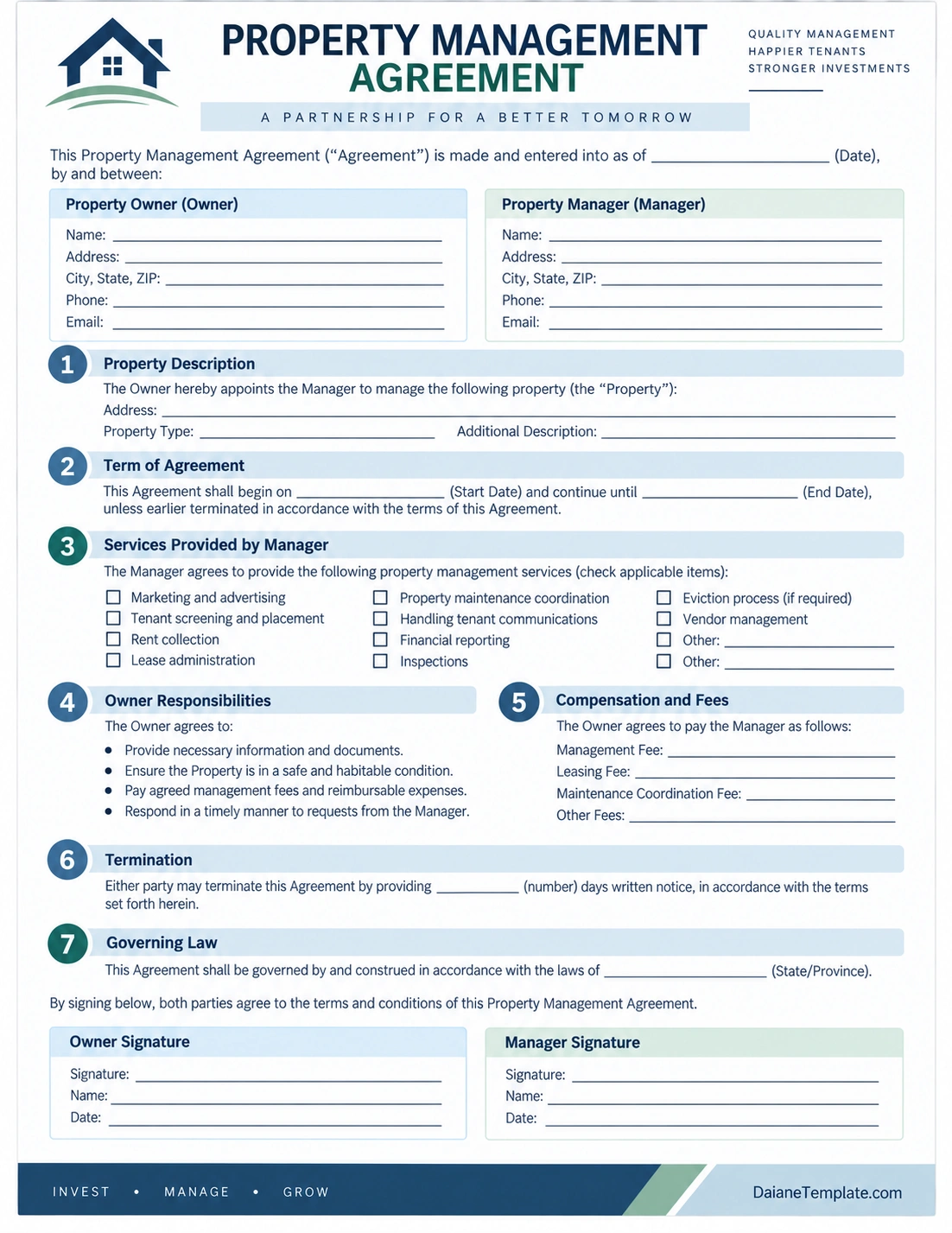
A property management agreement template provides a structured starting point for documenting the relationship between a property owner and property manager. A practical template can include sections for property information, management services, owner responsibilities, compensation, termination, governing law, and signatures.
The template should be customized before signing so that it accurately reflects the actual property, services, fees, authority, and responsibilities of the parties.
Common Mistakes to Avoid
Even a professionally formatted property management contract can create problems if important terms are left unclear. Reviewing the following areas can help identify potential gaps before the agreement is signed.
- Using a vague service description: Clearly identify which management services are included.
- Leaving fees undefined: Document regular management fees and additional charges.
- Ignoring maintenance procedures: Explain how routine and emergency repairs will be handled.
- Failing to define owner responsibilities: Identify information, funding, approvals, and other duties expected from the owner.
- Not addressing termination: Establish notice requirements and procedures for ending the relationship.
- Overlooking local requirements: Property management and rental regulations vary by jurisdiction.
- Using an unmodified template: A generic form may not address the specific property or management arrangement.
Tips for Using a Property Management Contract
A signed agreement should remain a useful reference throughout the management relationship. Both parties can reduce confusion by keeping important information organized and documenting significant changes.
- Keep a signed copy of the current agreement.
- Document amendments and changes to management services in writing.
- Keep fee schedules and expense records organized.
- Review the agreement when adding or removing properties.
- Communicate major maintenance and tenant-related decisions clearly.
- Keep property and financial records accessible to the appropriate parties.
- Review renewal and termination dates in advance.
When Should You Use a Property Management Agreement?
A property management agreement can be useful whenever a property owner hires another person or company to manage a rental or investment property on the owner’s behalf.
It may be appropriate for single-family rentals, apartments, multifamily properties, commercial buildings, vacation rentals, and other managed real estate arrangements. The complexity of the agreement should generally reflect the scope and complexity of the management relationship.
Final Thoughts on Property Management Agreements
A property management agreement creates a written framework for the relationship between a property owner and property manager. By clearly documenting management duties, tenant-related responsibilities, maintenance procedures, compensation, fees, contract duration, termination provisions, and other important terms, the parties can establish clearer expectations from the beginning.
A property management agreement template can make the drafting process more organized, but it should be customized to the actual property and management arrangement. Because property management and landlord-tenant requirements can vary by jurisdiction, parties should consider appropriate professional or legal advice when the agreement involves significant obligations or uncertainty.
Download: Property Management Agreement Template
