A quit-claim deed form is a legal document used to transfer whatever ownership interest a person has in a property to another person without guaranteeing that the title is clear or free of claims. It is commonly used for certain transfers between family members, property changes following a divorce, or situations where someone is being added to or removed from a property’s title.
Although a quitclaim deed can be a convenient way to transfer property interests, it is important to understand its limitations. Unlike some other property deeds, a quitclaim deed generally does not promise that the person transferring the interest owns the property free of liens, competing claims, or title defects. The recipient typically receives only the interest the grantor actually holds, if any.
In this guide, you’ll learn what a quit-claim deed form is, when it may be appropriate, what information it typically includes, and how the recording process works. You’ll also find practical precautions and answers to frequently asked questions. Because deed requirements vary by jurisdiction, use this guide as general information rather than a substitute for local legal advice.
What Is a Quit-Claim Deed Form?
A quit-claim deed form, also commonly spelled quitclaim deed form, is a document used to transfer a person’s existing interest in real property to another party. The person transferring the interest is generally called the grantor, while the person receiving it is called the grantee.
The key feature of a quitclaim deed is that it transfers the grantor’s interest without providing the same title warranties associated with certain other types of deeds. If the grantor owns only a partial interest, the grantee generally receives only that interest. If the grantor has no ownership interest to transfer, the deed typically does not create one.
A quitclaim deed may be considered in situations such as:
- Transferring a property interest between spouses or former spouses
- Adding a family member to a property title
- Removing a person’s ownership interest when legally appropriate
- Transferring property interests between certain relatives
- Correcting or clarifying ownership records when advised by a qualified professional
- Transferring an interest into a trust or another ownership arrangement when permitted and properly structured
Not every transfer is suitable for a quitclaim deed. The correct document depends on the purpose of the transfer, the parties’ existing rights, financing arrangements, and the laws of the property’s location.
How Does a Quitclaim Deed Work?
A quitclaim deed documents the grantor’s transfer of their existing interest in a property to the grantee. To understand the process, it helps to distinguish the transfer document from the underlying ownership rights.
The Grantor Transfers Their Existing Interest
The grantor is the person transferring their interest. The deed identifies the grantor and describes the property and interest being conveyed according to the applicable legal requirements.
The Grantee Receives the Interest Conveyed
The grantee is the person receiving the interest. The deed does not automatically guarantee that the grantor has valid ownership, that no other person has a claim, or that the property is free of liens.
Execution and Recording Follow Local Rules
The deed must meet the applicable requirements for signing, notarization or witnessing, and recording. These requirements differ by state and other jurisdictions. Recording the document in the appropriate land records office helps document the transfer, but recording does not necessarily resolve every underlying title problem.
When Should You Use a Quit-Claim Deed Form?
A quitclaim deed is generally most appropriate when the parties understand the existing ownership situation and do not require the grantor to provide title warranties. The following examples illustrate situations in which it may be considered.
1. Transfers Between Family Members
A person may wish to transfer an ownership interest to a spouse, child, sibling, or another relative. A quitclaim deed may be suitable in some circumstances, but the parties should consider tax consequences, mortgage terms, existing ownership rights, and local requirements before proceeding.
2. Divorce or Separation
When a divorce settlement or court order addresses ownership of real property, a quitclaim deed may be one of the documents used to implement the agreed transfer. However, signing a deed does not necessarily remove a person from the mortgage or eliminate their financial obligations to a lender.
Before transferring an interest, confirm that the deed is consistent with the settlement, court order, and financing arrangements. Legal advice may be especially important when the property has an outstanding mortgage.
3. Adding or Removing an Owner
Property owners sometimes consider a quitclaim deed when changing how a property is held. The legal consequences can depend on how the property is titled, the rights of existing owners, and the ownership structure created by the transfer.
Removing a name from a deed is not necessarily the same as removing that person’s responsibility for a mortgage, property tax, or other obligation.
4. Transfers to a Trust
Some property owners transfer real estate into a trust as part of an estate planning strategy. A quitclaim deed may be used in certain jurisdictions, but the deed, trust documents, title insurance, and mortgage terms should be reviewed together.
5. Other Limited Ownership Transfers
A quitclaim deed may be considered for other transfers where the parties understand the grantor’s existing interest and do not require title warranties. If ownership is disputed or the recipient needs protection against title defects, a different deed or a more comprehensive legal process may be appropriate.
What Information Should a Quit-Claim Deed Form Include?
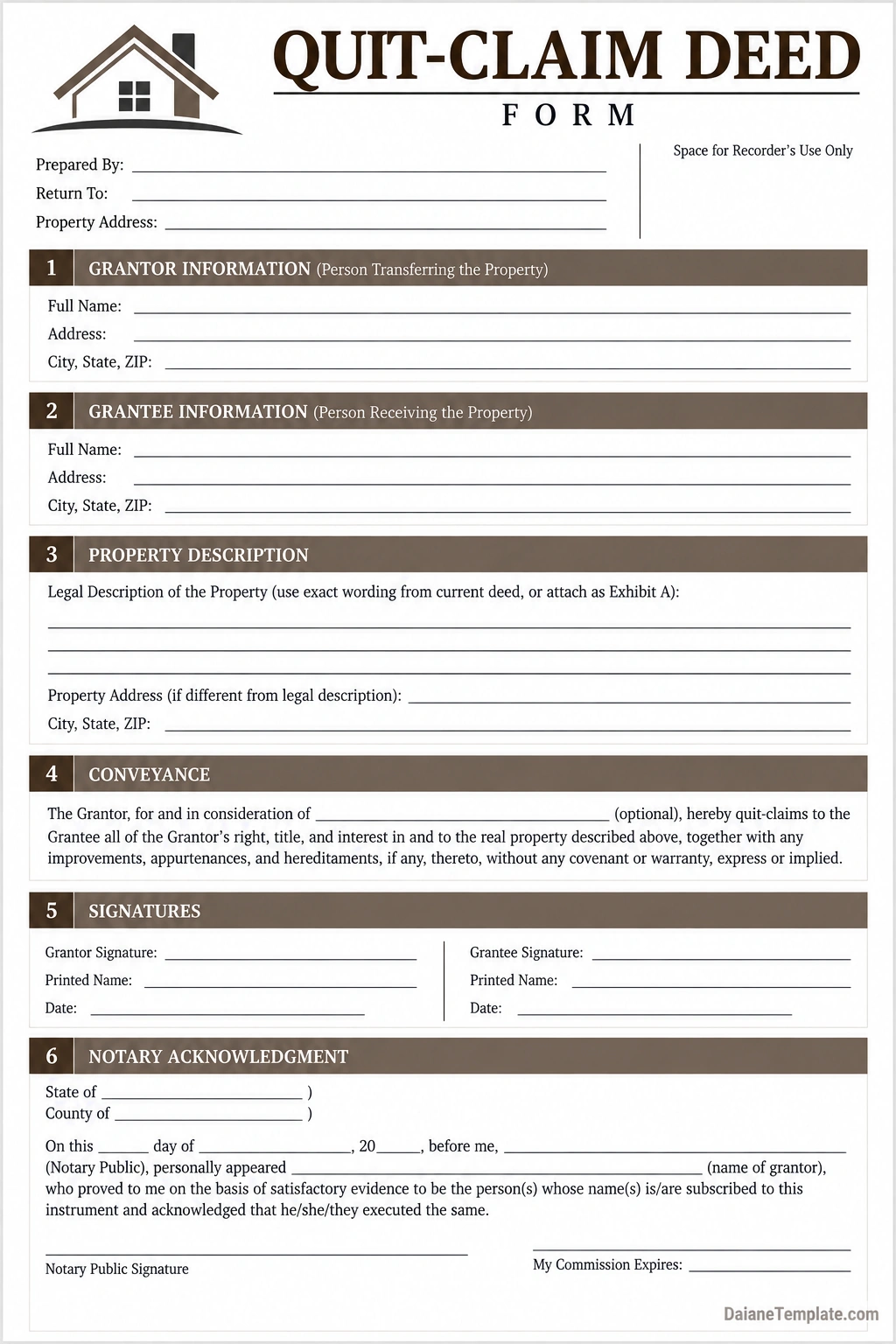
The required contents vary by jurisdiction. A typical quitclaim deed form may include the following information, but the form should be checked against local recording rules before use.
1. Grantor Information
Include the grantor’s full legal name and any other identifying information required by local law. Verify spelling and confirm that the person transferring the interest is correctly identified in the current property records.
2. Grantee Information
Identify the person or legal entity receiving the interest. If the grantee is a trust, company, or other entity, use the legally correct name and confirm that the intended ownership arrangement is accurately described.
3. Property Address and Legal Description
Include the property address where appropriate and the complete legal description required for recording. A street address alone may not be sufficient. The legal description is often obtained from a current deed or other official property record.
Copy the description carefully and avoid making assumptions about parcel boundaries or ownership. Errors in the legal description may delay recording or create problems with the intended transfer.
4. Conveyance Language
The deed needs language that clearly expresses the transfer of the grantor’s interest to the grantee. The exact wording and any required statutory language depend on the property’s jurisdiction.
5. Consideration or Transfer Details
Some deeds include a statement about consideration, which may refer to money or another form of value exchanged. Other transfers may be gifts or may use wording prescribed by local law. Do not assume that a nominal amount is appropriate for every transaction.
6. Signatures and Acknowledgment
The grantor must sign in accordance with the applicable legal requirements. A notarial acknowledgment, witnesses, or other formalities may be required. Confirm the rules before signing, since an improperly executed deed may be rejected or fail to achieve the intended result.
7. Return and Recording Information
The form may include a return address, preparer information, and space for recording details. Some recording offices require additional forms, transfer declarations, tax information, or specific page layouts.
How to Complete and Record a Quit-Claim Deed Form
Preparing a deed involves more than filling in names and signing a document. Use a careful process to reduce errors and confirm that the transfer meets local requirements.
Step 1: Confirm That a Quitclaim Deed Is Appropriate
Identify the purpose of the transfer and confirm what ownership interest the grantor holds. If the transaction involves a sale, a title dispute, an outstanding mortgage, or a complex ownership arrangement, ask a qualified real estate attorney or title professional whether another approach is more suitable.
Step 2: Obtain the Correct Local Form
Use a form that complies with the requirements of the jurisdiction where the property is located. A generic template may omit mandatory wording, tax declarations, or recording requirements.
Step 3: Verify the Property Records
Review the current deed and relevant property records. Confirm the grantor’s name, the legal description, and the ownership interest being transferred. If the records are unclear, seek professional help before preparing the deed.
Step 4: Complete Every Required Field
Enter the grantor and grantee information, property description, conveyance language, and any other required details. Follow local instructions for consideration, tax statements, preparer information, and return addresses.
Step 5: Sign and Complete Required Formalities
Arrange the required notarization, witnesses, or other execution formalities. Do not sign prematurely if local law requires the grantor to sign in front of a notary or witnesses.
Step 6: Submit the Deed for Recording
Submit the completed deed to the appropriate recording office and pay any required fees or taxes. Check whether the office requires additional documents or specific submission methods. Retain a copy of the signed deed and confirmation of recording.
Step 7: Confirm the Transfer and Address Related Matters
After submission, verify whether the deed was accepted and recorded. Depending on the transaction, you may also need to address property tax records, insurance, estate planning documents, or lender requirements.
Quitclaim Deed vs. Warranty Deed
Understanding the difference between deed types is important before transferring real estate. The main distinction concerns the assurances provided about ownership and title.
Quitclaim Deed
A quitclaim deed generally transfers whatever interest the grantor has without providing warranties about the quality of the title. It may be considered for certain transfers between parties who understand the existing ownership situation.
Warranty Deed
A warranty deed provides specified assurances about title, subject to the type of deed and applicable law. Buyers in an ordinary property sale may require title protections that a quitclaim deed does not provide.
A quitclaim deed should not be chosen merely because it appears simpler. The appropriate deed depends on the transaction, the parties’ needs, and the level of title protection required.
Important Risks and Precautions
Before using a quit-claim deed form, consider the following risks and precautions.
- No guarantee of clear title: The deed generally does not guarantee that the grantor owns the property free of competing claims.
- Mortgage obligations may remain: Transferring title does not automatically release a borrower from a mortgage or other loan obligation.
- Tax consequences may apply: A transfer can have gift, property, transfer-tax, or other tax consequences depending on the circumstances and jurisdiction.
- Ownership rights may change: Adding or removing an owner can affect control, inheritance, and the rights of other co-owners.
- Recording rules vary: Incorrect forms, missing signatures, or incomplete supporting documents may lead to rejection.
- Existing disputes need careful handling: A quitclaim deed may not resolve liens, title defects, or competing ownership claims.
If you are unsure about ownership, financing, taxes, or the legal effect of the transfer, consult a qualified professional before signing or recording the deed.
Frequently Asked Questions About Quit-Claim Deed Forms
What is a quit-claim deed form used for?
A quit-claim deed form is used to document the transfer of a person’s existing interest in real property to another party without providing title warranties. Common examples include certain family transfers, divorce-related transfers, and changes to property ownership.
Does a quitclaim deed prove that the grantor owns the property?
No. A quitclaim deed generally transfers whatever interest the grantor has, if any. It does not guarantee that the grantor owns the property or that the title is free of liens or competing claims.
Can a quitclaim deed remove someone from a mortgage?
Not by itself. A deed changes an ownership interest, while a mortgage or loan agreement creates separate obligations. A lender may need to approve a change or release a borrower under a separate process.
Does a quitclaim deed need to be notarized?
Notarization or other execution formalities are commonly required for recording, but the exact requirements depend on the property’s jurisdiction. Check the rules of the relevant recording office before signing.
Can I prepare a quitclaim deed myself?
Some people prepare deeds using an official local form, but errors in the legal description, signatures, or transfer language can create serious problems. Consider professional assistance if you are unfamiliar with the process or the transaction involves significant risks.
Is a quitclaim deed the same as a warranty deed?
No. A quitclaim deed generally transfers the grantor’s existing interest without title warranties. A warranty deed provides specified assurances about title, subject to its terms and applicable law.
How do I record a quitclaim deed?
After completing the deed and required formalities, submit it to the appropriate land records or recording office, along with any required supporting documents and fees. Confirm local requirements and retain proof that the document was accepted.
Conclusion
A quit-claim deed form can be useful for certain property interest transfers, especially when the parties understand the existing ownership situation and do not require title warranties. However, it does not guarantee clear title, eliminate mortgage obligations, or automatically resolve disputes about ownership.
Before using a quitclaim deed, confirm that it suits the transaction, obtain the correct local form, verify the property description, and follow all signing and recording requirements. When the transfer involves a divorce, a mortgage, taxes, an inheritance, or uncertain title, professional legal advice can help prevent costly mistakes.
Download: Quit-Claim Deed Form
