A report card is an important educational document used to communicate a student’s academic performance, progress, and development over a specific period. It gives students, parents, guardians, and teachers a clear overview of what the student has learned, where they are performing well, and which areas may need additional attention.
More than a collection of grades, a report card can provide valuable information about a student’s learning journey. Depending on the school and grade level, it may include subject grades, teacher comments, attendance records, learning behaviors, skills, achievements, and areas for improvement.
When used effectively, a report card becomes a communication tool between school and home. It can help parents understand their child’s progress and give teachers an opportunity to share meaningful observations about the student’s academic and personal development.
What Is a Report Card?
A report card is a formal record that summarizes a student’s performance during a particular grading period. Schools may issue report cards quarterly, by semester, or at other intervals depending on their academic calendar and reporting system.
Traditional report cards usually contain grades for individual subjects. Modern report cards may go further by including learning standards, competency ratings, teacher observations, attendance information, and personalized comments.
The exact format varies by school, but the primary purpose remains the same: to provide a clear summary of student progress and encourage communication between educators and families.
What Information Does a Report Card Include?
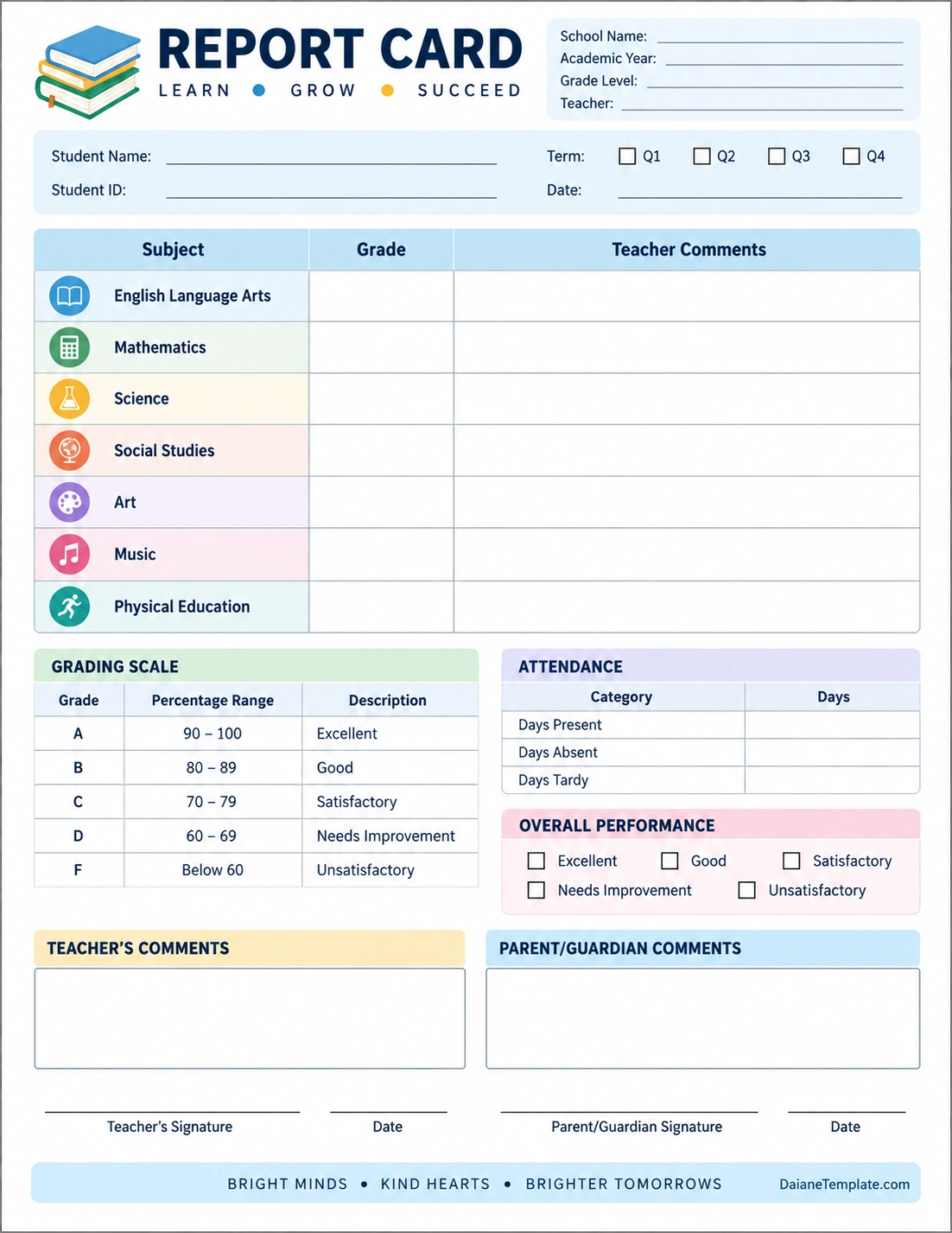
A report card can contain several sections designed to present a complete picture of student performance. The information included depends on the school’s requirements and the student’s grade level.
Student Information
The first section usually identifies the student and the reporting period. Common information includes:
- Student name
- Student identification number
- Grade or class
- School name
- Teacher name
- Academic year
- Grading period or term
- Report date
Subject Grades
The main section of many report cards lists academic subjects and the student’s corresponding grades or performance ratings. Common subjects may include English language arts, mathematics, science, social studies, art, music, and physical education.
Depending on the grading system, a school may use letter grades, percentages, numerical scores, standards-based ratings, or descriptive performance levels.
Teacher Comments
Teacher comments add context that a grade alone cannot provide. A thoughtful comment can describe a student’s strengths, participation, learning habits, progress, or areas that require additional practice.
For example, instead of simply recording a lower mathematics grade, a teacher might explain that the student understands basic concepts but needs additional practice applying those concepts to multi-step problems.
Attendance Information
Some report cards include attendance records such as days present, days absent, and days tardy. Attendance information can help families understand whether missed school time may be affecting academic progress.
Overall Performance
A report card may also provide an overall performance rating or summary. This section can help parents quickly understand the student’s general progress while the individual subject sections provide more detailed information.
Why Is a Report Card Important?
A report card serves several important purposes within the educational process. It creates a formal record of student achievement while also supporting communication among students, parents, guardians, and teachers.
- Communicates academic progress: Parents can see how their child is performing across different subjects.
- Identifies strengths: Grades and teacher comments can highlight subjects or skills where a student is doing well.
- Highlights areas for improvement: Lower grades or specific teacher feedback can identify where additional support may be helpful.
- Encourages communication: Families can use the report as a starting point for conversations with teachers and students.
- Documents progress: Report cards create a record that can be reviewed over time.
- Supports goal setting: Students can use feedback to establish realistic academic goals for the next grading period.
How to Read a Report Card
Reading a report card effectively involves looking beyond individual grades. A single grade provides useful information, but the overall pattern can reveal much more about a student’s progress.
Look at the Overall Pattern
Start by reviewing all subjects rather than focusing immediately on the highest or lowest grade. Look for consistent strengths and areas where performance may be changing.
For example, a student may perform strongly in reading and social studies while experiencing difficulty in mathematics. This pattern can help parents and teachers identify where additional support may be useful.
Read Teacher Comments Carefully
Teacher comments can provide important context behind the grades. Look for comments about participation, organization, homework completion, classroom behavior, communication, problem-solving, or other learning skills.
Compare Progress Over Time
One report card represents performance during a specific period. Comparing report cards over several grading periods can help reveal whether the student is improving, maintaining performance, or experiencing new challenges.
Consider Attendance
If attendance information is included, review it alongside academic results. Frequent absences or tardiness may affect opportunities to participate in lessons, complete assignments, or receive direct instruction.
Report Card Grading Systems
Schools use different approaches to communicate student performance. Understanding the grading system makes the information on a report card easier to interpret.
Letter Grades
Letter grades such as A, B, C, D, and F are commonly used to summarize academic achievement. Schools may define the percentage ranges associated with each letter differently, so families should refer to the school’s grading policy when interpreting them.
Percentage Grades
Percentage-based grading expresses performance as a numerical value, such as 92%, 84%, or 76%. This approach can provide a more detailed numerical representation of performance.
Standards-Based Grading
Standards-based report cards focus on a student’s progress toward specific learning standards or competencies. Instead of emphasizing a single overall letter grade, they may use performance levels such as meeting expectations, approaching expectations, or exceeding expectations.
Descriptive Ratings
Some schools use descriptions such as Excellent, Good, Satisfactory, Needs Improvement, or similar categories. These ratings can be combined with written teacher feedback to provide additional context.
How Teachers Can Create an Effective Report Card
A useful report card should be clear, accurate, and meaningful. Teachers can improve the quality of student reporting by combining objective performance information with concise observations.
Use Clear and Specific Comments
Avoid vague statements such as “needs to work harder.” Instead, describe a specific skill or behavior that can be improved.
For example, a more useful comment might explain that the student should review multiplication facts regularly and practice showing each step when solving multi-step problems.
Balance Strengths and Areas for Improvement
Effective feedback should recognize what the student is doing well while also identifying realistic opportunities for growth. This creates a more complete picture of student development.
Focus on Observable Evidence
Comments should be based on classroom observations, assignments, assessments, participation, and other relevant evidence. Specific observations make feedback more useful to both students and families.
Keep the Language Family-Friendly
Educational terminology can sometimes be difficult for families to understand. Use straightforward language whenever possible and explain specialized terms when they are necessary.
How Parents Can Use a Report Card
Parents and guardians can use a report card as a starting point for constructive conversations rather than simply treating it as a collection of scores.
- Ask the student which subjects they enjoy most.
- Discuss areas where the student feels confident.
- Ask what schoolwork feels challenging.
- Review teacher comments together.
- Celebrate progress and effort.
- Identify one or two realistic areas for improvement.
- Create specific goals for the next grading period.
- Contact the teacher when additional clarification is needed.
The goal should be to understand the student’s learning experience and determine how adults and students can work together to support continued growth.
How Students Can Use Their Report Card
Students can also take an active role in reviewing their report cards. Instead of viewing grades only as a final judgment, students can use the information to reflect on their learning habits and establish future goals.
Students can ask themselves:
- Which subjects am I performing well in?
- Which skills have improved since the previous grading period?
- Which areas are still challenging?
- What study habits are helping me?
- What habits should I change?
- What specific goal can I work toward next?
This type of reflection can help students develop greater ownership of their education and become more aware of how their choices affect their academic progress.
Tips for Designing a Report Card Template
A report card template should make important information easy to find and understand. A clean layout is particularly useful when the document will be printed or shared with families.
Consider including the following sections:
- School and academic year information
- Student identification details
- Grading period or term
- Subject and grade table
- Teacher comments
- Attendance summary
- Overall performance
- Parent or guardian comments
- Teacher signature and date
- Parent or guardian signature and date
Use consistent typography, clear headings, sufficient writing space, and simple tables. A well-organized layout allows teachers to complete the document efficiently while making it easier for families to review.
Report Card vs. Progress Report
A report card and a progress report both communicate information about student learning, but they may serve different purposes.
A report card generally provides a formal summary of performance at the end of a defined grading period. A progress report is often used during an academic period to provide an update on how the student is progressing before the final report for that period is issued.
Schools may use these terms differently, so the exact format and timing depend on the educational institution.
Common Problems With Report Cards
Although report cards are useful communication tools, they can be less effective when they provide too little context or information.
Common issues include:
- Comments that are too general.
- Grades without explanations.
- Inconsistent terminology.
- Overly complicated layouts.
- Insufficient space for meaningful feedback.
- Failure to communicate both strengths and areas for growth.
Schools and teachers can improve reporting by ensuring that grades are accompanied by useful context and that the overall document remains clear and accessible.
Conclusion
A report card is more than a record of grades. It is an important communication tool that helps students, parents, guardians, and teachers understand academic performance and progress over time.
When a report card combines clear grades, meaningful teacher comments, attendance information, and practical areas for improvement, it provides a stronger picture of the student’s learning experience. Families can then use that information to celebrate progress, discuss challenges, and establish goals for the next stage of learning.
Whether you are a teacher creating a report card, a parent reviewing one, or a student reflecting on academic progress, a well-designed report card can support better communication and encourage continuous growth throughout the school year.
Download: Report Card Template
