A rent roll is a detailed record that provides a quick overview of a rental property’s tenants, units, lease information, and rental income. It is an important management tool for landlords, property managers, and real estate investors because it brings essential property data together in one organized document.
A well-maintained rent roll can make it easier to monitor occupancy, track monthly rent, identify upcoming lease expirations, recognize potential payment issues, and estimate rental income. For investors, it can also provide useful information when evaluating the financial performance and potential value of a rental property.
Whether you manage one rental unit or a larger multifamily property, a clear rent roll can help turn scattered tenant and lease information into a practical at-a-glance overview.
What Is a Rent Roll?
A rent roll is a property management report that lists individual rental units and summarizes important information about the tenants and leases associated with those units. It commonly includes unit numbers, tenant names, monthly rent, lease dates, security deposits, payment status, and occupancy information.
The exact format can vary depending on the type and size of the property. A single-family rental may require only a small amount of information, while an apartment building may need a detailed table containing dozens or hundreds of units.
A typical rent roll may include:
- Unit number
- Unit type
- Tenant name
- Move-in date
- Lease start date
- Lease expiration date
- Monthly rental amount
- Security deposit
- Payment status
- Occupancy status
- Notes about the unit or tenancy
Why Is a Rent Roll Important?
A rent roll gives property owners and managers a centralized view of information that might otherwise be spread across leases, accounting records, spreadsheets, and property management systems.
Provides an At-a-Glance Property Overview
Instead of reviewing individual leases one by one, a rent roll allows the user to see important information for multiple units in a single report. This can make routine property management tasks more efficient.
Tracks Rental Income
Monthly rent information can help owners estimate the property’s scheduled rental income. Comparing scheduled rent with actual collections can also help identify differences that require attention.
Monitors Occupancy
A rent roll can show which units are occupied and which are vacant. Tracking occupancy is useful for identifying vacancies and understanding how much of the property’s available rental space is currently producing income.
Identifies Upcoming Lease Expirations
Lease start and end dates make it easier to identify leases that will expire in the coming months. Property managers can use this information to plan renewal conversations, marketing, inspections, or turnover activities.
Supports Financial and Investment Analysis
For investors, rental income and occupancy information can contribute to broader property analysis. A rent roll can be reviewed alongside operating expenses, vacancy information, market rents, and other financial data when evaluating an investment.
Key Information Included in a Rent Roll
The usefulness of a rent roll depends largely on the quality and relevance of the information it contains. The following fields are commonly included in a rental property rent roll.
Unit Information
Each rental unit should be clearly identified. Depending on the property, this may include a unit number, building, floor, unit type, bedroom count, or other identifying information.
Clear unit identification prevents confusion when multiple units have similar characteristics or when a property contains several buildings.
Tenant Information
The tenant’s name is commonly included so the owner or manager can quickly identify who occupies each unit. Depending on the intended use and privacy requirements, additional tenant information may or may not be appropriate.
Lease Dates
Lease start and expiration dates are important because they provide a timeline for each tenancy. These dates can help property managers plan renewals, inspections, marketing, and potential turnover.
Monthly Rent
The monthly rental amount shows the scheduled rent associated with each unit. When multiple units are listed together, these amounts can be used to estimate total scheduled rental income.
Security Deposit
If relevant, the rent roll may include the security deposit associated with each tenancy. This provides a convenient reference, although detailed deposit accounting may be maintained separately.
Payment Status
A payment status field can indicate whether rent has been paid, is outstanding, or requires follow-up. This can help property managers identify potential collection issues.
Notes
A notes section can be used for important administrative information that does not fit into the standard fields. Notes should be concise and handled appropriately when they contain sensitive tenant information.
Rent Roll vs. Rent Roll Report
The terms “rent roll” and “rent roll report” are often used interchangeably. Both generally refer to a document or report that summarizes rental units, tenants, lease information, and rental income.
However, the level of detail can vary. A basic rent roll spreadsheet may contain only unit, tenant, rent, and lease information, while a more comprehensive rent roll report may include occupancy, payment status, deposits, lease terms, and additional financial information.
How to Create a Rent Roll
Creating a rent roll is relatively straightforward when the property information is organized consistently. The most important step is deciding which information is useful for managing and evaluating the property.
Start With the Property Details
Identify the property by name or address and record the date the report was prepared. If the property is managed by a company or individual, the preparer’s name can also be included.
List Every Unit
Create a separate row for each rental unit. Include the unit number and any relevant unit characteristics needed to identify it.
Add Tenant and Lease Information
Enter the applicable tenant name, move-in date, lease start date, and lease expiration date. Keeping these dates accurate makes the rent roll much more useful for future planning.
Record Rental Amounts
Enter the scheduled monthly rent for each occupied unit. If a unit is vacant, identify it as vacant rather than leaving the status ambiguous.
Track Deposits and Payment Status
Add security deposit information where appropriate and include a simple payment status field if the rent roll is also used for collection monitoring.
Review the Information Regularly
A rent roll is only useful when the information is current. Update the document whenever tenants move in or out, leases are renewed, rent changes, or other significant property information changes.
Rent Roll Template
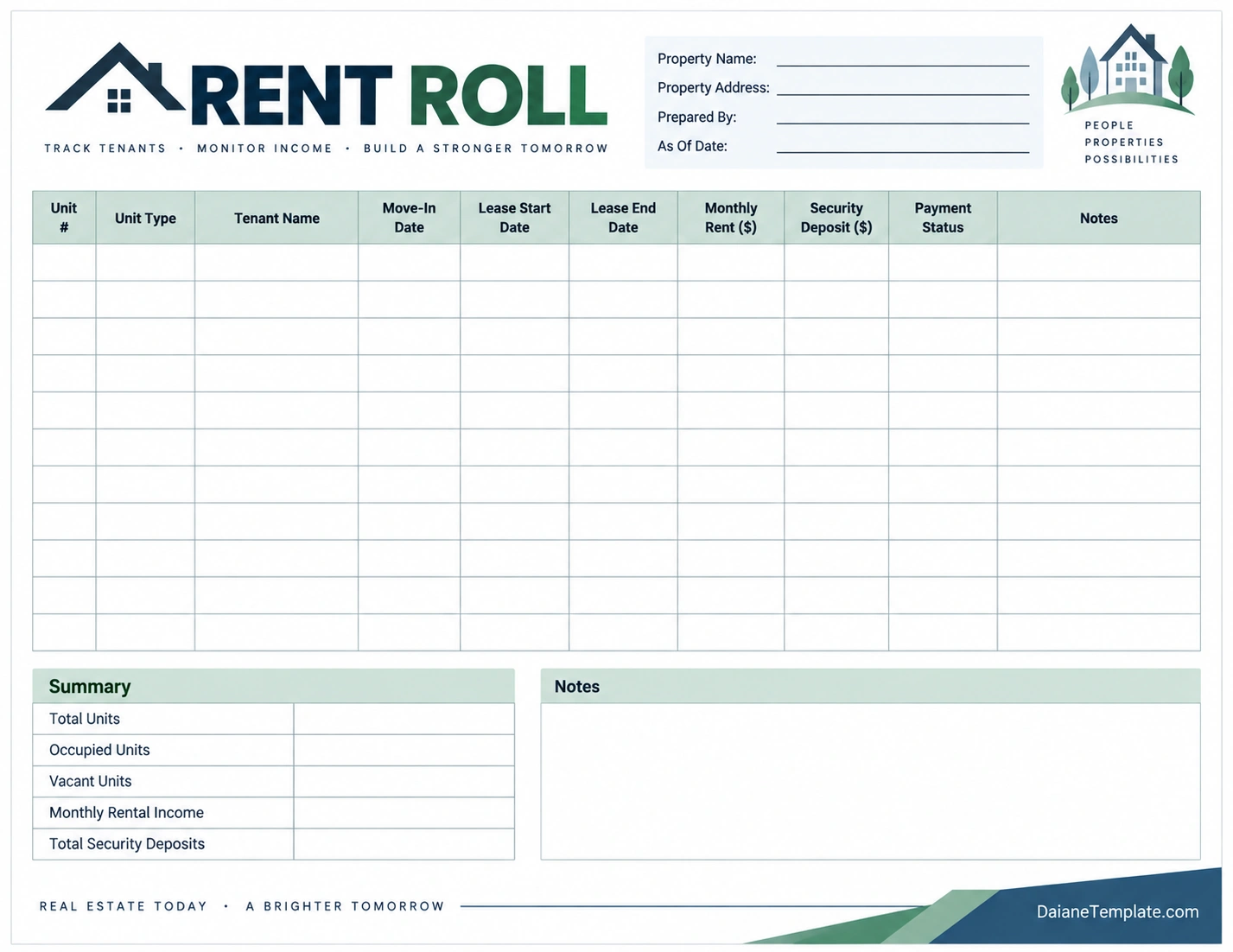
A rent roll template provides a structured way to organize tenant and property information without creating the report from scratch. A practical template can include columns for unit number, unit type, tenant name, move-in date, lease dates, monthly rent, security deposit, payment status, and notes.
For larger properties, the template can also include summary fields for total units, occupied units, vacant units, monthly rental income, and total security deposits. These summary fields provide a quick snapshot of the property’s current status.
How Landlords Can Use a Rent Roll
For individual landlords, a rent roll can provide a simple way to keep rental information organized. Even with only a few properties, having the key details in one place can make routine management easier.
- Review current tenants and rental amounts.
- Monitor lease expiration dates.
- Identify vacant units.
- Track payment status.
- Estimate scheduled monthly rental income.
- Keep basic property information organized.
- Prepare information for discussions with property managers or professionals.
How Property Managers Can Use a Rent Roll
Property managers often handle multiple units and tenants, making centralized information particularly valuable. A rent roll can serve as a quick operational reference for reviewing occupancy, lease dates, rent amounts, and potential follow-up items.
Managers can use the report to identify leases approaching expiration, monitor vacant units, review rental income, and coordinate communication with owners. A more detailed property management system may be used for day-to-day records, while the rent roll provides a concise summary.
How Investors Can Use a Rent Roll
Real estate investors may review a rent roll when analyzing an existing property or considering a potential acquisition. The report can provide insight into the property’s current tenant mix, scheduled rental income, lease expirations, and occupancy.
However, a rent roll should not be viewed in isolation. Investment analysis may also require operating expenses, historical collections, vacancy information, lease documents, market rental data, property condition, and other relevant financial and operational records.
Review Scheduled Rent
Compare the scheduled rental amounts across units to understand the property’s current rental income structure.
Review Lease Expirations
A concentration of leases expiring around the same period may be important when evaluating future occupancy and rental income planning.
Review Occupancy
Compare occupied and vacant units to understand the property’s current occupancy position and identify potential income gaps.
Compare With Supporting Records
Information in the rent roll should be compared with leases, payment records, accounting statements, and other documentation when conducting detailed due diligence.
Common Rent Roll Mistakes to Avoid
An outdated or incomplete rent roll can provide a misleading picture of a property’s status. Regular review and consistent data entry can help reduce these problems.
- Leaving vacant units unclear: Clearly identify units that are not currently occupied.
- Using outdated rent amounts: Update the rent roll when rental rates change.
- Ignoring lease expiration dates: Keep lease dates current so upcoming renewals can be identified.
- Failing to update tenant changes: Update the report when tenants move in or move out.
- Mixing scheduled and collected rent: Clearly distinguish contractual rental amounts from actual payments received.
- Entering inconsistent information: Use consistent formats for dates, unit numbers, payment statuses, and other fields.
- Including unnecessary sensitive information: Limit personal information to what is appropriate for the purpose of the report.
Tips for Maintaining an Accurate Rent Roll
A rent roll should be treated as a living property record rather than a document that is prepared once and forgotten. Regular updates can significantly improve its usefulness.
- Review the rent roll on a regular schedule.
- Update information immediately after major tenant or lease changes.
- Verify rental amounts against current lease agreements.
- Review upcoming lease expirations each month.
- Separate current tenants from vacant units clearly.
- Keep supporting lease and payment records organized.
- Use consistent date and currency formats.
- Keep historical versions when appropriate for recordkeeping.
Rent Roll and Cash Flow Forecasting
A rent roll can provide useful starting information for estimating potential rental income. By reviewing scheduled rents, occupancy, and upcoming lease changes, property owners can develop a clearer picture of expected rental revenue.
However, scheduled rent is not the same as actual cash flow. A complete cash flow analysis should also consider vacancies, late or unpaid rent, operating expenses, maintenance costs, taxes, insurance, utilities, management fees, and other relevant property expenses.
Final Thoughts on Rent Rolls
A rent roll is a practical tool for organizing the financial and occupancy information associated with a rental property. By bringing unit details, tenant information, lease dates, rental amounts, deposits, and payment status together, it gives landlords, property managers, and investors a convenient overview of the property.
A well-maintained rent roll can support day-to-day property management, help identify upcoming vacancies and lease expirations, improve income tracking, and provide useful information for broader property analysis. Using a structured rent roll template makes it easier to keep these details organized and review them consistently.
Download: Rent Roll Template
