A requirement traceability matrix is a project management document that connects project requirements to the design documents, development activities, test cases, and other deliverables used to implement them. It helps teams verify that every requirement is accounted for throughout the project lifecycle, from initial planning to final testing and delivery.
Without a clear traceability process, important requirements can be overlooked, misunderstood, or left untested. A well-maintained requirement traceability matrix helps project managers, business analysts, developers, and quality assurance teams monitor progress, identify gaps, manage changes, and confirm that the final product meets stakeholder expectations.
Whether you are managing a software development project, a business system implementation, or a regulated engineering initiative, a requirement traceability matrix can improve visibility and accountability. This guide explains how it works, what to include, how to create one, and how to use a printable requirement traceability matrix template to organize your project information.
What Is a Requirement Traceability Matrix?
A requirement traceability matrix, often abbreviated as RTM, is a structured table that links individual requirements to the project artifacts that address them. These artifacts may include business objectives, user stories, design specifications, source code modules, test cases, and acceptance results.
Each requirement is usually assigned a unique identifier. The matrix then records where the requirement originated, how it is implemented, how it will be verified, and its current status. This makes it easier to follow a requirement from its initial definition through development and testing.
For example, a requirement stating that users must be able to reset their passwords could be linked to a design specification, a development task, and one or more test cases. If the test cases are missing, the matrix helps the team identify the verification gap before release.
A requirement traceability matrix does not replace detailed requirements documents, project plans, or test management tools. Instead, it provides a central view of the relationships between them.
Why Is a Requirement Traceability Matrix Important?
A requirement traceability matrix helps teams maintain control over project scope and confirm that planned functionality has been addressed. It is especially valuable when a project has many requirements, multiple teams, complex dependencies, or formal quality assurance obligations.
- Improves requirement coverage: Teams can identify requirements that have no corresponding design, implementation task, or test case.
- Supports quality assurance: Testers can verify that the planned tests address the intended requirements.
- Reduces project risk: Missing, incomplete, or changed requirements become easier to identify.
- Improves communication: Stakeholders can see how requirements connect to project deliverables and verification activities.
- Supports change management: Teams can identify which designs, code modules, documents, and tests may be affected by a requirement change.
- Provides project evidence: The matrix can help demonstrate requirement coverage and verification status during reviews or audits.
Traceability does not guarantee project success on its own. Its value depends on the quality of the requirements, the accuracy of the links, and how consistently the team updates the matrix.
Types of Requirement Traceability
Requirement traceability can be organized in different directions depending on the project’s objectives. Understanding these approaches helps teams decide what relationships their matrix needs to show.
Forward Traceability
Forward traceability connects each requirement to the design, development, and testing activities intended to fulfill it. It helps confirm that requirements are implemented and verified rather than forgotten during delivery.
For example, a requirement for secure user authentication might link to the authentication design, the relevant development component, and security test cases.
Backward Traceability
Backward traceability connects project artifacts back to their original requirements or approved business needs. It helps teams determine whether a design element, feature, or test supports an authorized requirement.
This approach can reveal unnecessary features or work that has no clear connection to the agreed project scope.
Bidirectional Traceability
Bidirectional traceability combines forward and backward links. Teams can follow a requirement toward its implementation and testing, then trace each project artifact back to the requirement it supports.
This approach provides a more complete view of coverage and can be especially useful for projects with formal verification, audit, or compliance needs.
What Should a Requirement Traceability Matrix Include?
The structure of an RTM depends on the project’s size, complexity, and methodology. A simple project may need only a few columns, while a large software or engineering project may require detailed links across several systems.
Requirement ID
Assign a unique identifier to every requirement, such as REQ-001 or FR-010. Unique IDs make requirements easier to reference in meetings, issue trackers, test reports, and change requests.
Requirement Description
Record a concise description of what the requirement specifies. The description should be clear enough for team members to understand the intended outcome without replacing the full requirements document.
Requirement Type and Priority
Identify the requirement category, such as functional, non-functional, business, regulatory, or technical. Priority indicates its relative importance and can help teams plan implementation and testing.
Source or Stakeholder
Record where the requirement originated, such as a stakeholder interview, business specification, customer request, regulation, or approved change request. Knowing the source helps teams clarify questions and validate changes.
Design and Development References
Link the requirement to relevant design documents, architecture components, development tasks, code modules, or other implementation artifacts. Use stable identifiers or links so team members can locate the referenced material.
Test Case and Verification Status
Identify the test cases or other verification methods used to confirm that the requirement has been met. Record the current status, such as not started, in progress, passed, failed, blocked, or not applicable, according to the project’s agreed definitions.
Comments and Change History
Include notes for unresolved questions, dependencies, exceptions, and approved changes. For larger projects, maintain a change log or use a linked requirements management system to preserve the history of important updates.
Requirement Traceability Matrix Template
A requirement traceability matrix template provides a consistent format for documenting requirements and linking them to design, development, and testing artifacts. It can help project teams begin tracking coverage without building a matrix structure from scratch.
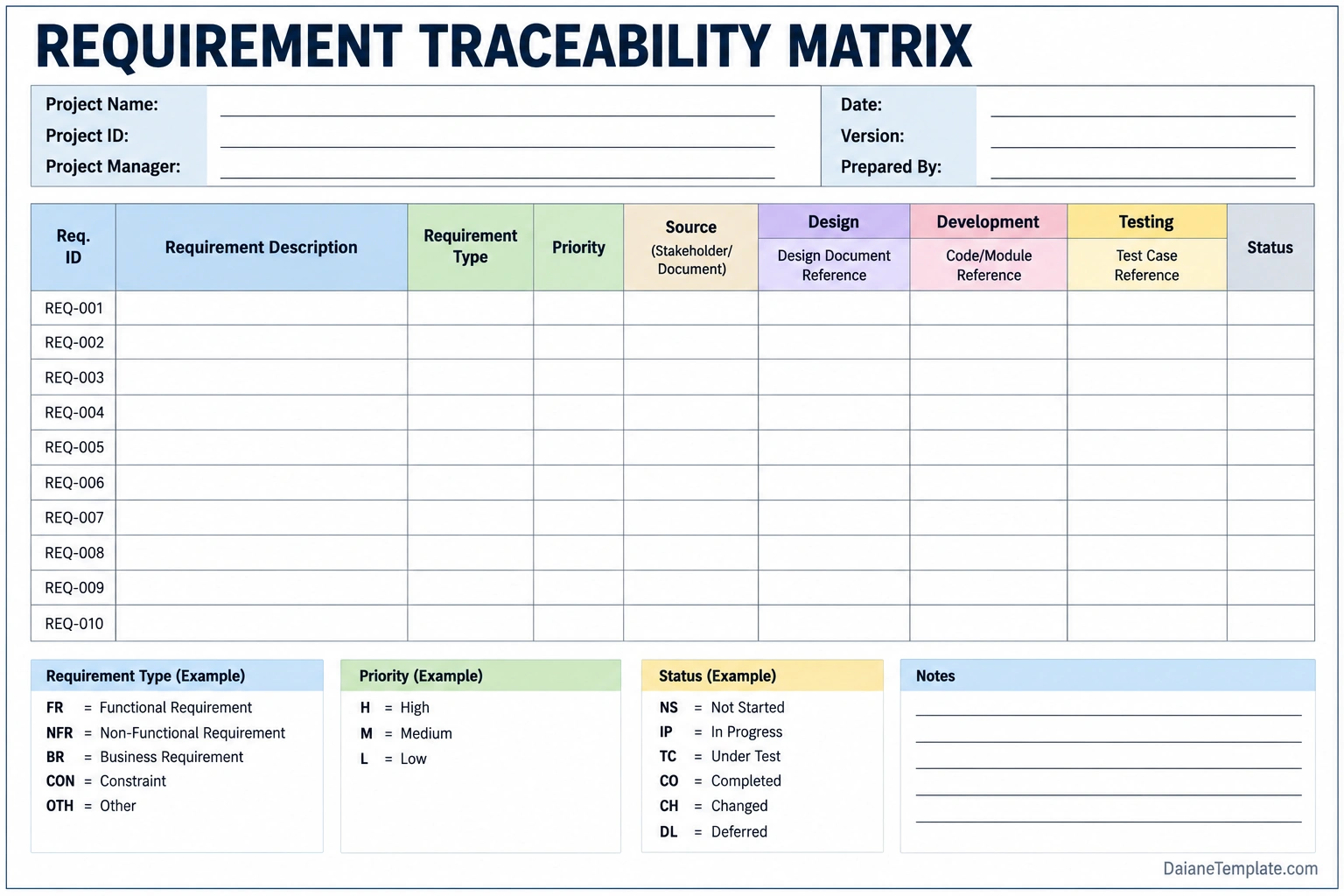
To use the template, enter each approved requirement on a separate row and assign it a unique identifier. Complete the relevant columns using the project’s source documents and tracking systems.
- Requirement ID: Enter a unique identifier for the requirement.
- Description: Summarize the requirement clearly.
- Type and priority: Classify the requirement and indicate its importance.
- Source: Identify the originating stakeholder, document, or business need.
- Design reference: Link to the design artifact that addresses the requirement.
- Development reference: Record the relevant development task, component, or code reference.
- Testing reference: Link to the test case or verification activity.
- Status: Record the current implementation or verification state using consistent definitions.
- Notes: Document gaps, dependencies, questions, or approved changes.
The template is a starting point. Add columns for acceptance criteria, responsible owners, risk level, release version, or approval status when your project requires them. For complex projects, a spreadsheet or requirements management tool may be more suitable than a printed worksheet.
How to Create a Requirement Traceability Matrix
Step 1: Gather and Review Requirements
Collect approved requirements from the business requirements document, product backlog, user stories, specifications, stakeholder records, and other authoritative sources. Check for duplicates, ambiguity, and missing information before adding them to the matrix.
Step 2: Assign Unique Requirement IDs
Create a consistent identification system so each requirement can be referenced across documents and tools. Avoid changing IDs unnecessarily because stable identifiers make traceability easier to maintain over time.
Step 3: Identify Related Project Artifacts
Determine which design documents, development tasks, components, and test cases address each requirement. Work with business analysts, developers, architects, and testers to confirm that the relationships are accurate.
Step 4: Record Verification Methods
Identify how each requirement will be checked. Depending on the requirement, verification may involve functional testing, performance testing, inspection, analysis, demonstration, or another approved method.
Make sure the verification method is appropriate for the requirement. A requirement about response time, for example, may need a measurable performance test rather than a simple visual inspection.
Step 5: Track Implementation and Test Results
Update the matrix as requirements move through design, development, and testing. Record missing links, failed tests, blocked activities, and outstanding decisions so the team can address them promptly.
Step 6: Review Coverage and Resolve Gaps
Review the matrix at project milestones and before release. Identify requirements without implementation references, requirements without verification evidence, and project artifacts that cannot be traced to an approved requirement.
Resolve gaps or document approved exceptions before considering the relevant requirements complete.
Step 7: Maintain the Matrix Throughout the Project
Update traceability links whenever requirements change, new features are approved, tests are revised, or implementation details move. Assign responsibility for maintaining the matrix so it remains a reliable project reference.
Example of a Requirement Traceability Matrix
Consider a simple online shopping application with a requirement that customers must be able to reset their passwords. A simplified traceability record might contain the following information.
- Requirement ID: REQ-001
- Requirement: Users can request a password reset through their registered email address.
- Type: Functional requirement
- Priority: High
- Source: Approved user authentication specification
- Design reference: Password reset workflow design
- Development reference: Authentication service and reset-token task
- Test reference: Valid reset request, expired token, and invalid email test cases
- Status: In testing
This record shows how one requirement connects to the artifacts needed to implement and verify it. If the test reference is missing, the team can investigate whether verification has been planned. If the requirement changes, the design, development, and test references help identify the work that may need review.
For a real project, use the matrix to record actual document identifiers, links, owners, and status values rather than relying on generic descriptions.
Best Practices for Maintaining Requirement Traceability
A requirement traceability matrix is most useful when it is accurate, easy to navigate, and integrated into the team’s normal workflow.
- Keep requirements testable: Write requirements with clear outcomes or acceptance criteria whenever possible.
- Use consistent identifiers: Follow the same ID conventions across project documents and tools.
- Define status values: Make sure everyone understands what each status means.
- Assign ownership: Identify who is responsible for updating requirements and their traceability links.
- Review regularly: Check the matrix during planning, design reviews, testing, and release preparation.
- Automate where practical: Integrate requirements, development tasks, and test management tools when the project size justifies it.
- Control changes: Document requirement changes and review their effects on linked artifacts.
- Focus on meaningful links: Traceability should explain real relationships rather than create unnecessary administrative work.
Common Requirement Traceability Matrix Mistakes
Teams may maintain a matrix but still miss its main benefits if the information is incomplete or outdated. Watch for these common problems.
- Missing test coverage: Requirements have implementation references but no verification method or test evidence.
- Unclear requirement descriptions: Vague wording makes it difficult to determine whether a requirement has been satisfied.
- Broken or outdated links: References no longer point to the correct documents, tasks, or tests.
- Uncontrolled changes: Requirements change without reviewing the related design, development, and testing work.
- Inconsistent status definitions: Team members interpret completion or approval states differently.
- Excessive manual effort: A complex project relies on an unwieldy spreadsheet when integrated tooling would be more reliable.
- Tracking without review: The matrix is filled in but not used to identify gaps or guide project decisions.
Frequently Asked Questions About Requirement Traceability Matrices
What is the main purpose of a requirement traceability matrix?
Its main purpose is to connect requirements to the project artifacts that implement and verify them. This helps teams monitor coverage, identify gaps, manage changes, and confirm that approved requirements have been addressed.
What is the difference between an RTM and a requirements document?
A requirements document describes what the system or project must achieve. A requirement traceability matrix maps those requirements to related design, development, testing, and other project artifacts. The two documents complement each other but serve different purposes.
What are the main types of traceability?
The main approaches are forward traceability, backward traceability, and bidirectional traceability. Forward traceability links requirements to implementation and verification, backward traceability connects artifacts to their originating requirements, and bidirectional traceability supports both directions.
When should a requirement traceability matrix be created?
It is generally useful to establish the matrix early, once requirements can be identified and assigned stable IDs. The matrix should then be updated as design, development, testing, and change management activities progress.
Can I create an RTM in Excel?
Yes. A spreadsheet is often sufficient for small and medium-sized projects with manageable numbers of requirements and links. Larger or more complex projects may benefit from dedicated requirements management or test management tools with linked records and change tracking.
How do you measure requirement coverage?
Teams can measure coverage by checking the proportion of requirements that have the required links or verification evidence. For example, test coverage may be calculated as the number of requirements linked to appropriate test cases divided by the total number of applicable requirements. Define the coverage rules clearly, because a link to a test case does not necessarily mean the test has passed.
Is a requirement traceability matrix required for every project?
Not every project needs a formal RTM. The appropriate level of traceability depends on project size, risk, complexity, stakeholder expectations, and applicable standards or contractual obligations. Projects with high assurance or compliance needs often require more rigorous traceability.
Who is responsible for maintaining the RTM?
Responsibility varies by organization. A business analyst, requirements engineer, project manager, quality assurance lead, or designated team member may coordinate maintenance. Developers, testers, and other stakeholders should provide accurate updates for the artifacts they manage.
Conclusion
A requirement traceability matrix helps project teams connect requirements to the design, development, and testing work needed to deliver them. By maintaining these links, teams can identify missing coverage, assess the impact of changes, improve communication, and provide clearer evidence that project requirements have been addressed.
Start with clear requirements, assign unique IDs, link each requirement to relevant artifacts, and update the matrix as the project evolves. Use a requirement traceability matrix template to organize the information, then adapt its columns and review process to fit your team’s workflow.
When maintained consistently, the RTM becomes more than a tracking document. It becomes a practical tool for managing project quality, reducing uncertainty, and supporting informed delivery decisions.
Download: Requirement Traceability Matrix Template
