A balance sheet for small business is an essential financial document that helps you understand what your business owns, what it owes, and how much equity remains. Whether you run a retail store, provide professional services, or manage an online business, a balance sheet gives you a clear picture of your company’s financial position.
Keeping an accurate balance sheet can help you make informed business decisions, prepare for tax filing, apply for a business loan, attract potential investors, or evaluate your company before selling it. It also helps you identify financial problems before they become more difficult to manage.
In this guide, you’ll learn what a small business balance sheet includes, how to prepare one, and how to use a free balance sheet template to organize your financial information.
What Is a Balance Sheet for Small Business?
A balance sheet is a financial statement that summarizes a business’s financial position at a specific point in time. It lists three main categories: assets, liabilities, and owner’s equity.
Assets represent everything the business owns or controls. Liabilities are financial obligations the business must pay. Owner’s equity represents the remaining value after subtracting liabilities from total assets.
Unlike an income statement, which reports revenue and expenses over a period, a balance sheet provides a snapshot of your business finances on a particular date.
A balance sheet follows a fundamental accounting formula:
Assets = Liabilities + Owner’s Equity
This equation must balance. If total assets do not equal total liabilities plus owner’s equity, there may be missing transactions, incorrect account balances, or calculation errors that need to be reviewed.
Why Does Your Small Business Need a Balance Sheet?
A balance sheet is more than an accounting requirement. It is a practical tool that helps business owners evaluate financial stability and plan for future growth.
1. Understand Your Business’s Financial Health
A balance sheet helps you see whether your business has enough assets to cover its outstanding obligations. By comparing current assets with current liabilities, you can assess whether the company can meet its short-term financial commitments.
2. Prepare for Tax Filing
Accurate financial records make tax preparation easier. Although a balance sheet is not required with every small business tax return, certain business structures, tax situations, and reporting requirements may require balance sheet information.
Keeping this statement updated also helps you organize business assets, outstanding debts, and owner’s equity when preparing financial information for your tax professional.
3. Apply for Business Loans
Lenders may request a balance sheet when reviewing a small business loan application. They use it to evaluate your assets, existing debt, available liquidity, and overall financial stability.
A well-organized balance sheet can make it easier to explain your business’s financial position and support your loan application.
4. Attract Investors and Business Partners
Potential investors want to understand the financial condition of a business before committing their money. A balance sheet provides useful information about existing resources, financial obligations, and the owner’s investment.
5. Prepare Your Business for Sale
If you plan to sell your business, an updated balance sheet can help potential buyers evaluate its financial position. It provides a starting point for reviewing business assets, liabilities, and equity before conducting a more detailed valuation.
What Should a Small Business Balance Sheet Include?
A standard balance sheet contains three main sections. Understanding each category will help you organize your financial information correctly.
1. Assets
Assets are resources owned or controlled by your business that provide economic value. They are generally divided into current assets and non-current assets.
Current assets are expected to be converted into cash, sold, or used within one year or the normal operating cycle. Common examples include:
- Cash and cash equivalents
- Accounts receivable
- Inventory and merchandise
- Prepaid expenses
- Short-term investments
Non-current assets are resources that the business expects to use for more than one year. Examples include:
- Land and buildings
- Equipment and machinery
- Furniture and fixtures
- Company vehicles
- Long-term investments
- Intangible assets, such as qualifying software and licenses
Remember to account for accumulated depreciation when calculating the carrying value of depreciable fixed assets.
2. Liabilities
Liabilities represent amounts your business owes to other parties. These obligations may include unpaid supplier invoices, outstanding loans, taxes, and other financial commitments.
Liabilities are generally divided into two categories:
- Current liabilities: Obligations expected to be settled within one year or the normal operating cycle.
- Long-term liabilities: Obligations that are generally due beyond one year.
Examples of business liabilities include:
- Accounts payable
- Short-term business loans
- Accrued expenses
- Payroll and tax liabilities
- Long-term bank loans
- Mortgage or equipment financing obligations
3. Owner’s Equity
Owner’s equity represents the owner’s residual interest in the business after all liabilities have been deducted from total assets.
Depending on the business structure, this section may include:
- Initial owner’s capital or investment
- Additional owner contributions
- Retained earnings
- Current-period profit or loss
- Other equity adjustments
For sole proprietorships, owner’s equity generally reflects the owner’s investment, accumulated business results, and withdrawals. Corporations use different equity accounts, such as common stock and retained earnings.
Free Balance Sheet for Small Business Template
Using a ready-made balance sheet template can save time and help you organize financial information consistently. Instead of building a financial statement from scratch, you can enter your business details and account balances into clearly labeled sections.
The following printable templates offer different layouts for organizing your small business finances.
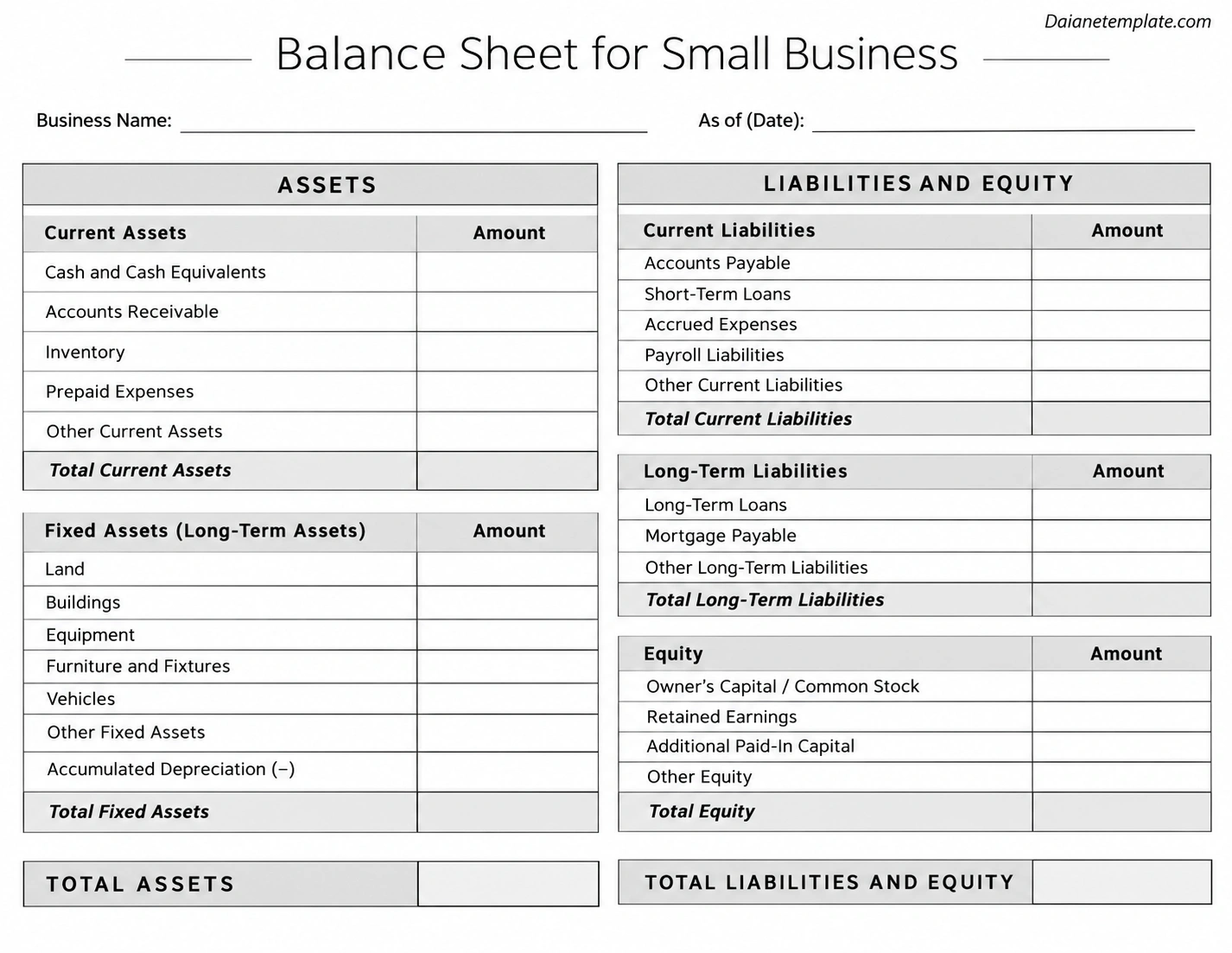
Standard Balance Sheet Template
Use this layout to record assets, liabilities, and owner’s equity side by side. It is useful for business owners who prefer a traditional financial statement with a simple two-column structure.
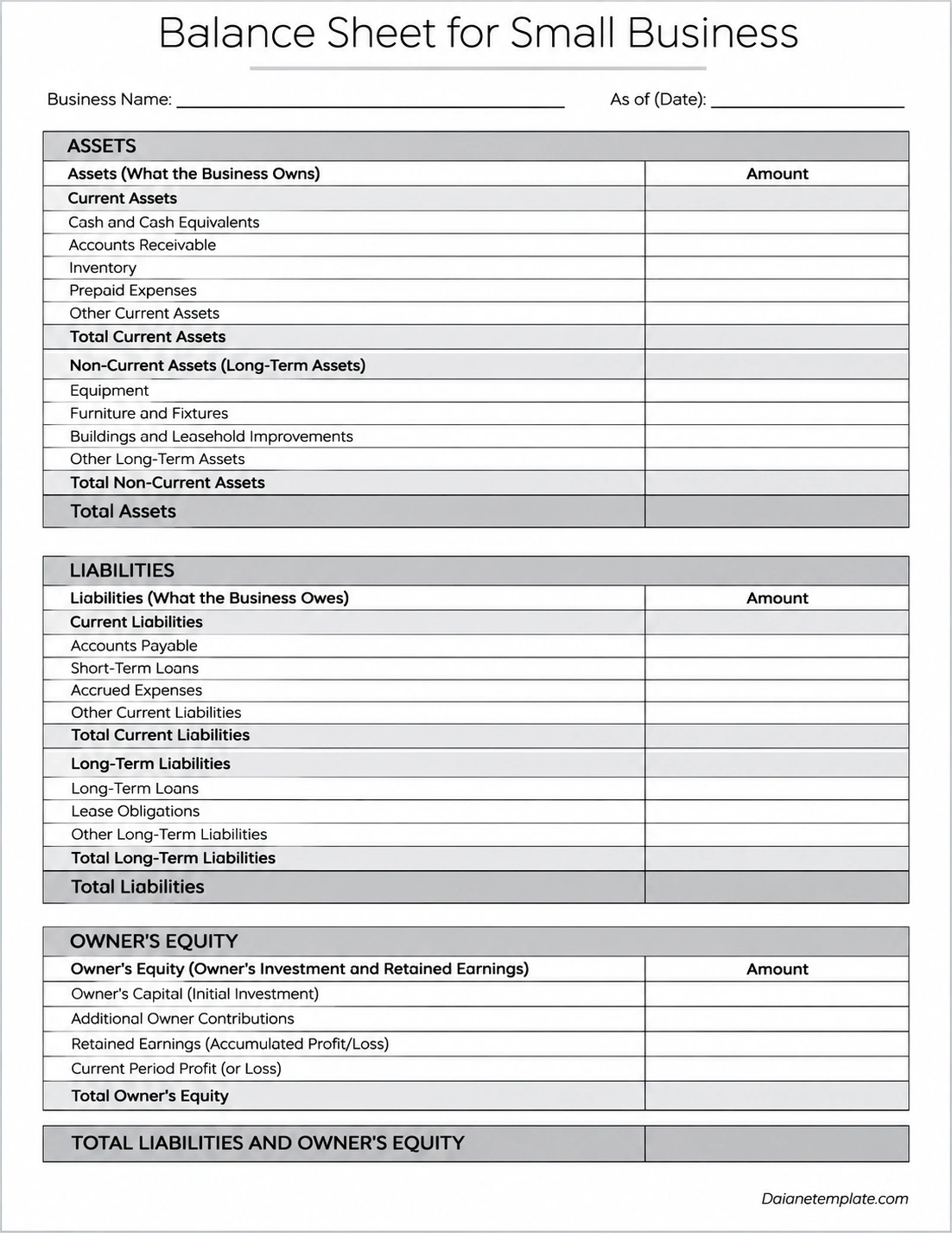
Detailed Balance Sheet Template
This portrait layout provides separate sections for current assets, non-current assets, current liabilities, long-term liabilities, and owner’s equity. It works well for businesses that want more detailed financial records.
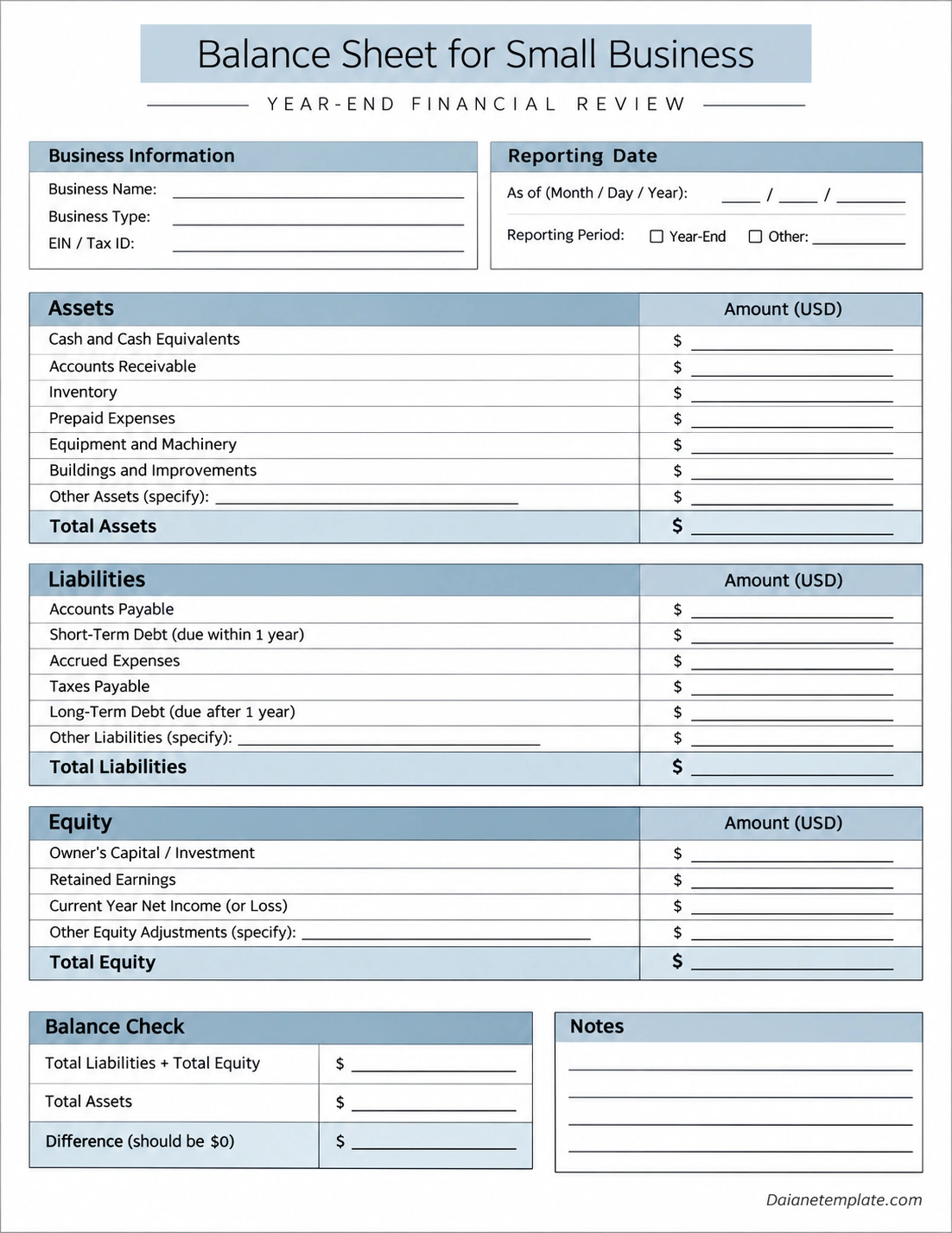
Year-End Financial Review Template
If you are preparing annual financial records, this layout offers additional space for business information, reporting dates, financial totals, and notes. The balance check section also helps you compare total assets against total liabilities and equity.
How to Prepare a Balance Sheet for Your Small Business
Creating a balance sheet does not have to be complicated. Follow these steps to organize your financial information and calculate the correct totals.
Step 1: Choose a Reporting Date
Start by selecting the date your balance sheet will represent. Common reporting dates include the last day of a month, quarter, or financial year.
For example, if you want to review your business finances at the end of December, use December 31 as your reporting date.
Step 2: List All Business Assets
Identify everything your business owns or controls. Review bank statements, accounting records, inventory reports, equipment records, and accounts receivable.
Separate current assets from non-current assets, then calculate the total value of each category.
Step 3: Calculate Your Liabilities
Review outstanding bills, supplier invoices, loan statements, unpaid taxes, and other financial obligations. Separate current liabilities from long-term liabilities based on their expected payment dates.
Make sure you include all outstanding obligations, even if they have not yet been paid.
Step 4: Calculate Owner’s Equity
Record the owner’s contributions, retained earnings, and other applicable equity accounts. The exact accounts will depend on your business structure and accounting method.
You can also calculate total equity by subtracting total liabilities from total assets.
Step 5: Check the Balance Sheet Formula
Add your total liabilities and owner’s equity, then compare the result with total assets.
Total Assets = Total Liabilities + Owner’s Equity
If both sides match, your balance sheet is mathematically balanced. If they do not, review your account classifications, calculations, and bookkeeping entries to find the discrepancy.
Example of a Small Business Balance Sheet
Here is a simplified example showing how a small business balance sheet might look. The figures below are illustrative and use US dollars.
ABC Small Business
Balance Sheet as of December 31, 2026
Assets
- Cash and cash equivalents: $15,000
- Accounts receivable: $5,000
- Inventory: $10,000
- Equipment, net: $20,000
- Total Assets: $50,000
Liabilities
- Accounts payable: $6,000
- Short-term loan: $4,000
- Long-term loan: $10,000
- Total Liabilities: $20,000
Owner’s Equity
- Owner’s capital and retained earnings: $30,000
- Total Owner’s Equity: $30,000
Balance Check:
- Total Assets: $50,000
- Total Liabilities: $20,000
- Total Owner’s Equity: $30,000
- Total Liabilities + Equity: $50,000
In this example, total assets equal total liabilities plus owner’s equity. Therefore, the balance sheet is balanced.
Tips for Maintaining an Accurate Business Balance Sheet
Preparing a balance sheet once is useful, but maintaining accurate financial records over time is even more important. These practical habits can help you keep your financial statements reliable.
- Update your records regularly: Review your balance sheet monthly or quarterly instead of waiting until tax season.
- Separate personal and business finances: Use dedicated business bank accounts and credit facilities to make bookkeeping easier.
- Reconcile bank accounts: Compare accounting records with bank statements to identify missing or incorrect transactions.
- Track outstanding invoices: Monitor accounts receivable and accounts payable to understand upcoming cash requirements.
- Record depreciation: Update the value of depreciable business assets according to your accounting policy.
- Keep supporting documents: Save invoices, receipts, loan statements, and other financial records.
- Review unusual changes: Investigate significant increases or decreases in assets, liabilities, and equity.
For more complex businesses, consider working with a qualified bookkeeper or accountant to review your financial statements and ensure that transactions are recorded correctly.
Frequently Asked Questions About Small Business Balance Sheets
1. Does a small business need a balance sheet?
Yes. A balance sheet is a valuable financial management tool for businesses of all sizes. It helps owners monitor assets, liabilities, and equity. Lenders, investors, and other stakeholders may also request one when evaluating a business.
2. How often should a small business prepare a balance sheet?
Most small businesses benefit from preparing a balance sheet monthly or quarterly. Regular reporting makes it easier to identify financial changes, monitor outstanding debts, and plan business expenses. Some businesses also prepare annual statements for financial reporting and tax purposes.
3. Can I create a balance sheet without an accountant?
Yes. You can create a basic balance sheet using a spreadsheet or printable template if you maintain accurate financial records. However, an accountant can help with complex transactions, depreciation, tax-related adjustments, and financial reporting requirements.
4. What is the difference between a balance sheet and an income statement?
A balance sheet shows a business’s financial position at a specific date by listing assets, liabilities, and equity. An income statement shows revenue, expenses, and profit or loss over a specific period. Both statements provide different but complementary financial information.
5. What happens if my balance sheet does not balance?
If your balance sheet does not balance, check for missing transactions, incorrect account classifications, duplicate entries, calculation mistakes, or errors in owner’s equity. Review your bookkeeping records before finalizing the statement.
6. Can I use an Excel spreadsheet as a small business balance sheet?
Absolutely. Excel and Google Sheets are useful for creating balance sheets because they allow you to organize account balances and calculate totals using formulas. A printable template is another practical option if you prefer to record information manually.
7. Is a balance sheet required for small business taxes?
Not every small business must submit a balance sheet with its tax return. Requirements depend on the business structure, applicable tax rules, and reporting circumstances. Consult a tax professional to determine which financial statements you need to maintain or submit.
Conclusion
A balance sheet for small business provides a clear overview of your company’s financial position by showing its assets, liabilities, and owner’s equity. It can help you monitor financial health, prepare for loan applications, organize tax records, and make better decisions about future growth.
Whether you manage a new startup or an established company, keeping an accurate balance sheet is an important part of responsible financial management. Start with a simple template, update your records regularly, and review the numbers to understand where your business stands.
Choose the printable balance sheet template that best fits your needs and use it to keep your small business finances organized.
Download: Balance Sheet Template for Small Business
