A pedigree chart is a useful tool for organizing and analyzing a family’s genetic history across multiple generations. It helps readers visualize relationships between family members and identify patterns that may indicate how inherited traits or genetic conditions pass from one generation to the next. Pedigree charts are commonly used in genetics education, genetic counseling, medical research, and family health history documentation.
Whether you are a student learning about heredity, a researcher studying inheritance, or someone organizing family health information, a pedigree chart template can make the process easier. A well-structured chart uses standard symbols and connecting lines to represent family members, relationships, and selected genetic characteristics. This guide explains what a pedigree chart is, how its symbols work, and how to create and interpret one.
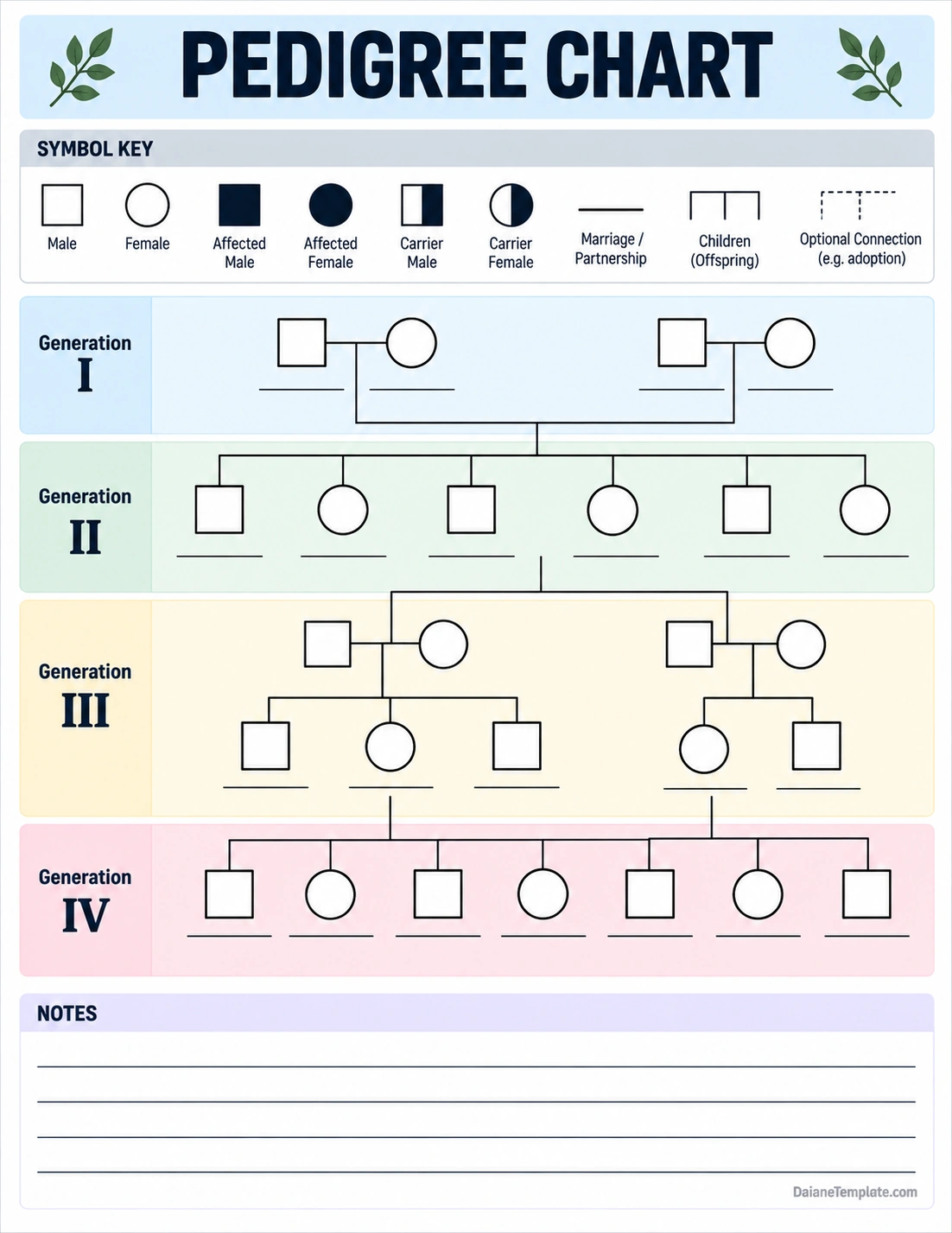
What Is a Pedigree Chart?
A pedigree chart is a diagram that shows relationships within a family and tracks the occurrence of a particular trait or genetic condition over several generations. It resembles a family tree, but it uses standardized symbols to communicate information relevant to genetic inheritance.
Unlike a traditional family tree, which primarily records ancestry and family relationships, a genetic pedigree focuses on how a specific characteristic may be inherited. For example, a chart might show which relatives have a particular inherited condition, which family members do not show the trait, and how the pattern appears among children and parents.
Pedigree charts are useful for:
- Genetics education: Learning how dominant, recessive, and sex-linked traits may be inherited.
- Genetic counseling: Organizing family history when discussing the possibility of inherited conditions.
- Medical research: Documenting patterns that may help researchers investigate genetic traits.
- Family health history: Recording relevant information about relatives and known diagnoses.
- Classroom assignments: Practicing the interpretation of inheritance patterns using hypothetical or approved family data.
A pedigree chart can provide helpful clues, but it does not independently confirm a genetic diagnosis or determine a person’s exact risk of developing a condition. Professional interpretation and, when appropriate, genetic testing may be needed.
Understanding Pedigree Chart Symbols
Standard symbols make a pedigree chart easier to read. Each shape represents a person or relationship, while shading and additional markings may indicate specific genetic information. Always check the legend because conventions can vary depending on the chart’s purpose.
Common Symbols and Their Meanings
- Square: Traditionally represents a male individual.
- Circle: Traditionally represents a female individual.
- Shaded symbol: Often represents an individual who expresses or is affected by the trait being studied.
- Unshaded symbol: Usually represents an individual who does not express the specified trait.
- Half-shaded symbol or a central dot: May represent a carrier for certain inherited conditions, depending on the chart’s legend and conventions.
- Horizontal line: Commonly connects partners or parents in a pedigree.
- Vertical line: Connects parents to their offspring.
- Sibling line: A horizontal line from which individual vertical lines connect to children.
- Slash through a symbol: Often indicates that an individual has died.
- Arrow: May identify the proband, the person through whom a family is brought to medical or genetic attention.
For a clear chart, include a symbol key that explains every shape, shading style, and special marking used. This is particularly important when documenting carrier status, affected individuals, adoption, unknown information, or other family circumstances.
How to Read a Pedigree Chart
Reading a pedigree chart involves identifying generations, following family connections, and observing where a trait appears. Begin with the legend before drawing conclusions about inheritance.
Identify the Generations
Generations are commonly labeled with Roman numerals, such as I, II, III, and IV. The oldest generation usually appears at the top, with younger generations arranged below it. Individuals within each generation may be numbered from left to right for easy reference.
This structure allows readers to compare the occurrence of a trait among parents, children, siblings, and more distant relatives. For example, if a condition appears in several successive generations, that pattern may be consistent with a dominant inheritance pattern, although it is not proof by itself.
Follow the Family Connections
Horizontal lines generally connect partners, while vertical lines connect parents with their children. Siblings are typically placed along a shared horizontal line. Following these connections helps establish which individuals belong to the same family branch.
Check each connection carefully before interpreting the chart. Missing information, small family sizes, and unclear relationships can make an inheritance pattern difficult to determine.
Compare Affected and Unaffected Individuals
Look for the symbols that indicate whether individuals express the trait under study. Compare the distribution of those symbols across generations and between different branches of the family.
An individual without a visible trait may still carry a genetic variant, depending on the condition and inheritance pattern. Similarly, a person’s health status should not be inferred from appearance alone. Use verified information where possible and clearly mark unknown or unconfirmed details.
Common Genetic Inheritance Patterns
Pedigree charts can help illustrate several major inheritance patterns. The following descriptions are educational guides rather than diagnostic rules.
Autosomal Dominant Inheritance
An autosomal dominant condition can occur when a person inherits one disease-causing variant in a particular gene. Affected individuals may appear in successive generations, and males and females may be affected at similar rates. However, reduced penetrance, new genetic variants, and incomplete family information can make the pattern less obvious.
Autosomal Recessive Inheritance
An autosomal recessive condition generally develops when a person inherits disease-causing variants in both copies of a relevant gene. Parents who each carry one variant may not show symptoms but can have an affected child. A pedigree may therefore show an affected individual whose parents appear unaffected.
X-Linked Inheritance
X-linked conditions involve genes on the X chromosome. Their patterns may differ between males and females because of differences in sex chromosome composition and the specific condition involved. Some X-linked recessive conditions affect males more frequently, while females may be carriers or may also be affected in certain circumstances.
Y-Linked and Mitochondrial Inheritance
Y-linked traits involve genes on the Y chromosome and generally follow paternal transmission through individuals who carry that chromosome. Mitochondrial inheritance involves genetic material in mitochondria and is typically transmitted through the maternal line. Actual patterns depend on the genetic condition, biological context, and family history.
Not every family pattern fits one simple inheritance category. Some conditions are influenced by multiple genes, environmental factors, or a combination of genetic and non-genetic influences.
How to Create a Pedigree Chart
Creating a pedigree chart is easier when you gather the necessary information before drawing the diagram. A printable pedigree chart template provides a consistent structure for arranging family members and recording observations.
Gather Relevant Family Information
Start by identifying the family members and generations relevant to the trait or condition being studied. Record known relationships and any verified information about the trait. For medical use, distinguish a confirmed diagnosis from a suspected condition or an unverified family report.
Choose a Starting Individual
Decide whose family history the chart will describe. In a clinical pedigree, this person may be the proband. Place the relevant family members in the appropriate generations and use consistent symbols throughout the chart.
Draw Symbols and Connections
Represent each person using the appropriate square, circle, or other defined symbol. Connect partners, parents, and children with standard lines. Keep the arrangement neat and leave enough space to add names, identifiers, dates, or notes without making the chart difficult to read.
Mark the Trait and Add a Legend
Use shading or another clearly defined marking to indicate the trait being studied. Add a legend that explains every symbol and marking. If information is missing or uncertain, label it accordingly rather than assuming that the individual is affected, unaffected, or a carrier.
Review the Completed Chart
Check the family relationships, generation labels, symbols, and notes. Confirm that the same conventions are used throughout the chart. If the pedigree will be used for medical or research purposes, review the information with an appropriately qualified professional and follow applicable privacy and consent requirements.
Benefits of Using a Pedigree Chart Template
A pedigree chart template saves time and helps maintain a consistent layout. Rather than drawing every symbol and connector from scratch, you can focus on gathering accurate information and presenting it clearly.
- Consistent formatting: Standardized shapes and lines make relationships easier to understand.
- Clear organization: Generations can be compared without repeatedly rearranging the diagram.
- Convenient printing: A printable worksheet is useful for classroom exercises, study notes, and permitted family-history documentation.
- Space for notes: A dedicated notes section can hold explanations, dates, or questions that require follow-up.
- Improved communication: A well-labeled chart can help students, researchers, and healthcare professionals discuss a family history more clearly.
Choose a template with readable symbols, sufficient writing space, a clear legend, and enough room for the generations you need. For larger families, a digital chart may be more practical than a single printed page.
Tips for Making an Accurate Pedigree Chart
Accuracy matters more than appearance when a pedigree chart is used to study genetic history. Follow these practical tips to make your chart more useful:
- Use reliable information: Record details from trustworthy family reports or appropriate medical records when available and authorized.
- Keep the symbol key visible: Readers should not have to guess what a marking means.
- Separate facts from assumptions: Mark uncertain diagnoses or unknown genetic status clearly.
- Include enough generations: The appropriate number depends on the trait, available information, and purpose of the chart.
- Protect privacy: Obtain permission where appropriate and avoid sharing identifiable family health information unnecessarily.
- Use professional guidance: Consult a genetic counselor or qualified healthcare professional when the chart relates to inherited disease risk.
- Keep a clear copy: Save a legible digital version or print a copy for reference, following relevant privacy and recordkeeping requirements.
Remember that a pedigree is a visual summary of available information. It can suggest possible inheritance patterns, but it may not reveal every genetic factor or predict an individual’s future health with certainty.
Frequently Asked Questions About Pedigree Charts
What is the main purpose of a pedigree chart?
The main purpose of a pedigree chart is to show family relationships and track the appearance of a specific trait or genetic condition across generations. It helps readers recognize possible inheritance patterns and organize family history information.
What is the difference between a pedigree chart and a family tree?
A family tree primarily documents ancestry and family relationships. A pedigree chart uses standardized genetic symbols and markings to focus on the inheritance of a particular trait or condition. A pedigree may include family relationships, but it adds information relevant to genetics.
What do squares and circles mean in a pedigree chart?
In conventional pedigree notation, a square represents a male and a circle represents a female. Shading and other markings may indicate affected status, carrier status, or additional information, according to the legend.
Can a pedigree chart identify genetic carriers?
A pedigree chart may help identify individuals who could be carriers of certain inherited conditions, based on family relationships and a known inheritance pattern. However, a chart alone cannot confirm carrier status in every case. Genetic testing or professional evaluation may be needed.
How many generations should a pedigree chart include?
The number of generations depends on the purpose of the chart and the information available. Three generations are often useful for documenting family health history, while research or educational projects may include more or fewer generations.
Can I use a pedigree chart for a school assignment?
Yes. A pedigree chart template can help students practice genetic notation and understand inheritance patterns. When a real family history is not necessary, use a fictional example or hypothetical data to protect personal privacy.
Does a pedigree chart predict whether a child will inherit a disease?
A pedigree chart can help illustrate possible inheritance patterns, but it cannot always predict whether a child will develop a genetic condition. Risk depends on the specific condition, the genetic variants involved, and other relevant factors. A qualified healthcare professional or genetic counselor can explain individual risks.
Conclusion
A pedigree chart is a practical way to visualize family relationships and explore how genetic traits may appear across multiple generations. By using standard symbols, clear connections, generation labels, and a complete legend, you can create a chart that is easier to understand and interpret.
Whether you are studying genetics, preparing a classroom assignment, or organizing family health history, a printable pedigree chart template can simplify the process. Gather reliable information, label uncertain details carefully, and protect personal information. For questions about inherited conditions or individual health risks, use the chart as a starting point for discussion with a qualified genetic professional.
Download: Pedigree Chart Template
