A performance appraisal form is a structured document used by managers and human resources professionals to evaluate an employee’s performance during a specific review period. It typically includes performance ratings, goals, achievements, areas for improvement, and space for manager comments.
A well-designed appraisal form helps make employee evaluations more consistent and organized. Instead of relying only on memory or informal conversations, managers can use documented criteria to review an employee’s work, contributions, skills, and progress.
Whether you are creating an annual employee review, a probation evaluation, or a regular performance assessment, a clear performance appraisal form can make the process easier for both managers and employees.
What Is a Performance Appraisal Form?
A performance appraisal form is an employee evaluation document that managers use to assess job performance over a defined period. The form provides a consistent framework for reviewing how well an employee has met expectations, completed goals, demonstrated workplace skills, and contributed to the organization.
Depending on the organization, an appraisal may be completed monthly, quarterly, semiannually, or annually. Some companies also use performance reviews when an employee completes a probationary period or takes on a new role.
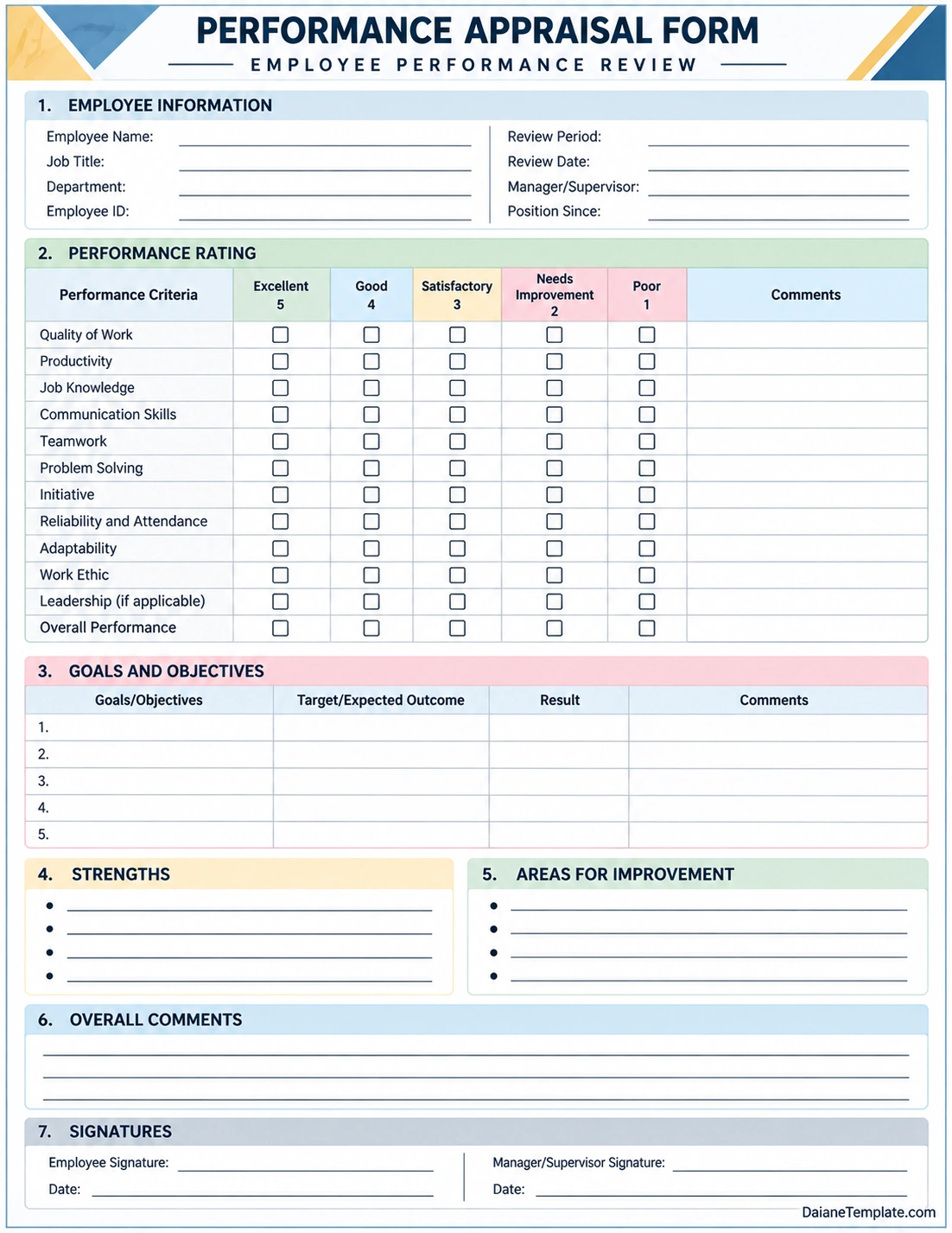
A typical employee performance appraisal form may include rating scales, written comments, performance goals, achievements, strengths, areas for improvement, and an overall evaluation.
Why Is a Performance Appraisal Form Important?
Employee evaluations are more useful when they follow a clear and consistent process. A performance appraisal form gives managers a practical structure for documenting observations and discussing performance with employees.
Here are several reasons organizations use performance appraisal forms:
- Creates consistency: Employees can be evaluated using similar performance criteria.
- Documents achievements: Managers can record important accomplishments and contributions.
- Identifies improvement areas: The form can highlight skills or behaviors that need additional attention.
- Supports goal setting: Managers and employees can establish measurable objectives for the next review period.
- Improves communication: A structured review can encourage productive conversations about performance.
- Supports development: Evaluation results can help identify training, coaching, or professional development needs.
- Creates a record: Completed evaluations provide useful documentation for ongoing employee management.
What Should Be Included in a Performance Appraisal Form?
The exact contents of an employee appraisal form can vary depending on the organization, job position, and evaluation process. However, several sections are commonly useful.
Employee Information
Start with basic information that identifies the employee and the review period. This section may include the employee’s name, job title, department, manager, review date, and evaluation period.
Keeping this information at the beginning of the form makes completed evaluations easier to organize and reference later.
Performance Rating Criteria
A rating section allows the manager to evaluate specific aspects of the employee’s performance. A five-point rating scale is commonly used, although organizations may choose another system.
Common performance criteria include:
- Quality of work
- Productivity
- Job knowledge
- Communication
- Teamwork
- Problem-solving
- Initiative
- Reliability and attendance
- Adaptability
- Work ethic
- Leadership skills
Each criterion should be relevant to the employee’s responsibilities. Not every position requires the same evaluation categories.
Goals and Objectives
A strong performance evaluation should consider not only general workplace behavior but also the employee’s progress toward specific goals.
The goals section can record the objective, expected result, actual outcome, and manager comments. Whenever possible, goals should be specific and measurable so that performance can be evaluated using evidence rather than vague impressions.
Employee Achievements and Contributions
Managers should have space to document meaningful achievements during the review period. Examples may include completing major projects, improving processes, exceeding targets, helping coworkers, solving operational problems, or receiving positive customer feedback.
Recording specific accomplishments makes the appraisal more informative and gives employees a clearer understanding of what they are doing well.
Strengths and Areas for Improvement
A balanced employee performance review should recognize strengths while also identifying opportunities for development.
The strengths section can highlight skills, behaviors, or accomplishments that contribute positively to the organization. The improvement section can identify specific areas where additional training, coaching, practice, or support may be beneficial.
Overall Comments
Include a space for the manager to provide an overall assessment. This section can summarize the employee’s performance, major accomplishments, challenges, and development priorities.
Comments should be professional, specific, and based on observable performance whenever possible.
Signatures and Dates
The final section can provide signature fields for the employee and manager. Signatures can confirm that the evaluation was reviewed and discussed. Depending on company policy, the form may also include a human resources representative’s signature.
Performance Rating Scale Examples
A rating scale helps managers communicate performance levels consistently. One simple approach is a five-level scale:
- 5 – Excellent: Consistently exceeds expectations and demonstrates exceptional performance.
- 4 – Good: Frequently exceeds expectations and performs responsibilities effectively.
- 3 – Satisfactory: Consistently meets the normal expectations of the position.
- 2 – Needs Improvement: Performance does not consistently meet expectations and requires development.
- 1 – Poor: Performance is significantly below expectations and requires immediate attention.
Organizations should define each rating clearly so managers understand how to apply the scale. A rating should reflect evidence from the review period rather than a manager’s general impression of an employee.
How to Use a Performance Appraisal Form
Using a structured process can make employee performance reviews more productive and fair. The following steps provide a practical approach.
1. Review the Employee’s Responsibilities
Before completing the form, review the employee’s job responsibilities and performance expectations. The evaluation should focus on duties and objectives that are relevant to the employee’s position.
2. Gather Performance Information
Collect relevant information from the review period, such as completed projects, measurable results, attendance records, customer feedback, work quality, and documented accomplishments.
Using multiple sources of information can help create a more balanced evaluation.
3. Evaluate Each Performance Category
Rate each applicable performance criterion based on the employee’s actual performance. Avoid giving every category the same rating simply because it is easier.
When a rating is particularly high or low, include a short explanation or example to provide context.
4. Record Specific Examples
Specific examples make performance feedback more useful. Instead of writing that an employee has “good communication skills,” explain how the employee demonstrated effective communication during a project, customer interaction, presentation, or team activity.
5. Discuss Strengths and Development Needs
Use the completed appraisal as a starting point for a two-way conversation. Discuss what the employee has accomplished, what is working well, and what could be improved.
6. Set Future Goals
End the review by establishing realistic goals for the next evaluation period. Goals may relate to productivity, quality, professional skills, leadership, customer service, project completion, or other job-specific outcomes.
Tips for Writing Effective Performance Appraisal Comments
Written comments can have a significant impact on the usefulness of an employee evaluation. Good comments should be clear, specific, professional, and connected to actual performance.
Consider these practical tips:
- Be specific: Mention the task, behavior, result, or achievement being evaluated.
- Use evidence: Support important observations with measurable results or concrete examples.
- Focus on performance: Evaluate work-related behavior rather than personal characteristics.
- Balance positive and developmental feedback: Recognize accomplishments while identifying areas for improvement.
- Avoid vague language: Comments such as “does better” or “needs to improve” provide little actionable information.
- Keep the tone professional: Feedback should be respectful and appropriate for a formal employee record.
- Suggest practical improvements: Explain what the employee can do differently or what support may help.
Common Types of Performance Appraisal Forms
Organizations may use different appraisal forms depending on the purpose of the evaluation.
Annual Performance Appraisal Form
An annual appraisal evaluates an employee’s performance over a full year. It often covers major accomplishments, goals, skills, development needs, and overall performance.
Probationary Performance Appraisal Form
A probation evaluation is commonly used to assess a new employee’s progress during an initial employment period. It may focus on job knowledge, reliability, work quality, teamwork, and whether the employee is meeting role expectations.
Quarterly Performance Review Form
A quarterly review provides more frequent feedback than an annual evaluation. It can help managers identify problems earlier and make adjustments to goals before the end of the year.
Employee Self-Appraisal Form
A self-appraisal allows employees to evaluate their own achievements, challenges, strengths, and development goals. It can be used together with a manager’s performance evaluation to encourage a more complete discussion.
How to Make a Performance Appraisal Form More Effective
A good appraisal form should be easy to understand and practical to complete. Avoid adding unnecessary categories simply to make the document longer.
Use criteria that are relevant to the position and make rating descriptions clear. Provide enough room for comments so managers can explain important ratings and employees can understand the reasoning behind the evaluation.
It is also useful to review the appraisal form periodically. As job responsibilities, company goals, and evaluation practices change, the form may need to be updated.
For a simple starting point, a printable performance appraisal form template can include employee information, review dates, performance ratings, goals, achievements, strengths, improvement areas, overall comments, and signatures.
Common Mistakes to Avoid During Employee Evaluations
Even a well-designed form cannot guarantee an effective review if it is used inconsistently. Managers should be aware of common evaluation problems.
- Relying on recent events only: Consider the employee’s performance throughout the entire review period.
- Using unsupported ratings: Provide examples when a rating requires explanation.
- Comparing employees unnecessarily: Evaluate employees against their responsibilities and established expectations.
- Focusing only on weaknesses: Recognize meaningful achievements and strengths as well.
- Setting unclear goals: Make future objectives specific enough to track.
- Using irrelevant criteria: Keep evaluation categories connected to the employee’s actual role.
- Waiting too long to provide feedback: Regular feedback can reduce surprises during formal reviews.
Frequently Asked Questions About Performance Appraisal Forms
What is the purpose of a performance appraisal form?
The purpose of a performance appraisal form is to provide a structured way to evaluate an employee’s performance, record achievements, identify development needs, discuss goals, and document feedback during a specific period.
What should a performance appraisal form include?
A performance appraisal form commonly includes employee information, review dates, performance criteria, rating scales, goals and objectives, achievements, strengths, areas for improvement, manager comments, and signature fields.
How often should employees complete a performance appraisal?
The frequency depends on the organization’s review process. Many organizations conduct annual evaluations, while others use quarterly, semiannual, monthly, or probationary reviews. Regular informal feedback can also complement formal appraisals.
What is a good performance rating scale?
A five-point rating scale is a common option, ranging from excellent to poor. However, the best scale depends on the organization’s evaluation system. The important point is to define each rating clearly and apply it consistently.
Should employees sign a performance appraisal form?
Many organizations include an employee signature to confirm that the evaluation was reviewed or discussed. A signature does not necessarily mean that the employee agrees with every assessment. Organizations should follow their own policies and applicable employment requirements.
Can a performance appraisal form be used for different employees?
Yes. A standardized form can provide consistency across an organization, but evaluation criteria should be adapted when different positions have substantially different responsibilities or performance expectations.
Conclusion
A performance appraisal form provides a practical framework for evaluating employee performance, documenting achievements, identifying development opportunities, and setting future goals. When the form uses relevant criteria and specific performance examples, it can make employee reviews more consistent and meaningful.
The most effective appraisal process goes beyond assigning ratings. Managers should use the completed form to recognize contributions, provide constructive feedback, discuss challenges, and establish clear objectives for the next review period.
Whether you need an annual employee evaluation, probation review, quarterly assessment, or general employee performance review, a clear and printable appraisal form can provide a useful foundation for a structured evaluation process.
Download: Performance Appraisal Form
