A performance improvement plan (PIP) provides a structured way to help an employee address performance concerns and meet clearly defined job expectations. It outlines the areas that need improvement, the goals to achieve, the actions required, the support available, and the timeline for reviewing progress.
For managers and human resources professionals, a performance improvement plan can turn general feedback into a practical, documented process. For employees, it can clarify what needs to change, how success will be measured, and where to get help during the improvement period.
Whether you are preparing a PIP for an employee, managing an improvement process, or learning how these plans work, a clear template can make the process easier to organize. This guide explains the essential sections of a performance improvement plan, how to write measurable goals, and how to conduct fair and constructive progress reviews.
What Is a Performance Improvement Plan?
A performance improvement plan is a formal document that identifies specific work-performance concerns and establishes a plan for improvement. It typically includes measurable objectives, deadlines, management support, review meetings, and criteria for evaluating results.
Organizations may use a PIP when an employee consistently falls short of documented job expectations. Examples include missed deadlines, recurring errors, incomplete assignments, customer service concerns, or difficulties following established procedures.
A well-designed plan should explain the performance gap using specific, factual examples. It should also give the employee a reasonable opportunity to understand expectations, access appropriate support, demonstrate progress, and ask questions.
A performance improvement plan is not automatically a disciplinary action or a guarantee of continued employment. Its purpose, procedures, and possible outcomes depend on the employer’s policies, the circumstances, and applicable employment laws.
Performance Improvement Plan Template: Printable Sample
A printable performance improvement plan template provides a consistent structure for documenting expectations and tracking progress. It can help managers organize performance concerns, improvement goals, action steps, support resources, review dates, and final outcomes in one place.
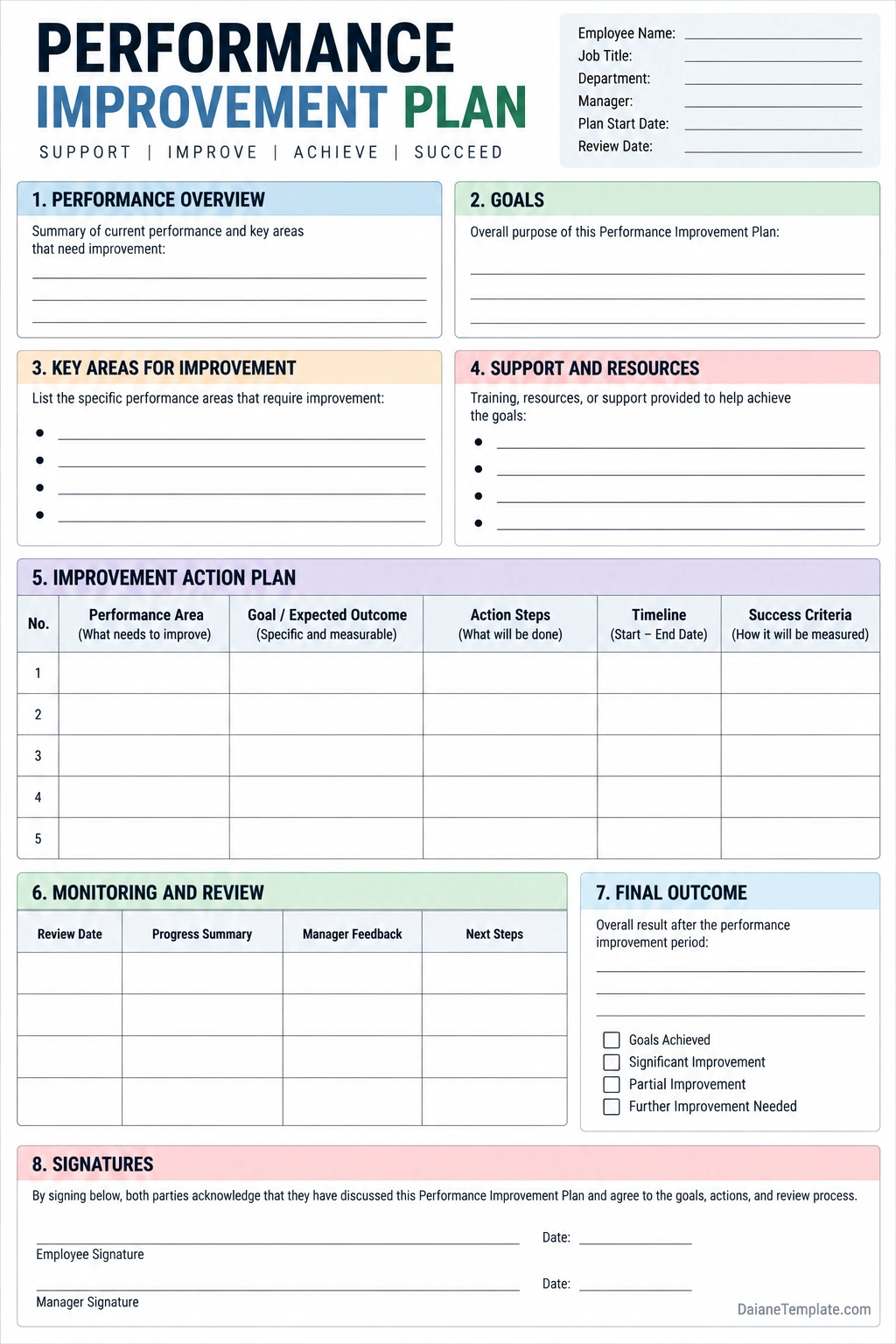
The sample includes spaces for employee and manager information, performance concerns, improvement objectives, action steps, timelines, success criteria, review notes, and signatures. Customize the document to match the employee’s role, your organization’s policies, and the specific circumstances.
Why Is a Performance Improvement Plan Important?
A structured improvement plan helps replace vague feedback with clear expectations and documented follow-up. When handled constructively, it can benefit employees, managers, and the organization.
1. Clarifies Performance Expectations
Employees need to understand what successful performance looks like. A PIP explains the standards that apply to the role and identifies the specific areas where current performance differs from those standards.
2. Establishes Measurable Goals
Instead of relying on general statements such as “work faster” or “improve communication,” a plan defines observable outcomes. Examples might include meeting agreed deadlines, reducing documented error rates, or responding to customer inquiries within an established service target.
3. Creates a Documented Process
Recording expectations, agreed actions, review dates, and progress provides a shared reference for the employee and manager. Documentation can reduce misunderstandings and make discussions more consistent.
4. Identifies Training and Support Needs
Performance challenges may relate to unclear instructions, insufficient training, competing priorities, limited resources, or other workplace factors. A PIP provides an opportunity to identify these barriers and agree on practical support.
5. Encourages Regular Feedback
Scheduled check-ins give employees opportunities to ask questions, receive feedback, and understand whether their progress meets expectations. Managers can also identify obstacles before they become more difficult to resolve.
What Should a Performance Improvement Plan Include?
A useful performance improvement plan should be specific to the employee’s role and the performance issues being addressed. The following sections provide a practical starting point.
1. Employee and Plan Information
Include the employee’s name, job title, department, manager, plan start date, and scheduled review date. This information helps identify the document and establishes the period covered by the plan.
2. Summary of Performance Concerns
Describe the performance areas that need improvement using factual, relevant examples. Identify the applicable job expectations and explain how the observed results differ from those expectations.
For example, rather than writing “poor time management,” document that several assigned reports were submitted after their agreed deadlines during a defined period, where that information is accurate and relevant.
Keep the description objective. Avoid personal judgments, vague labels, or statements that are unrelated to the employee’s job performance.
3. Improvement Goals
Define what the employee needs to achieve. Each goal should be understandable, relevant to the role, measurable where practical, and achievable within the agreed timeframe.
For example, a customer support employee might be expected to follow the approved response process and meet the team’s established response-time standard, subject to the complexity and volume of incoming requests.
4. Action Steps
List the specific activities the employee will complete to reach each goal. These actions might include attending training, using a revised checklist, meeting with a supervisor, reviewing work before submission, or following a documented workflow.
5. Timeline and Milestones
Specify the plan’s start date, review dates, milestones, and final assessment date. The timeline should provide a reasonable opportunity to demonstrate improvement based on the role, the nature of the performance gap, and the support required.
6. Support and Resources
Identify the assistance the organization will provide. This could include job-specific training, coaching, clearer procedures, access to tools, regular feedback, or help prioritizing assignments.
7. Success Criteria
Explain how progress will be evaluated. Use relevant evidence such as work quality, completion rates, documented deadlines, customer feedback, or adherence to established procedures. Make sure the criteria are appropriate for the role and can be assessed consistently.
8. Review Records and Acknowledgment
Include space for progress summaries, manager feedback, agreed next steps, and the final outcome. An acknowledgment signature can document that the plan was discussed or received; it should not automatically be treated as proof that the employee agrees with every statement.
How to Write an Effective Performance Improvement Plan
Writing a PIP requires careful preparation. The aim is to communicate the performance gap clearly, define a workable improvement process, and establish a fair method of evaluating progress.
Step 1: Gather Relevant Evidence
Review job expectations, work records, prior feedback, and relevant examples before preparing the plan. Confirm that the information is accurate and that the standards being applied are appropriate to the employee’s position.
Step 2: Identify the Main Improvement Areas
Focus on the most important performance gaps rather than listing every minor concern. Prioritize issues that have a clear connection to job responsibilities, work quality, deadlines, safety, or other established expectations.
Step 3: Write Clear, Measurable Goals
Use specific language to describe the desired outcome. Where appropriate, include a target, a measurement method, and a deadline. Avoid goals that depend entirely on subjective impressions or factors outside the employee’s reasonable control.
Step 4: Agree on Practical Action Steps
Identify what the employee will do and what the manager or organization will provide. For example, the employee might complete refresher training and use a quality checklist, while the manager provides weekly feedback and clarifies task priorities.
Step 5: Set Review Dates
Schedule regular check-ins during the improvement period. The frequency should reflect the role and the goals involved. Reviews should be frequent enough to provide useful feedback and allow timely adjustments when necessary.
Step 6: Explain Possible Outcomes
Describe how the organization will assess the plan at the end of the review period and what potential next steps may follow. These could include successful completion, an extension where policy permits, further support, or other employment action consistent with organizational policy and applicable law.
Performance Improvement Plan Examples
The following examples illustrate how a general performance concern can be converted into a more actionable improvement objective. Adapt the measures and timelines to the actual job requirements.
Example 1: Missed Deadlines
Performance concern: Assigned reports have repeatedly missed agreed submission dates.
Improvement goal: Submit assigned reports by their agreed deadlines during the review period, with any risks or dependencies communicated to the manager in advance.
Action steps: Maintain a task tracker, confirm priorities at the start of each week, and raise scheduling conflicts as soon as they become apparent.
Success criteria: Review completed assignments and deadline records during scheduled check-ins.
Example 2: Work Quality
Performance concern: Submitted work contains recurring errors that require avoidable rework.
Improvement goal: Meet the established quality standard for assigned work during the review period.
Action steps: Complete relevant refresher training, use the approved quality checklist, and review feedback from the manager.
Success criteria: Evaluate a representative sample of completed work against the same documented quality standards used for the role.
Example 3: Customer Communication
Performance concern: Customer inquiries have not consistently followed the organization’s communication procedures.
Improvement goal: Follow the approved communication process and applicable response-time standards for assigned inquiries.
Action steps: Review communication guidelines, practice appropriate response techniques, and discuss selected cases during coaching sessions.
Success criteria: Review relevant response records and quality assessments using consistent criteria.
Best Practices for Managers and HR Professionals
A performance improvement plan is most effective when it is administered consistently, respectfully, and with a genuine focus on the stated objectives.
- Be specific and objective: Connect feedback to documented job expectations and observable results.
- Listen to the employee: Allow the employee to explain obstacles, ask questions, and identify support needs.
- Apply standards consistently: Use comparable criteria for employees in similar circumstances, while considering relevant differences in role and context.
- Provide promised support: Make training, tools, and feedback available as outlined in the plan.
- Document check-ins: Record progress, examples, feedback, and agreed follow-up actions.
- Protect confidentiality: Share the plan only with people who have a legitimate business need to access it.
- Follow organizational policies: Consult HR when required and consider applicable employment laws, accommodations, and collective agreements.
Common Performance Improvement Plan Mistakes to Avoid
Even a well-designed template can be ineffective if the process is unclear or inconsistent. Avoid these common problems:
- Using vague objectives: Replace broad instructions with specific expectations and clear measurement methods.
- Setting unrealistic deadlines: Allow reasonable time for training, practice, and demonstrating improvement.
- Ignoring workplace barriers: Investigate whether unclear instructions, inadequate tools, workload, or other factors are contributing to the problem.
- Failing to provide feedback: Do not wait until the final review to explain that progress is insufficient.
- Changing the standards unexpectedly: Communicate material changes and follow applicable policies.
- Using the plan as a substitute for fair treatment: Ensure that the process is based on relevant performance evidence and applied appropriately.
- Neglecting documentation: Keep accurate records of meetings, support provided, and performance against agreed goals.
Frequently Asked Questions About Performance Improvement Plans
What is a performance improvement plan?
A performance improvement plan is a structured document that identifies job-performance concerns, sets improvement goals, outlines required actions and support, and establishes a timeline for reviewing progress.
How long should a performance improvement plan last?
The duration depends on the job, the nature of the performance concerns, the time needed to demonstrate improvement, and the employer’s policies. The review period should be reasonable for the goals and circumstances involved.
Is a performance improvement plan a disciplinary action?
It can be part of a formal performance management or disciplinary process, but practices vary by organization. Employees should review the plan and relevant workplace policies to understand its purpose and potential consequences.
What should a performance improvement plan include?
A typical PIP includes employee details, specific performance concerns, measurable goals, action steps, timelines, support resources, review dates, success criteria, and documentation of progress and outcomes.
Can an employee respond to a performance improvement plan?
Employees can ask questions, clarify expectations, explain relevant circumstances, and discuss the support they need. The organization’s procedures determine how written responses or disagreements are documented.
Does signing a performance improvement plan mean an employee agrees with it?
Not necessarily. A signature may simply acknowledge receipt or participation in a discussion. The meaning depends on the document’s wording and applicable policies, so the acknowledgment section should be clear.
What happens if an employee does not meet the PIP goals?
Possible outcomes depend on the employer’s policies, the plan’s terms, and applicable law. They may include additional coaching, an extension where appropriate, reassignment, or further employment action. The process should follow relevant policies and legal requirements.
Can a performance improvement plan help an employee succeed?
Yes. A well-managed plan can help an employee understand expectations, receive focused feedback, access relevant support, and track progress. Its effectiveness depends on clear goals, reasonable timelines, appropriate resources, and consistent follow-up.
Conclusion
A performance improvement plan provides a structured way to address performance concerns and clarify what an employee needs to achieve. By defining specific goals, practical action steps, timelines, support resources, and measurable success criteria, the plan creates a shared framework for improvement.
Use a performance improvement plan template to organize expectations, document progress, and conduct regular reviews. Customize the plan to the employee’s responsibilities and make sure the goals are realistic, relevant, and supported by appropriate resources.
When handled fairly and consistently, a performance improvement plan can support clearer communication, better accountability, and more informed performance decisions. The goal is to create a transparent process in which expectations are understood and progress can be evaluated using relevant evidence.
Download: Performance Improvement Plan Template
