A sales invoice is an important business document used to formally record a sale and request payment from a customer. It provides a clear summary of the goods or services provided, the amount owed, payment terms, and other transaction details.
For both sellers and buyers, an invoice can serve as an important business record. It helps the seller track accounts receivable and payments while giving the customer documentation of what was purchased. A properly prepared invoice can also support bookkeeping, tax reporting, audits, and the resolution of payment disputes.
Whether you run a small business, provide professional services, sell products, or manage a larger company, using a clear sales invoice template can make the billing process more organized and professional.
What Is a Sales Invoice?
A sales invoice is a document issued by a seller to a customer after goods or services are sold. It normally identifies the seller and buyer, describes the products or services, lists quantities and prices, and shows the total amount due.
A sales invoice can also specify payment terms, such as the payment deadline, accepted payment methods, late-payment conditions, or other agreed requirements.
In simple terms, a sales invoice answers several important questions:
- Who sold the goods or services?
- Who purchased them?
- What was sold?
- How much was sold?
- What is the price?
- How much does the customer owe?
- When is payment due?
- What terms apply to the transaction?
The exact invoice requirements can vary depending on the country, industry, transaction type, and applicable tax rules.
Why Is a Sales Invoice Important?
A sales invoice is more than a payment request. It creates a written record of the transaction and helps businesses maintain organized financial documentation.
Documents the Sale
An invoice records important details about a completed or agreed sale. This documentation can help both parties understand exactly what products or services were included in the transaction.
Requests Payment
The invoice tells the customer how much is due and when payment should be made. Clear payment terms can reduce confusion and make the collection process easier.
Supports Business Bookkeeping
Businesses can use sales invoices to track revenue, outstanding balances, customer transactions, and accounts receivable. Keeping invoices organized can make routine bookkeeping more efficient.
Supports Tax and Financial Records
Invoices may provide useful supporting documentation for financial reporting and tax records. Businesses should retain invoices according to applicable laws and their accountant’s or tax professional’s guidance.
Helps Resolve Disputes
A detailed invoice can help clarify disagreements about quantities, prices, services, payment deadlines, or other transaction details. It provides a written reference that both parties can review.
Creates a Professional Customer Experience
A clear and consistent invoice can make a business appear more organized and trustworthy. Professional invoices also make it easier for customers to understand what they are being charged for.
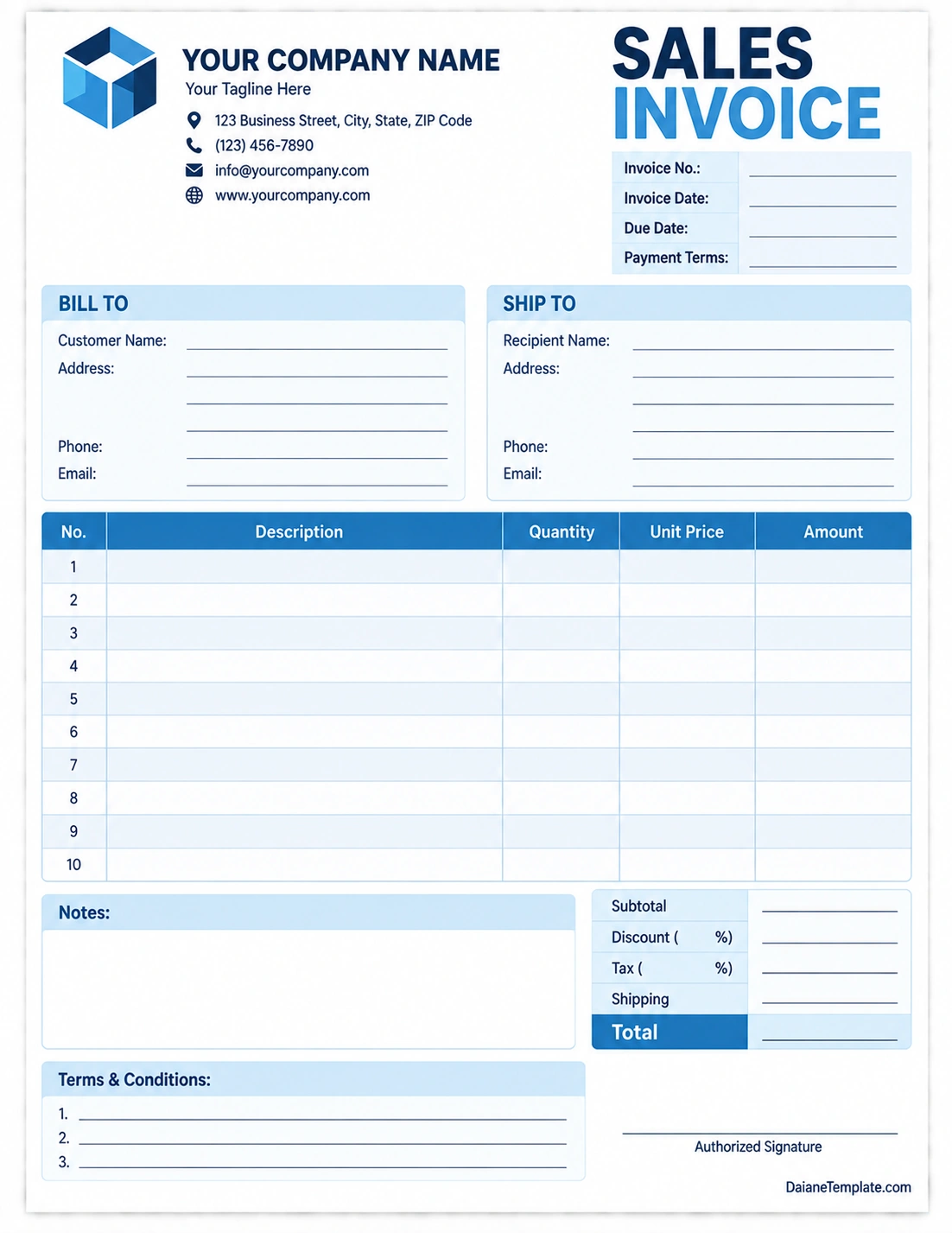
Sales Invoice Template
A sales invoice template provides a ready-to-use structure for recording customer and transaction information. Instead of creating every invoice from scratch, a business can customize a template with its company information, branding, payment terms, and preferred layout.
What Should a Sales Invoice Include?
A complete invoice should contain enough information for the customer and seller to identify and understand the transaction. The specific requirements may vary, but most sales invoices include several standard sections.
1. Seller Information
Start with the business name and contact information. Depending on the business and applicable requirements, this may include an address, phone number, email address, website, or tax identification information.
2. Customer Information
Include the customer’s name or business name and relevant contact or billing information. For business-to-business transactions, the customer’s billing details may be particularly important.
3. Invoice Number
Assign a unique invoice number to each invoice. A consistent numbering system makes it easier to locate individual transactions and maintain organized records.
4. Invoice Date
The invoice date indicates when the invoice was issued. It can be important for recordkeeping, payment tracking, and applicable accounting processes.
5. Payment Due Date
Clearly state when payment is expected. If the business uses payment terms such as Net 15 or Net 30, make those terms easy to find.
6. Description of Products or Services
List the products or services included in the transaction. Descriptions should be specific enough for the customer to understand what each charge represents.
7. Quantity and Unit Price
For products or services sold by quantity, show the number of units and the price per unit. This makes the calculation easier to review.
8. Subtotal, Discounts, and Taxes
Show the subtotal and any applicable discounts or taxes separately when appropriate. Clear calculations help customers verify the amount they owe.
9. Total Amount Due
The final amount due should be clearly displayed. Make this figure easy to locate so the customer does not have to search through the invoice.
10. Payment Terms and Notes
Include relevant payment instructions, accepted payment methods, delivery information, return terms, or other conditions that apply to the transaction.
How to Create a Sales Invoice
Creating an invoice becomes easier when you use a consistent process. The following steps can help you prepare a clear and accurate document.
Step 1: Add Your Business Information
Enter your business name and relevant contact details. If applicable, include required registration or tax information.
Step 2: Add the Customer Information
Enter the customer’s name, business name, billing address, and contact information. Check the spelling and details before sending the invoice.
Step 3: Assign an Invoice Number
Use a unique invoice number that follows your normal numbering system. Avoid accidentally assigning the same number to multiple invoices.
Step 4: Enter the Transaction Details
List every product or service included in the sale. Include quantities, unit prices, applicable discounts, and other relevant charges.
Step 5: Calculate the Total
Review the subtotal, discounts, taxes, shipping charges, and final amount carefully. Accurate calculations are essential for avoiding billing problems.
Step 6: Add Payment Terms
State the payment due date and any other important payment instructions. Make sure the terms match what was agreed with the customer.
Step 7: Review Before Sending
Check all names, dates, invoice numbers, descriptions, calculations, and payment information. Correcting errors before sending can prevent unnecessary follow-up later.
Sales Invoice vs. Receipt
A sales invoice and a receipt serve different purposes, although both relate to a transaction.
A sales invoice is generally used to document a sale and request payment. It typically shows the amount the customer owes and the applicable payment terms.
A receipt generally confirms that payment has already been received. Depending on the business process, a customer may receive an invoice first and a receipt after payment is completed.
Understanding the difference helps businesses maintain more accurate sales and payment records.
Sales Invoice vs. Purchase Order
A purchase order and a sales invoice are also different documents. A purchase order is generally created by the buyer to communicate what they want to purchase, including quantities, prices, or requested terms.
The sales invoice is issued by the seller to document the sale and request payment. In some business transactions, the invoice may be checked against the purchase order and other supporting documents before payment is approved.
When Should You Send a Sales Invoice?
The appropriate timing depends on the type of business and the agreement with the customer. Some businesses issue an invoice immediately after providing goods or services, while others invoice according to a recurring billing schedule or agreed milestone.
For products, the invoice may be issued at the time of sale or shipment. For services, it may be issued after the work is completed, at a project milestone, or on a recurring schedule.
The important point is to follow the payment terms agreed with the customer and any applicable legal or tax requirements.
Tips for Creating a Professional Sales Invoice
- Keep the layout simple: Use clear headings and enough white space to make the invoice easy to read.
- Use consistent invoice numbers: Maintain an organized numbering system for easier recordkeeping.
- Describe items clearly: Avoid vague descriptions that may confuse the customer.
- Show the total prominently: Make the amount due easy to find.
- State payment terms clearly: Include the due date and payment instructions.
- Check calculations: Review quantities, prices, discounts, taxes, and totals before sending.
- Keep copies: Store invoices securely for bookkeeping and recordkeeping.
- Use consistent branding: Add your business name and appropriate branding elements for a professional appearance.
- Send invoices promptly: Timely invoicing can help maintain predictable accounts receivable.
Common Sales Invoice Mistakes to Avoid
Missing Invoice Numbers
An invoice without a unique number can make recordkeeping more difficult. Use a consistent numbering system for every invoice you issue.
Incorrect Customer Information
Incorrect names, addresses, or billing information can cause delays and confusion. Review customer details before sending the invoice.
Unclear Product or Service Descriptions
A customer should be able to understand what each charge represents. Use descriptions that are specific and easy to identify.
Incorrect Calculations
Mathematical errors can lead to overbilling, underbilling, or payment disputes. Always verify the calculations before delivering the invoice.
Missing Payment Terms
Customers need to know when and how to pay. Include the payment due date and relevant instructions clearly.
Failing to Keep Records
Invoices should be stored in an organized system. Proper recordkeeping can make it easier to track unpaid invoices, prepare financial reports, and respond to questions about past transactions.
How to Keep Sales Invoices Organized
Good invoice management is especially important as a business grows. Create a consistent system for storing invoices and tracking their payment status.
- Use unique invoice numbers.
- Keep invoices in chronological or customer-based order.
- Track issued, paid, overdue, and canceled invoices.
- Keep supporting transaction documents when appropriate.
- Back up digital invoice records.
- Restrict access to sensitive customer and financial information.
- Follow applicable record-retention requirements.
A simple invoice tracking system can help a business quickly identify outstanding balances and maintain better control over accounts receivable.
Frequently Asked Questions About Sales Invoices
What is a sales invoice used for?
A sales invoice is used to document a sale and communicate the amount a customer owes for goods or services. It can also support bookkeeping, payment tracking, tax records, and transaction documentation.
Is a sales invoice proof of payment?
Usually, no. An invoice generally requests or documents an amount due, while a receipt is commonly used to confirm that payment has been received. Businesses may use both documents as part of their financial records.
Is a sales invoice legally binding?
An invoice can be important evidence of a transaction and may support a seller’s claim for payment, but whether an invoice itself creates a legally enforceable obligation depends on the underlying agreement, applicable law, and circumstances of the transaction.
What information should be on a sales invoice?
A sales invoice commonly includes seller and customer information, invoice number, invoice date, payment due date, product or service descriptions, quantities, prices, taxes, total amount due, and payment terms.
Can I use a sales invoice template?
Yes. A sales invoice template can provide a consistent structure for creating invoices. You should customize the template to reflect your business information, transaction requirements, payment terms, and applicable legal or tax requirements.
What is the difference between an invoice and a sales invoice?
The terms are often used interchangeably. A sales invoice specifically refers to an invoice issued by a seller to document a sale and request payment from a customer.
When should a sales invoice be issued?
The timing depends on the type of transaction and the agreed payment terms. An invoice may be issued when goods are sold or delivered, when services are completed, at project milestones, or according to a recurring billing schedule.
How should I number sales invoices?
Use a unique and consistent numbering system. For example, a business might use sequential numbers such as INV-1001, INV-1002, and INV-1003. Choose a system that is easy for your business to maintain and track.
Can a sales invoice be used for tax records?
Invoices can be important supporting documents for tax and accounting records. However, the information required for tax purposes varies by jurisdiction and transaction type, so businesses should follow applicable requirements and obtain professional tax advice when necessary.
Conclusion
A sales invoice is an essential document for recording sales, requesting customer payment, and maintaining organized business records. A well-prepared invoice clearly identifies the buyer and seller, describes the products or services provided, shows the amount due, and communicates the applicable payment terms.
Using a consistent sales invoice template can make billing easier while helping businesses maintain accurate records. By including complete transaction information, checking calculations, using clear payment terms, and keeping organized copies, businesses can create a more reliable invoicing process.
Whether you are a freelancer, small business owner, retailer, contractor, or service provider, a professional sales invoice can provide a simple and practical way to document transactions and manage customer payments.
Download: Sales Invoice Template
