A restaurant business plan is a practical roadmap for turning a restaurant idea into a structured and financially viable business. It explains the restaurant concept, target market, menu, marketing strategy, operations, management structure, startup costs, revenue expectations, and long-term goals.
Whether you are opening a neighborhood cafe, a fast-casual restaurant, a fine dining establishment, a food-focused business, or a specialty concept, a well-prepared business plan helps you think through the important decisions before investing significant time and money.
A restaurant business plan can also help communicate your vision to potential investors, lenders, business partners, and members of your management team. More importantly, the planning process can reveal opportunities, identify risks, clarify priorities, and provide measurable goals for the business.
What Is a Restaurant Business Plan?
A restaurant business plan is a written document that describes how a restaurant will operate, compete, generate revenue, and pursue its business goals. It combines strategic planning with practical information about the restaurant’s market, customers, products, operations, and finances.
The plan can be used before opening a restaurant and updated as the business develops. For a new restaurant, it can help the owner evaluate whether the concept is realistic. For an existing restaurant, it can provide a framework for expansion, repositioning, menu changes, new locations, or operational improvements.
A strong plan should be specific to the restaurant rather than a collection of generic statements. It should explain what makes the concept different, who the restaurant will serve, how it will attract customers, and how the business expects to generate sustainable revenue.
Why Is a Restaurant Business Plan Important?
Opening a restaurant involves many interconnected decisions. A business plan helps organize those decisions before they become expensive commitments.
Defines the Restaurant Concept
The plan forces you to clearly describe the type of restaurant you want to build. This includes the cuisine, service style, atmosphere, target customers, pricing strategy, and overall value proposition.
Identifies the Target Market
Market research helps you understand the customers you want to attract and the competitive environment in which the restaurant will operate.
Supports Financial Planning
A restaurant business plan can organize startup costs, operating expenses, revenue projections, cash flow expectations, and other financial assumptions. This helps determine how much capital may be required.
Helps Communicate With Investors and Lenders
Potential investors and lenders may want to understand the restaurant’s concept, market opportunity, management team, financial assumptions, and strategy before committing capital. A well-organized plan provides a structured way to present this information.
Creates a Roadmap for Operations
The plan can define staffing requirements, supplier relationships, equipment needs, daily procedures, marketing activities, and other operational priorities.
Key Sections of a Restaurant Business Plan
The exact structure can vary, but most restaurant business plans include several core sections. Each section should contribute useful information rather than simply fill space.
1. Executive Summary
The executive summary provides a concise overview of the entire business plan. It should explain the restaurant concept, target market, location, competitive advantage, financial objectives, and funding needs.
Although it appears first, many business owners find it easier to write the executive summary after completing the other sections.
2. Restaurant Business Description
Describe the restaurant in more detail. Explain the business name, restaurant type, cuisine, location, ownership structure, service model, and overall concept.
This section should answer a basic question: What is this restaurant, and why will customers choose it?
3. Market Analysis
The market analysis examines the customers and competitive environment surrounding the restaurant. It should be based on research rather than assumptions.
Consider factors such as:
- Target customer demographics
- Customer preferences and dining habits
- Local demand
- Competitor restaurants
- Competitor pricing
- Restaurant locations
- Market gaps
- Industry trends
- Potential opportunities and challenges
A useful market analysis explains why the restaurant concept fits its intended market.
4. Products and Services
Describe what the restaurant will sell. This section may include the menu concept, signature dishes, beverages, pricing approach, catering, takeout, delivery, private dining, or other services.
You do not necessarily need to include every menu item in the business plan. Instead, explain the overall product strategy and how the menu supports the restaurant’s positioning.
5. Marketing Plan
The marketing plan explains how the restaurant will attract customers and encourage repeat visits. It should connect directly to the target audience identified in the market analysis.
Potential marketing strategies include:
- Restaurant website and local search optimization
- Social media marketing
- Email marketing
- Opening promotions
- Loyalty programs
- Local partnerships
- Community events
- Online ordering promotions
- Customer referral programs
- Seasonal campaigns
Each marketing activity should have a purpose and, where possible, a measurable objective.
6. Operations Plan
The operations plan explains how the restaurant will function on a daily basis. It may cover the location, facility, kitchen equipment, suppliers, inventory, staffing, food preparation, service procedures, opening hours, sanitation practices, and quality control.
A detailed operations plan can help identify the resources required to deliver a consistent customer experience.
7. Management Plan
Identify the owners, managers, key employees, and major responsibilities. Explain how the restaurant will be managed and which roles are necessary for daily operations.
Depending on the size of the business, this section may cover the general manager, kitchen leadership, front-of-house management, accounting, marketing, purchasing, and other responsibilities.
8. Financial Plan
The financial plan is one of the most important sections of a restaurant business plan. It translates the restaurant concept into financial assumptions and projections.
Common financial components include:
- Startup costs
- Equipment costs
- Leasehold improvements
- Initial inventory
- Licensing and permits
- Marketing costs
- Payroll expenses
- Rent and occupancy costs
- Food and beverage costs
- Operating expenses
- Revenue projections
- Cash flow projections
- Break-even analysis
Financial projections should be based on realistic assumptions. Avoid creating overly optimistic numbers simply to make the business appear attractive.
9. SWOT Analysis
A SWOT analysis evaluates the restaurant’s strengths, weaknesses, opportunities, and threats. It provides a structured way to think about internal capabilities and external conditions.
- Strengths: Advantages the restaurant already has or plans to develop.
- Weaknesses: Internal limitations that may affect performance.
- Opportunities: External conditions that may create potential growth.
- Threats: External factors that could negatively affect the business.
10. Implementation Plan
The implementation plan converts the strategy into specific actions. Establish milestones for location selection, financing, permits, construction, equipment installation, hiring, training, marketing, soft opening, and official launch.
Assigning responsibilities and target dates can make the plan easier to execute.
How to Write a Restaurant Business Plan
Writing a restaurant business plan becomes easier when you approach it as a series of practical questions rather than one large document.
Start With the Restaurant Concept
Define the restaurant before working on detailed financial projections. Decide what type of food you will serve, who you want to serve, how customers will order, and what experience you want to create.
Research the Market
Study your target customers and competitors. Visit competing restaurants, examine their menus and pricing, observe customer traffic, and research the characteristics of the intended location.
Develop the Menu Strategy
Determine your core menu categories, signature offerings, pricing approach, portion strategy, and potential seasonal items. Consider how menu decisions affect food costs, preparation time, staffing, and customer demand.
Plan Restaurant Operations
Map out how the restaurant will function from opening to closing. Consider purchasing, receiving, storage, preparation, service, cleaning, inventory management, staffing, and customer service.
Build Realistic Financial Projections
Estimate startup expenses and ongoing operating costs. Then develop revenue assumptions based on factors such as expected customer volume, average check size, operating days, and capacity.
Set Measurable Goals
Define specific objectives for the first year and beyond. Goals might cover revenue, customer retention, marketing performance, operational efficiency, menu development, or expansion.
Restaurant Startup Costs to Consider
Opening a restaurant can require substantial upfront investment. Your restaurant business plan should identify the major startup expenses before you commit to a location or construction project.
Potential startup costs include:
- Lease deposit and initial occupancy expenses
- Construction or remodeling
- Kitchen equipment
- Furniture and fixtures
- Point-of-sale systems
- Initial food and beverage inventory
- Smallwares and kitchen supplies
- Licenses and permits
- Insurance
- Branding and signage
- Website development
- Pre-opening marketing
- Employee recruitment and training
- Professional services
- Working capital
Keeping a reserve for unexpected expenses can also be important because construction, equipment, permits, inventory, and other startup costs may differ from initial assumptions.
Restaurant Financial Planning
Financial planning should connect directly to the restaurant’s operational assumptions. For example, projected sales should have a logical relationship with seating capacity, operating hours, expected customer traffic, average transaction value, and menu pricing.
Revenue Projection
Estimate potential revenue using realistic assumptions about customers and average spending. Consider different scenarios rather than relying on a single optimistic forecast.
Expense Forecast
Identify fixed and variable expenses. Fixed expenses may include certain occupancy and administrative costs, while variable expenses can change with sales volume or production levels.
Break-Even Analysis
A break-even analysis estimates the sales level required for revenue to cover applicable costs. It can help the owner understand how much business the restaurant needs to generate before reaching the break-even point.
Cash Flow Planning
A profitable business can still experience cash flow challenges. Track when money is expected to come in and when major expenses must be paid. This can help identify periods when additional working capital may be needed.
Common Restaurant Business Plan Mistakes
Using Generic Market Research
Generic industry statistics do not replace local research. A restaurant’s actual customer base and competitive environment depend heavily on its location and concept.
Underestimating Startup Costs
Owners sometimes focus on obvious expenses while overlooking permits, professional services, equipment installation, opening inventory, training, marketing, and working capital.
Overestimating Revenue
Revenue projections should be supported by reasonable assumptions. Test conservative, expected, and more optimistic scenarios instead of assuming that the restaurant will immediately operate at full capacity.
Ignoring Competition
Competition is not limited to restaurants serving the same cuisine. Customers may choose between different restaurant types, delivery options, grocery alternatives, cafes, and other dining experiences.
Failing to Update the Plan
A business plan should not necessarily remain unchanged after the restaurant opens. Update assumptions as you collect real sales, customer, staffing, and operating data.
How a Restaurant Business Plan Can Help Attract Investors
Investors typically need to understand more than the restaurant idea itself. They need to see how the concept is expected to operate and generate returns.
A business plan can present:
- The restaurant’s concept and competitive position
- The target market
- The management team’s experience
- The planned operating model
- The funding requirement
- The use of funds
- Revenue assumptions
- Expense projections
- Potential risks
- Growth opportunities
Clear assumptions are especially important. Investors can evaluate a plan more effectively when they understand how the financial projections were developed.
Frequently Asked Questions About Restaurant Business Plans
What is the purpose of a restaurant business plan?
The purpose of a restaurant business plan is to provide a structured roadmap for launching and operating a restaurant. It brings together the concept, market research, marketing strategy, operations, management, financial projections, risks, and implementation goals.
How long should a restaurant business plan be?
There is no universal required length. A restaurant business plan should be detailed enough to explain the concept, market, operations, strategy, and financial expectations without adding unnecessary information. A concise plan with strong research is generally more useful than a long document filled with generic content.
What should a restaurant business plan include?
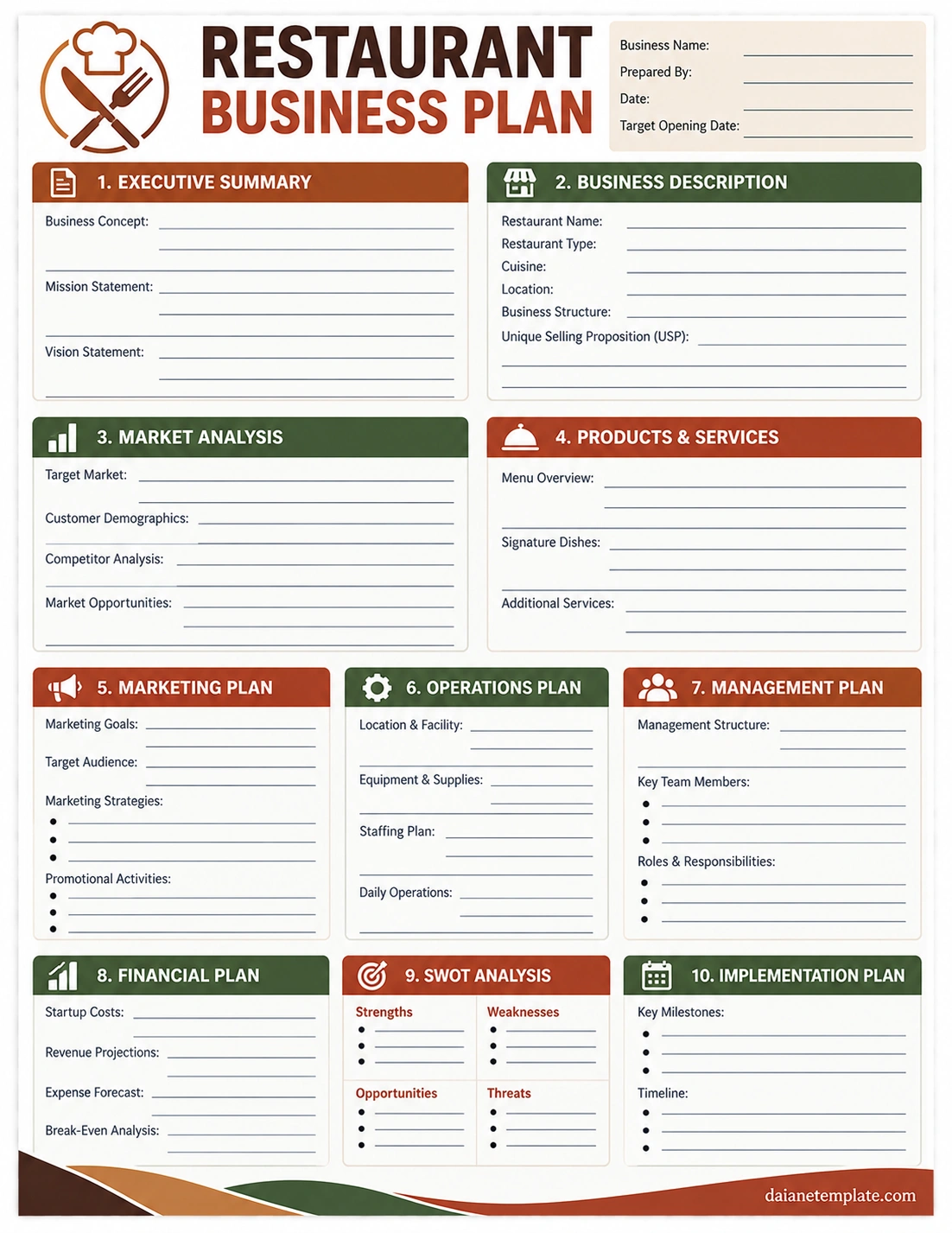
A typical plan includes an executive summary, business description, market analysis, products and services, marketing plan, operations plan, management plan, financial plan, SWOT analysis, and implementation strategy.
Do I need a business plan to open a restaurant?
A formal business plan may not be legally required to open every restaurant, but creating one can help organize the major decisions involved in starting the business. It can also be important when seeking outside financing or investment.
How do I make a restaurant business plan for investors?
Focus on the information investors need to evaluate the opportunity. Clearly explain the concept, target market, competitive environment, management team, funding requirements, use of funds, financial projections, risks, and growth strategy.
What financial information should a restaurant business plan include?
Common financial information includes startup costs, revenue projections, operating expenses, cash flow projections, break-even analysis, and funding requirements. The exact financial statements and projections needed can depend on the business and financing situation.
Can I use a restaurant business plan template?
Yes. A restaurant business plan template can provide a useful structure for organizing the major sections of the plan. However, the content should be customized to the restaurant’s actual concept, market, operations, costs, financial assumptions, and goals.
Final Thoughts
A restaurant business plan turns a restaurant idea into a structured strategy that can guide decisions before and after opening. It brings together the concept, target market, menu, marketing, operations, management, financial planning, risks, and implementation milestones in one document.
The most useful plan is not necessarily the longest one. It is the one that forces you to examine the restaurant realistically, identify potential challenges, establish measurable goals, and understand how the business intends to generate revenue and manage costs.
Using a restaurant business plan template can make the planning process more organized by providing dedicated sections for the executive summary, business description, market analysis, products and services, marketing, operations, management, finances, SWOT analysis, and implementation.
As the restaurant develops, revisit the plan and compare your original assumptions with actual results. Regular updates can help keep the strategy aligned with changing customer preferences, operating conditions, financial performance, and long-term business goals.
Download: Restaurant Business Plan Template
