A retainer agreement is a formal contract that establishes an ongoing working relationship between a client and a service provider. Instead of arranging a separate agreement for every individual project, the parties define the services, expectations, payment terms, responsibilities, and other important conditions for continuing work.
Retainer agreements are commonly used by consultants, lawyers, accountants, marketing agencies, designers, developers, writers, virtual assistants, and other professionals who provide recurring services. They can create a more predictable structure for both sides while reducing misunderstandings about what is included in the relationship.
A well-written retainer agreement does more than establish a recurring payment. It explains what the service provider will do, how the client will access those services, how compensation works, and what happens if either party needs to change or end the relationship.
What Is a Retainer Agreement?
A retainer agreement is a contract between a client and a service provider for ongoing or recurring professional services. The client typically agrees to pay a predetermined retainer fee in exchange for a defined level or scope of service during a specific period.
The exact structure can vary considerably. Some agreements provide a fixed number of hours each month, while others cover a defined group of services or provide ongoing access to the provider’s expertise.
For example, a marketing agency might provide monthly content strategy, social media management, and reporting for a fixed monthly fee. A freelance designer might reserve a specific number of working hours each month for a client. A consultant might provide ongoing advisory support with clearly defined availability and deliverables.
Why Use a Retainer Agreement?
An ongoing professional relationship can become complicated when expectations are not documented. A retainer contract creates a framework that helps both parties understand how the relationship will operate.
Some potential benefits include:
- Clear expectations: Both parties understand the services and responsibilities involved.
- Predictable billing: Payment terms can be established in advance.
- Reserved availability: The provider can allocate time or resources for the client.
- Continuity: The client can maintain access to an established service provider.
- Reduced misunderstandings: Important terms are documented instead of relying solely on conversations.
- Long-term planning: Both parties can plan resources and workloads more effectively.
The specific legal and financial effects of a retainer arrangement depend on the contract and applicable law, so important agreements may benefit from review by an appropriately qualified professional.
What Should a Retainer Agreement Include?
A strong retainer agreement should clearly describe the relationship and address the terms that are most likely to create misunderstandings if they are left undefined.
1. Parties and Contact Information
Start by identifying the client and service provider. Include the legal or business names and relevant contact information required for the relationship.
This section may include:
- Client name or company name
- Service provider name or company name
- Business addresses
- Email addresses
- Phone numbers
- Other identifying information required by the parties
2. Scope of Services
The scope of services is one of the most important parts of a retainer agreement. It should explain what the service provider is expected to deliver during the engagement.
Be as specific as reasonably possible. Depending on the type of service, the agreement may describe recurring tasks, deliverables, consultation hours, response expectations, reporting, meetings, or other services.
It is also useful to identify services that are specifically excluded. This can help prevent scope creep and clarify when additional work requires a separate agreement or fee.
3. Retainer Fee and Payment Terms
The agreement should clearly explain how the service provider will be compensated. A retainer may be paid monthly, quarterly, or according to another schedule agreed upon by the parties.
Important payment details can include:
- Retainer amount
- Payment frequency
- Payment due date
- Accepted payment methods
- Late-payment terms
- Additional service fees
- Expenses and reimbursable costs
- Unused hours or service credits, if applicable
Clearly defining these terms can reduce disputes and make recurring billing easier to manage.
4. Term and Renewal
The term identifies when the agreement begins and how long it remains in effect. The contract may have a fixed initial term or continue until terminated according to the agreed conditions.
If the agreement automatically renews, explain the renewal period and any notice requirements. If renewal requires mutual agreement, describe how the renewal will be handled.
5. Termination
A retainer agreement should explain how either party can end the relationship. This commonly includes the required notice period and any obligations that remain after termination.
The termination section may address:
- Notice requirements
- Final payment obligations
- Outstanding work
- Return of client materials
- Access to files or systems
- Confidentiality obligations
- Handling of unused retainers or prepaid amounts
Because termination provisions can have legal consequences, the wording should be appropriate for the applicable jurisdiction and specific relationship.
6. Confidentiality
Clients may share business information, customer information, strategies, documents, credentials, or other sensitive material with a service provider. A confidentiality provision can establish expectations regarding the handling and disclosure of confidential information.
The agreement can define what information is considered confidential, how it should be protected, and circumstances in which disclosure may be permitted or legally required.
7. Intellectual Property
When the service provider creates designs, reports, written content, software, marketing materials, or other work products, the agreement should clarify how intellectual property rights will be handled.
The parties may need to address ownership, licensing, permitted use, pre-existing materials, third-party materials, and when rights transfer, depending on the nature of the engagement.
8. Independent Contractor Relationship
When appropriate, a retainer agreement may state that the service provider operates as an independent contractor rather than as an employee. The exact legal classification depends on the applicable law and the actual working relationship, not simply on what the contract calls it.
9. Changes to the Agreement
Long-term relationships can evolve. A retainer agreement should explain how changes to the scope, fees, schedule, or other important terms will be approved and documented.
How Does a Retainer Agreement Work?
The basic process is relatively straightforward. First, the client and service provider discuss the ongoing relationship and determine what services are needed. They then agree on the scope, payment structure, schedule, responsibilities, and other relevant terms.
After the agreement is reviewed and signed, the service provider performs the agreed services during the applicable period. The client makes payments according to the contract, and both parties follow the established procedures for communication, deliverables, and changes.
If circumstances change, the parties can modify the agreement according to its amendment provisions or enter into a new agreement.
Types of Retainer Arrangements
Not every retainer relationship operates in exactly the same way. Several structures are commonly used depending on the type of professional service.
Monthly Retainer
The client pays a fixed amount each month for an agreed package of ongoing services. This model is common for marketing, consulting, design, and administrative services.
Hourly Retainer
The client purchases or reserves a specific number of service hours during a defined period. The agreement should clarify how hours are tracked and what happens to unused hours.
Service-Based Retainer
Instead of focusing on hours, the agreement defines a specific collection of recurring services. This can be useful when the provider’s work is measured by deliverables rather than time.
Availability Retainer
In some arrangements, the client pays for access to the provider’s availability or expertise during a particular period. The agreement should clearly define the expected availability and any limits.
Retainer Agreement vs. Standard Service Agreement
A standard service agreement may be designed around a specific project or defined engagement. A retainer agreement is generally structured around an ongoing relationship.
For example, a website designer might use a project agreement to build a website with a defined beginning and end. After the website launches, the same designer might use a retainer agreement for ongoing maintenance, updates, design support, or technical assistance.
The appropriate contract depends on the nature of the services, duration of the relationship, payment arrangement, and expectations of both parties.
How to Create an Effective Retainer Agreement
Creating a useful retainer agreement starts with identifying the areas most likely to cause confusion later. Focus on practical details rather than using unnecessarily complicated language.
Define the Scope Clearly
Describe the recurring services and establish reasonable boundaries. If additional work is billed separately, explain how the client will request and approve that work.
Set Clear Payment Rules
Specify the amount, payment schedule, due dates, and any additional charges. Avoid leaving important financial terms open to interpretation.
Establish Communication Expectations
For ongoing relationships, it can be helpful to define preferred communication channels, expected response times, meeting frequency, and procedures for urgent requests.
Document Changes
Long-term engagements often evolve. Keep significant changes to the scope, pricing, or responsibilities documented and approved by the appropriate parties.
Review the Agreement Periodically
A long-term retainer may continue for months or years. Periodically reviewing the agreement can help ensure that the documented services and payment structure still reflect the actual relationship.
Common Mistakes to Avoid
A retainer agreement is most useful when it addresses the practical issues that arise during ongoing work. Avoid these common problems:
- Vague service descriptions: Unclear scopes can lead to disagreements about what is included.
- Undefined availability: Clients and providers may have different expectations about response times.
- Unclear payment terms: Missing due dates or additional-fee provisions can create billing disputes.
- No termination procedure: Both parties should understand how the relationship can end.
- Ignoring intellectual property: Work-product ownership and usage rights should be addressed when relevant.
- Failing to document changes: Verbal changes can become difficult to verify later.
- Using the same agreement for every situation: A template should be adapted to the actual services and relationship.
Using a Retainer Agreement Template
A retainer agreement template can provide a practical starting point for organizing the terms of an ongoing professional relationship. A well-structured template can include sections for the parties, services, payment terms, term and termination, confidentiality, intellectual property, contractor status, miscellaneous provisions, and signatures.
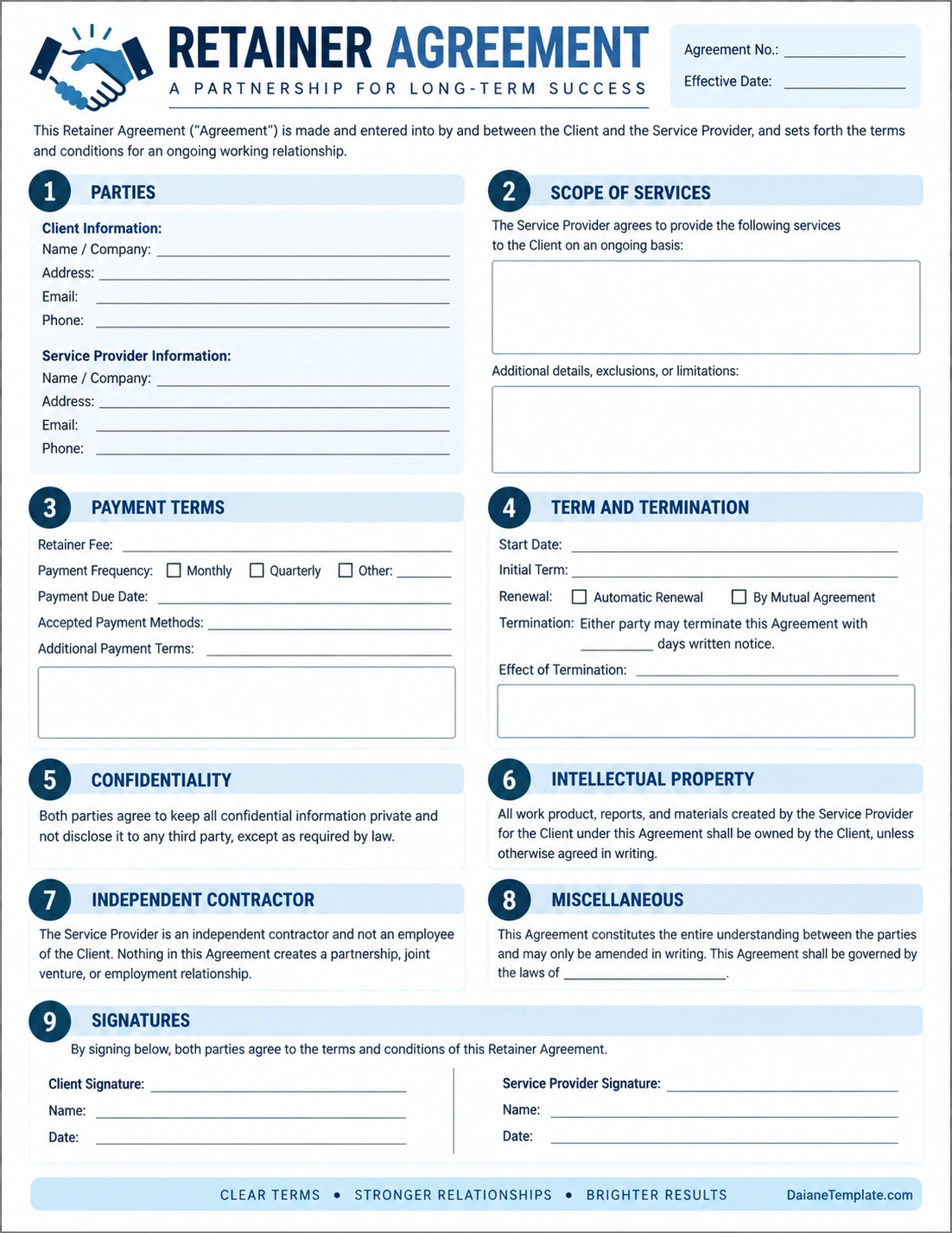
Using a template can make it easier to identify important topics that need to be discussed before the agreement is finalized. However, a template should be customized to the specific engagement rather than used automatically without review.
Because contracts can create legal obligations, parties should consider obtaining appropriate legal advice when the arrangement is complex, high-value, regulated, or subject to specific legal requirements.
Retainer Agreement Checklist
Before finalizing an ongoing service agreement, review whether the document addresses the key elements of the relationship.
- Client and service provider information is complete.
- Services are clearly described.
- Excluded services are identified when necessary.
- Retainer amount is specified.
- Payment frequency and due dates are clear.
- Additional fees and expenses are addressed.
- Start date and contract term are defined.
- Renewal conditions are explained.
- Termination and notice requirements are included.
- Confidentiality requirements are addressed when appropriate.
- Intellectual property provisions are included when relevant.
- Communication and availability expectations are clear.
- Changes and amendments are documented appropriately.
- Both parties have appropriate signature fields.
Conclusion
A retainer agreement provides a structured framework for an ongoing professional relationship. By clearly defining services, payment terms, responsibilities, availability, confidentiality, intellectual property, termination procedures, and other important conditions, it can help both clients and service providers establish clearer expectations.
The strongest retainer agreements are specific enough to reduce uncertainty while remaining practical for the actual working relationship. Whether you are a freelancer, consultant, agency, attorney, designer, developer, or client, taking the time to document the arrangement can make ongoing work easier to manage.
A carefully customized retainer agreement template can serve as a useful starting point for organizing these details, but the final agreement should reflect the specific services, parties, and applicable requirements of the engagement.
Download: Retainer Agreement Template
