Starting or investing in a company involves more than deciding how much each person owns. Shareholders also need clear rules about decision-making, financial rights, management responsibilities, and what happens when someone wants to leave the business. A shareholders agreement helps establish these rules and provides a framework for managing the relationship between shareholders.
A shareholders agreement is a private contract that explains the rights and obligations of a company’s shareholders. It can address important matters such as voting rights, share transfers, dividend policies, dispute resolution, and protections for minority shareholders. By agreeing on these issues early, shareholders can reduce uncertainty and avoid misunderstandings as the company grows.
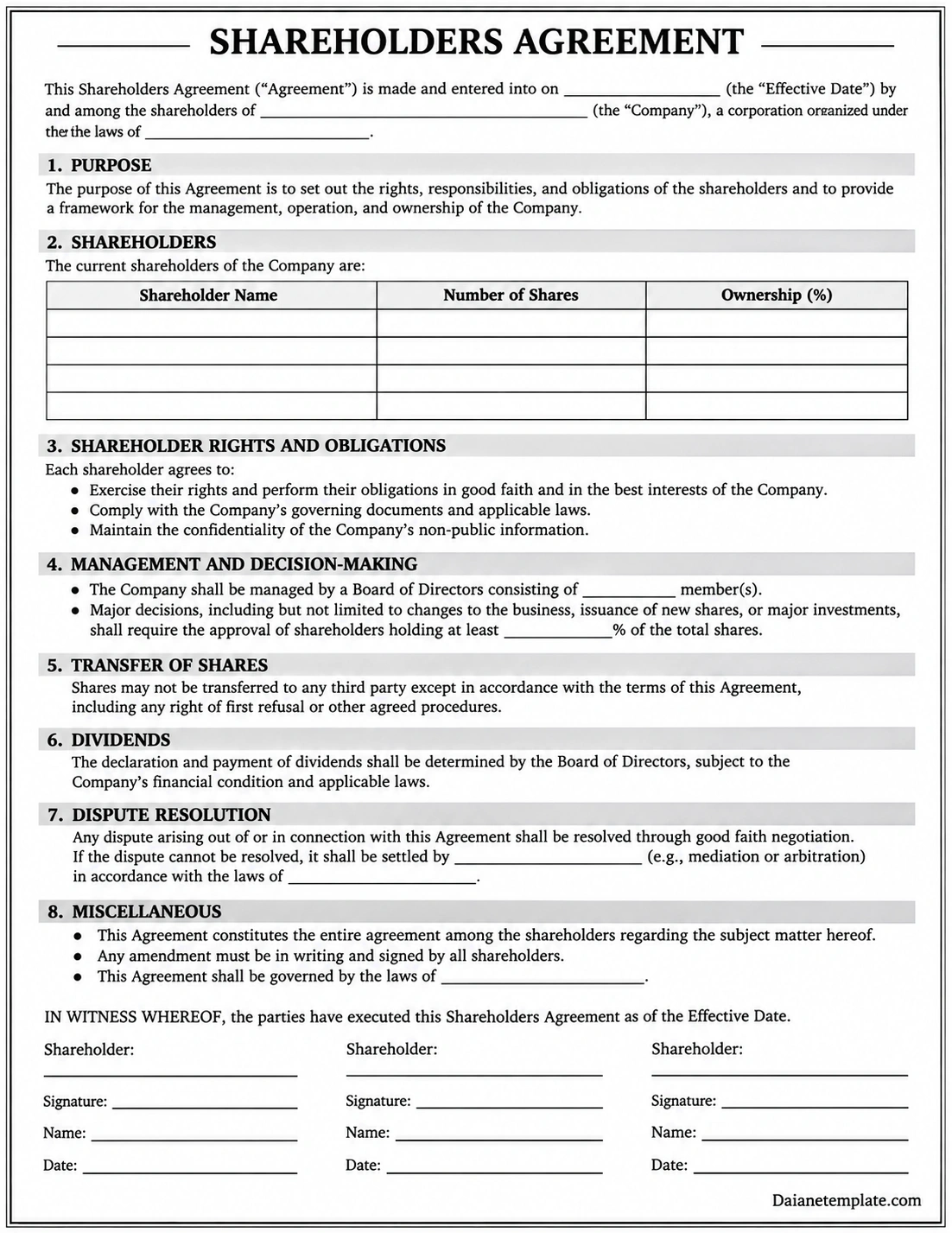
Whether you are a business founder, company owner, investor, or minority shareholder, understanding this agreement is important. This guide explains its purpose, common clauses, benefits, and practical considerations. It also includes a simplified shareholders agreement sample structure to help you understand what a typical document may contain.
What Is a Shareholders Agreement?
A shareholders agreement is a legally binding private contract between some or all shareholders of a company. Depending on its structure, the company itself may also become a party to the agreement. It establishes how shareholders interact with one another and how certain aspects of the business should be managed.
The agreement supplements the company’s constitutional documents, such as its articles of incorporation, articles of association, or bylaws. It can provide additional rules that are specifically negotiated by the shareholders.
A shareholders agreement commonly covers:
- Share ownership: Records the shareholders’ interests and ownership percentages.
- Voting rights: Explains how shareholders participate in important company decisions.
- Management arrangements: Establishes responsibilities and approval procedures for major business matters.
- Share transfers: Sets conditions for selling, transferring, or issuing shares.
- Dividend policies: Explains how decisions about profit distributions are handled.
- Minority shareholder protection: Provides safeguards against certain decisions that may unfairly affect smaller shareholders.
- Dispute resolution: Establishes procedures for addressing disagreements.
- Exit arrangements: Explains what happens when a shareholder wants to leave or sell their investment.
The exact terms depend on the company’s ownership structure, governing documents, jurisdiction, and the needs of its shareholders.
Why Is a Shareholders Agreement Important?
A shareholders agreement helps establish expectations before disagreements arise. Without clear arrangements, shareholders may have different ideas about how the company should operate, when profits should be distributed, or who has authority to approve important decisions.
A written agreement gives shareholders a shared reference point and can help protect the interests of both the business and its investors.
1. Prevents Shareholder Disputes
Disagreements can occur when shareholders have different business priorities or expectations. A shareholders agreement can establish decision-making procedures, voting thresholds, and dispute resolution methods before conflicts develop.
2. Protects Minority Shareholders
Minority shareholders may have limited voting power because they own a smaller percentage of the company. The agreement can provide additional protections for certain important decisions, such as issuing new shares, changing ownership rights, or selling significant business assets.
3. Clarifies Management Responsibilities
The agreement can explain which matters are handled by directors and which decisions require shareholder approval. This helps prevent confusion about authority and responsibilities.
4. Establishes Rules for Share Transfers
Shareholders may want to control who can become an owner of the company. Transfer provisions can establish procedures for selling shares, offering them to existing shareholders first, or obtaining approval before a transfer takes place.
5. Supports Business Continuity
Changes in ownership can affect the company’s operations. An agreement can address situations involving retirement, death, incapacity, resignation, or a shareholder’s decision to sell their investment.
Key Clauses in a Shareholders Agreement
A well-prepared agreement should address the company’s ownership structure and the practical needs of its shareholders. The following clauses are commonly considered when preparing a shareholder contract.
1. Parties and Company Details
The opening section identifies the company and the shareholders entering into the agreement. It may include legal names, registered addresses, company registration details, and the agreement’s effective date.
It should also clarify whether the company is a party to the agreement and which shareholders are bound by its provisions.
2. Share Ownership and Capital Contributions
This section records each shareholder’s ownership interest and, where relevant, their initial capital contributions. It may identify the number and class of shares held by each shareholder.
Important details can include:
- Shareholder names and contact details.
- Number and class of shares held.
- Percentage of company ownership.
- Initial investment or capital contribution.
- Rights attached to different share classes.
Keeping this information accurate helps shareholders understand their respective interests in the business.
3. Shareholder Rights and Obligations
This clause explains the rights shareholders receive and the responsibilities they agree to follow. Depending on the company structure, rights may include voting, receiving dividends when declared, accessing certain company information, and participating in shareholder meetings.
Obligations may include complying with the agreement, maintaining confidentiality, following applicable laws, and observing agreed procedures when transferring shares.
4. Management and Decision-Making
Management provisions explain how the company is governed and which decisions require approval. They can distinguish ordinary business decisions from major matters that require a higher voting threshold or special consent.
Major decisions may include:
- Issuing new shares or changing share capital.
- Approving significant investments or borrowing.
- Selling substantial company assets.
- Changing the company’s business activities.
- Appointing or removing directors, where applicable.
- Approving mergers, acquisitions, or restructuring.
The agreement should use clear approval requirements and remain consistent with the company’s governing documents and applicable law.
5. Share Transfer Restrictions
Share transfer provisions determine when and how shareholders may sell, assign, or transfer their shares. These restrictions can help prevent unwanted third parties from becoming shareholders.
Common arrangements include:
- Right of first refusal: Existing shareholders may have the opportunity to purchase shares before they are offered to an outside buyer.
- Transfer approval: Certain transfers may require approval under agreed procedures.
- Permitted transfers: The agreement may allow specific transfers, such as transfers to certain family members or related entities, subject to conditions.
- Valuation procedures: A method may be established for determining the value of shares in particular circumstances.
6. Dividend Policy
A dividend clause explains how the company approaches the distribution of profits to shareholders. It may establish a general policy, approval requirements, or factors that directors should consider before recommending a dividend.
The agreement should recognize that dividends are generally subject to the company’s financial position, applicable law, and the authority of the relevant corporate decision-makers. Shareholders should not assume that profits automatically create a right to immediate payment.
7. Minority Shareholder Protection
Minority shareholder protections are especially important when ownership is concentrated among a small number of investors. These provisions can help prevent majority shareholders from using their voting power in ways that unfairly disadvantage minority owners.
Possible protections include reserved matters requiring special approval, information rights, pre-emption rights, and procedures for resolving disputes about major decisions.
8. Confidentiality and Non-Disclosure
Shareholders may have access to sensitive information about the company’s finances, customers, strategy, technology, and operations. A confidentiality clause can explain how this information must be protected and when disclosure is permitted.
The clause should also recognize disclosures required by law, regulators, courts, or other legally authorized parties.
9. Deadlock and Dispute Resolution
A deadlock can occur when shareholders cannot reach the required agreement on an important decision. This is particularly challenging in companies with equal ownership or voting power.
A shareholders agreement can establish a process for addressing disagreements through:
- Good-faith discussions between shareholders.
- Formal negotiation procedures.
- Mediation with an independent third party.
- Arbitration or court proceedings, where appropriate.
- Agreed buyout or exit procedures if a deadlock cannot be resolved.
10. Exit and Buy-Sell Provisions
Exit provisions explain how a shareholder can leave the company and what happens to their shares. They may address voluntary sales, retirement, death, incapacity, or other specified events.
Some agreements also include drag-along and tag-along rights. Drag-along rights may allow qualifying majority shareholders to require minority shareholders to participate in an approved sale. Tag-along rights may allow minority shareholders to join a sale initiated by qualifying majority shareholders.
These provisions should clearly define the triggering conditions, notice requirements, pricing arrangements, and completion procedures.
Sample Shareholders Agreement Structure
The following simplified example demonstrates how a shareholders agreement may be organized. It is an educational outline rather than a complete legal contract. Actual wording should be adapted to the company’s jurisdiction, ownership structure, and governing documents.
Shareholders Agreement Sample
SHAREHOLDERS AGREEMENT
Effective Date: [Date]
This Agreement is made between [Company Legal Name], referred to as the “Company,” and the shareholders identified in this Agreement.
1. Purpose
The purpose of this Agreement is to establish the rights, responsibilities, and obligations of the shareholders and to provide a framework for the ownership, management, and operation of the Company.
2. Share Ownership
The shareholders and their respective ownership interests are recorded in the Company’s official share register and the ownership schedule attached to this Agreement.
3. Shareholder Rights and Obligations
Each shareholder agrees to exercise their rights in accordance with this Agreement, the Company’s governing documents, and applicable laws.
4. Management and Reserved Matters
The Company will be managed in accordance with its governing documents. Decisions identified as reserved matters will require the approval specified in this Agreement.
5. Transfer of Shares
A shareholder may transfer shares only in accordance with the procedures and restrictions set out in this Agreement and applicable law.
6. Dividends
Any dividend distribution will be considered and approved in accordance with the Company’s financial position, governing documents, and applicable legal requirements.
7. Confidentiality
Each shareholder agrees to protect confidential Company information, subject to disclosures required or permitted by law.
8. Dispute Resolution
The parties will first attempt to resolve disputes through good-faith negotiation. If the dispute remains unresolved, the parties will follow the agreed mediation, arbitration, or other dispute resolution procedure.
9. Governing Law
This Agreement will be governed by the laws of [Jurisdiction], subject to applicable mandatory legal requirements.
10. Signatures
Each party confirms that they have reviewed and agreed to the terms of this Agreement.
Company Representative: [Name and Title]
Signature: __________________________
Date: __________________________
Shareholder 1: [Full Name]
Signature: __________________________
Date: __________________________
Shareholder 2: [Full Name]
Signature: __________________________
Date: __________________________
Additional shareholders may sign separate counterparts or execution pages as permitted by the final agreement.
How to Create a Shareholders Agreement
Preparing an agreement requires more than filling in shareholder names and ownership percentages. The document should reflect how the company operates and how its owners want to handle important future events.
1. Identify All Relevant Parties
Confirm the company’s legal identity and determine which shareholders will be parties to the agreement. Check that names and company details match official records.
2. Review the Ownership Structure
Prepare an accurate schedule of share classes, share numbers, ownership percentages, and relevant voting rights. Consider whether different investors have different rights.
3. Discuss Important Business Decisions
Agree on which decisions can be made by directors and which require shareholder approval. Set realistic voting thresholds and identify reserved matters clearly.
4. Establish Transfer and Exit Procedures
Discuss what should happen if a shareholder wants to sell their shares, becomes unable to participate, or receives an offer from an outside buyer. Include workable valuation and notice procedures.
5. Agree on Dispute Resolution
Choose a practical process for resolving disagreements. Consider whether negotiation, mediation, arbitration, or a specific buyout mechanism is appropriate for the company.
6. Obtain Legal Review
Have a qualified corporate lawyer review the agreement before signing. The final document should be consistent with applicable company law, the company’s constitutional documents, and any relevant investment arrangements.
Common Mistakes to Avoid
A poorly drafted shareholder contract can create uncertainty instead of preventing disputes. Pay attention to these common mistakes when preparing or reviewing an agreement.
- Using a generic template without customization: A standard document may not reflect the company’s structure or local legal requirements.
- Leaving voting procedures unclear: Unclear approval thresholds can create disagreements over important decisions.
- Ignoring minority shareholder rights: Minority protections should be considered when ownership and voting power are uneven.
- Failing to define share valuation: Unclear pricing procedures can make shareholder exits difficult.
- Overlooking deadlock situations: Equal ownership can create decision-making problems without an agreed resolution process.
- Conflicting with company documents: The agreement should be reviewed alongside the articles, bylaws, or other constitutional documents.
- Not updating the agreement: Changes in ownership, financing, or business operations may require amendments.
- Ignoring legal formalities: Signing, approval, enforceability, and filing requirements may differ by jurisdiction.
Frequently Asked Questions About Shareholders Agreements
What is the main purpose of a shareholders agreement?
The main purpose is to establish clear rules governing the relationship between shareholders and certain aspects of the company’s operation. It can address ownership rights, voting procedures, share transfers, dividends, dispute resolution, and shareholder exits.
Is a shareholders agreement legally binding?
Generally, a properly formed shareholders agreement can be legally binding on the parties who enter into it. Its enforceability depends on the applicable law, the agreement’s wording, and whether required legal formalities have been satisfied.
Is a shareholders agreement mandatory?
In many jurisdictions, companies are not universally required to have a shareholders agreement. However, it can be particularly useful for privately held companies with multiple shareholders or investors. Specific requirements may differ depending on the company structure and local law.
Who should sign a shareholders agreement?
The shareholders who are intended to be bound by the agreement should sign it. The company may also become a party when appropriate. The correct parties depend on the agreement’s purpose, structure, and applicable legal requirements.
What is the difference between a shareholders agreement and articles of association?
A shareholders agreement is generally a private contract between its parties that sets out additional arrangements concerning shareholder rights and company matters. Articles of association or similar constitutional documents establish the company’s formal internal rules under applicable company law. The two documents should be reviewed together to avoid inconsistencies.
Does a shareholders agreement protect minority shareholders?
It can provide important protections through voting rights, reserved matters, information rights, pre-emption provisions, and exit arrangements. The actual protection depends on the wording of the agreement and applicable law.
Can a shareholders agreement be changed?
Yes. It can generally be amended if the required parties approve the changes in accordance with the agreement and applicable law. The amendment procedure should be clearly stated in the original document.
What happens if a shareholder breaches the agreement?
The consequences depend on the contract and applicable law. Possible remedies may include damages, enforcement of contractual obligations, dispute resolution procedures, or other legal remedies available to the parties.
Can a shareholder sell their shares freely?
Not always. A shareholders agreement may contain transfer restrictions, approval requirements, rights of first refusal, or other procedures that must be followed before shares can be sold or transferred.
Do small businesses need a shareholders agreement?
Small businesses with more than one shareholder can benefit from an agreement. Even when owners trust one another, a written document helps establish expectations and provides procedures for unexpected situations.
Final Thoughts
A shareholders agreement is an important tool for establishing clear expectations among company owners. It explains shareholder rights and obligations, supports structured decision-making, and provides procedures for handling ownership changes and potential disputes.
By addressing share transfers, voting rights, dividend policies, minority protections, and exit arrangements in advance, shareholders can create a more predictable framework for working together.
Whether you are establishing a new company or reviewing an existing ownership arrangement, take time to identify the issues that matter to all shareholders. Use a template as a starting point, customize it to your business, and seek qualified legal advice before signing the final agreement.
Download: Shareholders Agreement Template
