A RACI Chart is a project management tool used to clarify who is responsible for completing tasks, who is accountable for the final outcome, who should be consulted, and who needs to be informed. By assigning these four roles to project activities, a team can establish clearer expectations and reduce confusion about who should perform, approve, review, or receive information about each task.
Projects often involve multiple people, departments, stakeholders, and decision-makers. Without clearly defined responsibilities, important tasks can be duplicated, overlooked, or delayed because team members are unsure who should take action. A RACI matrix provides a simple visual framework for organizing responsibilities and improving communication throughout the project lifecycle.
What Is a RACI Chart?
A RACI Chart, also called a RACI matrix or responsibility assignment matrix, is a table that maps project tasks against team members, departments, or stakeholder groups. Each intersection contains one or more RACI designations that explain the person’s relationship to that activity.
The acronym RACI represents four different project roles: Responsible, Accountable, Consulted, and Informed. Understanding the distinction between these roles is essential because each one represents a different level of involvement in the work.
What Does RACI Stand For?
Responsible
Responsible refers to the person or people who perform the work required to complete a task. They are directly involved in carrying out the activity and producing the deliverable.
A task can have more than one Responsible person when multiple team members need to work together. However, assigning responsibility should remain clear enough that everyone understands who is expected to perform the work.
Accountable
Accountable refers to the person who owns the final outcome of the task. This person has authority over the result and is ultimately answerable for whether the activity is completed successfully.
A common RACI practice is to assign one Accountable person to each task. Having a single clear owner can make final decision-making easier and reduce uncertainty about who has authority to approve the outcome.
Consulted
Consulted identifies people who should provide input, expertise, advice, or feedback before a task or decision is completed.
These individuals do not necessarily perform the work themselves. Their knowledge may nevertheless be important for creating a suitable solution or avoiding problems.
Informed
Informed identifies people who should receive updates about the task, decision, progress, or outcome. They are kept aware of what is happening but are generally not directly involved in completing the activity.
Why Use a RACI Chart?
Projects can become complicated when responsibilities are not clearly defined. A RACI matrix provides a structured way to make ownership and communication expectations visible to everyone involved.
Clarifies Roles and Responsibilities
A RACI chart makes it easier to see who performs each task and who owns the result. This can reduce uncertainty when several people have overlapping areas of expertise.
Reduces Duplicate Work
When responsibilities are unclear, two team members may unknowingly work on the same task while another task receives no attention. Assigning roles in a RACI matrix helps reduce unnecessary overlap.
Improves Communication
The chart establishes who needs to be consulted and who should receive updates. This can help prevent both information overload and communication gaps.
Supports Faster Decision-Making
When accountability is clearly assigned, team members can identify who has authority over a particular decision. This can make project discussions more focused.
Helps Balance Workload
A completed RACI matrix can reveal when one person is Responsible or Accountable for too many activities. Project managers can then review the allocation of responsibilities and consider whether adjustments are needed.
RACI Chart Template
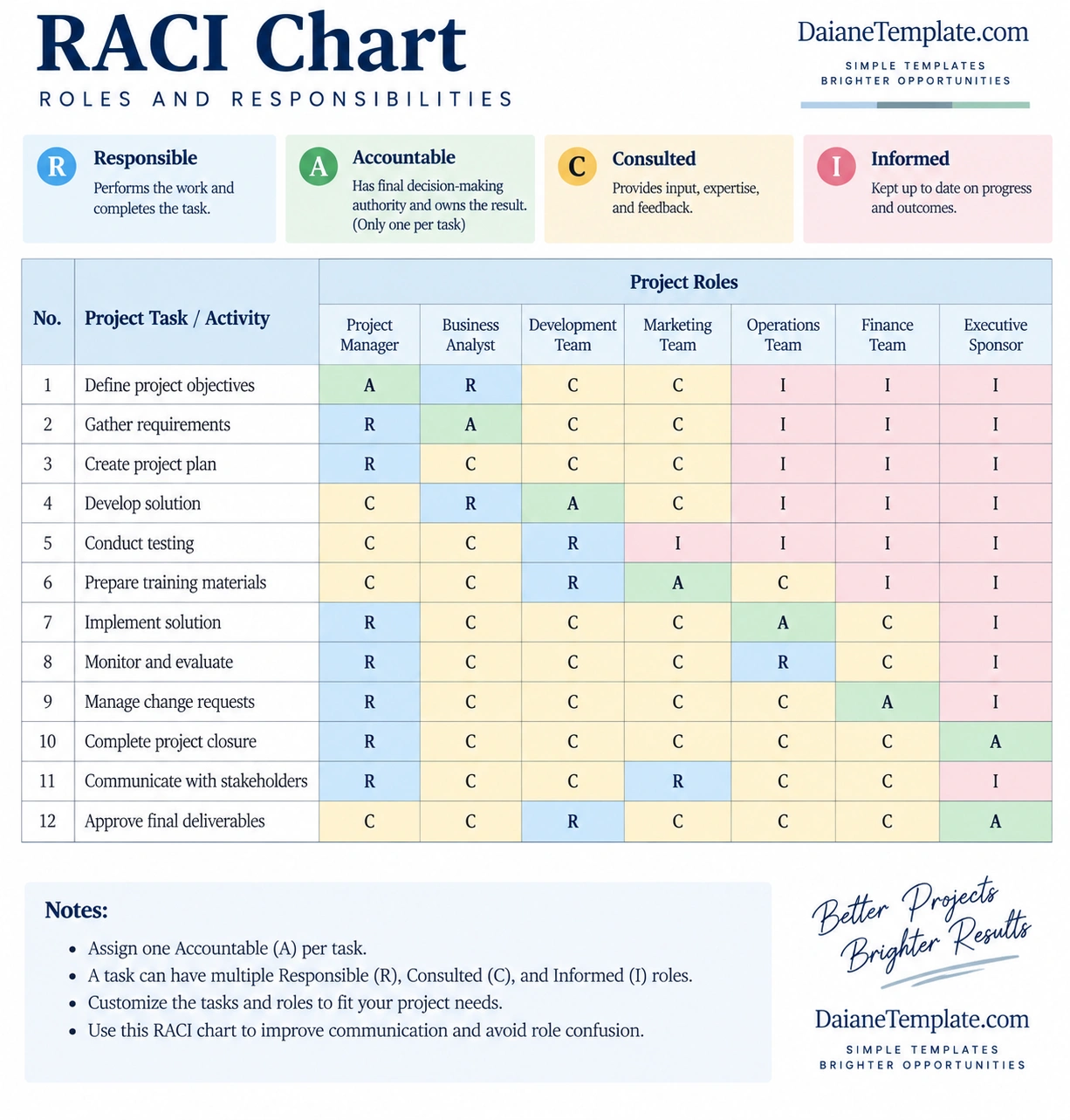
A RACI Chart Template provides a ready-made structure for mapping project activities to team roles. Instead of building a responsibility matrix from scratch, project managers can list tasks in the first column and team members or departments across the remaining columns.
Each cell can then be assigned an R, A, C, or I designation. A structured template also makes it easier to review the entire project and identify missing responsibilities, excessive involvement, or unclear ownership.
How to Create a RACI Chart
Step 1: List the Project Tasks
Start by identifying the major activities, deliverables, decisions, and milestones that require clear ownership. Write each task as a separate row in the matrix.
Focus on meaningful activities rather than listing every minor action. If the chart becomes excessively detailed, it may be difficult for the team to use effectively.
Step 2: Identify the People and Roles
List the team members, departments, stakeholders, or organizational roles that are involved in the project. Place these across the top of the chart.
Depending on the project, columns might represent a project manager, business analyst, development team, marketing team, operations team, finance team, executive sponsor, or other relevant groups.
Step 3: Assign Responsible Roles
For each task, determine who will actually perform the work. Assign the Responsible designation to the appropriate person or team.
Make sure the assigned individuals understand what the task involves and have the authority, resources, or skills necessary to perform it.
Step 4: Assign Accountability
Identify who owns the final result. The Accountable person should have sufficient authority to make decisions and approve the completed work.
Review tasks carefully to make sure accountability is not accidentally assigned to multiple people when a single decision owner would provide greater clarity.
Step 5: Identify Who Should Be Consulted
Determine which people need to provide expertise or feedback before the task is completed. These people should be involved at the appropriate stage rather than being included in every project discussion.
Step 6: Identify Who Needs to Be Informed
Finally, identify stakeholders who need updates but do not need to participate directly in the work or decision. This can include executives, department leaders, clients, or other stakeholders.
Step 7: Review the Matrix With the Team
A RACI chart should not be created in isolation when multiple stakeholders are involved. Review the assignments with the relevant team members and resolve disagreements before the project progresses too far.
Example of a RACI Matrix
Imagine that a company is implementing a new software system. The project includes defining objectives, gathering requirements, developing the solution, testing, preparing training materials, implementing the system, and completing project closure.
The project manager may be Responsible for creating the project plan, while a business analyst may be Responsible for gathering requirements. The development team may be Responsible for developing and testing the solution. An executive sponsor may be Accountable for major approvals. Marketing or operations teams may be Consulted or Informed depending on the activity.
The exact assignments should be determined by the project’s organizational structure and decision-making process. The purpose of the matrix is to make those decisions visible rather than assuming that everyone already understands them.
RACI Chart Best Practices
- Use clear task descriptions: Write activities so that team members understand what each row represents.
- Assign accountability deliberately: Identify the person who owns the final outcome.
- Avoid unnecessary Consulted roles: Only include people whose input is genuinely needed.
- Use Informed strategically: Keep stakeholders updated without involving them in every working-level decision.
- Review workload: Look for individuals who are Responsible or Accountable for an excessive number of tasks.
- Confirm assignments: Review the chart with the people whose responsibilities are being defined.
- Keep it readable: Avoid adding so many tasks or stakeholders that the matrix becomes difficult to understand.
- Update it when the project changes: Responsibility assignments may need to evolve as project scope, personnel, or priorities change.
Common RACI Chart Mistakes
Assigning Too Many Accountable People
One of the most common problems is giving several people final accountability for the same task. When everyone owns the final decision, it can become unclear who actually has authority to make it.
Where practical, designate one clear Accountable owner for each activity and involve other stakeholders through the Responsible, Consulted, or Informed roles.
Making Everyone Responsible
Assigning an entire department as Responsible for every task can make the matrix look complete while providing little practical clarity. Responsibility should identify who is actually expected to perform the work.
Consulting Too Many People
Consultation can improve decisions, but involving too many people can slow progress. Only include individuals whose knowledge or expertise is relevant to the specific task.
Failing to Assign an Owner
A blank responsibility cell can indicate that nobody has clearly accepted ownership. Review these gaps before project execution begins.
Never Updating the Chart
Projects change. Team members move to different roles, responsibilities shift, and project scope can expand or contract. A RACI matrix should be reviewed when meaningful changes occur.
RACI Chart for Different Types of Projects
A RACI matrix can be adapted to many project environments. The tasks and roles will vary depending on the type of work being performed.
Software Development Projects
A software project might include product requirements, design, development, testing, deployment, documentation, and maintenance. Developers, product managers, designers, testers, operations teams, and executives may have different RACI assignments.
Marketing Projects
A marketing campaign can include research, content development, creative design, approval, advertising, publication, performance monitoring, and reporting. A RACI chart can clarify which team owns each activity.
Business Process Projects
Process improvement initiatives often involve employees from multiple departments. A RACI matrix can establish who analyzes the existing process, proposes changes, approves new procedures, implements them, and receives progress updates.
Event Planning
Events require coordination across vendors, logistics, marketing, registration, finance, operations, and leadership. Assigning responsibilities in advance can reduce confusion as the event approaches.
RACI Chart vs. Project Schedule
A RACI chart and a project schedule serve different purposes. A project schedule focuses primarily on activities, timing, dependencies, milestones, and deadlines. A RACI chart focuses on roles and responsibility for those activities.
They can be used together. The schedule can show when a task needs to happen, while the RACI matrix shows who is responsible, accountable, consulted, or informed.
RACI Chart vs. Organizational Chart
An organizational chart shows reporting relationships and organizational structure. It can identify who reports to whom, but it does not necessarily explain who owns individual project tasks.
A RACI matrix focuses specifically on project responsibilities. Someone may report to one manager organizationally while being Responsible for a task owned by another person within a project structure.
How to Use a RACI Chart During a Project
The value of a RACI chart does not end after the initial planning meeting. Keep the matrix accessible throughout the project so team members can refer to it when questions about responsibility arise.
Use the chart when assigning new tasks, resolving responsibility conflicts, planning stakeholder communications, and reviewing project progress. If a major change occurs, update the matrix so it continues to reflect the actual project structure.
RACI Chart Checklist
Before finalizing your responsibility matrix, review the following points:
- Tasks: Are the important project activities included?
- Responsible: Does each task have someone assigned to perform the work?
- Accountable: Is final ownership clearly established?
- Consulted: Are the right subject-matter experts involved?
- Informed: Are the appropriate stakeholders receiving updates?
- Workload: Are responsibilities distributed reasonably across the team?
- Clarity: Can team members understand their responsibilities without additional explanation?
- Agreement: Have relevant stakeholders reviewed the assignments?
- Updates: Is there a process for revising the matrix when project responsibilities change?
Final Thoughts
A RACI Chart provides a straightforward way to clarify project roles and responsibilities. By identifying who is Responsible, Accountable, Consulted, and Informed for each important activity, teams can reduce confusion, improve communication, minimize overlapping work, and make ownership more visible.
The most useful RACI matrix is one that reflects the actual way a project operates. Keep task descriptions clear, assign accountability deliberately, involve only the stakeholders who need to participate, and review the chart as the project evolves. When integrated into project planning and communication, a RACI chart can serve as a practical reference for keeping teams aligned from project initiation through completion.
