A Sales Plan provides a clear roadmap for achieving revenue goals, reaching target customers, and improving sales performance. Instead of relying on informal goals or short-term decisions, a well-structured sales plan gives a sales team a documented strategy that explains what the business wants to achieve and how it plans to get there.
Whether you run a small business, manage a sales department, or lead a growing company, a sales plan can help turn broad revenue objectives into practical actions. It can define target markets, sales strategies, responsibilities, performance indicators, and review processes so everyone understands their role in achieving the company’s goals.
What Is a Sales Plan?
A Sales Plan is a strategic document that outlines a company’s sales objectives and the actions required to achieve them. It typically connects revenue targets with specific markets, customers, sales channels, strategies, and measurable performance indicators.
A sales plan is more than a list of sales targets. It explains the reasoning behind those targets and establishes a practical framework for execution. This makes it easier for sales managers and representatives to understand priorities and measure progress over time.
Depending on the business, a sales plan may cover a quarter, six months, or an entire year. It can also be updated as market conditions, customer needs, products, or business priorities change.
Why Is a Sales Plan Important?
A sales plan helps create alignment between business goals and day-to-day sales activities. Without a documented strategy, sales teams may spend time on activities that do not directly support the company’s priorities.
A well-designed sales plan can provide several benefits.
- Clear direction: Salespeople understand which objectives and markets deserve the most attention.
- Better accountability: Specific responsibilities and targets make it easier to track performance.
- Improved efficiency: Teams can focus resources on activities that support strategic goals.
- Informed decision-making: Sales data and performance indicators provide a basis for adjusting strategies.
- Revenue planning: Revenue targets and sales forecasts provide a framework for financial planning.
- Stronger customer relationships: A defined customer strategy can help sales teams better understand and respond to customer needs.
- Team motivation: Clear objectives can give employees measurable milestones to work toward.
Key Elements of a Sales Plan
Although sales plans vary between organizations, most effective plans contain several core components. Each component addresses a different part of the sales process.
1. Executive Summary
The executive summary provides a brief overview of the sales plan. It should explain the main sales objectives, expected results, target market, and overall strategy.
Keep this section concise. Someone should be able to read it quickly and understand the purpose and direction of the plan.
2. Sales Goals and Objectives
Sales goals define what the team is expected to accomplish. Common objectives include increasing revenue, acquiring new customers, improving customer retention, increasing sales volume, or expanding into a new market.
Whenever possible, make objectives specific and measurable. For example, instead of simply stating “increase sales,” a company could establish a defined revenue target for a specific period.
3. Target Market
The target market section identifies the customers the sales team intends to reach. It may include customer demographics, industries, company sizes, geographic areas, purchasing behaviors, or specific customer segments.
A clear target market helps sales representatives prioritize prospects rather than attempting to sell to everyone.
4. Sales Strategies
Sales strategies explain how the business intends to achieve its objectives. Depending on the company, strategies may include market expansion, product positioning, pricing adjustments, customer retention, relationship selling, or increasing sales through specific channels.
The strategy should connect directly to the target market and sales objectives. A strategy is more useful when it can be translated into specific actions.
5. Action Plan
The action plan converts sales strategies into practical tasks. It can identify what needs to be done, who is responsible, and when each activity should be completed.
Typical sales activities may include prospecting, lead qualification, sales presentations, customer follow-ups, product demonstrations, account reviews, and promotional campaigns.
6. Sales Forecast
A sales forecast estimates expected sales performance during a specific period. It can help management anticipate revenue, identify potential gaps, and allocate resources more effectively.
Forecasts can be organized by month, quarter, product, sales representative, customer segment, or sales channel, depending on the needs of the organization.
7. Key Performance Indicators
Key performance indicators, or KPIs, help measure whether the sales plan is producing the expected results. Common sales KPIs include total revenue, new customers, conversion rate, average deal size, customer retention rate, and sales cycle length.
Choosing relevant KPIs prevents the team from focusing only on activity volume when the ultimate objective is meaningful sales performance.
8. Review and Adjustment Process
A sales plan should not be treated as a document that is created once and forgotten. Regular reviews allow the team to compare actual performance with targets and identify areas that require adjustment.
For example, a business may discover that one customer segment is producing better results than expected. The company can then consider allocating additional resources to that segment while reviewing less productive activities.
Sales Plan Template
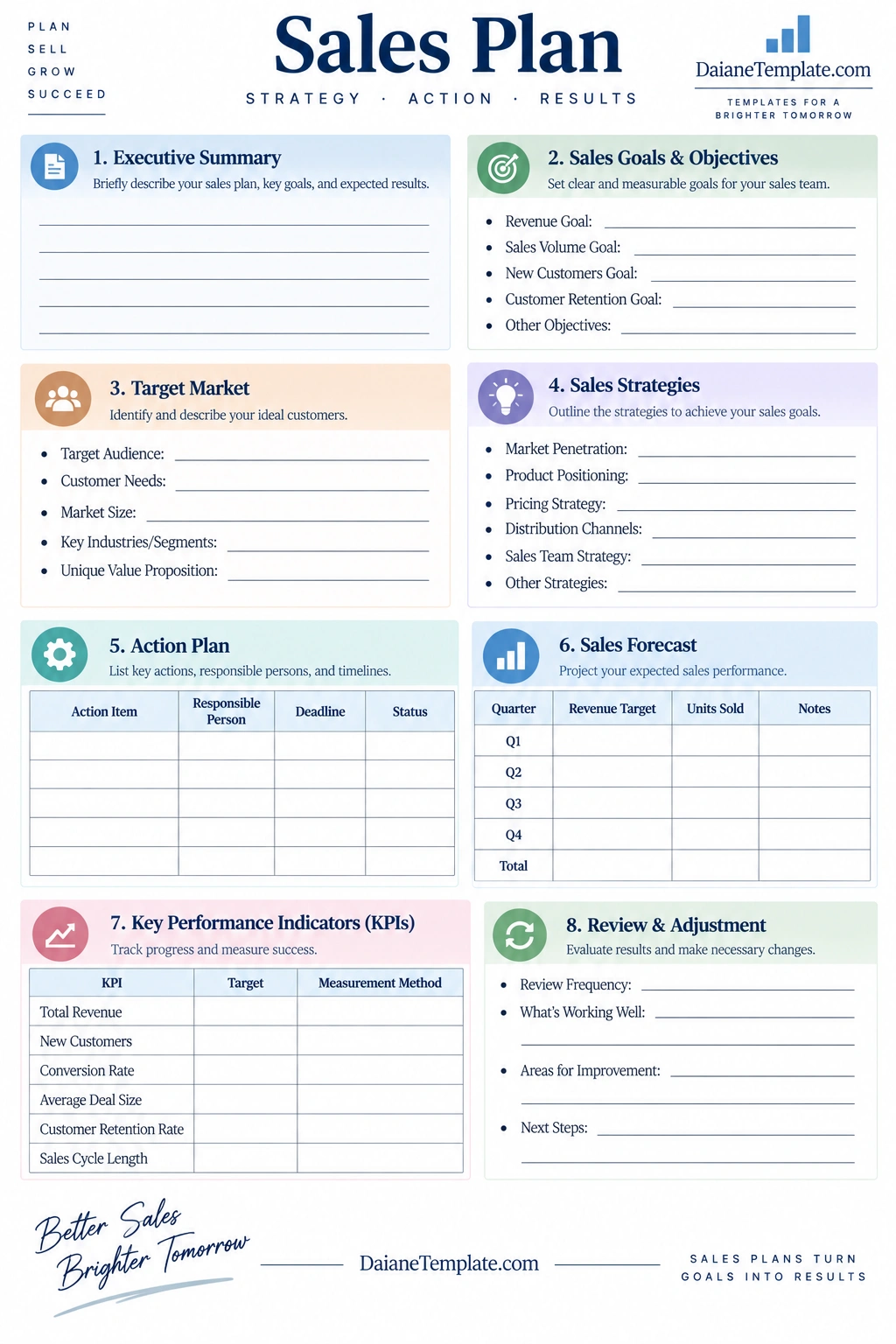
A Sales Plan Template can make the planning process easier by providing a structured framework for organizing objectives, target markets, strategies, action items, forecasts, and KPIs in one place.
The template below is designed as a practical planning worksheet. It can be customized for a small business, sales department, individual sales representative, or larger organization.
How to Create a Sales Plan
Step 1: Review Previous Sales Performance
Start by reviewing historical sales information. Look at revenue, customer acquisition, conversion rates, average deal size, sales cycle length, and other relevant metrics.
This analysis can reveal trends and provide a realistic starting point for setting new objectives.
Step 2: Define Your Sales Goals
Determine what the business wants to accomplish during the planning period. Goals might focus on revenue growth, customer acquisition, retention, market expansion, or product sales.
Make sure each goal can be measured so the team can determine whether it has been achieved.
Step 3: Identify Your Target Customers
Define the customers most likely to benefit from the company’s products or services. Consider their needs, problems, purchasing behavior, industry, location, and other relevant characteristics.
A well-defined customer profile helps the sales team focus its prospecting and communication efforts.
Step 4: Choose Sales Strategies
Determine how the team will reach its target customers and convert opportunities into sales. Consider the most appropriate sales channels, messaging, pricing approach, customer engagement methods, and promotional activities.
Step 5: Create Specific Sales Actions
Break each strategy into actionable tasks. Assign responsibilities and deadlines where appropriate. This makes the sales plan easier to execute and creates greater accountability within the team.
Step 6: Establish a Sales Forecast
Estimate expected sales based on historical performance, current opportunities, market conditions, sales capacity, and other relevant information.
A forecast should be realistic enough to support planning while still providing a useful target for the sales team.
Step 7: Select Sales KPIs
Choose the metrics that will be used to evaluate performance. Avoid tracking too many indicators. Focus on the measurements that provide meaningful insight into progress toward the sales objectives.
Step 8: Schedule Regular Reviews
Set a regular schedule for reviewing the sales plan. Monthly or quarterly reviews can help identify changes in customer behavior, sales performance, competitive conditions, and business priorities.
Sales Plan Example
Consider a software company that wants to increase annual recurring revenue while expanding its customer base. Its sales plan could include a specific revenue objective, a target market focused on small and medium-sized businesses, and a strategy centered on qualified outbound leads and customer referrals.
The action plan could include weekly prospecting activities, monthly customer presentations, referral campaigns, and regular account follow-ups. The company could then measure total revenue, new customers, conversion rate, average deal size, and customer retention.
This example demonstrates how a broad business objective can be translated into specific sales activities and measurable outcomes.
Sales Plan vs. Sales Strategy
A sales strategy describes the approach a company intends to use to generate sales. A sales plan is broader because it documents the goals, target market, strategies, actions, responsibilities, forecasts, and measurements associated with that approach.
In simple terms, the strategy explains the general approach, while the sales plan organizes that approach into a practical roadmap.
Tips for Creating an Effective Sales Plan
Keep Goals Specific
Vague goals make performance difficult to measure. Use clear targets that define what the sales team needs to accomplish and during which period.
Focus on the Right Customers
Not every prospect has the same value or needs. Define customer segments carefully so sales resources are directed toward appropriate opportunities.
Connect Activities to Outcomes
Do not measure activity simply for the sake of activity. Consider how prospecting, meetings, follow-ups, proposals, and other actions contribute to meaningful sales results.
Make Responsibilities Clear
Every important action should have clear ownership. When responsibilities are understood, teams can reduce duplicated work and make it easier to identify where follow-up is needed.
Use Data to Guide Decisions
Review sales metrics regularly instead of relying entirely on assumptions. Performance data can help identify successful channels, weak points in the sales funnel, and opportunities for improvement.
Keep the Plan Flexible
A sales plan should provide direction without becoming unnecessarily rigid. Customer preferences, market conditions, products, and business priorities can change, so the plan should be updated when new information becomes available.
Common Sales Plan Mistakes to Avoid
- Setting unrealistic targets: Aggressive goals without a reasonable basis can reduce motivation and make forecasting less useful.
- Ignoring the target market: A sales plan becomes less effective when it does not clearly identify the customers being pursued.
- Listing strategies without actions: A strategy needs practical activities that the team can execute.
- Tracking too many KPIs: Excessive metrics can make it difficult to identify the measurements that actually matter.
- Failing to assign responsibility: Important tasks can be overlooked when ownership is unclear.
- Never reviewing the plan: A plan that is not compared with actual performance may quickly become outdated.
How a Sales Plan Supports a Sales Team
A documented sales plan can give sales representatives a clearer understanding of priorities. Instead of making independent decisions about where to spend their time, team members can work from shared objectives and strategies.
Managers can also use the plan to support coaching and performance discussions. When goals, activities, and KPIs are documented, conversations about progress can focus on specific information rather than general impressions.
A clear plan can also help new employees understand the company’s target customers, sales process, priorities, and expectations more quickly.
How to Review and Improve Your Sales Plan
Regular review is an important part of sales planning. Compare actual results with the targets established at the beginning of the planning period.
Ask practical questions such as:
- Are revenue and sales volume moving toward the expected targets?
- Which customer segments are producing the strongest results?
- Which sales channels are generating qualified opportunities?
- Where are prospects dropping out of the sales process?
- Which sales activities are producing measurable results?
- Are current targets still realistic?
- What should the team change during the next review period?
Use the answers to refine the plan. Continuous improvement allows the sales strategy to remain relevant instead of becoming a static document.
Sales Plan Checklist
Before finalizing your sales plan, make sure it includes the essential information needed by the team.
- Executive summary
- Sales goals and measurable objectives
- Target market and customer segments
- Sales strategies
- Action items and responsibilities
- Sales forecast
- Key performance indicators
- Review schedule
- Adjustment process
Final Thoughts
A Sales Plan turns revenue goals into a structured strategy that a sales team can understand and execute. By defining objectives, target customers, sales strategies, action items, forecasts, and KPIs, a business can create a clearer connection between its sales activities and broader business goals.
The most useful sales plan is not necessarily the longest one. It is a practical document that provides clear direction, assigns responsibility, measures meaningful results, and can be updated as conditions change. Using a Sales Plan Template can simplify the process and provide a convenient starting point for organizing the information your team needs.
