An operating plan is a practical document that explains how an organization will turn its strategic goals into day-to-day actions. It connects long-term objectives with specific activities, responsibilities, resources, schedules, and performance measures.
While a business plan often explains where a company wants to go, an operating plan focuses on how the organization will get there. It helps managers and teams understand what needs to be done, who is responsible, what resources are required, and how progress will be measured.
A well-organized operating plan can improve coordination, resource allocation, accountability, and operational efficiency. It can be used by businesses, nonprofits, departments, startups, and other organizations that need a structured approach to managing daily operations and achieving measurable objectives.
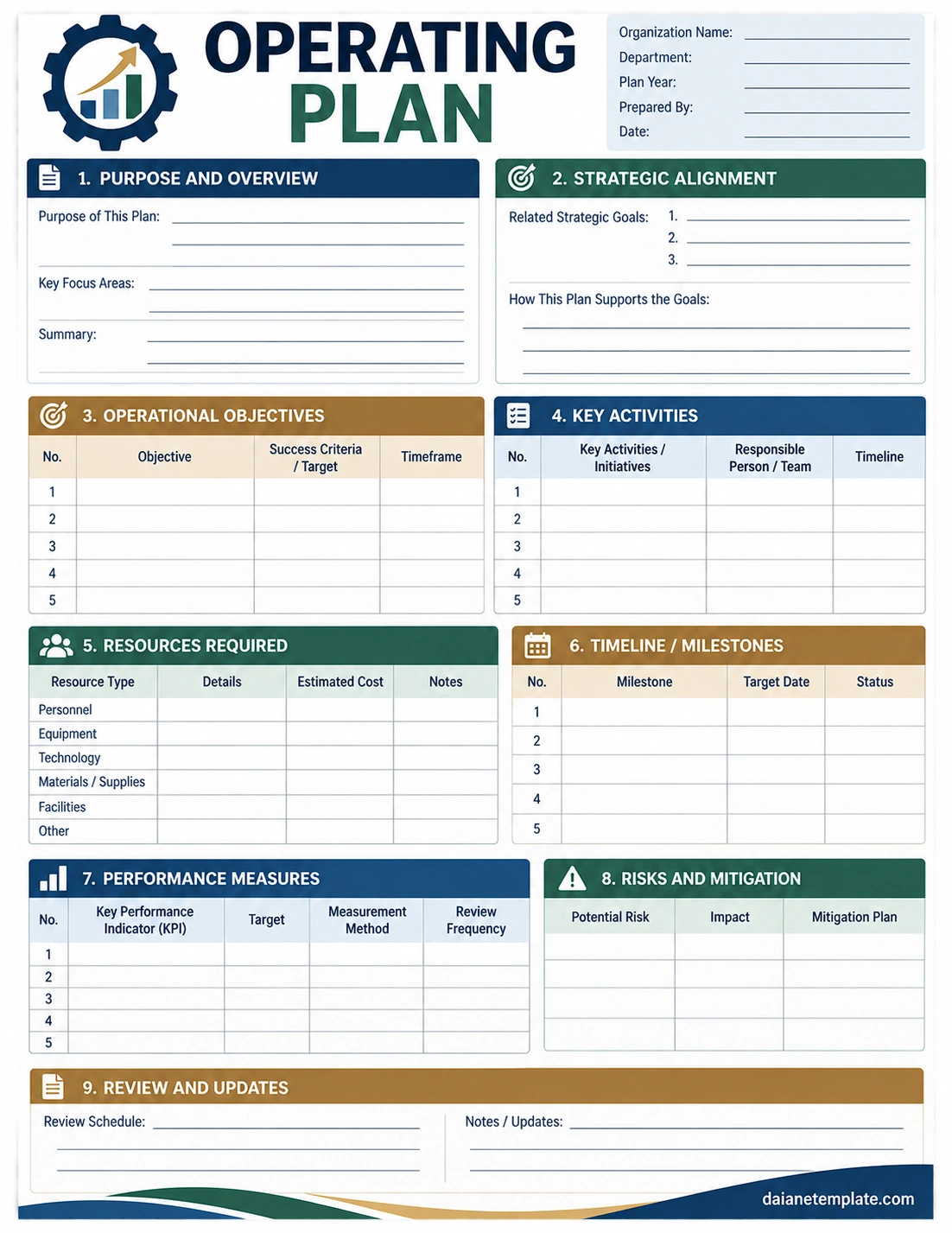
What Is an Operating Plan?
An operating plan is a detailed roadmap for managing the activities required to achieve an organization’s goals. It translates strategic priorities into specific tasks and operational responsibilities.
The plan may cover daily operations, staffing, budgets, resources, processes, projects, performance targets, schedules, and other activities that support organizational objectives.
For example, if a company’s strategic goal is to increase customer retention, its operating plan might include customer service training, follow-up procedures, customer feedback activities, retention targets, assigned team members, and a timeline for implementation.
The exact structure of an operating plan depends on the organization’s size, industry, goals, and operational needs.
Why Is an Operating Plan Important?
An operating plan helps turn broad strategic goals into practical work. Without a clear operational framework, teams may understand the overall objective but remain uncertain about their specific responsibilities and priorities.
Connects Strategy With Action
An operating plan translates strategic objectives into activities that employees and managers can execute. It creates a practical connection between what an organization wants to achieve and what its teams need to do.
Clarifies Responsibilities
Assigning specific responsibilities helps employees understand who owns each task, project, or operational objective. Clear ownership can improve accountability and reduce duplicated work.
Improves Resource Allocation
The plan can identify the personnel, budget, equipment, technology, materials, and other resources required to complete planned activities.
Supports Daily Operations
A detailed operating plan gives teams a structured reference for recurring activities, deadlines, priorities, and operational requirements.
Provides a Basis for Measurement
Performance indicators and milestones allow managers to compare actual results with planned objectives and identify areas that need attention.
Improves Coordination
When departments understand their responsibilities and timelines, it becomes easier to coordinate activities across the organization.
What Should an Operating Plan Include?
A useful operating plan should contain enough detail to guide implementation without becoming unnecessarily complicated. The following sections are commonly useful.
1. Executive Summary
The executive summary provides a brief overview of the operating plan. It can explain the organization’s main priorities, operating objectives, planning period, and expected outcomes.
2. Strategic Goals
Identify the broader goals that the operational activities are designed to support. Strategic goals provide context for the specific actions included in the plan.
3. Operational Objectives
Break strategic goals into specific and measurable operational objectives. Each objective should describe a result the organization intends to achieve during the planning period.
4. Key Activities
List the actions required to achieve each objective. Activities should be specific enough that employees can understand what needs to be completed.
Examples may include:
- Launching a new operational process
- Hiring or training employees
- Improving customer service procedures
- Managing inventory
- Updating technology systems
- Implementing marketing activities
- Reviewing operational performance
- Improving production processes
5. Responsibilities
Identify the person, team, or department responsible for each major activity. Clear ownership makes it easier to monitor progress and address delays.
6. Resources
Document the resources required to execute the plan. Resources may include employees, equipment, software, facilities, materials, suppliers, and financial resources.
7. Budget
Include estimated costs associated with major activities when appropriate. A budget section can help management allocate available resources and identify potential funding requirements.
8. Timeline
Establish deadlines, milestones, and important dates. A timeline can be organized by month, quarter, project phase, or another period that fits the organization’s operations.
9. Key Performance Indicators
Define measurable indicators that will be used to evaluate progress. Common operational metrics may include productivity, revenue, customer satisfaction, response time, production volume, employee performance, or cost efficiency.
10. Risks and Contingencies
Identify potential operational risks and describe how the organization may respond. This can include staffing shortages, supply disruptions, technology problems, budget constraints, or changes in demand.
11. Review Process
Explain when and how the operating plan will be reviewed. Regular reviews help organizations compare actual performance with planned objectives and make adjustments when necessary.
How to Create an Operating Plan
Creating an operating plan becomes easier when the process starts with clearly defined goals and moves toward specific actions, responsibilities, and measurements.
Start With Strategic Priorities
Review the organization’s strategic goals and identify which priorities need operational support. Avoid including activities that do not contribute meaningfully to the organization’s objectives.
Define Measurable Objectives
Convert broad goals into specific operational objectives. Whenever possible, establish measurable outcomes so that progress can be evaluated objectively.
List Required Activities
Determine the tasks, projects, processes, and initiatives required to achieve each objective. Organize related activities into logical groups.
Assign Ownership
Assign a responsible person, team, or department to each major activity. Make sure responsibilities are realistic and clearly understood.
Determine Required Resources
Identify the personnel, budget, equipment, technology, materials, and other resources needed to execute the plan.
Set Deadlines and Milestones
Create a realistic timeline with important deadlines and milestones. Breaking larger objectives into smaller milestones can make progress easier to track.
Choose Performance Measures
Select key performance indicators that show whether planned activities are producing the expected results. Avoid tracking unnecessary metrics that do not support decision-making.
Review and Adjust
An operating plan should not necessarily remain unchanged throughout the planning period. Managers can review results, identify problems, and adjust activities or resources when circumstances change.
Operating Plan Example
Consider a small business whose objective is to improve customer service over the next year. Its operating plan could translate that objective into several concrete activities.
- Objective: Improve customer response times.
- Activity: Implement a new customer support system.
- Responsibility: Customer service manager.
- Resources: Software, training, and staff time.
- Timeline: System implementation during the first quarter.
- Performance measure: Average customer response time.
- Review: Monthly performance evaluation.
This example shows how an operating objective can be converted into specific actions, ownership, resources, deadlines, and measurable results.
Operating Plan vs. Business Plan
An operating plan and a business plan serve different but related purposes.
A business plan generally provides a broader overview of the organization. It may describe the business concept, market, customers, competitive environment, marketing strategy, management structure, and financial expectations.
An operating plan focuses more closely on execution. It explains how the organization will manage activities, people, resources, processes, schedules, and performance during a defined period.
In simple terms, a business plan can describe the overall business direction, while an operating plan explains how the organization will carry out the work required to move toward that direction.
Operating Plan vs. Strategic Plan
A strategic plan focuses on long-term direction, priorities, and organizational goals. An operating plan translates those priorities into practical activities and operational responsibilities.
For example, a strategic plan may establish a goal of expanding into a new market. The operating plan could then identify the research, hiring, marketing, technology, training, budget, and implementation activities required to support that expansion.
The two plans work together: strategy establishes priorities, while operations provide the framework for execution.
Tips for Creating an Effective Operating Plan
- Keep objectives specific: Make operational goals clear enough to guide action.
- Assign clear ownership: Every major activity should have an accountable person or team.
- Use realistic timelines: Consider workload, dependencies, resources, and potential delays.
- Connect activities to goals: Include work that directly supports organizational priorities.
- Budget realistically: Estimate the resources required instead of assuming existing resources will be sufficient.
- Use measurable indicators: Select metrics that provide useful information about performance.
- Identify dependencies: Note activities that cannot begin until another task or decision is completed.
- Plan for risks: Identify likely operational challenges and possible responses.
- Review regularly: Compare actual results with planned performance and update the plan when needed.
- Keep the document practical: The plan should be useful to the people responsible for executing it.
Common Operating Plan Mistakes
Making the Plan Too General
An operating plan should translate goals into specific actions. Statements such as “improve operations” are difficult to execute unless they are supported by defined activities, responsibilities, and measurements.
Including Too Many Priorities
A long list of competing priorities can make execution difficult. Focus on the activities that have the greatest connection to the organization’s objectives.
Failing to Assign Responsibilities
Tasks without clear ownership can be delayed because employees may assume someone else is responsible.
Using Unrealistic Deadlines
Timelines should reflect the organization’s available resources, workload, dependencies, and operational capacity.
Ignoring Resource Requirements
A plan may fail during implementation if the organization does not have enough staff, budget, technology, equipment, or other resources to complete the planned activities.
Not Measuring Progress
Without performance measures, it can be difficult to determine whether operational activities are producing the intended results.
Never Updating the Plan
Business conditions can change. Regular reviews allow managers to respond to new information, unexpected problems, changing priorities, and performance results.
How to Use an Operating Plan Throughout the Year
An operating plan is most useful when it becomes part of the organization’s regular management process rather than a document that is created and then ignored.
Managers can use the plan during periodic meetings to review completed activities, upcoming deadlines, resource needs, risks, and performance indicators.
Teams can also use the document to coordinate projects and understand how their daily responsibilities contribute to broader organizational objectives.
At the end of the planning period, actual results can be compared with the original objectives. The findings can then help inform the next operating plan.
Frequently Asked Questions About Operating Plans
What is the main purpose of an operating plan?
The main purpose of an operating plan is to translate organizational goals into specific activities, responsibilities, resources, timelines, and performance measures. It provides a practical framework for executing strategy.
What should an operating plan include?
An operating plan commonly includes strategic priorities, operational objectives, key activities, responsibilities, resources, budget, timelines, performance indicators, risks, and a review process.
Who creates an operating plan?
Operating plans are often developed by managers and organizational leaders with input from the teams responsible for implementation. The appropriate participants depend on the organization’s structure and planning process.
How long should an operating plan be?
There is no universal required length. An effective operating plan should contain enough information to guide implementation without adding unnecessary detail. A small organization may need a relatively concise plan, while a larger organization may require more detailed departmental plans.
How often should an operating plan be reviewed?
The review schedule depends on the organization and planning period. Monthly or quarterly reviews are common approaches, while certain operational areas may require more frequent monitoring.
Is an operating plan the same as a business plan?
No. A business plan generally provides a broader overview of the organization, while an operating plan focuses on the activities, resources, responsibilities, and processes required to execute organizational objectives.
Can a small business use an operating plan?
Yes. Small businesses can use an operating plan to organize staffing, daily operations, budgets, projects, responsibilities, schedules, and performance goals. The document can be scaled to match the size and complexity of the business.
Can an operating plan be changed?
Yes. An operating plan can be updated when priorities, resources, timelines, market conditions, or operational requirements change. Regular review helps keep the plan relevant and practical.
Final Thoughts
An operating plan turns organizational strategy into practical work. It gives teams a clear framework for understanding objectives, activities, responsibilities, resources, deadlines, and performance expectations.
A strong plan should be specific enough to guide daily operations while remaining flexible enough to accommodate changing circumstances. By connecting goals with actionable tasks and measurable outcomes, an operating plan can support better coordination, accountability, resource allocation, and operational efficiency.
An operating plan template can make the planning process easier by organizing objectives, activities, responsibilities, resources, timelines, and performance measures in one structured document. The template should be adapted to the organization’s specific goals, size, industry, and operating requirements.
When reviewed regularly and used as part of the management process, an operating plan becomes more than a planning document. It becomes a practical tool for keeping daily work aligned with the organization’s larger objectives.
Download: Operating Plan Template
