A successful business relationship depends on clear expectations, reliable services, and mutual accountability. When a company hires an external provider or delivers services to customers, both parties need to understand what is included, how performance will be measured, and what happens if expectations are not met. A Service Level Agreement (SLA) helps establish these expectations in a formal and organized way.
Whether you manage an IT department, operate a service-based business, or work with external vendors, an SLA provides a framework for defining service quality, performance standards, responsibilities, and remedies for service failures. It helps reduce misunderstandings and creates a shared understanding of what successful service delivery looks like.
In this guide, you will learn what a service level agreement is, why businesses use it, what sections to include, and how to create an effective SLA. You will also find practical examples and a free printable Service Level Agreement Template to help document your service expectations.
What Is a Service Level Agreement?
A Service Level Agreement (SLA) is a formal agreement between a service provider and a customer that defines the services being delivered and the performance standards the provider is expected to meet.
The agreement establishes measurable service targets, responsibilities, monitoring procedures, and possible remedies when agreed service levels are not achieved. Depending on its wording and applicable law, an SLA may form part of a legally binding contract or operate as a separate contractual document.
Service level agreements are commonly used in industries where service quality, availability, response times, and reliability are important. They are particularly common in information technology, telecommunications, cloud computing, customer support, and outsourced business operations.
A typical service level agreement includes:
- Names and contact details of the service provider and customer.
- Description and scope of the services.
- Service performance standards and measurable targets.
- Availability and response time requirements.
- Roles and responsibilities of both parties.
- Monitoring and reporting procedures.
- Service failure remedies and escalation procedures.
- Agreement duration, review dates, and termination conditions.
By documenting these details, an SLA helps both parties understand their obligations and evaluate whether the services are meeting expectations.
Why Is a Service Level Agreement Important?
A service level agreement provides structure to business relationships by defining what each party can expect. Without clear service standards, customers and providers may have different interpretations of acceptable performance.
Here are some important benefits of using an SLA:
- Establishes clear expectations: Both parties understand the services being provided and the required performance standards.
- Improves accountability: Responsibilities and obligations are documented, making it easier to identify who handles specific tasks.
- Measures service quality: Performance metrics provide a consistent way to evaluate service delivery.
- Reduces misunderstandings: Written terms help prevent disagreements about availability, response times, and service scope.
- Supports problem resolution: Escalation procedures explain how service failures and disputes should be handled.
- Encourages continuous improvement: Regular performance reviews help identify weaknesses and opportunities to improve services.
- Protects business relationships: Clear obligations and remedies provide a framework for managing service failures.
An effective SLA does more than describe a service. It creates a practical system for measuring performance and maintaining service quality over time.
What Are the Main Types of Service Level Agreements?
Service level agreements can be structured in different ways depending on the relationship between the provider and the customer. The most common types include customer-based, service-based, and multi-level SLAs.
1. Customer-Based SLA
A customer-based SLA is created for an individual customer or organization. It covers the services provided to that customer and defines the specific performance requirements agreed upon by both parties.
For example, a managed IT provider may create a customer-based SLA for a company that requires technical support, network monitoring, and system maintenance.
2. Service-Based SLA
A service-based SLA applies the same service standards to multiple customers who use the same service. It is useful when a provider offers standardized services with consistent performance requirements.
For example, a cloud hosting company may establish a service-based SLA defining uptime targets, technical support availability, and service maintenance procedures for all customers using a particular hosting package.
3. Multi-Level SLA
A multi-level SLA divides service commitments into different levels. It may include general company-wide requirements, customer-specific conditions, and service-specific performance standards.
This structure is useful for organizations that provide multiple services to different customers with varying operational requirements.
What Should a Service Level Agreement Include?
A well-written SLA should be specific, measurable, and easy to understand. The following sections provide a practical structure for creating a complete service agreement.
1. Agreement Overview
Start with the basic information identifying the agreement. Include the agreement title, reference number if applicable, effective date, and review date.
This section helps both parties identify the document and understand when the service commitments begin.
2. Parties Involved
Identify the service provider and customer. Include their legal business names, addresses, authorized representatives, and contact information.
Make sure the correct legal entities are listed, especially when the agreement involves subsidiaries or multiple business units.
3. Purpose of the Agreement
Explain why the SLA is being created and what the parties intend to achieve. This section should briefly describe the relationship and the service standards the agreement is designed to establish.
4. Scope of Services
Describe the services covered by the agreement. Clearly explain what the provider will deliver and identify any services or responsibilities that are excluded.
For example, an IT support SLA may cover:
- Technical support and troubleshooting.
- System monitoring and maintenance.
- Software updates and configuration.
- Incident management.
- Network and infrastructure support.
- Service reporting and performance reviews.
A clearly defined service scope reduces confusion and helps prevent disagreements about work that falls outside the agreement.
5. Service Levels and Performance Metrics
This is one of the most important sections of an SLA. It defines the performance standards that the provider is expected to achieve.
Common service level metrics include:
- Service availability: The percentage of time a service is operational and accessible.
- Response time: The time required to acknowledge a request or incident.
- Resolution time: The target time for resolving an issue.
- First response rate: The percentage of requests acknowledged within the agreed target.
- Customer satisfaction: A measure of customer experience and service quality.
- Service completion rate: The percentage of assigned tasks completed within the agreed timeframe.
Each metric should include a measurement method, reporting frequency, and clearly defined target.
6. Roles and Responsibilities
An SLA should explain what the service provider and customer are each responsible for. This helps ensure that both parties understand their obligations.
Service provider responsibilities may include:
- Delivering services according to agreed performance standards.
- Maintaining qualified personnel and appropriate resources.
- Monitoring service performance.
- Reporting incidents and service interruptions.
- Providing technical support and maintenance.
Customer responsibilities may include:
- Providing accurate information and necessary access.
- Submitting service requests through approved channels.
- Assigning appropriate contacts for communication.
- Following agreed operational procedures.
- Providing timely feedback and approvals when required.
7. Monitoring and Reporting
Explain how service performance will be monitored and how results will be communicated. Identify the tools, reporting methods, and review frequency used to evaluate compliance with the agreed service levels.
Regular reporting helps both parties identify performance problems before they become major issues.
8. Remedies and Dispute Resolution
Describe what happens when the provider fails to meet the agreed service levels. Depending on the agreement, remedies may include service credits, corrective action requirements, additional support, or other contractual remedies.
This section should also explain how disagreements will be escalated and resolved. Specify the appropriate contacts, response periods, and dispute resolution procedures.
9. Agreement Duration and Termination
State when the agreement begins, how long it remains effective, and how it may be renewed or terminated.
Include any required notice periods, termination conditions, and procedures for handling outstanding obligations when the agreement ends.
10. Signatures and Authorization
Provide signature fields for authorized representatives of both parties. Include their names, job titles, signatures, and signing dates.
Depending on the nature of the agreement, additional contractual terms or formalities may be required to establish enforceability.
Free Service Level Agreement Template
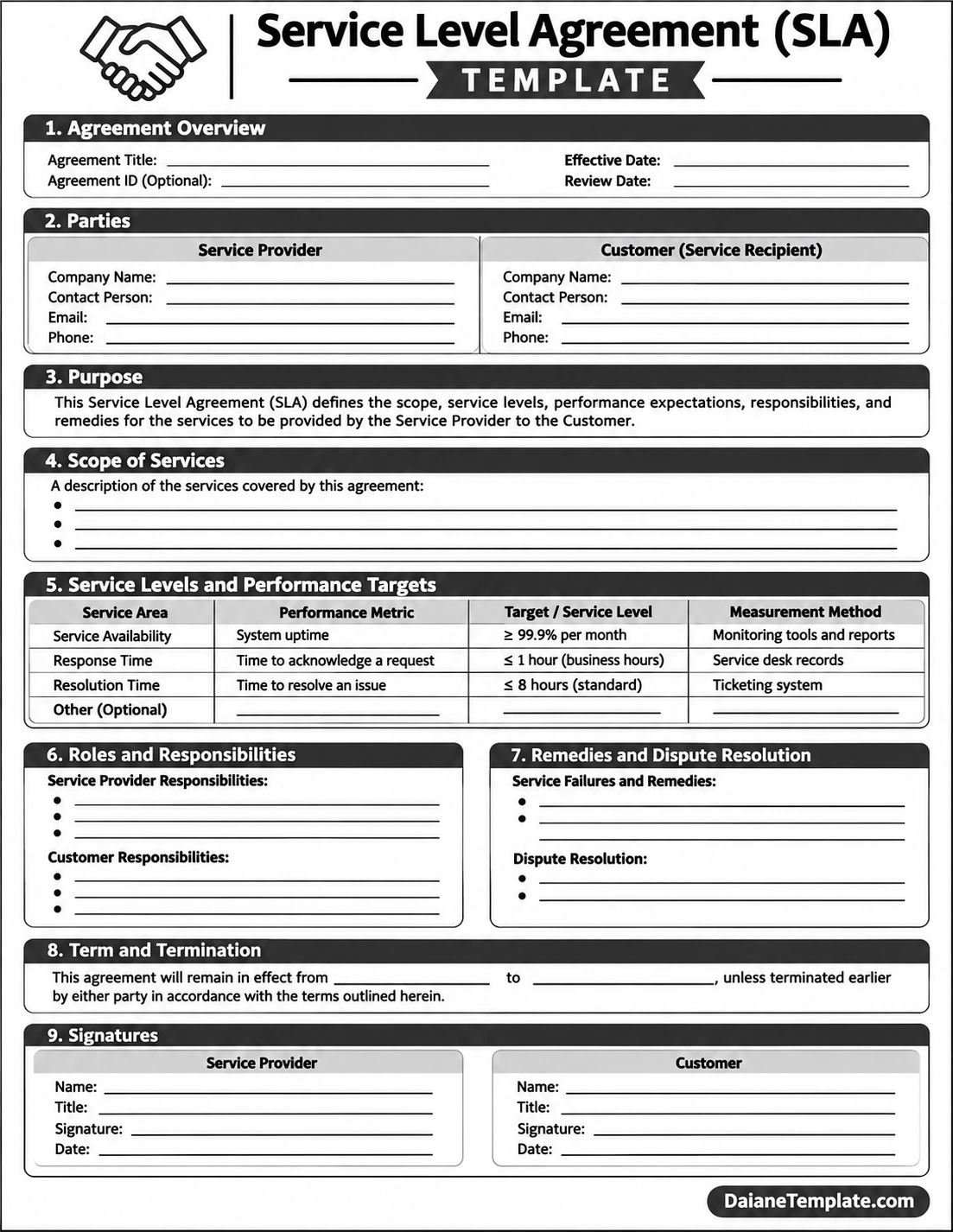
Creating an SLA from scratch can take time, especially when you need to organize multiple performance requirements and responsibilities. A printable Service Level Agreement Template provides a structured starting point for documenting these details.
This template includes dedicated sections for agreement information, service provider and customer details, service scope, performance targets, responsibilities, remedies, dispute resolution, and signatures.
You can customize the worksheet according to your industry, service type, business requirements, and relationship with the customer.
The Service Level Agreement Template includes:
- Agreement overview and effective dates.
- Service provider and customer information.
- Purpose and scope of services.
- Service level metrics and performance targets.
- Roles and responsibilities.
- Remedies for service failures.
- Dispute resolution information.
- Agreement duration and termination details.
- Authorization and signature sections.
How to Create an Effective Service Level Agreement
Creating an effective SLA requires more than listing general service expectations. Both parties should agree on realistic performance targets, clear responsibilities, and measurable outcomes.
Step 1: Identify the Services
Begin by listing the services that will be covered. Describe the expected deliverables and identify any limitations or exclusions.
Step 2: Define Measurable Performance Targets
Choose performance metrics that can be monitored objectively. Avoid vague statements such as “provide fast support” or “maintain excellent service.”
Instead, define measurable requirements such as an acknowledgment within one business hour or a specified monthly service availability target.
Step 3: Assign Responsibilities
Identify which tasks belong to the service provider and which obligations belong to the customer. Make sure each responsibility has a clear owner.
Step 4: Establish Monitoring Procedures
Decide how service performance will be measured and reported. Identify the tools, data sources, reporting periods, and individuals responsible for reviewing results.
Step 5: Define Remedies and Escalation Procedures
Explain how service failures will be handled. Include escalation contacts, corrective action requirements, and any agreed service credits or other remedies.
Step 6: Review and Approve the Agreement
Both parties should review the complete SLA before approval. Check that the service scope, targets, responsibilities, and contractual terms are accurate and realistic.
Consider obtaining legal review before signing, particularly when the agreement involves substantial financial commitments or critical services.
Step 7: Monitor and Update the SLA
Review performance regularly and update the agreement when business needs, technology, or service requirements change. Keep a record of approved amendments so both parties work from the same version.
Service Level Agreement Example
Consider a business that hires an external IT support company to maintain its computer systems and provide technical assistance.
The following example illustrates how service level expectations can be documented:
- Service Provider: ABC IT Solutions.
- Customer: XYZ Business Group.
- Service Scope: Technical support, system monitoring, and routine maintenance.
- Availability Target: 99.9% monthly uptime for covered systems.
- Priority 1 Response: Acknowledgment within 30 minutes.
- Priority 2 Response: Acknowledgment within 2 business hours.
- Standard Support Hours: Monday through Friday, 8:00 AM to 5:00 PM.
- Reporting: Monthly service performance reports.
- Escalation: Unresolved critical incidents are escalated to the service manager.
- Review Period: Every three months.
These figures are illustrative examples, not universal service standards. Actual targets should reflect the service requirements, operating hours, technical capabilities, and agreement between the parties.
Common Service Level Agreement Metrics
Choosing appropriate service metrics is essential for evaluating performance. The following examples can help you determine which measurements are relevant to your agreement.
Service Availability
Measures how often a service is available during the agreed measurement period. For example, a cloud hosting provider may commit to 99.9% monthly availability, subject to defined exclusions.
Response Time
Measures how quickly the provider acknowledges a customer request or incident after it has been submitted through an approved support channel.
Resolution Time
Measures how long the provider takes to resolve an incident or complete a service request. Different priority levels may have different targets.
First Contact Resolution
Measures the percentage of customer issues resolved during the initial interaction without requiring additional support requests.
Customer Satisfaction
Measures customer feedback through surveys, ratings, or other agreed evaluation methods. It can provide useful information about the overall service experience.
Common Mistakes to Avoid When Creating an SLA
An SLA should be practical, measurable, and realistic. Avoid these common mistakes when preparing a service agreement:
- Using vague performance targets: General promises are difficult to measure and enforce.
- Ignoring service exclusions: Unclear limitations can lead to disagreements about what is covered.
- Setting unrealistic targets: Performance commitments should reflect available resources and technical capabilities.
- Overlooking customer responsibilities: Providers may depend on customer access, information, or approvals to meet their targets.
- Failing to define remedies: Both parties should understand what happens when service commitments are not achieved.
- Ignoring monitoring procedures: Targets are difficult to evaluate without reliable performance data.
- Using outdated terms: Review the SLA periodically to ensure it reflects current services and business requirements.
Frequently Asked Questions About Service Level Agreements
What is the main purpose of a service level agreement?
The main purpose of a service level agreement is to define the quality, scope, and performance standards expected from a service provider. It also establishes responsibilities, monitoring procedures, and remedies when agreed service levels are not achieved.
Is a service level agreement legally binding?
An SLA may be legally binding when it forms part of an enforceable contract and satisfies applicable legal requirements. Its legal effect depends on the wording, the parties’ intentions, governing law, and how the agreement is executed.
What are the five key elements of an SLA?
Five essential elements are service scope, performance metrics, roles and responsibilities, monitoring and reporting procedures, and remedies for service failures. A complete agreement should also address duration, termination, and dispute resolution.
What are common examples of service level agreements?
Common examples include IT support SLAs, cloud hosting agreements, telecommunications service agreements, customer support SLAs, and outsourced maintenance agreements. Each defines service commitments relevant to its industry.
What is a good uptime target in an SLA?
A common example for certain technology services is 99.9% monthly availability. However, the appropriate target depends on business requirements, service architecture, cost, maintenance arrangements, and the consequences of downtime.
What happens if a service provider fails to meet an SLA?
The consequences depend on the agreement. Possible remedies include service credits, corrective action plans, additional support, escalation procedures, or termination rights. The SLA should clearly explain how failures are measured and addressed.
What is the difference between an SLA and a contract?
A contract is a broader legal agreement that establishes the rights and obligations of the parties. An SLA focuses specifically on service scope, performance standards, responsibilities, and service-related remedies. An SLA may be included within a larger contract or signed separately.
Who is responsible for monitoring an SLA?
Monitoring responsibilities should be specified in the agreement. The service provider often tracks operational performance, while the customer may review reports, validate results, and raise concerns about service delivery.
How often should an SLA be reviewed?
An SLA should be reviewed regularly and whenever significant changes occur in service requirements, business operations, or technology. Quarterly or annual reviews are common options, depending on the nature of the service.
Can an SLA be changed after it is signed?
Yes. An SLA can generally be amended when both parties agree to the changes and follow the amendment procedures established in the agreement. Approved changes should be documented in writing.
Conclusion
A Service Level Agreement is an important tool for establishing clear expectations between service providers and customers. By defining service scope, performance targets, responsibilities, monitoring procedures, and remedies, an SLA creates a structured framework for managing service quality and accountability.
A well-written agreement should be specific, measurable, and realistic. It should explain what each party must do, how performance will be evaluated, and how service failures will be addressed.
Whether you are managing an IT service, working with an external vendor, or delivering professional services to customers, using a structured Service Level Agreement Template can simplify the documentation process and support a more reliable business relationship.
Review the agreement carefully, customize its terms to your service requirements, and obtain appropriate legal advice before signing. A clear SLA provides both parties with a practical foundation for successful and consistent service delivery.
Download: Service Level Agreement Template
