A resignation letter with notice is a formal written message informing your employer that you intend to leave your job on a specific future date. It confirms your decision to resign, states your intended last working day, and gives your employer time to prepare for your departure. Writing a clear, professional resignation letter can help maintain positive working relationships and support a smooth transition.
Whether you are accepting a new job, changing careers, returning to school, or leaving for personal reasons, providing appropriate notice is an important part of the resignation process. Your letter does not need to be complicated. It should communicate your decision clearly, follow the notice requirements that apply to your employment, and express your willingness to help with the transition when appropriate.
This guide explains how to write a resignation letter with notice, what details to include, how to determine your final working day, and which mistakes to avoid. You will also find a professional resignation letter sample and a printable reference image to help you prepare your own letter.
What Is a Resignation Letter With Notice?
A resignation letter with notice is a formal document that tells an employer an employee plans to leave their position after a specified notice period. It creates a written record of the resignation and identifies the employee’s intended final working day.
The notice period gives the employer an opportunity to plan for the employee’s departure. Depending on the role, this may involve reallocating responsibilities, hiring a replacement, arranging training, transferring project information, or notifying relevant colleagues.
The required notice period varies according to the employment agreement, company policy, local employment law, and individual circumstances. Two weeks is a common convention in some workplaces, but it is not a universal requirement. Always check the rules that apply to your situation before confirming your departure date.
A resignation letter with notice is different from an immediate resignation letter, which communicates a request or decision to leave without a standard notice period. Providing notice can make the transition easier, but the appropriate approach depends on your circumstances and applicable requirements.
Why Is Giving Notice Important?
Providing written notice helps make your departure more organized and professional. It also gives both parties a clear record of the resignation date and the intended end of employment.
- Creates a formal record: The letter documents your intention to resign and your proposed last working day.
- Supports transition planning: Your manager can arrange coverage, reassign tasks, and plan knowledge transfer.
- Clarifies expectations: Written notice reduces confusion about your departure timeline.
- Maintains professional relationships: A respectful message can help preserve positive connections with managers and colleagues.
- Helps with administrative arrangements: Human resources may need to coordinate final pay, benefits, equipment returns, and exit procedures.
Giving notice does not guarantee a particular outcome, and the legal consequences of resigning depend on the applicable rules and employment terms. Review your obligations before submitting your letter, especially if you have a fixed-term agreement, special contractual conditions, or a role with specific handover requirements.
What to Include in a Resignation Letter With Notice
A professional resignation letter should be concise and easy to understand. Include the essential details so your employer can confirm your departure and begin planning the transition.
1. Your Contact Information and the Date
For a traditional business letter, include your name and contact information at the top, followed by the date. If you are sending the letter by email, you can usually use a simpler format that follows your company’s preferred procedure.
2. The Recipient’s Name and Title
Address the letter to your direct manager, supervisor, or the appropriate human resources representative. Use the correct name and professional title when known. If you are unsure who should receive your resignation, check your workplace policy.
3. A Clear Statement of Resignation
State your intention to resign near the beginning of the letter. Include your job title and, where appropriate, the company name. Direct wording helps prevent uncertainty about your decision.
For example, you can write: “Please accept this letter as formal notice of my resignation from my position as Marketing Specialist at ABC Company.”
4. Your Notice Period and Last Working Day
Clearly identify your intended final working day. If you are providing two weeks’ notice, make sure the date aligns with the requirements that apply to your employment and any agreed arrangements with your employer.
Do not assume that every employer calculates notice periods in the same way. If you are uncertain about the date, ask your manager or human resources representative to confirm it before submitting the letter.
5. A Brief Thank-You Message
You may include a short expression of appreciation for the experience, training, support, or opportunities you received. Keep the message sincere and appropriate to your circumstances. You can remain professional without providing praise that does not reflect your experience.
6. An Offer to Support the Transition
Where appropriate, offer to document ongoing work, organize project files, complete outstanding tasks, or assist with handing over responsibilities during your notice period. Make realistic commitments that fit your remaining time and role.
7. A Professional Closing
End with a courteous closing such as “Sincerely” or “Best regards,” followed by your name. For a printed letter, leave space for a signature if needed. For an email, a typed name is generally sufficient unless your employer requires another format.
Resignation Letter With Notice Sample
The following example demonstrates how to give formal notice while maintaining a respectful tone. Replace the sample details with your own information and confirm your final working day before sending the letter.
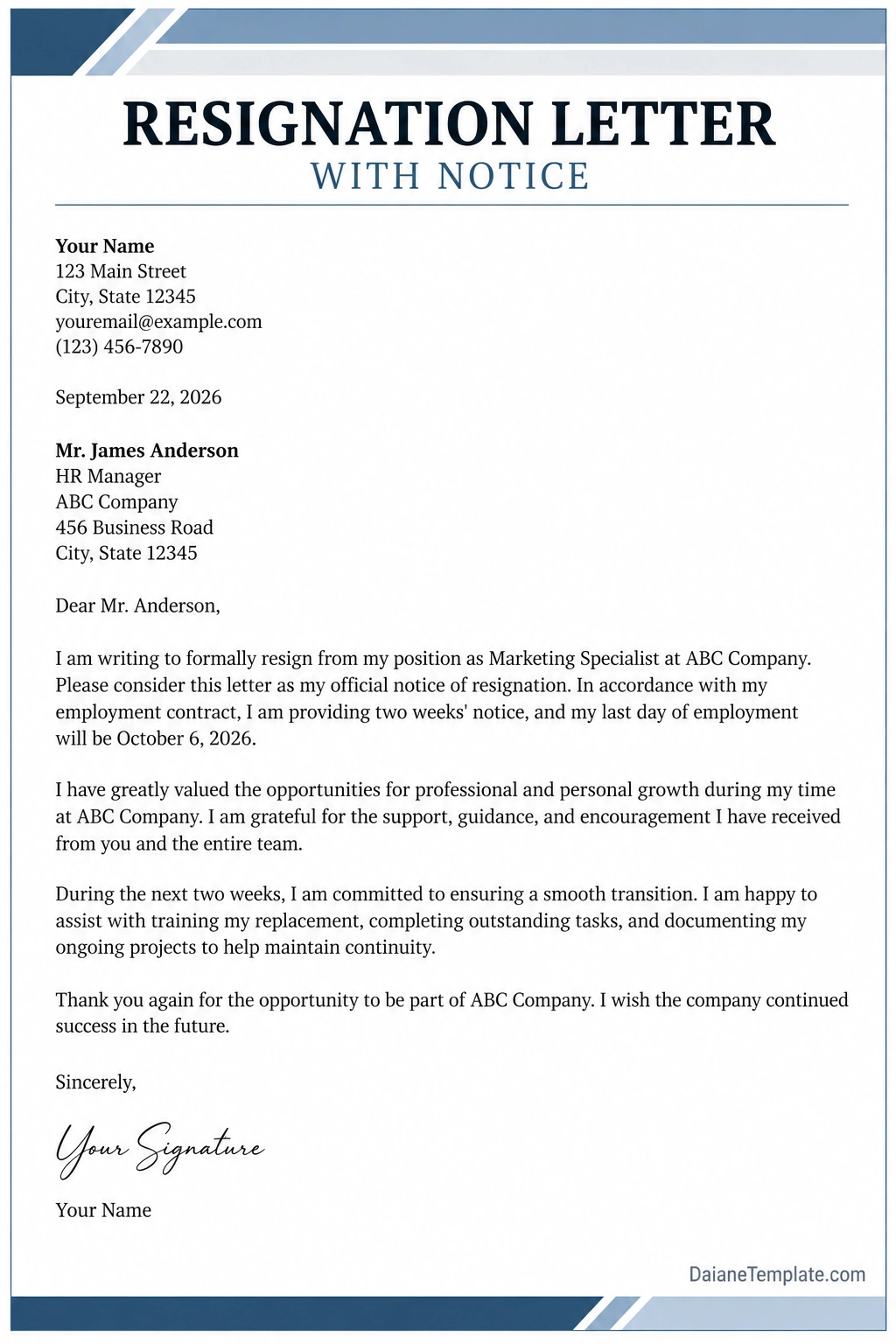
Sample Letter
Your Name
123 Main Street
City, State 12345
[email protected]
(123) 456-7890
September 22, 2026
Mr. James Anderson
HR Manager
ABC Company
456 Business Road
City, State 12345
Dear Mr. Anderson,
Please accept this letter as formal notice of my resignation from my position as Marketing Specialist at ABC Company. In accordance with the notice period applicable to my employment, my intended last working day will be October 6, 2026.
I have appreciated the opportunities for professional growth and development during my time at ABC Company. Thank you for the support, guidance, and experience I have gained while working with the team.
During my remaining time, I will do my best to support a smooth transition. I am happy to document ongoing projects, organize relevant files, and assist with handing over my responsibilities as appropriate.
Thank you again for the opportunity to be part of ABC Company. I wish you and the team continued success.
Sincerely,
Your Name
Note: This is an illustrative sample. The names, contact information, and dates are examples only. Confirm that the proposed final working day follows the notice requirements and arrangements that apply to your employment.
How to Write a Resignation Letter With Notice Step by Step
Step 1: Review Your Employment Terms
Before writing your letter, check your employment agreement, employee handbook, and relevant company policies. Look for notice requirements, the correct recipient, and any formal resignation procedure you must follow.
Step 2: Choose Your Intended Last Working Day
Determine the date you plan to leave based on your applicable notice requirements and any agreed arrangements. If you hope to leave earlier than the standard period, discuss the request with your employer rather than assuming an earlier date will be accepted.
Step 3: Write a Direct Opening
Use a clear sentence to announce your resignation. Avoid vague wording that could make your employer think you are merely considering leaving rather than formally giving notice.
Step 4: Keep Your Reason Brief
You may state a general reason for leaving, such as accepting another opportunity, pursuing further education, relocating, or attending to personal matters. However, a detailed explanation is usually unnecessary unless your employer requests additional information through an appropriate process.
Step 5: Offer Reasonable Transition Support
Identify practical ways you can help during the notice period. Depending on your role, this may include preparing handover notes, documenting processes, updating project records, or helping a colleague understand ongoing responsibilities.
Step 6: Proofread and Submit Your Letter
Check the recipient’s name, your job title, the notice period, and your last working day. Submit the letter using the method required by your employer and keep a copy for your records.
Tips for Giving Notice Professionally
A resignation letter with notice should be respectful, clear, and focused on the practical details of your departure. These tips can help you communicate your decision professionally.
- Be direct: State that you are resigning and identify your intended final working day.
- Check the applicable notice period: Do not assume that two weeks is always sufficient.
- Keep the letter concise: A standard resignation letter generally fits on one page.
- Use neutral language: Avoid insults, accusations, or unnecessary criticism.
- Protect confidential information: Do not include sensitive company or customer information in the letter.
- Plan the handover: Identify important tasks and records that another team member may need.
- Follow company procedures: Ask about equipment returns, exit interviews, and other departure requirements.
- Keep written records: Save your resignation letter and any confirmation of your final working day.
Common Resignation Letter Mistakes to Avoid
Even a short resignation letter can create unnecessary confusion if important details are missing or the tone is inappropriate. Avoid these common mistakes when preparing your notice.
- Leaving out the final working day: A clear date helps your employer plan staffing and handover arrangements.
- Assuming a notice period: Review the terms and requirements that apply to your employment.
- Including too much personal detail: You can keep your explanation brief and professional.
- Using an emotional or hostile tone: Avoid language that may damage future professional relationships.
- Making unrealistic promises: Offer transition support that is achievable within your remaining time.
- Sending the letter to the wrong recipient: Confirm whether your manager, HR, or both should receive it.
- Forgetting to keep a copy: Retain a record of what you submitted and when it was sent.
Resignation Letter With Notice vs. Immediate Resignation Letter
A resignation letter with notice communicates that you intend to leave after a specified period. An immediate resignation letter communicates that you intend to leave without working through a standard notice period, or that you are requesting an earlier departure.
Providing notice can give your employer more time to arrange coverage and transfer responsibilities. However, immediate resignation may be considered in certain circumstances, depending on the employee’s situation and applicable requirements.
Before choosing either approach, review your employment terms and relevant law. If you need to request a shorter notice period, state your preferred date clearly and discuss the request with your employer. Keep any agreed change in writing.
Frequently Asked Questions About Resignation Letters With Notice
How much notice should I give when resigning?
The appropriate notice period depends on your employment agreement, company policy, local law, and individual circumstances. Two weeks is a common convention in some workplaces, but it is not universal. Review the requirements that apply to your position before choosing a final working day.
Do I need to explain why I am resigning?
Usually, a detailed explanation is not necessary in the resignation letter. You can include a brief, neutral reason if you wish, but the main purpose is to communicate your decision and final working day clearly.
Should I mention my last working day in the letter?
Yes. Stating your intended last working day helps your employer plan the transition and confirms the date you are proposing. Make sure the date reflects the notice requirements and any agreed arrangements.
Can I send a resignation letter with notice by email?
Often, yes, if your employer accepts email resignations. Follow your company’s procedure and include a clear subject line, resignation statement, and intended final working day. Keep a copy of the message and any confirmation you receive.
Should I thank my employer in my resignation letter?
A short thank-you message is common and can help maintain a professional tone. Keep it sincere and appropriate to your experience. If you prefer not to express appreciation, you can still write a courteous and respectful letter.
Can my employer ask me to leave before my notice period ends?
The answer depends on the employment agreement, workplace policies, local law, and the circumstances. If your employer proposes an earlier departure, clarify how it affects pay, benefits, and other obligations before agreeing to any change.
What should I do after submitting my resignation letter?
Keep a copy of the letter, confirm receipt if appropriate, and ask your manager or HR about the next steps. These may include handover planning, final pay arrangements, benefits information, equipment returns, and exit procedures.
Can I change my mind after submitting my resignation?
You can ask your employer whether withdrawing your resignation is possible, but acceptance depends on the circumstances, applicable rules, and the employer’s response. If you want to withdraw your notice, communicate promptly and request written confirmation of any agreed outcome.
Conclusion
A resignation letter with notice is an important professional document that communicates your decision to leave a job and identifies your intended last working day. By providing clear written notice, you help your employer plan the transition and create a record of your departure.
Before submitting your letter, review the notice requirements that apply to your employment, confirm your final working day, and keep the message concise and respectful. Offer reasonable transition support and follow your organization’s departure procedures.
Use the sample in this guide as a starting point, then customize it to reflect your position, employer, dates, and circumstances. A clear and professional resignation letter can help make the transition more organized for both you and your employer.
Download: Resignation Letter With Notice Template
