A profit and loss account is an important financial statement that shows how much a business earns and spends over a specific period. It helps business owners understand whether their operations generate a profit or a loss. By reviewing revenue, operating costs, and other expenses, businesses can evaluate financial performance and make better decisions.
Also known as a profit and loss statement or income statement, this financial report provides a clear summary of a company’s financial results. It is useful for small business owners, managers, accountants, investors, and lenders who need to assess profitability and identify opportunities for improvement.
A profit and loss account template makes it easier to organize financial information in a consistent format. Whether you run a small shop, provide professional services, or manage a growing company, this guide explains what the statement includes, how to prepare one, and how to use it to monitor business performance.
What Is a Profit and Loss Account?
A profit and loss account is a financial statement that summarizes a business’s income and expenses during a defined accounting period. The period may be a month, quarter, or financial year, depending on the company’s reporting needs.
The statement calculates the difference between revenue and expenses to determine the business’s net profit or net loss. When income exceeds expenses, the business records a profit. When expenses exceed income, it records a loss.
In many accounting contexts, the terms profit and loss account, profit and loss statement, and income statement refer to substantially similar reports. The exact presentation and terminology may vary by country, accounting framework, and business type.
Unlike a balance sheet, which shows assets, liabilities, and equity at a particular date, a profit and loss account focuses on financial performance over a period. It helps explain whether business activities are generating sustainable earnings.
Why Is a Profit and Loss Account Important?
A profit and loss account gives business owners a structured way to evaluate performance instead of relying on sales figures or bank balances alone. Reviewing the statement regularly can reveal trends that require attention.
- Measures profitability: Shows whether the business earns more than it spends.
- Tracks expenses: Identifies major operating costs and areas where spending may be reduced.
- Supports business decisions: Helps managers assess pricing, staffing, purchasing, and expansion plans.
- Reveals financial trends: Comparing periods can highlight growth, declining sales, or rising costs.
- Assists budgeting: Actual revenue and expenses can be compared with forecasts and budgets.
- Supports financing discussions: Lenders and investors may review the statement when evaluating business performance.
- Improves accountability: Consistent reporting helps owners understand how different activities affect results.
A profit and loss account is most useful when its figures are accurate, consistently categorized, and reviewed alongside other financial information. A profitable result does not automatically mean the business has enough cash available to pay every bill when it falls due.
Printable Profit and Loss Account Template
A printable profit and loss account template provides a convenient structure for recording revenue, cost of goods sold, operating expenses, and the final profit or loss. It helps keep financial information organized and easier to review.
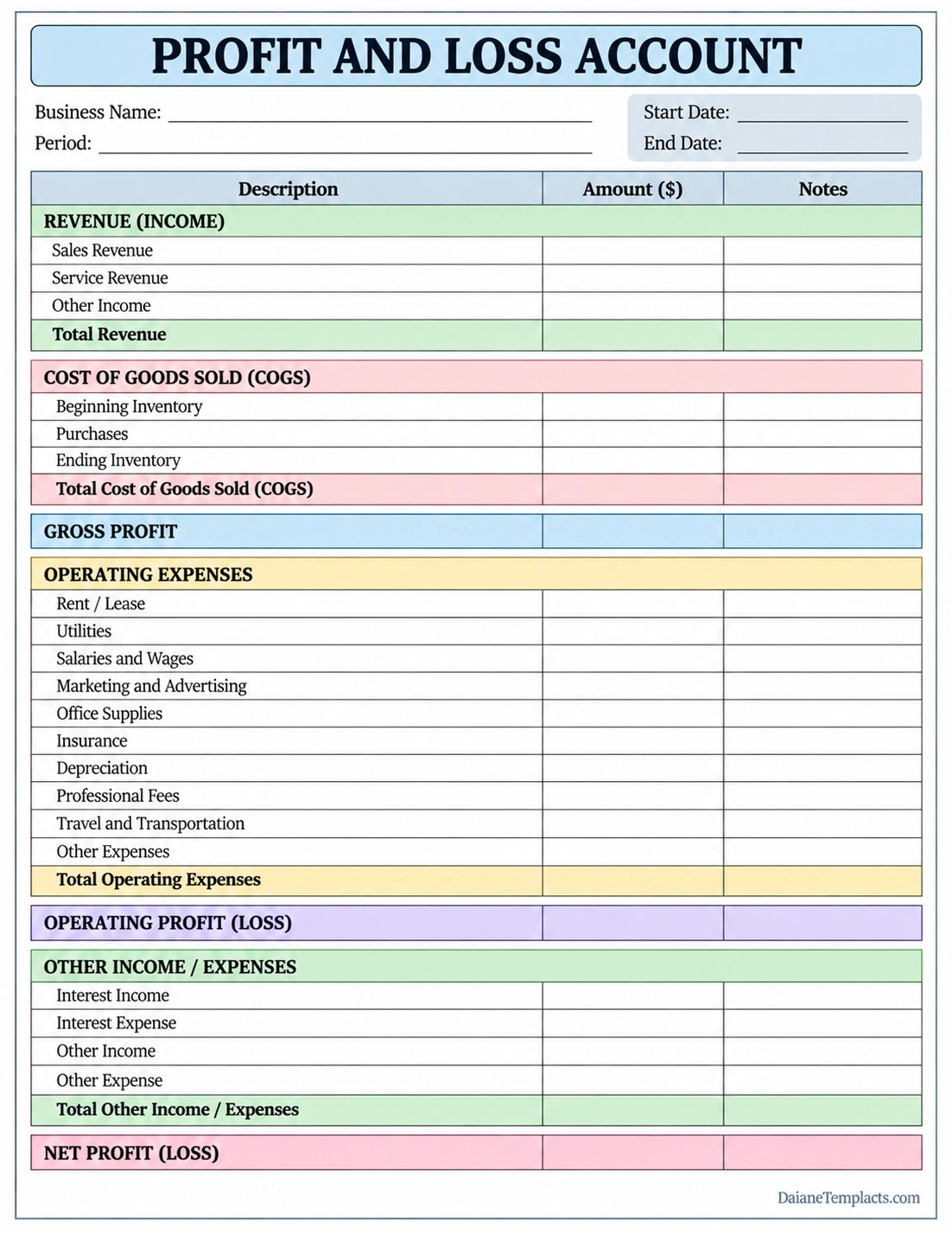
The template includes fields for the business name and reporting period, followed by sections for revenue, cost of goods sold, gross profit, operating expenses, operating profit or loss, other income and expenses, and net profit or loss.
Enter the relevant figures in the amount column and use the notes column to explain unusual transactions or provide supporting details. You can adapt the categories to match your business activities and accounting system.
This printable worksheet is useful for preliminary calculations and internal reviews. For formal financial reporting, make sure the figures follow the applicable accounting standards and are checked by a qualified accountant when necessary.
What Does a Profit and Loss Account Include?
A profit and loss account groups income and expenses into sections that show how the business moves from revenue to its final financial result. The main components are explained below.
Revenue or Sales Income
Revenue is the income earned from selling products or providing services during the reporting period. Depending on the business, it may include product sales, service fees, subscriptions, or other income from normal operations.
Record revenue consistently and account for sales returns, discounts, and allowances according to the business’s accounting method. Reliable revenue figures provide the starting point for measuring profitability.
Cost of Goods Sold
Cost of goods sold, commonly abbreviated as COGS, represents the direct costs associated with products sold during the period. For a retailer, this may include the cost of inventory sold. For a manufacturer, it can include direct materials and production labor, along with other qualifying production costs.
Service businesses may use a different cost classification because they do not necessarily sell physical inventory. The categories should reflect the business model and applicable accounting rules.
Gross Profit
Gross profit is the amount remaining after subtracting the cost of goods sold from revenue.
Formula: Gross Profit = Revenue − Cost of Goods Sold
Gross profit helps show how much income remains to cover operating expenses and other costs. It can also help a business evaluate pricing, purchasing costs, and product profitability.
Operating Expenses
Operating expenses are costs associated with running the business that are not included in the cost of goods sold. Common examples include:
- Rent and lease payments
- Utilities and internet services
- Salaries and wages
- Marketing and advertising
- Office supplies and software subscriptions
- Insurance and professional fees
- Travel and transportation
- Depreciation and other operating costs
Classify expenses consistently so that comparisons between months or years remain meaningful. The appropriate categories depend on the nature of the business and its accounting policies.
Operating Profit or Loss
Operating profit is generally calculated by subtracting operating expenses from gross profit. It shows the result of the business’s core operations before items such as interest and income tax, subject to the statement’s presentation and accounting framework.
Basic formula: Operating Profit = Gross Profit − Operating Expenses
Reviewing operating profit can help identify whether the business’s main activities are financially sustainable before considering financing costs and other non-operating items.
Other Income and Expenses
Some businesses earn income or incur costs outside their primary operations. Depending on the circumstances, these items may include interest income, interest expense, or certain gains and losses. They should be classified according to the applicable accounting framework.
Net Profit or Loss
Net profit or loss is the final result after accounting for the relevant income and expenses for the reporting period, including applicable taxes and other required items.
Basic formula: Net Profit = Total Income − Total Expenses
A positive result indicates a net profit, while a negative result indicates a net loss. Review the statement’s specific categories to ensure the calculation includes all relevant items and avoids double-counting.
How to Prepare a Profit and Loss Account
Preparing a profit and loss account involves collecting financial records, organizing transactions, and calculating the results for a defined period. Follow these steps to build a useful statement.
- Step 1: Choose the reporting period. Decide whether you are preparing a monthly, quarterly, or annual statement.
- Step 2: Gather financial records. Collect sales invoices, receipts, purchase records, payroll information, bank records, and other relevant documents.
- Step 3: Calculate revenue. Total the income earned during the period and apply the appropriate treatment for returns, discounts, and adjustments.
- Step 4: Calculate direct costs. Determine the cost of goods sold or the relevant direct costs for your business.
- Step 5: Calculate gross profit. Subtract the cost of goods sold from revenue.
- Step 6: Total operating expenses. Group costs into consistent categories and calculate the total.
- Step 7: Calculate operating profit or loss. Subtract operating expenses from gross profit, following your reporting method.
- Step 8: Include other relevant items. Record applicable non-operating income, expenses, and taxes as required.
- Step 9: Calculate net profit or loss. Check the figures and calculate the final result.
- Step 10: Review the statement. Compare totals with supporting records and investigate unusual changes or discrepancies.
Businesses that use accrual accounting generally recognize income when earned and expenses when incurred, rather than simply when cash is received or paid. The accounting method can therefore affect the figures shown in the statement.
Example of a Profit and Loss Account
Consider a small business with the following illustrative figures for one month. The example shows how revenue and expenses can be organized to calculate profitability.
- Total revenue: $20,000
- Cost of goods sold: $8,000
- Gross profit: $12,000
- Operating expenses: $7,000
- Operating profit: $5,000
- Other expenses and taxes: $1,000
- Net profit: $4,000
In this example, the business earns $20,000 in revenue and records $16,000 in total costs and expenses. Its net profit is $4,000 for the period. The figures are illustrative only; actual reporting categories and tax calculations depend on the business and applicable rules.
Reviewing this result over several periods can reveal whether revenue is growing, costs are increasing, or profit margins are changing.
Tips for Maintaining an Accurate Profit and Loss Account
Consistent financial records make the profit and loss account more useful for planning and decision-making. These practices can help improve accuracy.
- Update records regularly: Record transactions throughout the period instead of waiting until the end.
- Use consistent categories: Apply the same classification rules when recording similar income and expenses.
- Keep supporting documents: Retain invoices, receipts, payroll records, and other evidence for reported figures.
- Separate business and personal spending: Keep business transactions distinct to reduce errors and simplify reporting.
- Review unusual changes: Investigate large increases or decreases in revenue and expenses.
- Compare reporting periods: Review monthly or quarterly results to identify trends and seasonal patterns.
- Check calculations: Confirm that subtotals and the final profit or loss are calculated correctly.
- Follow applicable accounting rules: Use the reporting framework and tax requirements relevant to your business.
Common Profit and Loss Account Mistakes to Avoid
Errors in financial reporting can lead to poor decisions or misleading conclusions. Watch for these common problems when preparing your statement.
- Omitting expenses: Missing costs can make profit appear higher than it really is.
- Recording transactions in the wrong period: Apply the appropriate accounting method to determine when income and expenses should be recognized.
- Mixing personal and business costs: Keep personal spending separate and classify owner-related transactions correctly.
- Double-counting transactions: Check for duplicate invoices, payments, or accounting entries.
- Using inconsistent categories: Changes in classification can make comparisons between periods less reliable.
- Confusing profit with cash flow: Profit does not necessarily equal the cash available in a bank account.
- Ignoring supporting records: Verify figures against relevant accounting records and documents.
Profit and Loss Account vs. Balance Sheet
A profit and loss account and a balance sheet provide different views of a business’s finances. The profit and loss account summarizes income and expenses over a period, while the balance sheet shows assets, liabilities, and equity at a specific date.
For example, a business may report a profit but still experience cash shortages because customers have not paid their invoices or because loan repayments and equipment purchases require cash. Reviewing the income statement alongside the balance sheet and cash flow statement provides a more complete picture of financial health.
Frequently Asked Questions About Profit and Loss Accounts
What is the main purpose of a profit and loss account?
Its main purpose is to summarize income and expenses over a specific period and determine whether a business made a profit or loss. It also helps owners evaluate performance, monitor costs, and make informed decisions.
Is a profit and loss account the same as an income statement?
In many accounting contexts, yes. Both terms generally refer to a financial statement that reports income, expenses, and profit or loss for a period. Terminology and presentation can vary by jurisdiction and accounting framework.
How often should a business prepare a profit and loss account?
Many businesses review profit and loss results monthly and prepare quarterly or annual reports as needed. The best frequency depends on the size of the business, management requirements, and applicable reporting obligations.
What is the formula for net profit?
A basic formula is net profit equals total income minus total expenses. The calculation should include all relevant costs, other income and expenses, and applicable taxes according to the business’s accounting framework.
Can a small business use a profit and loss account template?
Yes. A template helps small businesses organize financial information and calculate results consistently. However, the categories and accounting treatment should be appropriate for the business, and formal reporting may require additional review.
Does a profit and loss account show cash available?
No. It measures financial performance over a period, not the exact cash available at a particular moment. A cash flow statement and balance sheet provide additional information about cash movements, assets, liabilities, and financial position.
Who uses a profit and loss account?
Business owners, managers, accountants, investors, and lenders may use the statement to assess profitability, review costs, compare performance, and support financial decisions.
Conclusion
A profit and loss account is a valuable financial tool for understanding how a business performs over a specific period. By organizing revenue, direct costs, operating expenses, and other relevant items, it shows whether the business generates a net profit or loss.
Use a printable profit and loss account template to structure your records, check calculations carefully, and review results regularly. For a more complete understanding of financial health, compare the statement with your balance sheet, cash flow information, and budget. Accurate reporting can help you identify trends, manage costs, and make better business decisions.
Download: Profit And Loss Account Template
